Heads up: This post contains affiliate links. As an Amazon Associate I earn from qualifying purchases, at no extra cost to you. Learn more
Specs are compiled from manufacturer listings and verified buyer reviews and can change over time — please confirm the key details on the product page before buying.
If a groundhog has already turned your vegetable bed into a crater, you know the pattern: you fill the hole, and it digs a fresh one overnight. The fix is not more shoveling. It is picking the right deterrent for how your yard actually works — a scent-based granular product for wide, cheap coverage, a motion-triggered water jet for a specific entry point, or a sound-and-light unit for a shed or fence line. This guide breaks down six real options by how they physically stop the digging, what each one covers, and where each one quietly falls short.
This guide is built by comparing the manufacturers’ published specifications and the patterns across verified customer reviews, so you get each pick’s real strengths and trade-offs instead of marketing spin.
You will see coverage areas, placement counts, and honest caveats so you can match a device to your own lawn rather than guess. Below is the field guide to choosing the groundhog deterrent that suits your yard’s layout and your patience level.
Top Picks

How To Choose The Best Groundhog Deterrent
A groundhog is a burrower with a home range that shifts with the season, and no single deterrent wins every yard. The smart move is to pick the mechanism that matches your situation: a wide-open lawn with scattered holes calls for granules you can broadcast, while a single gap under a shed calls for a targeted stake or sprayer. Start by asking what your bank account and your patience can absorb — you may need two different types working together.
Match the mechanism to the groundhog’s habit
Scent-based products work on the animal’s nose, laying down a smell barrier the groundhog avoids. Ultrasonic stakes send a vibration into the soil every 30 seconds or so, which can push a burrower to relocate. Motion-triggered water sprayers rely on surprise — the blast of water startles the animal enough to change its route. None of these kill the animal; they make the yard unpleasant enough that it digs elsewhere.
Count your coverage before you buy
This is where most buyers get burned. A granular product that protects up to 120 sq ft per ball tells you exactly how many to place for a 1,000 sq ft lawn. An eight-pack of stakes is a count, not an area — you place them along tunnels and borders. A single motion sprinkler covers the approach path it is aimed at, not the whole property. Read the coverage figure on each product and sketch your yard before ordering.
Power source and weather decide longevity
Solar stakes need direct sun to charge, and the instructions on one eight-pack recommend at least two days of charging before installation. A unit with dual solar and USB charging keeps working through cloudy stretches. A battery-powered sprinkler with two AA batteries included is immune to shade but depends on the batteries holding up. If your groundhog tunnels run through a shaded north side, plan the power accordingly.
Side-by-Side Comparison
| Model | Best For | Type | Coverage / Count | Power Source | Amazon |
|---|---|---|---|---|---|
| Mole, Gopher, Groundhog Repellent Outdoor 8P★ Best Overall | Broad lawn and bed coverage | Plant-based granular balls | Up to 120 sq ft per ball; 8 pack | None required | Amazon |
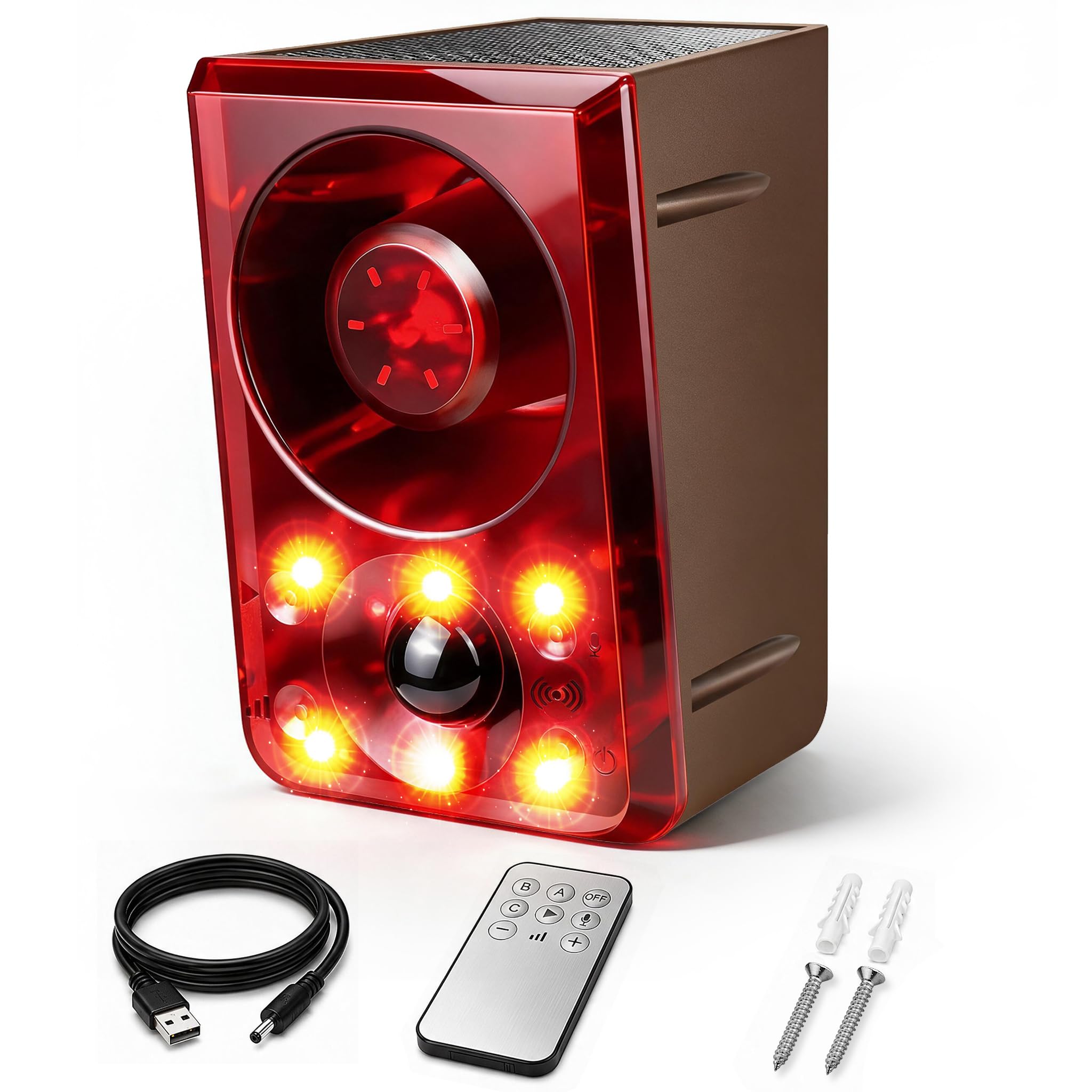
| Solar Motion Sensor Alarm with Dog Bark and Gunshot SoundLoudest Warning | Fence lines, sheds, and entry points | Motion alarm with strobe | Up to 26.25 ft range; 13 sounds | Solar with USB backup | Amazon |
| 8 Pack Solar Powered Mole Repeller Ultrasonic | Spreading stakes along tunnels | Ultrasonic solar stakes | 8 stakes | 1 AA battery each (included) plus solar | Amazon |
| Motion Activated Sprinkler for Yard (TruRid TR-803) | Targeted spray at a single approach | Motion water sprinkler | Single unit | 2 AA batteries (included) | Amazon |
| Tirgo 8 Pack Solar Mole Repellent Stakes | Large lawns needing many stake positions | Ultrasonic solar stakes | 8 stakes, one every 96 ft recommended | Solar powered | Amazon |
| G-Jyuncyou Motion Activated Animal Repeller | Garden beds and courtyards with dual power needs | Motion water sprinkler with flashing light | Up to 6 m spray range; 4 sensitivity settings | Solar plus USB charging | Amazon |
Detailed Reviews
1. Mole, Gopher, Groundhog Repellent Outdoor 8P
Our pick — 4.0+★ from 900+ verified ratings; the strongest balance of quality and price.
Eight plant-based balls that push groundhogs off a lawn without wires, batteries, or buried spikes.
For a yard where the damage is already spread across the grass rather than pinned to one gap under the porch, you want coverage that goes everywhere at once. Each ball here covers up to 120 sq ft, and the pack holds 8 — so you can drop them around a bed, an orchard, or a vegetable plot in one afternoon. No tools are needed: you place them at active digging spots and walk away, and the quiet plant-based formula does the work with no setup ritual.
What wins people over is the state of the lawn after placement. Where the balls sit, fresh tunnels and mounds stop appearing and the lawn starts to look cared for again. The application itself takes minutes, and the protection is stated to last up to 2 months per placement, so re-baiting is a seasonal chore rather than a weekly one. The plant-based formula is stated safe around children, pets, and plants when used as directed, which matters if dogs or grandchildren share the yard.
Here is the honest pivot. Functionality is the most-discussed subject across the reviews and it splits — some yards clear up beautifully, others report no change at all. Groundhog behavior varies by site, and a scent barrier only works where the animal keeps meeting it. The scent itself is strong and noticeable outdoors, and a portion of buyers find it unpleasant, especially in a small enclosed garden. Size to your lawn before ordering, and expect to reapply if rain washes the barrier down. For the price of a mid-range one-zone device, this blanket-coverage approach is the smarter start.
What the scent barrier gives you
- Up to 120 sq ft per ball, 8 balls in the pack — wide coverage for a low per-zone cost
- Plant-based formula stated safe around children, pets, and plants when used as directed
- No tools, no batteries, no wiring — place and walk away
- Stated up to 2 months of coverage per placement
What a realistic buyer should weigh
- Effectiveness splits across reviews — great in some yards, no change in others
- The scent is strong outdoors and some buyers find it off-putting in tight spaces
- Rain can wash down the barrier, so a reapplication plan matters
Grab this first if: your damage is scattered across a lawn, bed, or orchard and you want coverage on day one without power or plumbing.
Budget the downtime: the protection window is 2 months per placement, so treat it as a seasonal routine, not a one-and-done.
2. Solar Outdoor Motion Sensor Alarm
A motion-triggered siren and strobe that turns one gap under the shed into a no-go zone.
When you know exactly where the animal crosses, a single alert point beats scattering hardware. This unit triggers a 130dB alarm and a strobe light the moment motion is picked up, with a maximum detection range of 26.25 feet — roughly the width of a two-car driveway, so it watches a gate or fence line cleanly. Choose from 13 preloaded sounds or record your own, and run it in 24-hour mode, night mode, or timer mode with an alert every 5 minutes.
Power is flexible: solar with USB backup keeps it running when the panel sees no sun, and the whole assembly weighs 13.12 ounces — light enough to hang on a post without a heavy mount. Its design is aimed at the wider pest crowd — raccoons, deer, skunks, bears, and coyotes all appear in the maker’s own description, and the same motion-and-noise logic applies to a groundhog that trips it. For a buyer who wants to protect a specific entry, that is a fair fit.
Two things to plan around. The remote uses infrared line-of-sight control and needs to be within 3 ft of the unit with nothing in between, so set the modes before you mount it high. And reliability is the most-discussed theme overall and splits nearly down the middle — some units run for months, others stop after about two weeks or fire nonstop. Treat this as a supplementary sensor at a vantage point rather than your whole defense, and test it for a week before you depend on it.
Why it earns a slot: 130dB of bark, siren, or whatever you record — plus a strobe — is a real psychological wall at a known crossing point, and the 26.25 ft range and solar-plus-USB power make it practical around a shed or gate.
What to watch: the infrared remote needs clean line of sight and a 3 ft proximity, and the reliability picture is uneven enough that you should buy it expecting to monitor it.
Reach for this if: the groundhog has one habitual route and you want loud, visible pushback at that exact spot with no wiring.
Plan B in your pocket: pair it with a scent or water product so one flaky sensor never leaves the yard open.
3. 8 Pack Solar Powered Mole Repeller
Eight solar stakes to ring a whole tunnel network instead of covering one spot.
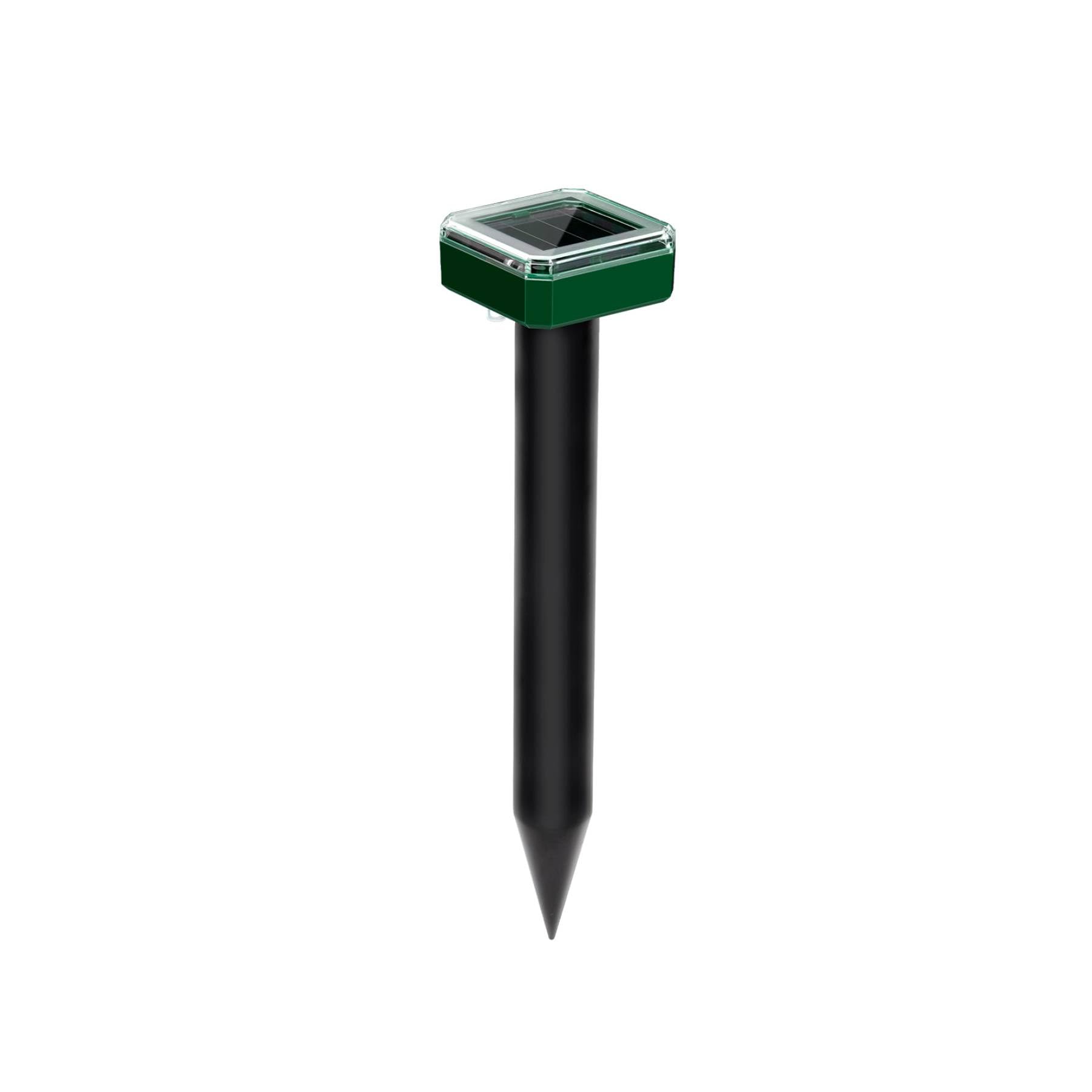
Groundhogs dig in patterns — fence bottoms, bed edges, the same corner every spring. A stake approach lets you mark all of those at once, and this pack gives you eight positions for one price. Each stake runs on a supplied AA battery topped up by its solar panel, so placement flexibility is high. At 1.79 pounds for the whole pack, carrying and planting all eight is a single morning’s job.
The design size of each stake — 11.4 inches tall — means it stands above most lawn growth without looking like a fence post, and it applies to moles, gophers, groundhogs, snakes, and armadillos in the maker’s own listing. For a buyer whose tunnels crisscross a yard, having eight independent positions matters more than having one powerful device.
Honesty matters here. This is the lowest-rated pick on the page, and the effect on mole activity splits in buyer reaction — some report fewer tunnels, some see no change. Ultrasonic stakes need a burrower close enough to feel the vibration, so placement along active runs is the whole game. Think of it as a perimeter tool for someone willing to move the stakes every few weeks toward the newest digging, not a fire-and-forget solution.
Best suited to: a large lawn with several active runs where you want cheap positions in many spots.
Be realistic about: the split effectiveness and the need to reposition — budget a re-check every couple of weeks.
4. Motion Activated Sprinkler for Yard — TruRid TR-803

A hose-fed sprinkler that surprises a groundhog with a blast of water on its own schedule.
You attach it to a hose with the quick-connect fitting, stake it in with the heavy-duty metal stake, and it watches the approach. When motion is detected, it sprays — the surprise is the deterrent, and it doubles as ordinary lawn irrigation when nothing is moving. Assembly is quick with complete instructions, and it runs on two AA batteries that come in the box. That means no wiring and no dependence on sunlight for the trigger.
The practical case is a vegetable garden gate or the path a groundhog uses to get from its burrow to your beds. One sprinkler aimed at that approach covers the gap. The metal stake is designed to hold steady on uneven ground, which is more than many flimsy plastic stakes manage. Tune the sensitivity down before you deploy it, because the motion sensor can be finicky and will fire at a passing cat or a wind-blown branch if it is wound up too high.
The catch is durability, and it is the theme buyers hit most. Effectiveness holds up for some for about two months, then falls off; the water leakage issue — spray shooting out of the sides — is a common complaint, along with units failing within a week of use. Treat it as an inexpensive first water deterrent with a finite service life, not a permanent fixture, and check the hose fitting for leaks after the first week. Its 4 x 4 x 6 inch footprint is compact enough to tuck beside a raised bed.
Where it shines: fast hose-connect setup, complete instructions, and a surprise-water blast that works just as well on deer, raccoons, skunks, and cats as on a groundhog.
Set expectations: leakage and short service life are the recurring gripes, so buy it as a season-long experiment with a low outlay.
Try this if: you already have a hose bib nearby and want a cheap, active surprise at one approach.
Look elsewhere if: you need something that lasts several seasons without a leak check.
5. Tirgo 8 Pack Solar Mole Repellent Stakes
Eight stakes spaced one every 96 feet, built to hum a buried groundhog out of a lawn.
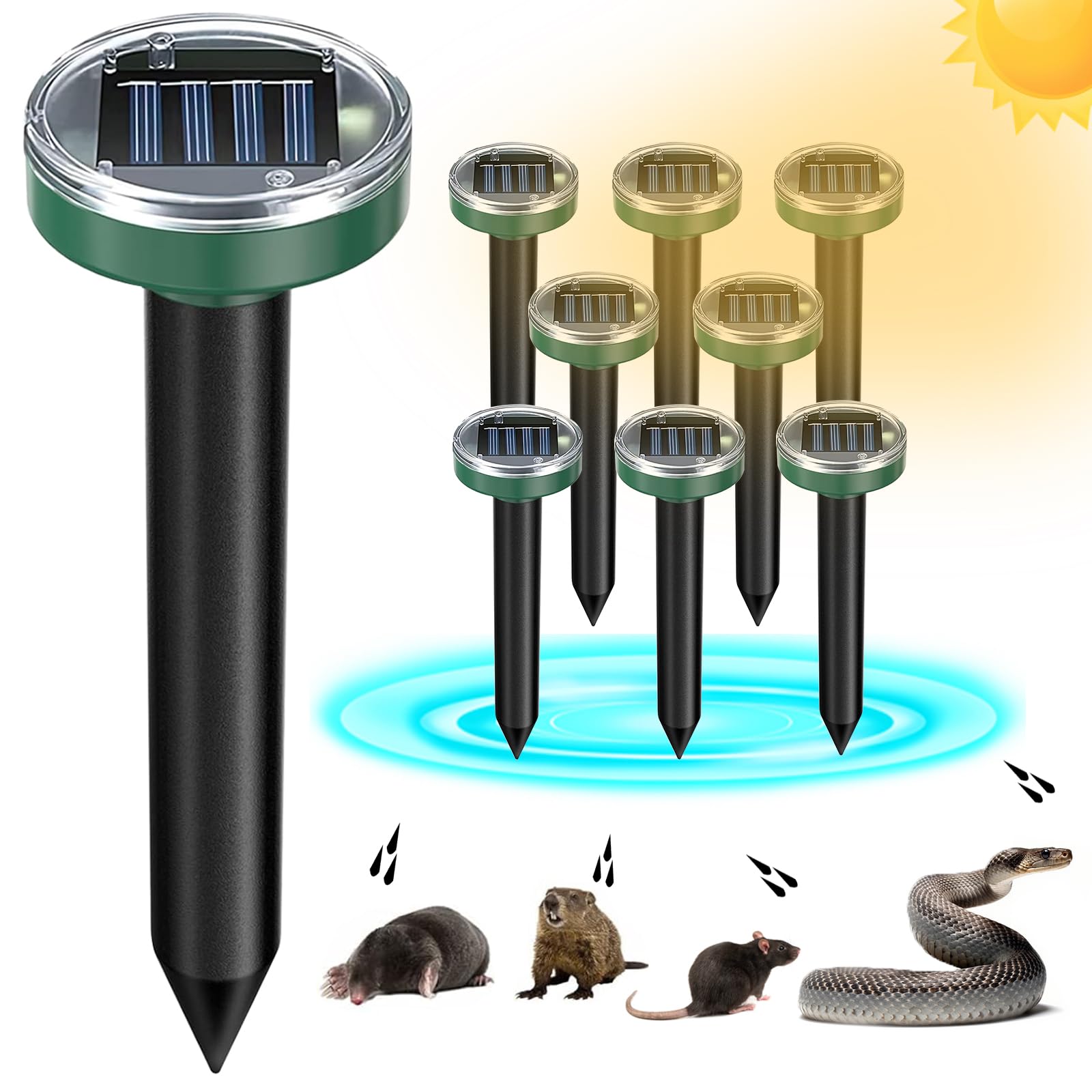
This is the option for a property large enough that a couple of devices just cannot cover it. The manufacturer recommends an installation every 96 feet across the lawn for best results, so eight stakes mark out a serious perimeter. Each one hums for 3 to 4 seconds every 30 seconds — a gentle buzz the maker says will not disturb your family or pets — and the solar panel keeps it working whenever there is sufficient direct sunlight.
Waterproofing gets real attention here. The high-quality ABS and PC body is stated to withstand rain, snow, frost, and heat, and the maker notes you should wipe the panel regularly with a damp cloth, since a dirty panel cuts the charge. The target list is broad — moles, voles, gophers, groundhogs, snakes, and chipmunks — and the solar-only design means no battery swaps. A note in the instructions: let the stakes charge in the sun for at least 2 days before installing them.
The trade-off is common to every ultrasonic stake on the page: effectiveness divides. Some yards report it working perfectly, others see nothing happen. A few owners find the high-pitched hum itself annoying once they are outdoors near the stake. The real value is the count — eight positions at a mid-range price lets you test the whole property at once rather than guess one spot.
Pick this for: expansive lawns and orchards where the 96-foot spacing guidance is exactly the layout you need.
Know before you buy: it is solar-only, so shaded plots will underperform and you must pre-charge the stakes for 2 days.
6. G-Jyuncyou Motion Activated Animal Repeller
A water-jet repeller with a flashing light, four sensitivity levels, and two ways to charge.
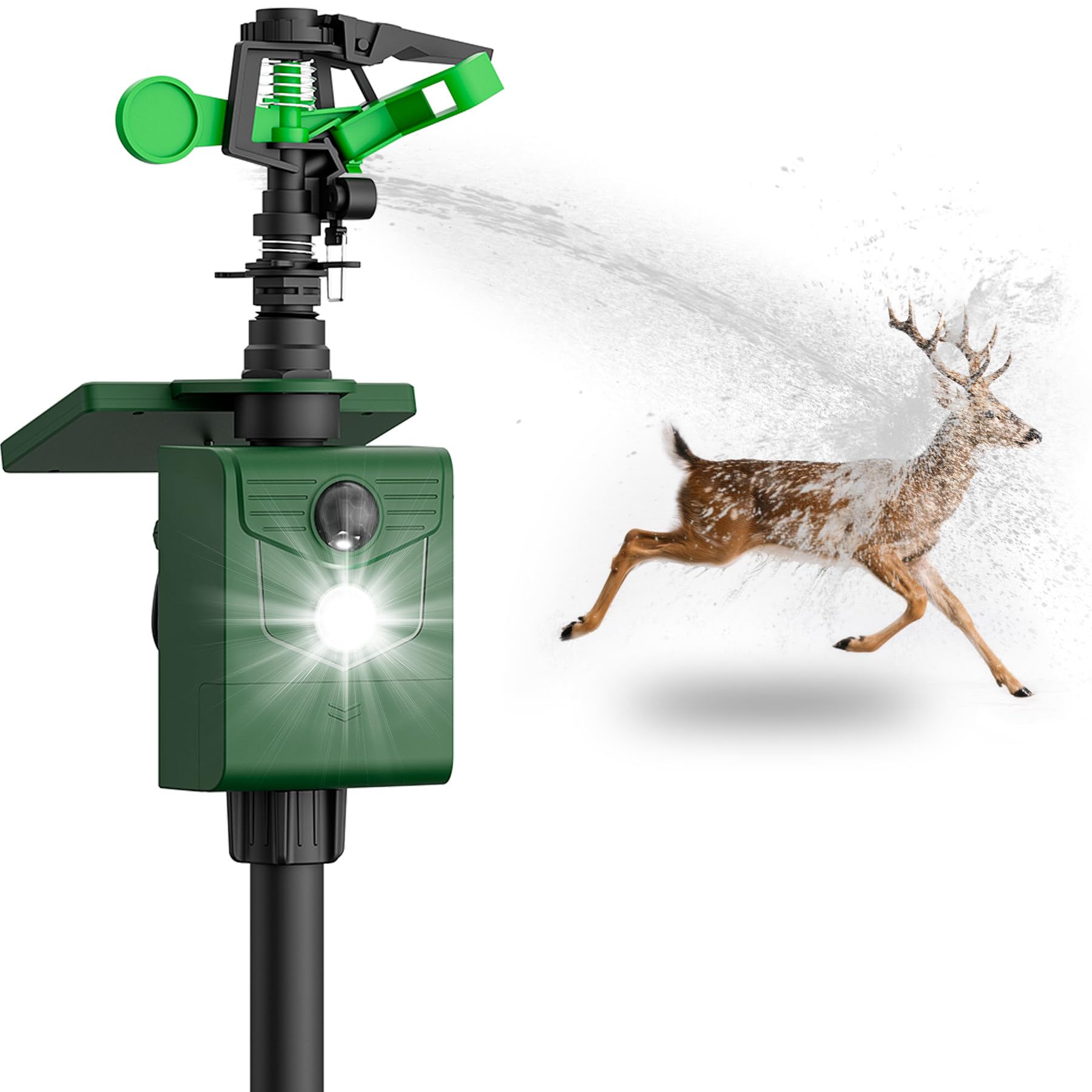
If your garden stays cloudy for days at a time, dual charging matters more than any other feature. This unit runs on a solar panel when the sun is out and switches to USB charging on rainy and cloudy days, so the defense does not go dark when the weather turns. The PIR sensor — that is a passive infrared detector that notices body heat in motion — triggers a spray of water and a flashing light together. That double cue is aimed at deer, cats, dogs, foxes, skunks, and raccoons, and it works on a groundhog by the same startle logic.
The spray head adjusts manually for 360° rotation or a fixed angle, with a range up to 6 meters depending on your water pressure, and you can switch between a focused jet and a wide spray. A 4-level PIR sensitivity knob tunes how far out it detects. There is a thoughtful detail too: if no animal triggers it for 24 hours, it auto-sprays once to keep the nozzle from clogging. The IP65 rating means it is sealed against dust and water jets for outdoor use, and the 2026 upgraded metal ground stake is designed for a stable hold.
The honest note is that this is the least-reviewed unit here, so long-term field evidence is thin — you are buying on the spec sheet and the maker’s stated support. That said, the dual-power design, the four sensitivity steps, and the clog-prevention auto-spray are features the cheaper sprinkler lacks. If you have lost one to a cloudy season already, the USB fallback alone is worth the step up. Treat the first week as a test: confirm the sensitivity, watch the nozzle, and make sure the stake sits firm.
Standout design details: the 4-level PIR sensitivity knob, selectable jet or wide spray, 360° adjustable nozzle, and the once-a-day auto-spray that protects the nozzle from clogging.
The caveat to weigh: fresh to the market with little review history, so the dual-power build is a bet on the spec rather than a proven track record.
Best match for: shaded or variable-weather gardens where solar-only devices have failed, and buyers who want a water jet plus light cue.
Be prepared to: monitor it closely the first week, since its review history is still being written.
Know the Specs
Coverage Area vs. Stake Count
Granular products give you a square-footage figure per placement — the 8P balls cover up to 120 sq ft each. Stake products give you a count and a spacing rule instead — the Tirgo pack says one stake every 96 feet. A sprayer covers the path it is aimed at, not a measured area. Know which figure your product uses before deciding how many to buy.
How the Trigger Works
Granules work chemically through scent. Ultrasonic stakes send a vibration into the soil on a set cycle — 3 to 4 seconds every 30 seconds on the Tirgo. Water sprinklers and alarms use a PIR sensor, a passive infrared detector that notices moving body heat, then respond with water, sound, or light. Each mechanism is aimable; none of them works on every animal every time.
Solar vs. Battery Power
A solar-only stake needs direct sun and should pre-charge for 2 days before installation. Dual solar-plus-USB keeps you covered through cloudy weeks. Battery-only sprinklers are immune to shade but depend on the cells holding up. Weight also matters for mounting — the motion alarm is 13.12 ounces, light enough to hang on a post.
Weather Ratings and Water Leaks
An IP65 rating means the unit is sealed against dust and water jets for outdoor use. Leakage is a separate issue — it affects hose-fed sprinklers where fittings and joints wear. Check the hose connection after the first week and tighten any joint that sprays sideways. For solar stakes, wipe the panel so dirt does not block the charge.
Common Questions
How long does a groundhog deterrent last before I need to replace it?
Will a deterrent kill the groundhog?
How many units do I need for a 1,000 square foot lawn?
Do ultrasonic stakes really work on groundhogs?
Solar stakes show no activity after installation — what is wrong?
Will a motion sprinkler also water my plants?
How sensitive is the motion sensor on a water repellent?
What if a sprinkler leaks at the hose fitting?
Can I use a motion alarm around pets and children?
What is the difference between a scent deterrent and a water deterrent?
The Bottom Line
For most yards, the Mole, Gopher, Groundhog Repellent Outdoor 8P is the smart first buy because 8 balls at up to 120 sq ft each cover a lot of ground without power or plumbing. If you know the exact route the animal uses, grab the Solar Outdoor Motion Sensor Alarm for a loud, visible wall at that spot. And for a shaded garden that has already burned through a solar-only device, the dual-charging G-Jyuncyou Motion Activated Animal Repeller is the one to reach for. A single deterrent rarely clears a yard for long — combining a scent barrier with one reactive unit is what most successful buyers describe.
How we choose
We do not accept paid placement. Every pick is matched to a real buyer and a real use-case; we do not hands-on test units.
Sources
Specifications: manufacturer listings and product documentation. Review insights: verified customer reviews, as of November 2026. Pricing: not shown on this page (it changes often); check the current price via the retailer link.
As an Amazon Associate, My Heart Lives Here earns from qualifying purchases. This does not affect which products we feature.