Heads up: This post contains affiliate links. As an Amazon Associate I earn from qualifying purchases, at no extra cost to you. Learn more
Specs are compiled from manufacturer listings and verified buyer reviews and can change over time — please confirm the key details on the product page before buying.
If you need two cooking zones on a normal wall outlet, the short answer is this: buy an infrared or cast-iron countertop burner for any pan you own, and buy an induction unit only if you already own magnetic cookware. That single choice decides whether you are cooking tonight or returning a cooktop next week. Below you get seven models sorted by what they actually do well — fast heat, low fuss, or real built-in flexibility.
This guide is built by comparing the manufacturers’ published specifications and the patterns across verified customer reviews, so you get each pick’s real strengths and trade-offs instead of marketing spin.
A 2 Burner Electric Cooktop only earns its counter space when the wattage, pan compatibility, and safety shutoffs genuinely fit how you cook. Every pick here was chosen on those three points, not on brochure wording.
Top Picks

How To Choose The Best 2 Burner Electric Cooktop
Start with your pans, not the wattage. Induction only works with a magnetic base, so a favorite aluminum skillet will simply not heat. Infrared and cast-iron burners accept aluminum, copper, glass, and stainless steel without argument.
Next, check that the unit runs on 110–120V with a normal plug. A plug-in model means no electrician, no new circuit, and no cabinet work — you set it down and cook.
Split the wattage before you plan a meal
An 1800W double burner is usually two 900W elements. That is plenty for eggs, sauces, and simmering, but it is not a race to a rolling boil. If you plan to boil a big pot fast, look for a booster mode or a primary burner that carries more of the load.
Match the surface to your cleaning habits
Ceramic glass wipes clean with a damp cloth once it cools. Cast-iron plates hold heat well but reward you with more scrubbing around the rings. Stainless bodies stay presentable through daily use and simply need a cloth when cool.
Decide between sitting on the counter and dropping in
A countertop burner lifts off and travels to a dorm, RV, or campsite. A built-in unit needs a cutout in the cabinet but frees up worktop space and looks like part of the kitchen. Pick the one that matches where the cooktop will live for the next few years.
Side-by-Side Comparison
| Model | Best For | Heating Type | Total Power | Cookware Support | Amazon |
|---|---|---|---|---|---|
| Infrared Double Burner Electric Cooktop (Vayepro)★ Best Overall | Dorms, RVs, and any pan you already own | Infrared | 1800W (900W per burner) | Aluminum, stainless, ceramic, glass up to 7.1″ | Amazon |
| CUSIMAX Electric Double BurnerBest Value | Extra burner duty in a tight kitchen | Cast iron sealed plate | 900W + 900W | Any cookware up to 7.4″ | Amazon |
| Cuisinart Double Burner Hot Plate | Heat retention for longer cooks | Cast iron plate | 1800W (1300W + 500W) | Flat-bottom pots and pans | Amazon |
| AMZCHEF Double Induction Cooktop | Precise, touch-controlled induction cooking | Induction | 1800W shared | Magnetic cookware 4.7″–9.4″ | Amazon |
| Nuwave Induction Cooktop with Digital Probe | Temperature-critical cooking like sauces and searing | Induction | 1800W single zone | Magnetic cookware only | Amazon |
| GTKZW 110V Electric Cooktop 2 Burners | Countertop or drop-in flexibility with knob controls | Radiant ceramic glass | 1200W + 900W | Iron, stainless, glass, ceramic | Amazon |
| COOKTRON Portable Induction Cooktop 2 Burner | Two dishes at once with a one-minute booster | Induction | 1800W shared | Magnetic cookware only | Amazon |
Detailed Reviews
1. Infrared Double Burner Electric Cooktop
Our pick — 4.5+★ from 600+ verified ratings; the strongest balance of quality and price.
The cooktop that says yes to the pan you already own, without asking about magnets.
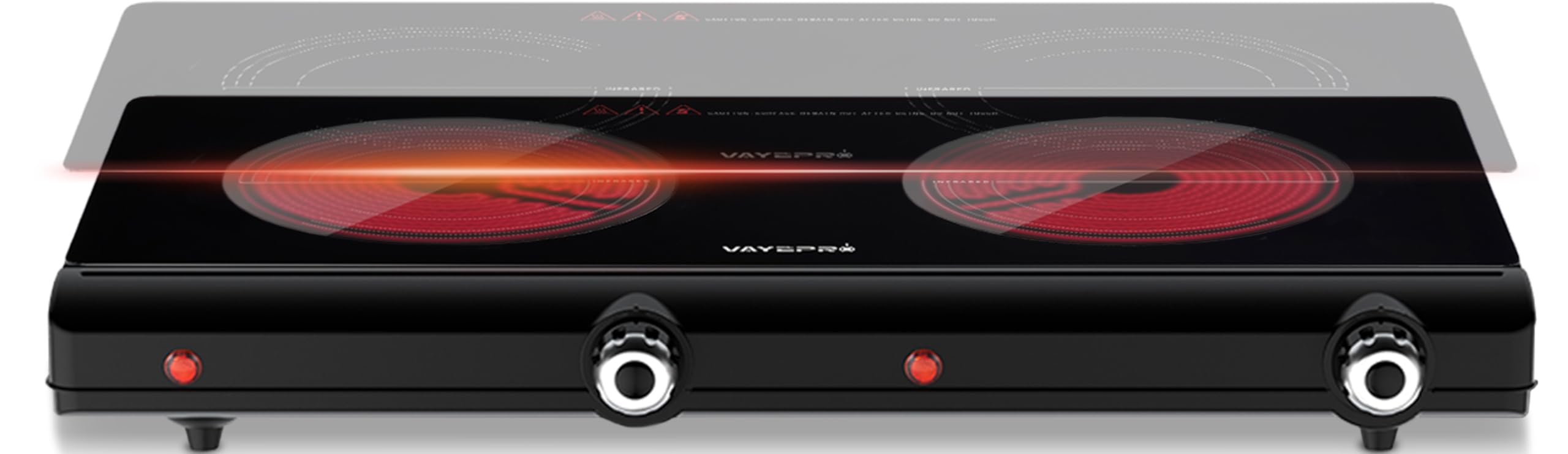
Here is the number that shapes your first week: 1800W of total power split into 900W per burner. That is real cooking heat for soups, stir-fries, and breakfast plates, delivered through an infrared heating element — a coil that radiates heat straight into the base of the pan rather than glowing red beneath a plate. The upside is almost no waiting for the surface to warm. The other upside is that the surface itself never has to be magnetic.
Pan freedom is the whole pitch. Aluminum, stainless steel, ceramic, and glass all heat on this thing, up to 7.1″ in diameter and 22 lbs of pot. Compare that to the induction picks further down, which need a magnetic base and will sit silent under your favorite aluminum skillet. If your kitchen is a mixed bag of hand-me-down pans, that difference decides the purchase.
The honest catch is heat output. Buyers describe it as quick to heat but not scorching at the top end, and the element cycles on and off to hold a temperature — normal thermostat behavior that can look like a failure. Cover a pot with a lid for boiling water and it behaves. Its 4.5+ star average across 600+ ratings suggests most owners adjust once they stop expecting gas-flame power.
Where the design earns its keep
- Accept-anything heating means your existing pots all work
- 1800W across two 900W burners fits a normal 120V outlet
- Ceramic glass face wipes down with one cloth
- Thermal fuse cuts the element if it overheats
Where it asks patience
- Top-end heat is gentler than a gas flame
- Pots are capped at 7.1″ across and 22 lbs
- Cycling on and off surprises first-time owners
Grab this one: a renter, dorm resident, or RV cook with a cupboard full of mismatched pans and one standard outlet.
Look past it: you regularly sear at screaming-high heat and want the burner to stay pinned there.
2. CUSIMAX Electric Double Burner
The budget workhorse that turns a card table into a second kitchen.
Two cast-iron plates, one 6.1 inches and one 7.4 inches, each with its own thermostatic knob. You get 900W plus 900W of straightforward heat and a pan-size ceiling of 7.4 inches, which covers a saucepan, a skillet, and a cast-iron pan without complaint. Aluminum, copper, cast iron, and non-magnetic stainless all work here — the same open-door policy the infrared pick above offers, just through a different kind of element.
What wins people over is that it simply functions. Functionality dominates its review comments by a wide margin — 833 of them — followed by ease of use at 277 and ease of cleaning at 230. Stainless body, non-slip rubber feet, an indicator light, and an automatic safety shutoff round out the package. At 9.9 pounds it lifts off the counter one-handed.
Weigh it against the Cuisinart below and the numbers split: the Cuisinart carries 10.6 pounds to this unit’s 9.9, a small difference in the hand but a real one when you carry it to a campsite. The flip side is heat. Comments on heat output and heating time run mixed rather than glowing, so plan for slow, steady warming of soups and sauces rather than hard sears. That fits the price tier honestly.
Who it fits: students, office lunchers, and anyone who needs one reliable spare burner and does not want to spend much.
What to expect: gentle-to-moderate heat, a stainless face that wipes down cold, and a cycling light that is normal operation.
Reach for this if: you want maximum years of service per dollar and mostly warm, simmer, and fry.
Look elsewhere if: you need a fast rolling boil on a big stockpot every night.
3. Cuisinart Double Burner Hot Plate

Two cast-iron plates that hold their heat long after you turn the dial down.
This is the pick for anyone who simmers rather than sprints. The 1800W splits unevenly on purpose — a 1300W primary burner and a 500W secondary — so the big plate does the heavy lifting while the small one keeps a sauce warm. Two 6-setting dials, On and Ready lights, and non-slip feet make it feel like a piece of equipment rather than a gadget. If you are choosing between this and the infrared pick, note the heat-setting count: 6 dial positions here versus 5 on the infrared double burner.
Cast iron is the whole reason. Those plates give quick heat-up and, more importantly, hold temperature through a long cooking cycle, which is why it suits a slow ragù, a pot of chili, or a griddle session. The stainless and black finish cleans up easily once cool. At 10.6 pounds it also outweighs the CUSIMAX above by a measurable margin — fine on a fixed counter, slightly more of a lift if you move it.
The mixed note is the same one the whole category shares: top-end heat is not blistering, and some cooks want more from the high setting. Treat it as a strong simmer-and-hold machine and you will be happy. Its 4.0+ star average across thousands of ratings fits that simmer-and-hold role.
What the cast plates buy you
- 1300W primary burner carries the real cooking load
- Heat retention suits long, low simmers
- Separate dials and On/Ready lights read at a glance
What to square with yourself
- Top heat falls short if you want a hard sear
- Cast plates want a proper scrub, not just a wipe
The right buy for: slow-cook sessions, holiday overflow cooking, and anyone who wants a burner that stays hot without babysitting.
The wrong buy for: kitchens that depend on a violent boil or a charring sear.
4. AMZCHEF Double Induction Cooktop

Touch controls, 18 power steps, and a ten-hour timer on one slim glass slab.
This is induction done for people who like dials and screens more than knobs. You get 18 power levels from 100W to 1800W and 20 temperature levels from 100°F to 465°F, all set on a touch panel. The timer runs up to 10 hours, a safety lock keeps small hands from changing anything, and a residual heat reminder tells you when the glass is still warm. ETL certification means the unit has been through third-party electrical safety testing.
Functionality leads its review comments at 91, with heating speed next at 46. That tracks with how induction behaves: the pan heats directly, so water comes to a simmer quickly and a delicate sauce can hold without scorching. The glass face wipes clean with a cloth once it cools.
The trade-off is the pan rule, and it is absolute. Magnetic cookware between 4.7″ and 9.4″ only — and when both zones run, total output cannot exceed 1800W or push a single zone past P13. That means two big dishes at full power is not a thing. If your cookware collection is aluminum, this cooktop stays quiet. Set against the CUSIMAX, which takes any pan, this one demands you check your pans before you cook.
The reason to upgrade: precise, repeatable heat with one-touch control beats guesswork on a knob.
The deal you make: replace your non-magnetic pans, and accept that both burners share a single 1800W ceiling.
Suits you if: you already own magnetic cookware and want a clean, touch-driven cooktop with a real timer.
skip it if: your favorite pan would not hold a fridge magnet.
5. Nuwave Induction Cooktop

A single burner that knows the internal temperature of your food, not just the pan.
The probe is the story. You set a target and the thermal sensor tracks the food’s internal temperature through the cook, ending the cycle when it arrives. Backing that up is the temperature range: 50°F to 575°F in 5°F increments, with five presets — Low at 100°F, Medium at 200°F, Med High at 300°F, High at 400°F, and Sear at 575°F. That Sear figure is the highest cooking temperature anywhere on this list.
Underneath the pan sits an 8-inch magnetic coil, which spreads heat more evenly than a small coil would, and the shatter-proof ceramic glass surface is built to take that heat without cracking. No open flame, no glowing element. Owners rank functionality first and temperature control second — fitting for a burner built around exact set temperatures.
One honest limit sits right in the specs — this is a single heating element, not a double. If you need two pans moving at once, the COOKTRON or the AMZCHEF below and above are the shapes you want instead. It is also induction-only, so magnetic cookware is required. Note that heat output draws mixed comments, so expect precision over raw punch.
Why cooks who measure things like it
- 5°F increments put real numbers on your cooking
- Digital probe tracks internal food temperature
- Sear preset reaches 575°F
- 8-inch coil spreads heat across the pan base
What you give up
- Only one burner, so no simultaneous cooking
- Raw heat is measured, not overpowering
Buy it when: sauces, chocolate, and precise searing matter more to you than two pans at once.
Pass when: your dinner routine needs a main and a side cooking side by side.
6. GTKZW 2 Burners Electric Cooktop

Sits on the counter today, drops into the cabinet tomorrow, and still plugs into a wall socket.
Two ways to install is rare in this category. Set it on the worktop with its four bottom brackets, or cut a hole and drop it in — the cutout measures 19.49 in by 10.63 in. Either way it runs on 110–120V with a plug already on the cord, so no electrician and no new wiring. For a rental kitchen or a garage setup, that flexibility is the reason to pick it over the fixed units.
Heat comes from two radiant ceramic elements rated 1200W and 900W across 10 power levels, cooking from 212°F up to 1112°F. Radiant is the old, reliable way to cook — a coil beneath glass warms the pan, and it takes any cookware you own: iron, stainless, glass, or ceramic. Knob control is deliberately simple, which makes it genuinely usable for anyone who finds touch panels fiddly.
Safety is where this one earns quiet confidence: a timer, automatic shutdown, child safety lock, residual heat indicator, and overheat protection all come built in. It also carries no electromagnetic radiation, because it is a ceramic element rather than induction. The honest note is speed — radiant glass warms up more slowly than induction, and the two elements do not split power evenly, so one side is noticeably stronger.
The argument for it: a plug-in cooktop that can be built into the counter is a genuinely hard combination to find.
The cost of it: knob controls and a radiant element mean a slower, more old-fashioned cook than induction.
Pick it for: a mini kitchen, basement, or rental where a real drop-in stove is out of reach.
Don’t pick it for: quick-response cooking where you want instant heat changes under the pan.
7. COOKTRON Portable Induction Cooktop 2 Burner
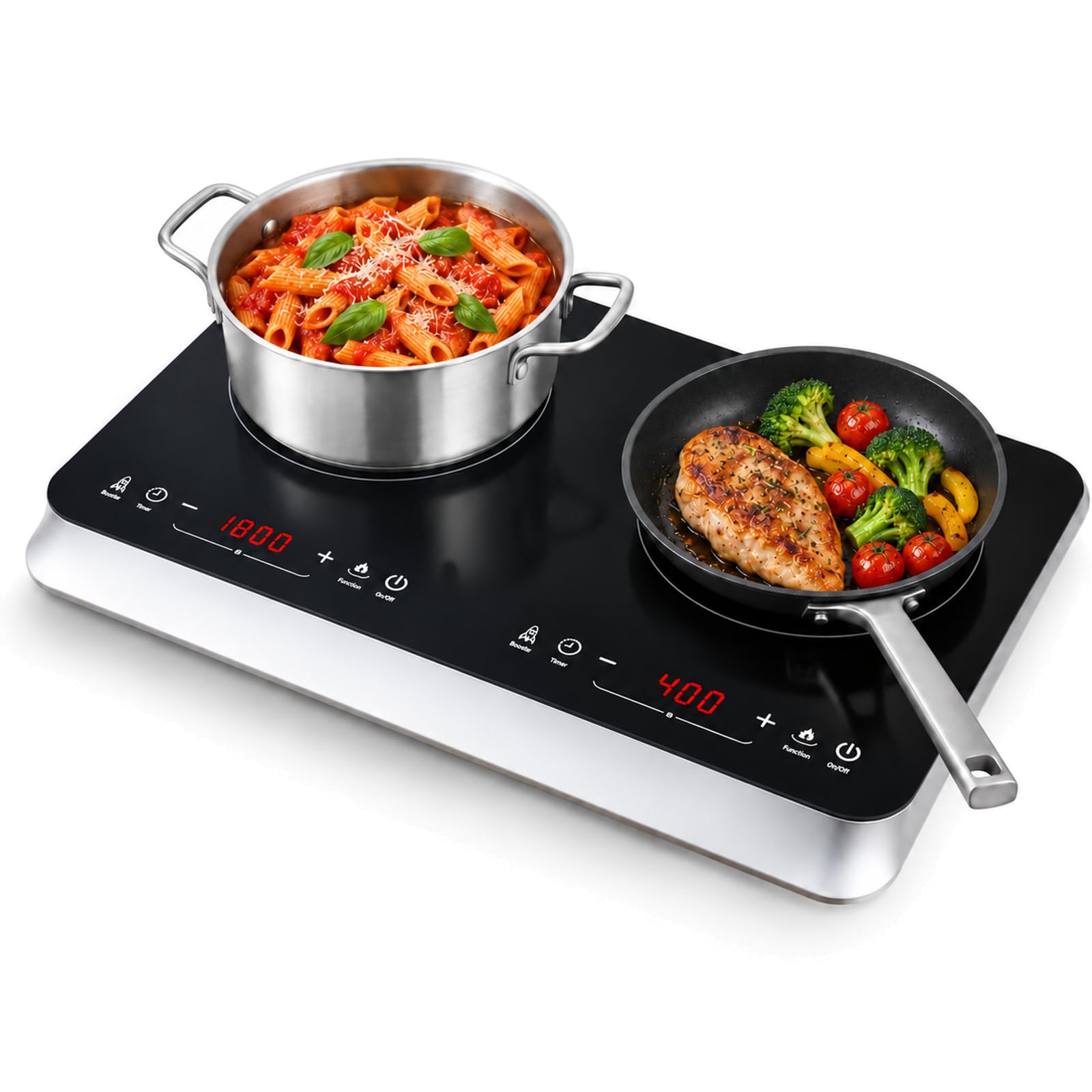
Two zones, one booster, and a main course and side running at the same time.
The booster is the small feature that changes mornings. Press it and the cooktop pushes maximum heat for one minute to get water moving or a pan started, then drops back to wherever you had it. Alongside that you get 9 power levels and 10 temperature settings between 140°F and 464°F, plus a timer that runs up to 4 hours.
The 1800W is distributed between the two, so plan on one strong zone and one supporting zone rather than two full-power burners. Smooth flat-bottom magnetic cookware is required; anything without a magnetic base simply will not heat.
Quality is the most-mentioned trait in its reviews, with heating speed close behind. Build-wise it is the heaviest pick here at 12.6 pounds and sits just 1.9 inches tall, so it slides under a cabinet and stores upright. Child lock, cookware detection, residual-heat indication, and automatic shutoff after inactivity round out the safety picture. The obvious gap is the one induction always carries: your aluminum pans are out.
Why it wins holiday cooking: independent controls let you run two dishes without juggling one dial.
What you trade: shared 1800W and a magnetic-cookware requirement, in exchange for the fastest short burst of heat on this list.
Make it yours if: you cook two components at once and want a booster to short-circuit the wait.
Leave it if: you want maximum heat on both burners simultaneously.
Know the Specs
Total Wattage and How It Splits
A cooktop listed at 1800W is almost always two 900W elements, so each burner carries half the load. That handles eggs, sauces, and reheating easily but slows a hard boil.
Some units split unevenly on purpose — the Cuisinart runs a 1300W primary plus a 500W secondary — which is ideal when one burner does the real cooking. Induction units share a single upper ceiling, so both zones running at once is capped.
Induction vs Infrared vs Radiant Glass
Induction heats the pan itself through a magnetic field, which is why it responds instantly and stays cool to the touch. It also refuses any pan that will not hold a magnet.
Infrared and radiant glass warm the pan from a heating element beneath the surface. They accept aluminum, copper, glass, and ceramic — a huge convenience if your cookware is mixed. The cost is slower warm-up.
Cookware Diameter and Weight Limits
Most double burners top out around 7 to 7.4 inches of pan diameter, and one pick lists a 22 lb weight ceiling. A big stockpot may simply not fit.
Induction models often set a minimum too — the AMZCHEF needs 4.7″ to 9.4″ of magnetic base. Measure your largest pan before you buy.
Safety Features That Actually Matter
Residual heat indicators warn you the glass is still warm after you switch off. Child locks stop accidental changes. Auto shutoff and overheat protection guard against a forgotten pan.
On induction, cookware detection is the quiet safety feature — no pan means no heat, which reduces the chance of a scorched surface.
Common Questions
Will a 2 burner electric cooktop work with my existing aluminum pans?
Can I run two burners at full power at the same time?
Do I need an electrician to install one of these cooktops?
How long does it take to boil water on a 900W burner?
Is induction better than an infrared or cast-iron hot plate?
Will a double burner hot plate trip my kitchen circuit?
Can I build a portable cooktop into my countertop?
What does a residual heat indicator actually do?
How much pan weight can a countertop double burner hold?
Why does the burner light keep cycling on and off?
The Bottom Line
For most kitchens, the 2 burner electric cooktop winner is the Vayepro Infrared Double Burner because it takes the aluminum and glass pans you already own and does not ask for a new circuit. If you want long, low simmers that hold heat, the Cuisinart Double Burner with its 1300W primary plate is the one. And if you want two dishes moving at once with a booster to shortcut the wait, the COOKTRON earns its spot.
One nudge, built on the data itself: the CUSIMAX has drawn far more owner feedback than anything else here — 7,000+ ratings — and still holds a 4.0+ average, which says the plain cast-iron approach satisfies most buyers. Buy the cooktop whose pan rule matches your cupboard, and you will not need to return it.
How we choose
We do not accept paid placement. Every pick is matched to a real buyer and a real use-case; we do not hands-on test units.
Sources
Specifications: manufacturer listings and product documentation. Review insights: verified customer reviews, as of November 2026. Pricing: not shown on this page (it changes often); check the current price via the retailer link.
As an Amazon Associate, My Heart Lives Here earns from qualifying purchases. This does not affect which products we feature.