Heads up: This post contains affiliate links. As an Amazon Associate I earn from qualifying purchases, at no extra cost to you. Learn more
Specs are compiled from manufacturer listings and verified buyer reviews and can change over time — please confirm the key details on the product page before buying.
Most barcode scanners fail in the same boring way: the label is smudged, the cable snags, or the beam cannot read a screen at two in the morning. If you are stocking shelves or running a checkout lane, you want one thing — a trigger that fires a clean scan every time, in dim light, on a beaten-up label. This guide covers the handhelds that actually do that, grouped by how you’ll use them: wired for a fixed counter, wireless for walking the aisles, and a wearable for hands-busy work.
This guide is built by comparing the manufacturers’ published specifications and the patterns across verified customer reviews, so you get each pick’s real strengths and trade-offs instead of marketing spin.
What separates a good scanner from a frustrating one is rarely the brand name — it is depth of field, decoding on damaged labels, and battery honesty. Whether you’re outfitting a checkout lane or restocking shelves, these are the handhelds that fire a clean scan on a smudged label in dim light.
Top Picks


How To Choose The Best 1D Barcode Scanner
Start with the job, not the spec sheet. A checkout counter needs a scanner that reads screen-based codes and sits on a stand, while a stockroom sweep needs one that survives drops and keeps scanning at the edge of the aisle. Pick the connection type first, then the battery, then the decoding — that order keeps you from paying for range you’ll never walk.
Wired or wireless comes before everything else
A wired scanner (USB cable straight into your PC) is plug-and-play — no charging, no pairing, no low-battery surprises. That suits a fixed POS counter. A wireless scanner frees you to walk a shelf with the scanner in hand and the laptop on a cart, but you trade a cable for a battery you have to remember to charge. The 2.4G wireless models pair through a tiny USB receiver; Bluetooth models pair with phones and tablets that may not have a spare USB port.
Decoding: laser vs CCD
Laser scanners throw a beam and read traditional printed barcodes at speed. CCD scanners capture the barcode like a tiny camera, which is why CCD models often handle smudged, damaged, or fuzzy labels better, and can sometimes read codes from a screen. If your labels live on worn cardboard or get coffee on them, lean toward CCD. If you scan crisp retail codes all day, laser is faster and cheaper.
Range, drops, and battery honesty
Wireless range uses words like “up to 328 ft in barrier-free environment,” which means no walls between scanner and receiver. Shelving, steel racks, and refrigerators all cut that down. On durability, look for a stated drop height instead of a vague “anti-shock” claim — 5ft, 6ft, and 8ft to concrete are all real numbers from the picks below. For battery, separate standby time (sitting idle) from continuous scanning time — you need the second one to survive a shift.
Side-by-Side Comparison
| Model | Best For | Connection | Battery / Power | Drop Rating | Amazon |
|---|---|---|---|---|---|
| Inateck BCST-70★ Best Overall | Everyday warehouse scanning | Bluetooth + USB | 2600mAh, 180-day standby | 6ft / 1.8m | Amazon |
| Barcode Scanner Wireless (2.4G + Screen)Budget Wireless | Budget wireless with a status screen | 2.4G wireless + USB | 2000mAh | 8ft / 2.4m | Amazon |
| NetumScan USB CCDScreen Reader | Worn labels on a fixed counter | USB wired | Corded | 2m | Amazon |
| Esup Wired with Stand | Hands-free checkout and retail | USB wired | Corded | — | Amazon |
| Tera 5100-BU | Long-range wireless walkarounds | 2.4G wireless + USB | 2200mAh, battery indicator | 6.56ft | Amazon |
| Inateck BCST-21 | Bluetooth scanning on phone or tablet | 2.4G + Bluetooth + USB | 2000mAh, 3 months per charge | — | Amazon |
| TEEMI TMCT-07 | Inventory mode batch uploads | 2.4G wireless + USB | 24-hour continuous | 5ft / 1.5m | Amazon |
| Zebra LS2208 Kit | Counter work with a gooseneck stand | USB wired | Corded | — | Amazon |
| Eyoyo Ring Scanner | Hands-free picking and event check-in | Bluetooth + 2.4G + USB | 8-hour continuous, 720-hour standby | — | Amazon |
Detailed Reviews
1. Inateck BCST-70 Barcode Scanner
Our pick — 4.5+★ from 800+ verified ratings; the strongest balance of quality and price.
A full charge sits idle for 180 days, then fires a clean scan in three seconds.
The number that wins a warehouse manager over is the standby figure: 180 days on one charge, so the scanner in the drawer is ready when the new hire pulls it out. Setup takes about three seconds over Bluetooth, and it also runs on a USB cable when you want a fixed desk connection. The decoding handles blurry and broken barcodes under both strong and dim light, which is exactly the situation you hit over a dim stockroom shelf.
Durability is baked in, not claimed loosely. The external TPU protective case (a rubberized shell around the body) is twice as thick as similar products, and the internal core gets a triple consolidation treatment for repeated 6ft (1.8m) drops to concrete. At 7.04 ounces it is 70% lighter than the Tera 5100-BU below — you’ll notice that by hour six of a swing shift. It reads 1D barcodes only, so plan a different scanner if your shelf labels are QR codes on screens.
The customization earns its keep: an editable prefix or suffix stretches to 32 digits, and you can hide part of a barcode so the data lands in your spreadsheet exactly how your system expects. Buyers report scanning 300 barcodes in under 45 minutes. It handles English, German, French, Italian, and Spanish keyboards, so a multilingual counter isn’t a problem. It’s the crowd favorite by a wide margin — 4.5+ stars across 800+ ratings — with build quality the most-praised aspect.
Where it earns the top spot
- 180-day standby with 2600mAh on board — no scramble for a charger between shifts.
- 6ft (1.8m) drop rating to concrete plus a TPU case twice as thick as similar products.
- Three-second Bluetooth pairing; USB cable as a backup wired mode.
- 32-digit editable prefix/suffix and barcode-hiding for clean exports.
What to weigh first
- 1D only — no 2D or QR support, so a phone-screen code will not read.
- Compatibility is the one mixed talking point across its listing; confirm your OS and POS before you buy.
Pick it for: high-turnover retail and warehouse floors that need a scanner sitting charged and ready.
Look past it if: your codes live on a phone screen or you need 2D decoding.
2. Barcode Scanner Wireless 1D
A shockproof ABS body that shrugs off 8ft drops for a lot less than the competition.
This is the rugged pick on a tight budget. The ABS shell (a hard plastic that absorbs impact) is rated to withstand drops from 8ft / 2.4m onto concrete — a higher stated drop height than the Inateck BCST-70’s 6ft (1.8m). If your scanner gets knocked off a shelf or a truck bed, that extra fall allowance is real insurance. The 1.8″ color screen shows wireless channel, signal strength, and battery level, so you’re not guessing whether the link is live.
The 2000mAh battery gives more than half a year of standby if fully charged, and continuous scanning for more than one week. The 2.4GHz wireless reaches up to 300m in open air and 100m indoors, and a USB cable is in the box for a wired desk setup. Offline storage mode holds up to 100,000 barcodes, which is the spec that matters if you walk the far aisles and need to dump data back at the desk later.
One hard limit: the maker states it is not compatible with Square, and it wants Windows, Mac, or Linux on the other end. So if your POS runs on Square Register, this is the wrong scanner no matter how good the drop rating looks. For a small warehouse or retail back room that just needs durable, cheap wireless with offline memory, the package is hard to argue with.
The stand-out spec: an 8ft / 2.4m concrete drop rating at the budget end of the shelf.
The catch: no Square support, and the offline buffer is only useful if you actually remember to upload.
Reach for this if: your scanner takes abuse and your software runs on Windows, Mac, or Linux.
Look elsewhere if: you’re on a Square POS — the maker flags this one as incompatible.
3. NetumScan USB 1D Barcode Scanner
A CCD sensor that reads the labels every laser scanner gives up on.
If your barcodes arrive smudged, torn, or printed on reflective paper, the CCD sensor here is the reason to look. A CCD captures the image like a tiny camera instead of throwing a laser line, so it can pull a read off deformed, damaged, fuzzy, or reflective codes. It also captures 1D codes from paper and screen — including UPC/EAN with 2 or 5 add-ons. The maker claims it reads rough labels faster and more accurately than a laser scanner.
Setup is pure plug-and-play: plug the USB cable into any port and the driver installs itself, and it works with Mac, Win10, Win7, Win8.1, iOS7, and Linux. The ABS body is built to survive repeated drops from 2m to concrete. A stand is included for hands-free counter scanning, and value for money is the quality owners talk about most, with functionality a close second.
Where it needs care is compatibility — that’s the one talking point the listing flags as mixed, so check your OS and POS before you buy. One practical note: the brand asks you to buy from NetumScan directly, because an unauthorized seller is moving counterfeit units under the same model name. Buy from the right listing and this is a solid, cheap workhorse for a supermarket, library, or drugstore counter.
The reason to pick it: CCD decoding turns unsreadable, smudged labels into a normal day’s work.
Before you click: confirm the seller is NetumScan and that your POS software accepts a plug-and-play USB keyboard-style input.
Best fit: a fixed counter with tired, over-handled labels and a spare USB port.
Not for: anyone who needs a wireless walkaround — this one is corded.
4. Esup Barcode Scanner with Stand USB Scanner Wired

A fast 240-lines-per-second counter scanner that wants the label at the right distance.
Speed is the selling point here: 240 lines per second with a scan depth of 0-60cm. That bandwidth keeps a busy checkout moving when the queue is six deep. The flexible adjustable stand holds the scanner hands-free, and the ABS plastic with an ergonomic grip feels natural in the hand between picks. It handles the usual retail barcode set — Code11, Code39, Code93, Code32, Code128, Codabar, UPC-A, UPC-E, EAN-8, EAN-13 and more.
Setup is a two-second affair: plug the USB cable into your laptop and the driver installs itself in 2-5 seconds. You can switch between manual trigger and automatic scanning by holding the trigger key about 10 seconds — handy when a clerk goes hands-free with the stand. Functionality is the quality owners mention most, and value for money comes second.
The honest caveat is distance. Scanning performance is the mixed point on this listing — the recurring note is that if you hold the product too close to the scanner, it won’t read. So it rewards the stand setup or a deliberate 0-60cm working distance, not a jab-and-hope technique. Treat it as a counter or library scanner that lives on its stand, and it holds up.
Why it works at a checkout
- 240 lines per second keeps a busy lane moving.
- Adjustable stand for hands-free scanning.
- Automatic mode switch by holding the trigger about 10 seconds.
- Plug-and-play USB installs in 2-5 seconds.
The distance it wants
- Too close and the code won’t read — keep to the 0-60cm depth.
- Wired only, so no walking the aisles with it.
Great for: retail lanes and library desks where the scanner lives on its stand and codes come at a comfortable distance.
Skip if: you like to scan point-blank by hand — this one needs a little space to read.
5. Tera Barcode Scanner 5100

Enough wireless range to scan across a warehouse floor, with a battery light so you never guess.
You can walk a long aisle with the laptop parked at the desk, because this Tera reaches 328 ft in a barrier-free environment (open air with nothing in the way). That beats the Inateck above at 115 ft — a 2.9x gap you’ll feel on a long walk. A 2200mAh battery (the power pack inside) plus a battery indicator light ends the low-battery guessing game. An IP54 rating (protection from dust) and an anti-shock silicone cover that takes drops up to 6.56 feet keep it working on a busy floor.
The handle is extended and widened with a smooth, flat trigger, so a full shift of scanning doesn’t leave your hand cramped. Connectivity runs 2.4G wireless through a USB receiver or a USB cable, plug-and-play with no drivers. It reads all the common 1D codes — Codabar, Code 11, Code93, MSI, Code 128, EAN-128, Code 39, EAN-8, EAN-13, UPC-A, ISBN and more — and handles damaged, fuzzy, reflective, and smudged barcodes.
It’s not the featherweight of the group. At 12 ounces it’s 70% heavier than the Inateck BCST-70’s 7.04 ounces, so a long handheld shift will feel it in your wrist. The upside: effectiveness is the quality buyers praise most, with battery life second, and one early adopter described walking around with a laptop on a cart and never losing the scan. Scanning speed and wireless connectivity are the two mixed notes to keep in mind — treat the range as “barrier-free” and you’ll be fine.
Where it wins: that 328 ft barrier-free range is in a different class from most handhelds here.
The trade-off: 12 ounces of scanner in your hand all shift, plus a slightly heavier handle than the small Inateck.
Suits: large-floor operations that walk between shelves with the receiver left at the desk.
Think twice if: your scanning is desk-bound and light — the extra weight won’t pay you back there.
6. Inateck 1D Barcode Scanner
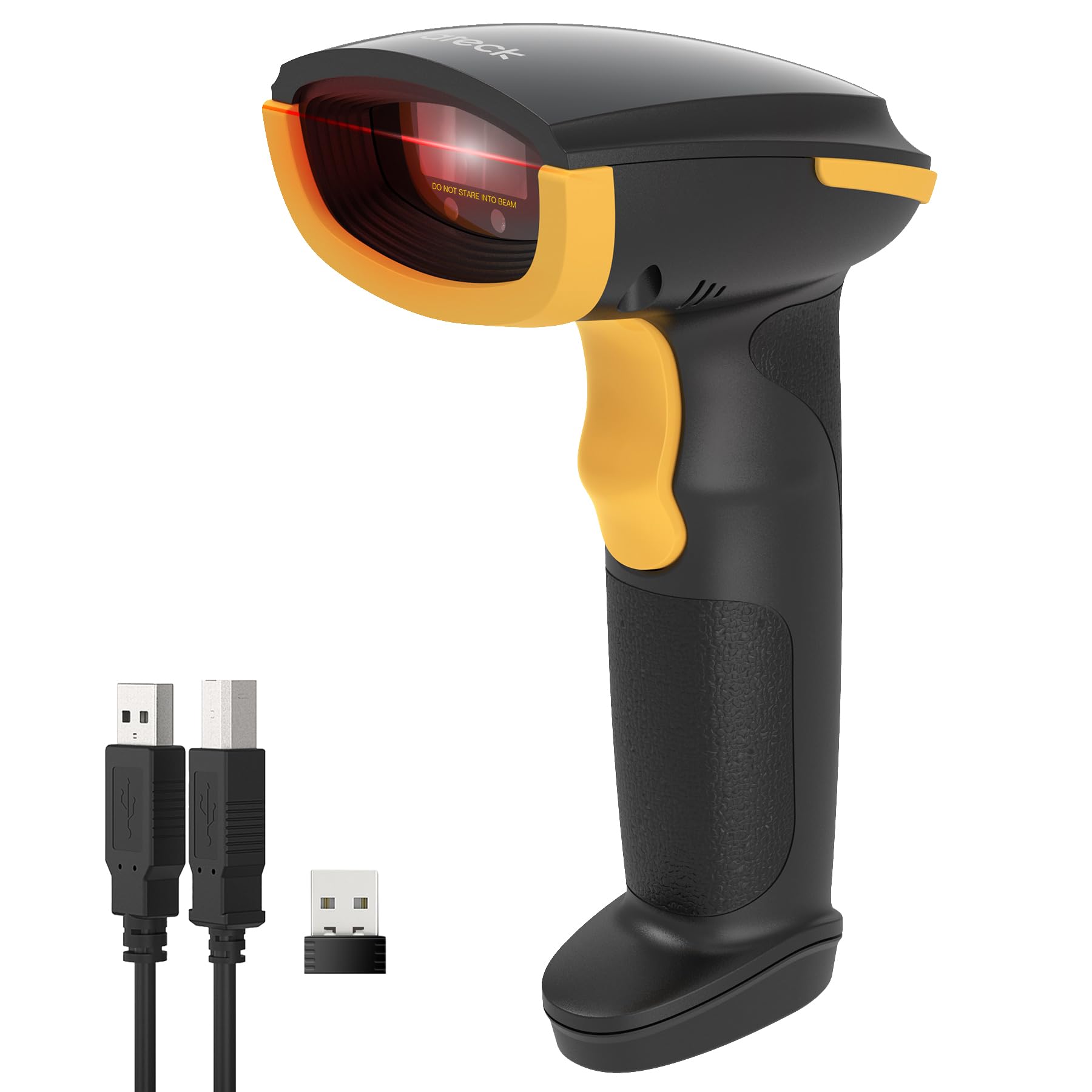
A whole quarter between charges, and an app to configure it from your phone.
Three months on a single charge is the headline — 2000mAh, managed by advanced battery algorithms that cut power draw. Under high-frequency use the maker says expect about a month; at normal scanning frequency, you get three. That’s the kind of battery honesty that keeps a courier route or warehouse shift moving without a charging station. At 6.2 ounces it’s the lightest full-size scanner in this list, so it won’t drag on your wrist.
The Inateck Office app is the differentiator: configure barcode recognition, Bluetooth management, and battery monitoring from the app rather than memorizing setup barcodes. The three connection modes — 2.4G wireless, Bluetooth, and wired USB — cover POS, courier, and library workflows, and it works with Windows, Mac OS, iOS, Android, iPad OS, and Linux. The laser module reads blurry, damaged, dirty, wrinkled, and distorted codes under strong and dim lighting.
What owners mention most strongly is just how functional it is — quick Bluetooth pairing to a computer, fast scanning, and a charge that holds. The mixed notes are accuracy and durability, which in practice means some users find the decode fine for clean codes but not magical on the worst labels. If you want app-based configuration and long battery life over brute-force range, this is the one.
The case for it
- 2000mAh gives 3 months per charge (about 1 month at high frequency).
- App and SDK configuration for recognition, Bluetooth, and battery monitoring.
- Three connection modes: 2.4G, Bluetooth, and wired USB.
- 6.2 ounces — light for a full-size handheld.
What to know
- Accuracy is a mixed note on the listing — fine for clean codes, less forgiving on worn ones.
- Durability doesn’t come with a stated drop rating, unlike the rugged budget pick above.
Made for: couriers, library staff, and logistics teams that want app setup and long battery life.
Not the first pick if: your labels are battered and you need the CCD decoding of the NetumScan.
7. TEEMI TMCT-07 Wireless 1D Barcode Scanner with USB Receiver

Stores codes when you’re out of range, then dumps them back at the desk.
Inventory work is where this TEEMI shines: it saves scanned data in memory and uploads it in batch, and if you walk out of range it buffers the codes and uploads automatically when you return. That’s the spec that turns a wandering aisle-by-aisle stock count into a clean spreadsheet. The 2.4G wireless runs through a mini USB receiver, plug-and-play, and the standby time reaches 90 days with up to 24 hours of continuous operation on a full charge.
Range reaches 60 meters (200ft) indoors, and the design survives a 5ft / 1.5m fall. Three scanning modes — trigger, automatic, and continuous — mean you can program it to scan without pressing anything, or keep the line on all the time. Multi-language support covers English, French, German, Spanish, and Italian, and it handles UPS, FedEx, and USPS tracking numbers and VIN numbers. There’s even an OTG adapter path for a phone or tablet.
Functionality is the quality owners praise most, with value for money second. The mixed notes are reliability and scanning performance — some report it works for over six months and scans accurately, while others had one stop within weeks. The manual is the weakest link, so plan on a setup session. Buy it for inventory mode and batch upload; it handles that job well.
top-tier at: capturing inventory offline, then uploading it automatically when you walk back into range.
The fine print: reliability and the manual are the recurring mixed points — get it set up once and leave the settings alone.
Pick it when: stock counts mean walking aisles with the receiver parked at a charging desk.
Pass if: you need 2D codes or phone-screen scans — this one is 1D tracking numbers and retail codes only.
8. Symbol Zebra LS2208 Scanner Kit

A corded standby the checkout desk can leave docked on its gooseneck stand.
The LS2208 arrives as a kit with the gooseneck stand and cable, which is exactly what a tired POS counter wants — dock it, angle the stand, scan hands-free. At 5.3 ounces it’s the lightest corded scanner here, so passing it across the desk between clerks is no burden. It’s a standard-range laser model with a 30-degree angle of view, and the USB cable keeps it plug-and-play with no battery to charge or lose.
Quality is the trait the listing calls out, with compatibility a close second — and buyers specifically point to working with a Square Register POS. That’s worth noting: this is the corded pick that pairs with Square when the wireless options in this list won’t. For a bookstore, pharmacy, or small retail desk running a Square setup, the pairing is the reason to choose it.
Its limits are straightforward. It’s corded, so no walking the aisles. It’s standard range, so it’s built for counter-height scanning rather than a warehouse reach across shelves. And as a laser scanner it does best on crisp printed retail codes rather than smudged CCD-friendly labels. For a fixed checkout that needs a reliable docked scanner, those limits rarely come up.
The deciding reason: it’s the documented Square Register-compatible corded pick in this lineup.
The honest scope: standard-range and corded — it belongs on a counter, not in a warehouse aisle.
Right for: a fixed counter, especially a Square Register setup that needs a docked hands-free scanner.
Not for: stockroom walkarounds or anyone who needs wireless range.
9. Eyoyo Mini 1D Barcode Scanner

Slip it on a finger and scan with both hands already full.
This is the odd one out, and it earns its slot by solving a specific pain: packing and picking where both hands are already loaded. The ring-style body sits on your finger with a reinforced 330° rotating head for left or right-hand wear, and an adjustable velcro strap fits any finger even over gloves. At 1.6 ounces, it disappears on your hand. The 8-hour continuous runtime and 720-hour standby cover a full inventory day, with a 1.5-hour recharge via USB.
Connectivity runs three ways — Bluetooth, 2.4G wireless, and USB wired. The 2.4G mode reaches up to 30m (98ft), and Bluetooth reaches up to 10m (30ft) without barriers. It reads the common 1D family from UPC/EAN to Code 128 and Codabar, including damaged and reflective codes, and stores up to 5,000 UPC barcodes offline when you’re out of range. Configuration options include prefix/suffix editing, character deletion, and adding TAB or CR&LF keys.
The fine print is where you have to be careful, and the maker flags it clearly. It reads printed 1D codes only — no screen codes, no QR, and no barcodes on silver or metallic surfaces that reflect light. It’s not compatible with Square POS or Register. And the biggest buyer note is durability, with a share of owners reporting it broke within six months of use. So wear it for event check-in and light picking, and treat it gently.
The reason to choose it: hands-free scanning while you carry boxes, check in guests, or sort parcels.
The real caution: durability is the weakest point here, and it can’t read screen codes or Square POS systems — both are hard limits.
Best fit: event registration, sorting stations, and light picking where two hands are busy.
skip it if: you scan phone screens, run Square, or need a scanner for hard daily abuse.
Know the Specs
1D Laser vs CCD Decoding
A laser scanner sweeps a single beam across the barcode, while a CCD scanner captures the whole code like a small camera image. That difference shows up on worn labels: CCD models tend to pull a read from smudged, damaged, or reflective codes that a laser struggles with, and they can often read codes off paper or a screen. Laser models usually win on speed and price for crisp retail codes. Neither reads 2D or QR codes — that needs a separate 2D scanner, which several picks here are not.
Range, Standby, and Continuous Runtime
A wireless range spec usually assumes a “barrier-free environment” (open air with nothing in the way). So a 328ft or 200ft headline is open-air distance with no shelving between scanner and receiver. Walls and steel racks cut it. For battery, separate the two numbers. Standby time is how long the scanner sits idle and ready — from 180 days to 720 hours depending on the model. Continuous runtime is how long it actually scans — a full shift, or a full week depending on use. On a busy floor, the second one is the number you care about.
Durability and Drop Ratings
A stated drop height is the honest durability number. The picks here range from 5ft / 1.5m to 8ft / 2.4m to concrete, and some pair that with a TPU or silicone protective shell. If you work anywhere a scanner can fall off a shelf or a cart, prefer a model with a concrete drop rating rather than a vague “anti-shock” claim. Corded models on a stand rarely need the same protection.
Offline Storage and Batch Upload
Offline storage lets a wireless scanner hold scans in its own memory when it is out of range of the receiver — then upload them in one batch when you’re back. Capacities here run from 5,000 to 100,000 barcodes. That’s the feature that makes a stock count practical: walk the aisles without the computer, then upload the whole batch at the desk. Without it, you’re staying within wireless range all day.
Common Questions
Will a 1D barcode scanner read QR codes?
Can the Inateck BCST-70 read barcodes off a phone or computer screen?
How far can a wireless barcode scanner really reach indoors?
Is a CCD scanner better than a laser scanner for worn labels?
Will these scanners work with a Square POS system?
Do I need to install drivers or software to use one of these?
What’s the difference between standby time and continuous scanning time?
Can I use a 1D scanner with my phone or tablet?
How durable are these scanners if they get dropped on a concrete warehouse floor?
What does offline storage mode do on a barcode scanner?
The Bottom Line
Across the board, the best 1D barcode scanner is the Inateck BCST-70, because its 180-day standby and 6ft drop rating make it a leave-it-in-the-drawer-and-forget-it scanner that’s still ready on shift day. If you want long-reach wireless and a battery light to end the guessing, the Tera 5100-BU gives you 328ft of barrier-free range. For hands-free inventory counts with batch uploads, the TEEMI TMCT-07 is the one to reach for. And if you’re on a Square Register, the Symbol Zebra LS2208 kit is the corded pick built to pair with it. Whichever you choose, let the drop rating and continuous-runtime spec decide for you — those are the two numbers that actually shape your week.
How we choose
We do not accept paid placement. Every pick is matched to a real buyer and a real use-case; we do not hands-on test units.
Sources
Specifications: manufacturer listings and product documentation. Review insights: verified customer reviews, as of November 2026. Pricing: not shown on this page (it changes often); check the current price via the retailer link.
As an Amazon Associate, My Heart Lives Here earns from qualifying purchases. This does not affect which products we feature.