Heads up: This post contains affiliate links. As an Amazon Associate I earn from qualifying purchases, at no extra cost to you. Learn more
Specs are compiled from manufacturer listings and verified buyer reviews and can change over time — please confirm the key details on the product page before buying.
Cold room, and you want it warm without dragging a portable unit across the floor. A 220 volt wall mounted electric heater does exactly that — it wires straight into your wall on a 240 volt supply and pushes serious heat into a bathroom, basement, garage, or entryway. The catch most buyers hit first: a 240 volt heater is not a plug-in appliance. It needs a dedicated breaker and a hardwired connection, so an electrician is usually part of the plan. Below, you get eight real units sorted into what each one is genuinely good at — high-wattage workshop blasters, compact bathroom warmers, and quiet whole-room models with digital controls.
This guide is built by comparing the manufacturers’ published specifications and the patterns across verified customer reviews, so you get each pick’s real strengths and trade-offs instead of marketing spin.
You will see how wattage maps to room size, why a 240 volt unit heats faster than a 120 volt one, and where a thermostat on the unit beats a wall switch. Every pick here is a hardwired heater, so check your breaker panel before you buy anything. Here is the honest shortlist of 220 volt wall mounted electric heaters that earn their wall space.
Top Picks


How To Choose A 220 Volt Wall Mounted Electric Heater
Start with the room, not the heater. A hardwired 240 volt wall heater is sized by watts, and the watts need to match the space or the unit runs nonstop without ever catching up. The second decision is your wiring: a 240 volt heater draws a dedicated circuit, while a 120 volt model can often share an existing one.
Match the wattage to the room
Wattage is the amount of heat the unit can push. Higher watts warm bigger spaces, and the data here shows a clear gap — the KING PAW2422-W covers 400 square feet while the Cadet Com-Pak 120V model covers 200 square feet. If you are heating a bathroom, a smaller wattage is plenty; for a garage or lobby, you want the high-output end.
Know your circuit before you buy
Every heater here is hardwired, meaning no cord and no plug. A 240 volt unit like the Heat Storm HS-6000-GC pulls 25 amps, so the breaker and wiring have to be sized for it. The 120 volt Cadet Com-Pak draws 12.5 amps. Check your panel with an electrician first — that single step saves you a return.
Decide how you want to control it
A built-in thermostat lets you set the temperature right on the unit. A wall or remote thermostat puts control elsewhere in the room. Some units here, like the Heat Storm, add Wi-Fi and scheduling so you can warm a workshop before you walk in. Simpler models use a knob and a positive off switch.
Side-by-Side Comparison
| Model | Best For | Wattage | Voltage | Coverage | Amazon |
|---|---|---|---|---|---|
| KING PAW2422-W Pic-A-Watt★ Best Overall | Whole-room adjustable heat | 2250 W | 240 V | 400 sq ft | Amazon |
| Stiebel Eltron CK 200-2 TrendBest for Bathrooms | Bathrooms and small rooms | 2000 W | 240 V | — | Amazon |
| Cadet Com-Pak 120V with ThermostatEasiest Retrofit | Bathroom walls on 120V | 1500 W | 120 V | 200 sq ft | Amazon |
| Cadet Com-Pak 240V Complete Unit | Compact room heat on 240V | 2000 W | 240 V | 200 sq ft | Amazon |
| Cadet Energy Plus 1600W | Efficient digital control | 1600 W | 240 V | — | Amazon |
| Broan-NuTone 198 High Capacity | Large rooms, downflow heat | 4000 W | 240 V | 265–400 sq ft | Amazon |
| Heat Storm HS-6000-GC | Garages with Wi-Fi control | 3000–6000 W | 240 V | 1000 sq ft | Amazon |
| Fahrenheat FZL4004F | Entryways and vestibules | 4000 W | 240 V | 400 sq ft | Amazon |
Detailed Reviews
1. KING PAW2422-W PAW Pic-A-Watt Electric Wall Heater
Our pick — 4.5+★ from 300+ verified ratings; the strongest balance of quality and price.
The one whose 2250 W output you can trim to match the room you are heating.
The standout here is 2250 watts that you can trim down to suit the space — the Pic-A-Watt element is built so you tailor the heat to your room instead of swallowing whatever the factory shipped. That flexibility is why it takes the top slot. It covers up to 400 square feet, which is the largest single-room rating on this list alongside the Fahrenheat, and it runs on a 240 volt supply at 9.38 amps. In plain terms: it warms a real living space, not a closet.
What wins people over is speed and simplicity. The consensus from buyers is that it heats up fast and is genuinely easy to install, with the adjustable wattage getting steady praise — and the 400 square feet headline tells you why. It pairs a whisper quiet squirrel cage blower (a fan shaped to move air with minimal noise) with a patented Smart Limit Protection cutout, a safety switch that trips if the unit runs too hot. It comes with a wall can and QuickSet stud tabs, which are mounting flanges that grab the wall studs so the can sits flush.
Here is the honest catch. Noise is the one thing buyers split on — plenty find it reasonably quiet, but a share say it is a little noisy in a bedroom. It is a forced-air heater, so you will hear the fan cycle. And unlike the Cadet Com-Pak 120V below, this needs a 240 volt circuit, so confirm you have one before ordering. The heat output spec lists 500 watts, but the model is a 2250 W unit — trust the 2250 W rating when sizing your room.
Where it earns its keep
- Adjustable 2250 W output lets you match heat to the room
- 400 square feet coverage handles a real living space
- QuickSet stud tabs and included wall can make the install cleaner
- Smart Limit Protection cutout for overheat safety
Where it may not suit you
- Fan noise divides opinion in a bedroom setting
- Requires a 240 volt dedicated circuit
The pick if: you want one heater whose output you can tune to the room and you have a 240 volt line ready.
Reconsider if: silence matters most — this is a fan-forced design that cycles audibly.
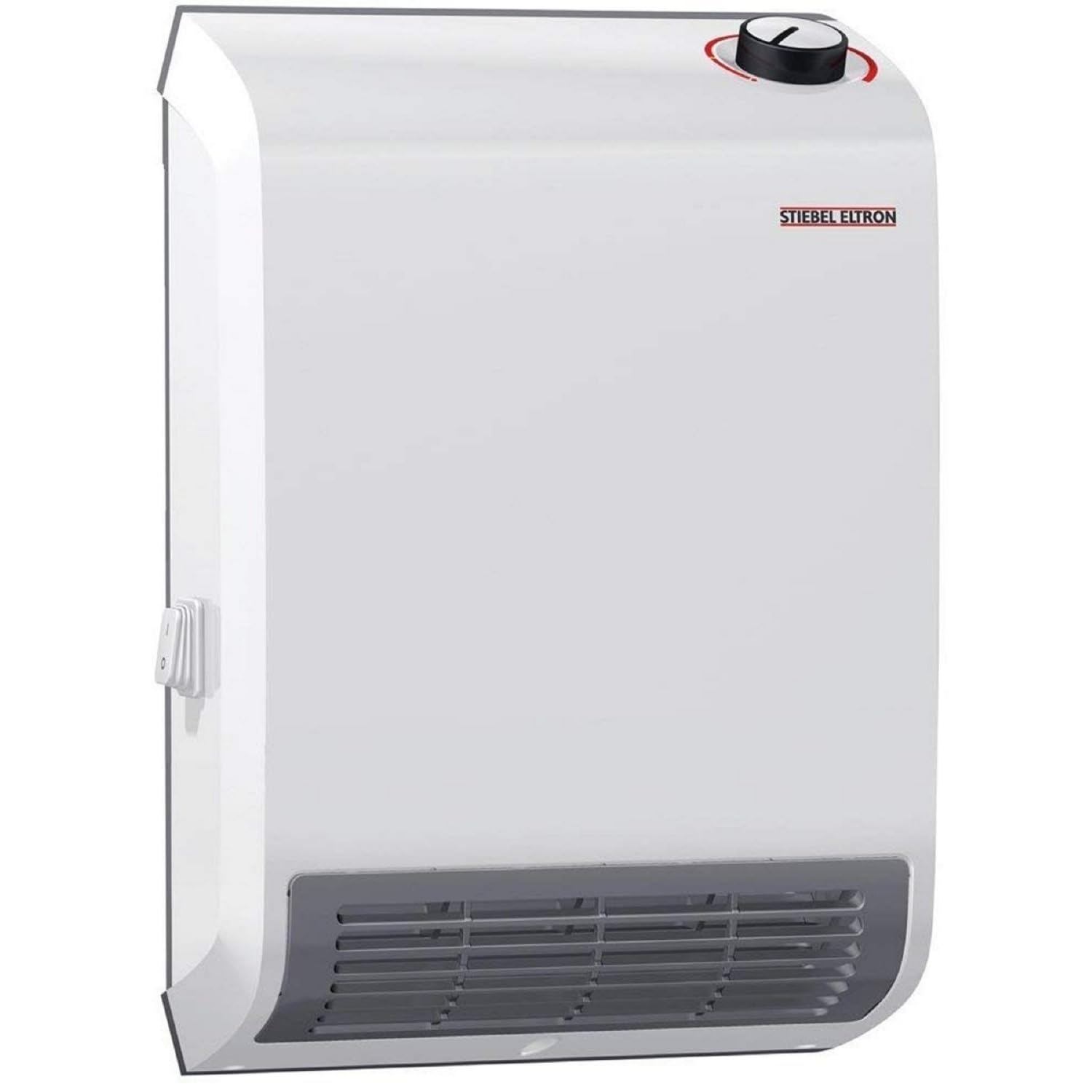
2. Stiebel Eltron CK Trend Wall-Mounted Fan Heater
German-built with a 49 dB fan that stays near a quiet conversation.
The number that decides it for a bathroom is 49 dB(a) — the noise level of its glass-reinforced polycarbonate radial fan, measured in decibels where lower is softer. That is close to a quiet conversation, so it will not roar to life over your shower. It pushes 2000 watts at 240 volts, or 1800 watts on a 208 volt supply, and the ceramic PTC heating element is a self-regulating ceramic core that warms fast and holds its temperature.
Buyers report this heater warms a 10×14 room in minutes, and they like how it looks on the wall. The box is 5.13 inches deep, so it fits over a doorway. It is rated for basements, offices, playrooms, three-season porches, cabins, campers and mobile homes. It is ETL listed (an independent lab tested it to the UL and CSA safety standards used in the US and Canada). You can also wire it to a remote line voltage thermostat (a wall control that sets heat from another spot) if you want control away from the unit.
The one thing to plan for: this ships with no cord or plug and must be hardwired, and the maker specifies a 15 Amp breaker with 14 AWG wire. Installation is where opinions split — some found it easy to mount, others hit snags. It also carries a 3-year warranty against defects in workmanship and materials. That is the trade-off: a quiet, well-sealed heater that installs cleanly if your wiring is ready.
What the 49 dB gets you: a fan heater that fades into the background in a small room, backed by a 3-year warranty and ETL listing.
The install reality: no plug, hardwired only, so budget for the electrician and the 15 Amp circuit.
Worth it for: a bathroom or small office where you want heat without a loud fan and you are ready to hardwire it.
Not the one for: anyone hoping to plug it in — it has no cord or plug at all.
3. Cadet Com-Pak Electric Wall Heater 1500W
The 120 volt bathroom pick for when running a 240 volt line is not practical.
This is the pick that gentles the wiring ask. It runs on a standard 120 volt circuit at 12.5 amps, so it can often share the wiring you already have instead of demanding a new 240 volt run — a real help in an older bathroom. Compare it to the Cadet Energy Plus above: that unit draws 6.67 A on 240 volts, while this one pulls 12.5 A on 120 volts. Same idea, different circuit, and the 120 volt route is often the easier install.
It ships as a complete unit — heater assembly, galvanized steel wall can, front grille and a built-in single-pole thermostat you set from 40 to 85 degrees right on the heater. No separate thermostat to buy. The 1500 watt, 5120 BTU fan-forced heater is aimed at medium rooms and warms up quickly, and the compact can mounts horizontally or vertically to save floor space. It is also approved for ceiling installation at this wattage, and a high-temperature safety shutoff cuts power if it overheats.
The honest trade-off is coverage. It is rated for 200 square feet — half the space the KING above handles — so it is a bathroom or bedroom heater, not a garage solution. Ease of installation and quiet operation are what buyers consistently notice, along with the clean look once it is flush in the wall. It is UL listed and needs a qualified electrician for the hardwired connection.
Why it fits a bathroom: 120 volt wiring, a built-in thermostat, and a 200 square foot rating sized right for a small room.
The size limit: 200 square feet is the ceiling here — bigger rooms need more wattage.
Reach for this if: you want a hardwired bathroom heater without adding a 240 volt circuit.
Look elsewhere if: your room runs past 200 square feet.
4. Cadet Com-Pak Electric Wall Heater Complete Unit
A recessed 240 volt box that sits flush in the wall and warms a medium room fast.
Same Com-Pak family as the 120 volt model, but upgraded to 240/208 volts and 2000/1500 watts, delivering 6825/5120 BTU. That extra voltage is the whole point — it draws 8.33 amps and warms up to 200 square feet in a hurry, so a medium bedroom or office reaches temperature quicker than a 120 volt equivalent. It recesses discreetly into the wall, and the complete unit ships with the wall can, heater, grille and thermostat for a hardwired install.
Functionality is what buyers praise most here — how reliably it does its simple job — followed closely by the heat output, and both line up with a 70-count and 55-count in the feedback. The built-in adjustable thermostat holds an even room temperature, and owners also notice how relatively quiet it runs and how compact it looks once mounted. The look is helped by a high-gloss enamel finish and a UL listing.
The real caution is durability. A cluster of feedback reports units giving out after a few months, and that is the most serious downside on this whole list — worth weighing if you want a set-and-hold heater that runs for seasons. The model is also 1500 watts at the lower setting, and ceiling mounting is only possible at 1500 watts or less, so confirm your install plan. Cut-out dimensions run 8 inches wide by 10.25 inches high, so measure the wall cavity first.
What buyers notice
- Fast warm-up to 200 square feet on 240 volts
- Built-in adjustable thermostat holds an even temperature
- Compact recessed mount keeps floor space clear
What to weigh
- Durability complaints land after a few months of use
- Ceiling mounting limited to the 1500 watt setting
Suits you if: you want fast 240 volt heat in a medium room and a flush recessed look.
Weigh carefully if: you want one heater to run for years without attention.
5. Cadet Energy Plus Electric Wall Heater
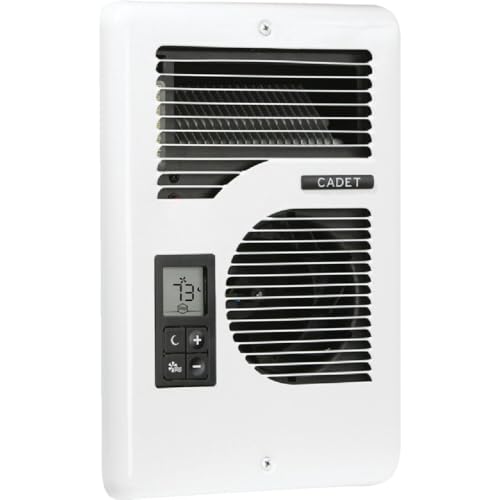
The digital-control heater that holds your room within 1 degree of the set temperature.
Here is the defining spec: the maker states it uses up to 30% less energy than a standard wall heater, because its intelligent controls and auto-adjusting variable-speed fan hold the room within 1 degree of your set temperature. That is the whole case for it — you are buying tighter control, not just raw heat. It also has a multi-volt auto sensor that matches itself to a 120, 208, or 240 volt supply and delivers 1000, 1500, or 1600 watts with no guesswork, which removes a real install risk.
The controls earn their keep too. A large backlit digital display runs on one-touch Night and Away modes that drop to a preset setback temperature while you sleep or step out. A fan-only mode circulates air year round, and a high-temperature safety shutoff plus tamperproof min/max settings let you lock in the temperature range. As an upgrade, it fits existing Cadet Com-Pak wall cans, so an older heater can be swapped without patching the wall.
Performance is what buyers praise most — how well it delivers heat — and the heat output follows closely in the feedback. The heater takes roughly an hour to warm a small bedroom and then holds it, and the ultra-quiet operation is repeatedly noticed. The honest caveat: a cluster of feedback says the main button breaks off after several months, the most-discussed reason to think twice. The controls also draw some mixed notes, with buyers wanting a clear on/off switch. Treat the button gently and it serves well.
The efficiency argument: variable-speed fan plus digital control within 1 degree, claimed at up to 30% less energy than a standard wall heater.
The one weak point: the main control button is where durability complaints land.
Best match for: a bedroom or office where steady temperature and low noise beat raw wattage.
Think twice if: you want a heavy-duty dial you can spin often — the button is the fragile part.
6. Broan-NuTone 198 High Capacity Wall Heater
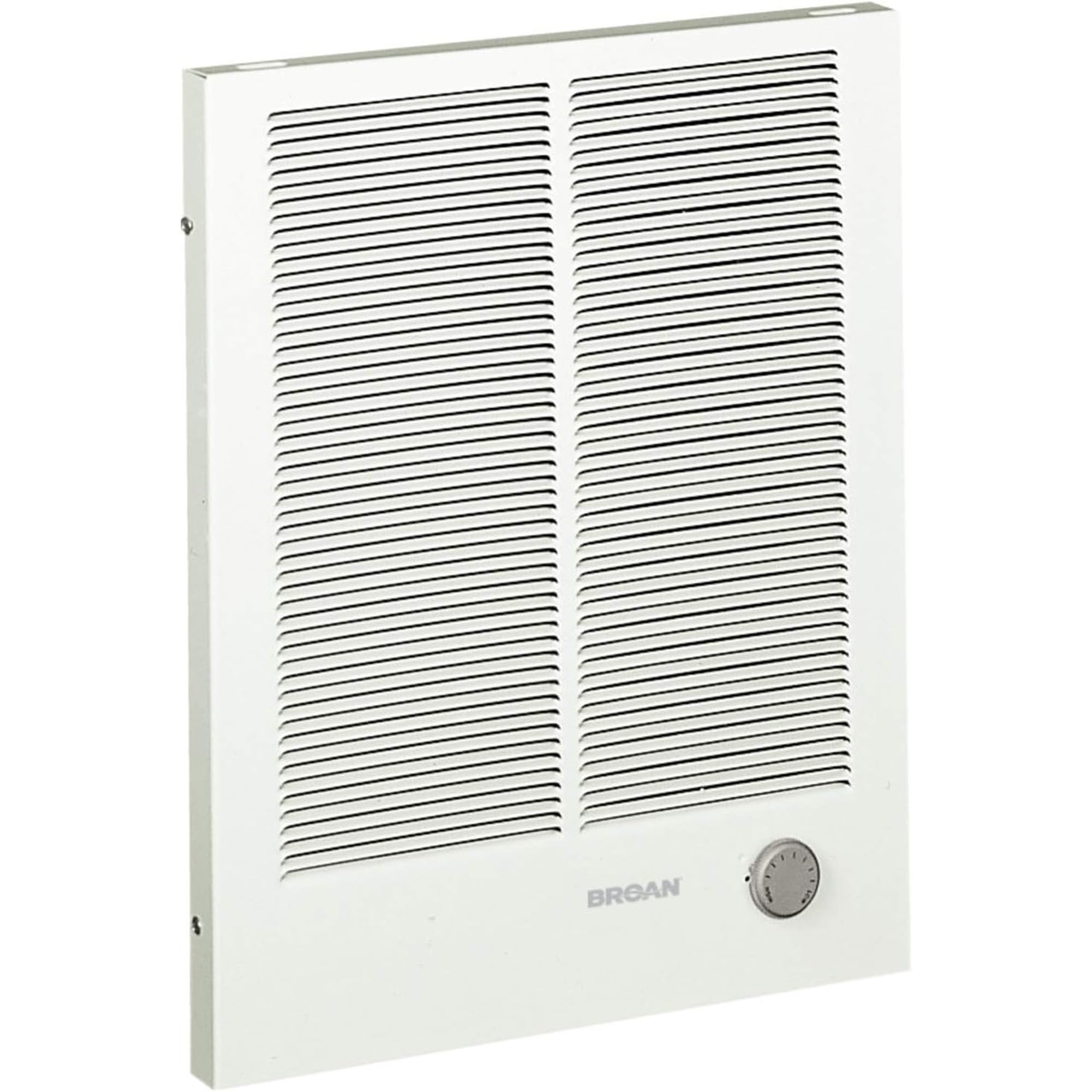
A 4000 watt workhorse whose 18-gauge steel grille sends downflow heat toward the floor.
For a big, cold room, the number that matters is 4000 watts. This unit runs on 240 VAC (standard household high-voltage power) and puts out 4000 watts, or 2000 watts on the lower setting. That covers 265 to 400 square feet at 16.67 amps, so a two-car garage stays warm. It matches the Fahrenheat’s 4000 watts and 400 square feet, so both sit in the big-room class. The downflow louvers (angled vents) on the 18-gauge steel grille push heat gently toward the floor, so your feet get warm instead of the ceiling.
Performance is what buyers praise most — it heats two small rooms quickly and the detailed install instructions win steady thanks. The heavy-duty build shows in a permanently lubricated motor, a high-efficiency blower wheel, a manual reset thermal overload protector and a heavy-duty sheathed element with steel plate fins, all UL listed. It can be recessed or surface-mounted, so you have placement options.
Two things to know. Noise splits opinion — some find it very quiet, others say it is a bit loud — so it is the kind of heater you notice in a quiet room. And the manual reset means if the overload trips, you reset it by hand rather than it flipping back on its own; that reset is one of the more-mentioned gripes. For a garage or large basement where you want serious output, that is a fair trade.
Why big rooms like it
- 4000 watts covers 265 to 400 square feet
- Downflow louvers push heat toward the floor
- Heavy-duty steel build with a permanent-split motor
What you give up
- Noise level is a coin toss in a quiet space
- Manual reset means you flip it back by hand
The pick for: a garage, basement, or large room that needs 4000 watts of downflow heat.
Skip if: you need silent operation or an automatic reset.
7. Heat Storm HS-6000-GC Heater, Gray, 7″D x 18″W x 13″H
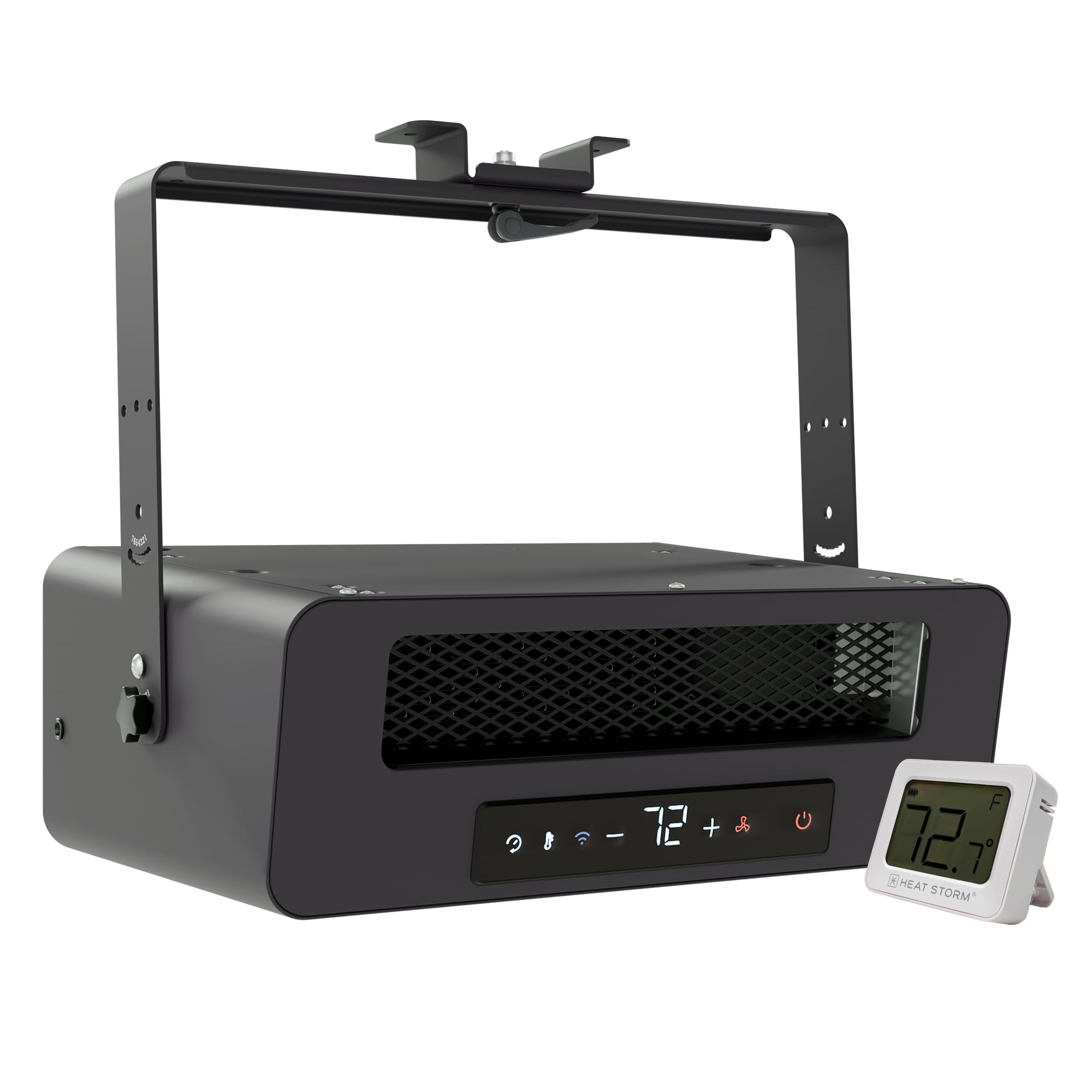
The only heater here with Wi-Fi app control and day-specific schedules.
The headline is range and control: this goes from 3000 to 6000 watts, outputting 10,000 to 20,000 BTU, and covers up to 1000 square feet — double what the KING PAW2422-W handles at 400 square feet. That is workshop-and-garage territory. It is Wi-Fi enabled so you control it from your phone, has a built-in thermostat to hold a set temperature, and lets you set schedules for specific days so heat is on before you walk in. Wiring is not included and an electrician install is recommended.
Heat output is what buyers praise most — it warms up nicely within 15 minutes and suits a shop around 260 square feet comfortably. Remote control access and wireless connectivity both get noticed in the feedback, and the scheduling is the feature that earns its keep for a home office or garage. It mounts on the ceiling or the wall and is hardwired, drawing 25 amps, so the circuit needs to be sized for it.
One honest warning: the temperature reading can be off. Some owners mention the ambient temperature (the room’s actual air temp) reads about 6 degrees Fahrenheit too high, so the room may be cooler than the display shows. Set it a touch higher and check with a separate thermometer. That aside, pre-warming a cold garage on a schedule is a real convenience.
Why it earns the smart label: Wi-Fi app control plus day-specific schedules on a 6000 watt, 1000 square foot unit.
The catch: the ambient reading can run about 6 degrees Fahrenheit high, so trust a second thermometer.
Built for: a garage or workshop owner who wants schedule-driven heat and app control.
Not ideal if: you need the room temperature reading to match the display exactly.
8. Fahrenheat FZL4004F High Capacity Fan Forced Wall Heater

Purpose-built for entryways and vestibules, with a fan delay that blocks the cold blast at start-up.
Titled for a reason: this is designed for entryways, vestibules, lobbies, hallways, restaurants and basements where a cold draft hits you first. It delivers 4000 watts of fan-forced heat over 400 square feet at 16.67 amps, and an integral double-pole thermostat adjusts from 40 to 90 degrees Fahrenheit so you dial in the comfort level right on the unit. It matches the Broan’s 4000 watts and 400 square feet, but leans toward commercial-grade steel construction for a sleek look.
The feature that earns its place is the fan delay. It keeps the fan off until the element reaches temperature, which means no cold draft at start-up, and it keeps pushing residual heat after shut-down — both of which help prolong the life of the heating element. A positive ON/OFF switch and a safety cutoff that trips if the unit is accidentally blocked round out the sensible design. Installation is a simple three-piece setup.
Owners notice fast heat and easy installation, and one detail stands out in the feedback: it works as a prime heat source (the main heater) all winter, not just a spot warmer. Noise splits opinion, with some buyers finding it a bit loud, so expect a fan hum in a room where people gather. For a lobby or mudroom where strong output matters more than silence, that trade-off works.
The fan delay payoff: no cold blast at start-up and residual heat pushed out at shut-down, which the maker says prolongs element life.
The noise note: it is a fan-forced heater aimed at busy spaces, so expect some hum.
Right for: entryways, lobbies, and basements that need a strong, commercial-feel heat source.
Wrong for: a bedroom where a completely silent heater is the goal.
Know the Specs
Wattage and square-foot coverage
Wattage is how much heat a unit can produce, and it maps directly to coverage. This list runs from 1500 watts over 200 square feet up to 6000 watts over 1000 square feet. Buy for the space: a bathroom needs less than a garage. Undersizing a heater means it runs flat out and never fully catches up.
Voltage and circuit needs
Voltage is the supply the heater runs on. Most of these are 240 volt units, which need a dedicated circuit and a hardwired install, while the 120 volt Cadet Com-Pak runs at 12.5 amps on a standard circuit. Amp draw tells your electrician how the breaker must be sized — the Heat Storm’s 25 amps is the highest here.
Thermostat: built-in versus remote
A built-in thermostat lets you set the temperature on the unit, like the Cadet’s 40 to 85 degree dial or the Fahrenheat’s 40 to 90 degree double-pole control. A remote line voltage thermostat puts control elsewhere — the Stiebel can be wired that way. Pick built-in for simplicity, remote for a switch across the room.
Fan-forced versus convection
Fan-forced heat moves air with a blower, so a room warms fast and evenly, which is why most units here use it. Convection relies on air circulation and runs quieter, the method the Heat Storm uses. Fan-forced tends to be quicker; convection tends to be quieter. Match the method to how fast you need the room warm.
Common Questions
Can a 220 or 240 volt wall heater plug into a normal outlet?
What size heater do I need for a garage or large room?
Do I need a separate wall thermostat?
How long does a wall heater take to warm a room?
Are 240 volt wall heaters noisy?
Can a wall heater be mounted on the ceiling?
Is a fan-forced heater better than a convection heater?
What does Smart Limit Protection mean on a wall heater?
Will a 240 volt heater lower my energy bill?
Can I install a hardwired wall heater myself?
The Bottom Line
For most rooms, the best 220 volt wall mounted electric heaters pick is the KING PAW2422-W. Its adjustable 2250 watts let you tune the heat to the space, and it covers 400 square feet on a 240 volt line. If quiet matters more than raw output, as in a bathroom or small office, the Stiebel Eltron CK Trend runs at 49 dB(a) (a quiet fan level) with a 3-year warranty. Need to blast heat into a garage or large room? The Heat Storm HS-6000-GC covers up to 1000 square feet and lets you schedule the warm-up from your phone.
The one honest nudge: figure out your circuitry before anything else. A 240 volt heater demands a dedicated breaker, and that single decision will point you to the right pick faster than any spec sheet. Once the wiring is settled, match the watts to the room and you are done.
How we choose
We do not accept paid placement. Every pick is matched to a real buyer and a real use-case; we do not hands-on test units.
Sources
Specifications: manufacturer listings and product documentation. Review insights: verified customer reviews, as of November 2026. Pricing: not shown on this page (it changes often); check the current price via the retailer link.
As an Amazon Associate, My Heart Lives Here earns from qualifying purchases. This does not affect which products we feature.