Heads up: This post contains affiliate links. As an Amazon Associate I earn from qualifying purchases, at no extra cost to you. Learn more
Specs are compiled from manufacturer listings and verified buyer reviews and can change over time — please confirm the key details on the product page before buying.
The part that matters most with a ceiling mounted pull up bar is not the bar — it is whether the thing stays dead still when you add your bodyweight to it. A bar that shifts a millimetre at the mounting plate will rattle your confidence on every rep, and that is the exact problem this guide sorts out for you. Below you get six bars that bolt to joists or beams, ranked by how solid they feel and how much room they give your head.
This guide is built by comparing the manufacturers’ published specifications and the patterns across verified customer reviews, so you get each pick’s real strengths and trade-offs instead of marketing spin.
You will see how weight capacity, riser height and grip spacing change what a bar can actually do in a spare room or garage. Every pick below is checked against the published specs so you can choose a Best Ceiling Mounted Pull Up Bar with confidence before you drill a single hole in a joist.
Top Picks

How To Choose The Best Ceiling Mounted Pull Up Bar
Buying one of these is really a measuring job before it is a shopping job. Get the joist layout and the ceiling height right and almost any bar on this list will serve you for years. Get them wrong and you will be returning a box of steel.
Measure your joists before anything else
Your bar has to reach two ceiling beams before you can hang from it safely. Those wooden beams are called joists, and the gap between them is the on-center spacing. Most homes run 16 inches on center, and some run 24. Two bars here are built to bridge that gap — the Ultimate Body Press 48 inch model spans two 24 inch joists or three 16 inch joists, and the Kipika 32 inch model spaces its mounting holes 32 inches apart to suit studs at 16 or 32 inches. Check yours with a stud finder (a handheld tool that locates beams behind drywall) first, because a bar that cannot reach two joists is not safe to hang from.
Riser height sets your head clearance
The risers are the short vertical legs lifting the bar down from the ceiling. Short risers tuck the bar up high and suit low rooms. Longer risers drop the bar into comfortable reach and let you pull without scraping your head on the ceiling. The AmStaff uses 12 inch risers, the Ultimate Body Press joist bar uses 16 inch risers, and the Ultimate Body Press ceiling bar uses 14 inch risers aimed at rooms with 8 foot ceilings. Match that figure to your own room height.
Match the load rating to what you will hang on it
Every bar here quotes a maximum weight, and that number covers you plus any motion. The spread runs from 350 pounds on the ATENTO up to 500 pounds on the Ultimate Body Press joist bar and the Kipika 48 inch model. If you plan to add resistance bands, a punching bag or ab straps, start at the higher end of the range rather than the lowest rating that technically covers you.
Grip width and handle shapes decide your workout
Bar width runs from 39 inches on the Kipika 32 inch model to 42 and 48 inches on the wider options. A wider bar gives your hands room to spread out for lat work. The 5 inch parallel grips on the AmStaff let you pull palms-facing for a shoulder-friendly alternative to the straight bar. Pick the shape that matches the exercises you actually do.
Side-by-Side Comparison
| Model | Best For | Weight Capacity | Bar Width | Riser / Height | Amazon |
|---|---|---|---|---|---|
| AmStaff Fitness Joist Mount★ Best Overall | Wide grip with parallel handles | 400 lbs | 42″ | 12″ | Amazon |
| Ultimate Body Press Ergonomic Joist MountHeaviest Load Rating | Heaviest load rating | 500 lbs | — | 16″ | Amazon |
| ATENTO Ceiling Mount | Budget-friendly starter bar | 350 lbs | 40″ | — | Amazon |
| Kipika 32″ Adjustable | Adjustable height with accessory hooks | 400 lbs | 39″ | 21.3″ | Amazon |
| Kipika 48″ Multi-Grip | Widest bar with the highest rating | 500 lbs | 50.2″ | 41″ | Amazon |
| Ultimate Body Press 48″ Ceiling Mount | 8 foot ceilings and standard joists | 450 lbs | 48″ | 14″ | Amazon |
Detailed Reviews
1. AmStaff Fitness Joist Mount Pull Up Bar – TU038
Our pick — 4.5+★ from 850+ verified ratings; the strongest balance of quality and price.
A 42 inch bar with parallel handles built for people who want grip variety from the first rep.
Start with the 42 inch width, because that is the number that opens up your workout. It is the widest bar among the 39 inch and 40 inch options here, and it carries a 1 1/4 inch padded diameter so your hands wrap around a bar with some meat to it. The 5 inch parallel grips sit alongside it, letting you switch to a palms-facing-each-other pull for back and lats without bolting anything else to the ceiling.
What holds you up is 1 inch by 1.75 inch heavy-duty steel in the mounting supports, rated to 400 pounds. The 12 inch vertical supports are the shortest riser figure in this group, so the bar tucks close to the ceiling. That is great in a low utility room and less great if you are tall, because you lose some head clearance — the Ultimate Body Press joist bar hangs on 16 inch risers by comparison. The whole unit weighs 3.38 kg, so one person can lift it into place while lining up the bolts.
The thing that wins people over is the build itself — the solid feel once the bar is finally up. Installation generally goes smoothly for most, but alignment is the recurring snag, with bolt holes that do not always line up cleanly on the first try. Have a drill, a level and a second pair of hands ready and that friction mostly disappears. With 4.5+ stars from a large pool of buyers, it is the crowd favorite and the easiest recommendation on this list.
Where This Bar Delivers
- 42 inch grip width gives your hands room to spread for wide pulls
- 5 inch parallel handles add a shoulder-friendly grip option
- Padded 1 1/4 inch diameter bar feels solid in the hands
- 3.38 kg weight means it installs without a struggle
What To Plan Around
- 12 inch risers sit close to the ceiling, so tall users lose head clearance
- Bolt-hole alignment can fight you on the first install
Go for it: your ceiling is low, your joists are reachable and you want multiple grips from one bar.
Hold off if: you are tall and need the extra drop that longer risers give you.
2. Ergonomic Joist Mount Pull Up Bar by Ultimate Body Press
The bar to pick when you plus a loaded set of resistance bands need the ceiling to hold firm.
The headline figure is 500 pounds — the highest capacity in this lineup, and the number to trust if you are heavy, adding weight, or hanging a bodyweight trainer off the anchor. The ATENTO sits at 350 pounds by comparison. That headroom matters because a pull-up is not a static hang; the rating covers the work, not just your resting bodyweight. All-welded steel tubing at 1.25 inches thick gives the bar its rigidity.
Second number worth knowing is 16 inches — the length of the risers that separate bar from ceiling. That is the longest riser set on this list except the adjustable Kipika option, and it buys you real clearance to pull your chin over without ducking. The trade-off is a bar that hangs lower, so a room with tight headroom may put the bar at chest height rather than over your reach. The bar offers three grip positions, and the heavier 6.5 pound frame reflects the extra steel.
The angled grip positions your hands at a more natural wrist angle, easing strain on the elbows during pulls. It also doubles as an anchor point for optional bodyweight trainers, so you can build assisted variations into the same setup. If installation is on your mind, that is what reviewers lean on most favorably, and the value for money holds up. A basement with exposed joists is the natural home for this one.
The 500 pound case: nothing else on this page matches that capacity, and the 16 inch risers keep the bar clear of your head.
The honest catch: a lower-hanging bar eats headroom, so measure your room floor-to-ceiling before you commit.
Pick this one when: you are a heavier lifter or you plan to hang accessories off the anchor.
Room to think about: a tight ceiling height will put this bar closer to eye level than you may want.
3. ATENTO Pull Up Bar Ceiling Mount
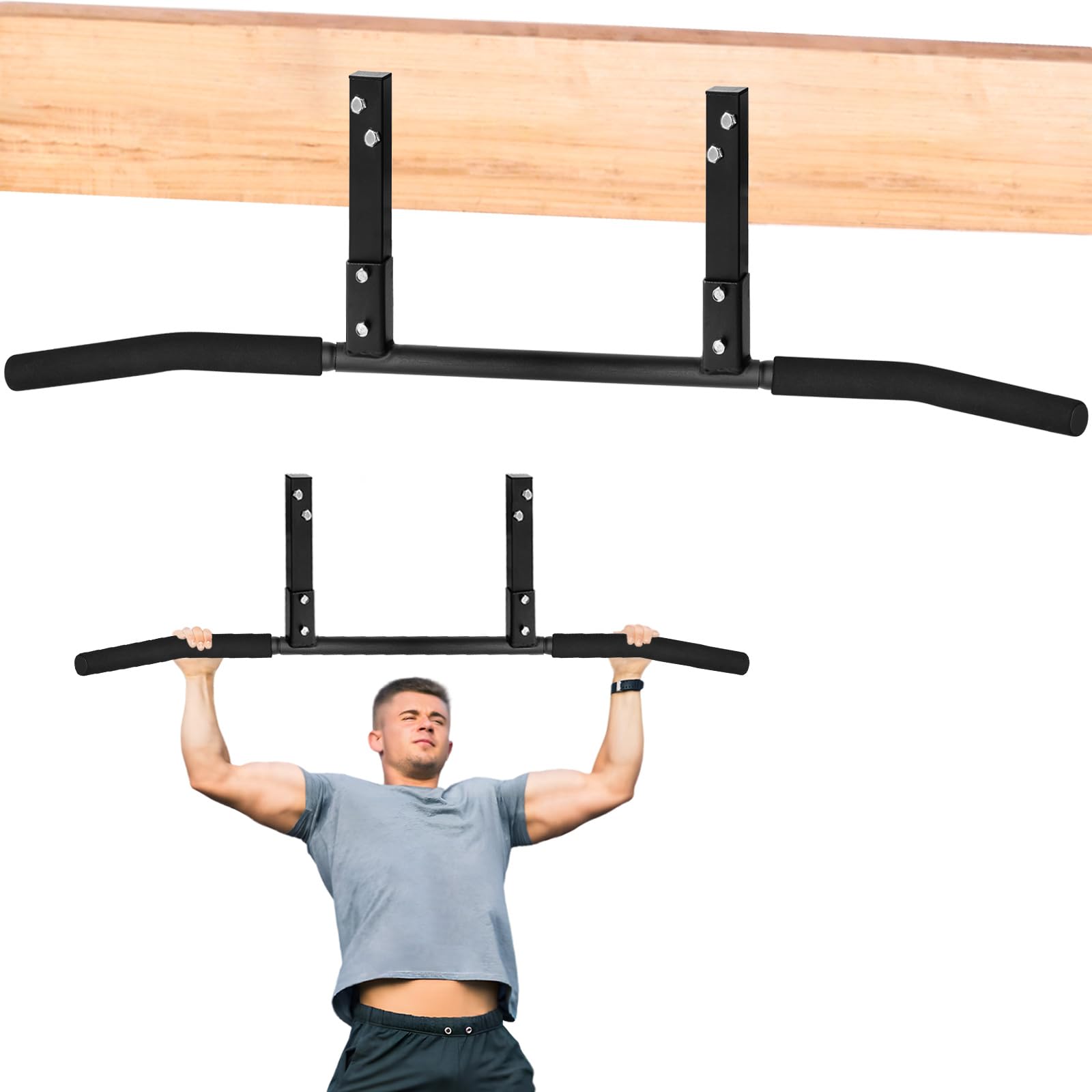
Light enough for one person to hang alone, at 2.31 kg of one-piece steel.
Where this one stands apart is weight — 2.31 kg against the 8.3 kg Kipika 32 inch bar, so it is the easiest of the group to raise overhead and line up solo. The one-piece heavy gauge steel frame is coated black to keep rust and corrosion at bay. A 40 inch wide bar with 12.5 inch grip spacing and 11 inches of hand grip distance gives you a straightforward overhand pull without fuss.
On capacity it tops out at 350 pounds, the lowest rating in this lineup. That is still a healthy number for a typical home user, and it comes with high density foam pads over the steel grips to spare your palms. The thickened, wear-resistant foam holds up through long sets without flattening. Full mounting hardware and instructions ship in the box, with pre-drilled holes that make the drill-and-bolt step quicker. The steel frame carries a lifetime warranty.
Build quality is the part that lands best, with the simple install close behind. Two honest notes: the bar thickness draws mixed feelings, and the fit does too, with some buyers finding the grip spacing not quite to their preference. Neither makes this a bad bar — it just means a taller or broader lifter may want the wider AmStaff instead. For a first ceiling bar in a spare room, it gets the job done at the entry level.
Why entry-level works here: 2.31 kg, pre-drilled holes and a full hardware kit mean it goes up fast and alone.
The limit to know: at 350 pounds it is the lightest-rated bar on this page, so a bigger lifter should step up.
Worth grabbing for: a first home bar, a spare room and a lighter trainee who wants minimal fuss.
Better elsewhere for: heavier users or anyone who prefers a thicker bar in the hands.
4. Kipika 32″ Ceiling Mounted Pull Up Bar

Four gears of height adjustment, so the bar fits the room instead of the other way round.
Height flexibility is the reason to look here. Four gears let you set the bar to your preference and ceiling height, and you can also change the angle of the bar to hit a different exercise. That is a step past the fixed-riser bars above. The mounting base is 2.2 inches wide, which suits studs from 2 inches up, and the holes sit 32 inches apart to take ceiling studs set at 16 or 32 inches. Wood screws and pull-pop screws for concrete both come in the kit.
You get two multifunctional hooks carrying suspension straps, training rope, yoga straps or a boxing bag. The bar itself holds up to 400 pounds, pulled down across a 39 inch width. A three-hole mounting plate adds stability, and two rubber grips keep your hands from slipping or blistering. Weight sits at 8.3 kg, a heavy frame compared to the 2.31 kg ATENTO, and it hangs 21.3 inches from the ceiling — the second-deepest drop in this group.
Build quality is the standout, with sturdiness close behind it. Installation draws mixed results — some find it straightforward, others more tedious. The mounting system is the piece to treat with care, because the bolt holes for the cross bar run on the large side. Thread them carefully and check the fit before you tighten everything down, and the 400 pound rating holds up. It is the most versatile hardware package in this lineup, and the extra bulk reflects that.
What Makes It Flexible
- Four gears of height adjustment plus a tilting bar angle
- Two hooks for bands, straps or a punching bag
- Three-hole mounting plate for a more stable hold
- Rubber grips resist slipping and blisters
The Trade-Offs
- Bolt holes at the cross bar run large, so fit needs patient checking
- 8.3 kg is a two-person lift at the ceiling
The fit for you: you want training variety — bands, a bag, different angles — from one mounting point.
Look past it if: you want the simplest possible bolt-up-and-go install.
5. Kipika 48″ Ceiling Mounted Pull Up Bar

A 50.2 inch span that turns a garage bay into a full pull-up station.
The clean win here is width — 50.2 inches against the 39 inch Kipika 32 inch model, giving your hands the most room to spread of anything on this page. Capacity matches the best at 500 pounds, so the wide bar takes a heavy load without bowing or wobbling. Height adjusts from 25.8 inches to 41 inches, letting you dial the drop to your space and pull through a full range of motion. An 8-hole base is what keeps it stable.
Steel pipes with a black electrophoretic coating shrug off rust and corrosion over years of use. The thick grip is contoured to cut blister pressure and hand fatigue across high-rep sets. At 9.25 kg it is the heaviest of the six, so plan on a helper for the ceiling lift. The mounting kit includes everything you need to fix it to a standard joist. The bar’s strength is the range of exercises it supports, not just its size.
The practical catch is the hardware. The advertised no-drill setup is not a literal one — you are still driving bolts into a joist. Treat the listed hardware as the fastener set rather than a tool-free install, and set aside a proper afternoon for it. Functionality and ease of install are the things owners lean on most favorably. With 4.5+ stars, it is the highest-rated bar here, though the Kipika 32 inch sibling has closer to double the buyer feedback behind it.
The width case: 50.2 inches of bar plus a 500 pound rating give you the biggest, strongest single mount in this lineup.
The real limit: 9.25 kg and a bolt-in joist install make this a two-person, plan-ahead job.
Reach for this if: you have a garage or open bay and want the widest bar with the top rating.
Pass it over if: your space is tight or you are installing without a second set of hands.
6. Ultimate Body Press Ceiling Mount Pull Up Bar

Engineered for the standard 8 foot ceiling, with a 48 inch bar to match.
This bar answers a specific problem — rooms with 8 foot ceilings. The 14 inch risers drop the straight 48 inch bar to a height that lets you pull with a full range of motion without your head meeting the ceiling. On capacity it carries 450 pounds, between the AmStaff at 400 and the top-rated 500 pound bars. The 48 inch on-center mounting plates span two 24 inch joists or three 16 inch joists, so it fits typical residential framing.
The build detail worth knowing is the through-bolt design on the risers. Jig-welded square tube steel legs are bolted through the bar rather than clamped, which kills the rotation you get under heavy power. The whole thing weighs 5.26 kg. An ideal anchor point, it also accepts optional ab straps and gymnastic rings if you want to expand into full bodyweight work. Complete hardware is in the box.
Through-bolted risers keep it from rotating under two people at once, and the pre-drilled plates speed the install. Buyers report a 220 pound user paired with a 140 pound partner with no movement at the plates. Stability, size and grip each draw mixed feedback, which mostly depends on which ceiling you are fitting it to. If your basement or garage has standard joists, this is the fit-first choice. If you have an unusual ceiling layout, measure before you commit.
Why It Fits Real Rooms
- 14 inch risers tuned for 8 foot ceilings
- 48 inch bar gives a full range of motion
- Through-bolted risers stop rotation under load
- Mounting plates span 16 or 24 inch joist spacing
Where It Asks More
- Stability, size and grip draw mixed opinions depending on the ceiling
- Rated at 450 pounds, below the 500 pound tops on this list
Made for you if: your ceiling is right around 8 feet and your joists run at standard spacing.
Weigh the alternative if: you need the very top capacity or a shorter riser for a low room.
Know the Specs
Weight Capacity
This is the maximum load the bar and its mounting supports are rated to carry. It covers your bodyweight plus the extra force of a pull-up or a swinging movement. Higher numbers, like the 500 pounds on the Ultimate Body Press joist bar and the Kipika 48 inch model, give you more margin if you add weight, bands or a bag. The lowest rating here, 350 pounds on the ATENTO, is still enough for most home users.
Riser Length
Risers are the short vertical legs that stand the bar down from the ceiling. Shorter risers, such as the 12 inch set on the AmStaff, keep the bar high and suit low rooms, but they cost you head clearance. Longer risers, like the 16 inch set on the Ultimate Body Press joist bar, drop the bar into easier reach and give your head room to clear the ceiling on every rep. Measure your room first, then pick the riser that fits.
Joist Spacing
Joists are the wooden beams running under a ceiling, and their on-center spacing is the gap from the middle of one to the middle of the next. Standard homes run at 16 inches or 24 inches. A bar’s mounting plates have to reach two joists to hold safely. The Ultimate Body Press 48 inch model spans either spacing, and the Kipika 32 inch bar spaces its holes 32 inches apart to fit studs at 16 or 32 inches. Check yours with a stud finder before you buy.
Grip Width and Handles
Bar width runs from 39 inches up to 50.2 inches across these six. Wider bars let your hands spread for wide-grip lat work, while a 42 inch bar with 5 inch parallel handles, like the AmStaff, lets you rotate to a palms-facing grip. Parallel handles keep your palms facing each other, which loads the lats with less shoulder strain than a straight overhand bar. Match the width and handle shape to the exercises you will actually repeat.
Common Questions
Will a ceiling mounted pull up bar fit my joists at 16 inches on center?
How much weight can a ceiling mounted pull up bar hold?
Do I need to find a stud before mounting one of these bars?
What is the difference between a joist mount and a ceiling mount pull up bar?
How low will the bar hang from my ceiling?
Can I hang a punching bag or resistance bands from these bars?
Which bar is best for a low ceiling or a tight garage?
Is a wider pull up bar better than a narrow one?
Do these bars come with the hardware I need to install them?
Can a pull up bar damage my ceiling or joists?
The Bottom Line
You want one bar that fits the most homes and holds the most buyers’ trust. That is the ceiling mounted pull up bar to beat: the AmStaff Fitness Joist Mount — a 42 inch bar with 5 inch parallel handles, a 400 pound rating and 4.5+ stars backed by the largest base of buyers on this list. Need the maximum load at 500 pounds and a longer 16 inch riser drop (the distance the bar hangs below the ceiling)? The Ultimate Body Press Ergonomic Joist Mount is the one. On a tight budget or buying your first bar? The lightweight 2.31 kg ATENTO gets you hanging without the extra heft. Check your joists, match your riser height, and any of these will feel rock solid overhead.
How we choose
We do not accept paid placement. Every pick is matched to a real buyer and a real use-case; we do not hands-on test units.
Sources
Specifications: manufacturer listings and product documentation. Review insights: verified customer reviews, as of November 2026. Pricing: not shown on this page (it changes often); check the current price via the retailer link.
As an Amazon Associate, My Heart Lives Here earns from qualifying purchases. This does not affect which products we feature.