Heads up: This post contains affiliate links. As an Amazon Associate I earn from qualifying purchases, at no extra cost to you. Learn more
Specs are compiled from manufacturer listings and verified buyer reviews and can change over time — please confirm the key details on the product page before buying.
Painting a banner is mostly a fight against streaks and stray bristles, because a single loose hair in wet paint means touching up a whole section of lettering. The fix is a brush whose width matches the flat area you need to cover and whose bristles hold together under thinned acrylic or heavy gesso. That is exactly what this shortlist covers.
This guide is built by comparing the manufacturers’ published specifications and the patterns across verified customer reviews, so you get each pick’s real strengths and trade-offs instead of marketing spin.
You will see which widths suit big background fills and which ones handle borders, lettering and touch-ups. Below are the best brushes for banner painting, sorted by width, bristle type and handle feel so you can choose without guesswork.
Top Picks


How To Choose The Best Brushes for Banner Painting
Banner work is not canvas painting, and it is not house trim either. You are usually working on a large flat panel that has to look consistent from a distance, often with thinned acrylic, gesso or varnish. Pick the wrong tool and you spend your evening chasing dry edges and fishing bristles out of wet paint.
Match the brush width to the area you are filling
A wide flat brush covers a lot of ground per stroke, so backgrounds and big colour blocks go faster. An 8 inch brush lays a broad band in one pass, which is why large banners get finished with far fewer overlaps. Narrow 1 inch brushes are the opposite job: edges, letter outlines, small touch-ups and the details a wide brush will smear.
Bristle type changes the finish more than the handle does
Flagged bristles (tips that split into tiny forks) spread paint more evenly and cut down visible lines between strokes. Foam brushes absorb paint and release it smoothly but blur fine edges, so they suit washes and varnish rather than crisp lettering. Soft nylon keeps its shape in wet paint and cleans up quickly with warm soapy water.
Look at the ferrule and the handle join
The ferrule is the metal sleeve that pins the bristles to the handle. Double-crimped aluminum ferrules hold the head together far longer than a single crimp. A sealed wood handle resists swelling when you wash it repeatedly, which is the point where cheap brushes usually start loosening at the join.
Side-by-Side Comparison
| Model | Best For | Brush Width | Bristle Type | Set Size | Amazon |
|---|---|---|---|---|---|
| GACDR 1 Inch Flat Paint Brushes★ Best Overall | Lettering and detail work | 1 inch | Flagged bristle | 12 pieces | Amazon |
| Pro Grade 3 Inch Flat Paint BrushBest for Edges | Trim, edges and medium fills | 3 inches | Flagged bristle | 2 pack | Amazon |
| U.S. Art Supply Foam Sponge SetBest Bulk Value | Washes, varnish and craft coverage | 1, 2, 3 and 4 inches | Foam round tip | 40 pieces | Amazon |
| Magimate 8 Inch Paddle Brush | Large background fills | 8 inches | Synthetic | 1 brush | Amazon |
| LAPXSNZD 4 Inch Flat Paint Brushes | Walls, boards and touch-ups | 4 inches | Flagged bristle | 4 pack | Amazon |
| Pro Grade 4 Inch Foam Brush Set | One-use varnish and glue passes | 4 inches | Poly foam | 24 pieces | Amazon |
| Dainayw Large Wash Brush Set | Mixed-size gesso and washes | Six sizes from 0.79 to 2.36 inches | Synthetic nylon | 6 pieces | Amazon |
| Liquitex Large Scale Broad Flat Brush | Pro-grade sweeping varnish coats | 8 inches | Flagged bristle | 1 brush | Amazon |
Detailed Reviews
1. 1 Inch Flat Paint Brushes
Our pick — 4.5+★ from 850+ verified ratings; the strongest balance of quality and price.
Twelve identical 1 inch flats, so one can die mid-project without stalling the job.
Banner lettering is where a cheap brush embarrasses you: a flag of bristle drags through a wet letter and the whole word needs redoing. This GACDR set attacks that problem from two directions. Each 1 inch flat head is locked into a double-crimped aluminum ferrule, meaning the metal sleeve is pressed twice around the bristles so the head cannot work loose. And you get twelve of them, so a worn brush is a swap rather than a shopping trip.
You get crisp outlines, borders and block lettering on a banner because the working width is 1 inch. Compare that with the 8 inch Magimate paddle below and you can see the split — that one lays a band of colour across a whole background in a pass, while this one puts the edge where you meant it. The flagged bristle tips (split ends that fan paint out) keep strokes from banding, and the birch wood handle stays straight and crack-free through repeated washing.
The catch you should know before buying: these are light-duty tools. Sixteen ounces covers the whole twelve-piece set, so each brush is a genuinely small instrument that suits acrylic, watercolour and craft paint. Load it with heavy oil-based exterior paint on a rough banner surface and you will be asking more of it than it was built for. Used as intended — acrylics, base coating, broad coverage and craft glue — owners consistently describe clean, streak-free strokes and bristles that stay in the ferrule.
What holds up under real banner use
- Double-crimped aluminum ferrules keep the 1 inch head locked to the handle instead of flapping loose mid-stroke.
- Twelve brushes in one set means a dedicated brush for each colour, so you are not rinsing between passes.
- Flagged bristles spread acrylic evenly, which is what keeps a flat background looking flat.
- Straight birch wood handles stay comfortable during long sessions on a big panel.
Where it asks you to be realistic
- At 1 inch it is a detail and outline tool — filling a large banner background with it takes many passes.
- Light build: it is happiest with acrylic, watercolour and craft media rather than thick exterior coatings.
- You have to clean and reshape it by hand right after use to keep the tip square.
This is your brush if: you are laying down lettering, borders and tight colour blocks and want a fresh head ready when one tires.
Pair it with a wide brush: the 1 inch head cannot cover broad areas efficiently, so buy a paddle-style brush alongside it for the background.
2. Pro Grade 3 Inch Flat Paint Brush
A 3 inch flat with a thick filament load, built to hold paint instead of dribbling it.
Two brushes in the pack, each 3 inches wide. That width is the practical middle ground on a banner: wide enough to run a border or a colour band without a dozen passes, narrow enough that you can still stop where the lettering starts. The bristles are a thick synthetic filament blend, which holds more paint per dip so you are reloading less often and getting fewer streaks where a stroke ended dry.
Where this brush actually earns its place is the tip. The ends are cut thinner than the body, so you get a finer contact point for trim lines and cabinet edges while the rest of the head still carries volume. Solid wood handles give you something to grip properly on a long horizontal banner where your wrist wants to drift. Owners judge it mainly on build and function, and DIY home-project painters are clearly the core audience.
Here is the honest part. Bristle retention is the split issue with this pair — some heads hold firm and some shed during use. That does not make it a bad brush; it makes it a brush you inspect and break in before you trust it on final lettering. Run a thumb through the bristles and give it a wash before the important stroke.
Where the value sits: a 3 inch flat with a thick filament load and a thinner tip, at a two-pack quantity — that combination is what makes edge work on a banner feel controlled instead of sloppy.
Give it a test pass: break the head in on scrap board first; the brushes that hold firm from the start are the ones to keep for the visible areas.
Reach for this if: you want a mid-width flat for borders, trim lines and medium colour fills across latex, oil or acrylic.
Look elsewhere if: you need guaranteed zero shedding on a single high-stakes pass — a pair of these wants a trial run first.
3. U.S. Art Supply Foam Sponge Paint Brush Set
Forty foam brushes in four widths, enough that you can throw one away without flinching.
This is the pack you buy when the banner job includes a wash coat, a varnish pass or a glue-down, and you do not want to spend the evening rescuing bristles. The count is the story: forty brushes total, split as 20 at 1 inch, 12 at 2 inch, 4 at 3 inch and 4 at 4 inch. That spread lets you pick the width that matches the band you are laying rather than forcing one brush to do everything.
Foam behaves differently from filament, and it matters for banners. The open foam cells trap paint and release it gradually, which cuts drips before they reach the surface — the exact failure that ruins a large flat panel. Bevel foam tips let you push into tight corners and feather an edge soft. Wood handles keep the whole thing light in the hand across a long horizontal run. Acrylics, stains, varnishes, polyurethanes and chalk all sit inside its range.
What it will not do is cut a crisp line. Foam blurs the boundary, so use it for fields, washes and coatings, and hand the sharp lettering over to a flagged bristle brush like the GACDR set. Treat these as semi-disposable and the maths works out well: a fresh brush for a new colour costs you nothing but a bin liner.
Buy this for: varnish coats, wash layers and craft coverage where drips are the enemy and you want a fresh brush per colour.
Know the limit: foam cannot give you a hard painted edge, so keep a bristle brush alongside for the lettering and borders.
4. 8 Inch Large Paint Brush
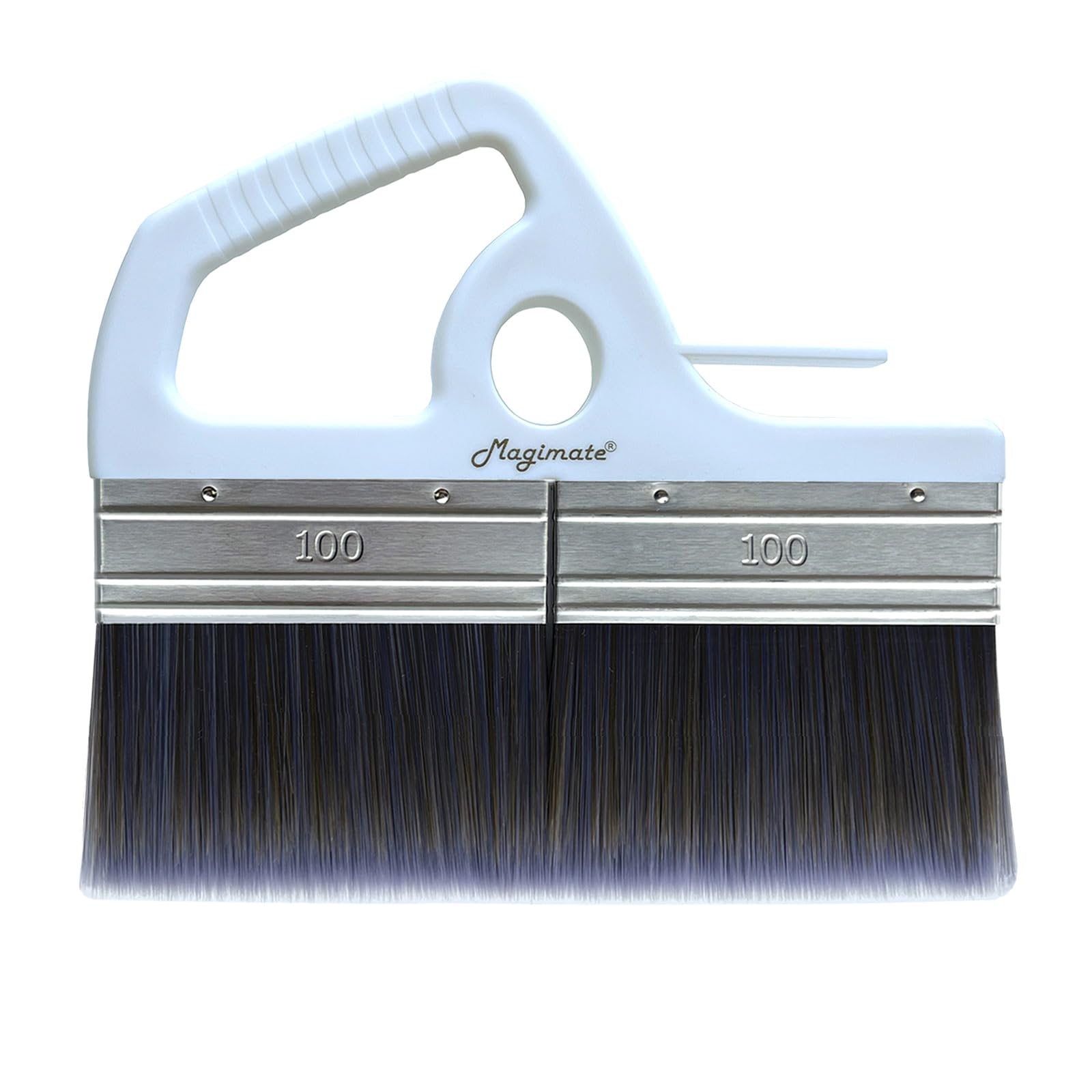
Eight inches of brush head turns a banner background from an ordeal into three or four sweeps.
The number that decides everything here is the width: 8 inches, or 200mm, across a double brush head. Put that next to the 1 inch GACDR flats in this list and the division of labour is obvious. One strokes a band of background colour wider than your hand; the other draws the letters on top of it.
The head uses a selected SRT blend filament, which the maker states sheds no bristles. In practice the feel is smooth and even, which is what you want when you are coating gesso or wallpaper paste over a large flat panel and cannot afford a scratchy, uneven first pass. The fluted plastic handle gives your fingers a place to sit. It works across all paints, plus furniture and fence work if the banner job is only part of your weekend.
The trade-offs are real and worth naming. An 8 inch head full of paint has weight to it, and the handle ergonomics divide opinion — some find it easy to run, some find it hard to hold steady across a long horizontal stroke. Bristle shedding is the other split issue. Give it a firm wash before the first coat and work with your arm, not your wrist.
Why the width wins: covering a wide banner in 8 inch passes means fewer overlaps, and fewer overlaps means fewer visible seams once it dries.
Grip it properly: the fluted handle rewards a firm palm grip; a light fingertip hold makes an 8 inch head wander.
This one is for: filling large banner backgrounds, priming with gesso, and paste or varnish coats where speed matters more than precision.
Keep a narrow brush nearby: an 8 inch head has no business near a letter edge — that is the 1 inch set’s job.
5. 4 inch Flat Paint Brushes, Professional Paint Tools

Four 4 inch flats with a lightweight plastic handle — a working width you can reload fast.
Four brushes, all 4 inches wide. That single size across a four-pack is useful on a banner because it means every brush in the set behaves the same, so you learn one stroke and repeat it. The heads are flagged bristle, which fans paint out at the tip and keeps a flat field looking flat rather than striped.
The build is honest about what it is: natural fill anchored with epoxy resin inside a lightweight plastic handle. Epoxy resin at the ferrule is the part that matters, because that is what keeps the head attached when paint works its way down. Buyers report the 4 inch heads cover both large areas and small touch-ups, and that they wash out easily enough to reuse.
Bristle durability is the conversation around this set — some heads hold together well, some lose bristles during use. Get ahead of it by washing the head thoroughly before the first coat on your banner. Once past that first wash, the 4 inch width is a sensible middle option between the 3 inch Pro Grade and the 8 inch Magimate paddle above.
What makes it easy to work with
- Four identical 4 inch flats means consistent strokes and a spare ready when one head tires.
- Epoxy resin at the ferrule holds the natural fill in place under wet paint.
- Lightweight plastic handle keeps your arm fresh across a wide horizontal run.
- Flagged bristles lay an even band of colour for medium-size fills and bands.
What to plan around
- Bristle retention varies head to head, so give each brush a wash-and-comb before the visible coats.
- Plastic handles feel less premium in the hand than solid wood.
- One width only — no narrow option for lettering inside the pack.
Good fit when: you want a repeatable 4 inch stroke for bands, panels and touch-up work, and you like having spares on the bench.
Not your set if: you need a range of widths in one purchase — this pack is deliberately single-size.
6. Pro Grade Foam Brushes 4 Inch

Twenty-four 4 inch foam heads at 6.72 ounces for the whole box — the throwaway coat brush.
Here is a number worth sitting with: the entire 24-piece set weighs 6.72 ounces. Compare that to the 16 ounces of the GACDR twelve-pack and you can feel the difference in the hand before you even open the box. These are feather-light tools built around a simple idea — use one, work it hard, bin it, move on.
What they are for is specific: touch-ups, crafts, staining, varnish and glue, plus trim, mouldings and small interior or exterior areas. On a banner that translates to a varnish seal coat or a glue-down edge, where you want an even release of product without dragging a brush through solvent afterwards. Poly foam over a wooden handle, sized at 4 inches wide, twenty-four to a pack.
Set your expectation correctly on longevity. These are described by the maker as disposable for fast cleanup, and owners treat them that way — they work well for the job in front of you, but they are not a brush you refinish and keep. Buy the box for the messy passes and keep your real brushes for the visible artwork.
The weight argument: 6.72 ounces for twenty-four brushes means a whole banner’s worth of coating passes without ever stopping to clean a head.
Not a keeper brush: plan on one job per head and the value lands exactly where it should.
Pick the box if: your banner needs varnish, glue or stain passes and you would rather not spend the evening washing brushes.
Skip the foam for detail: a 4 inch foam head softens every edge, so lettering needs filament instead.
7. Artist Flat Paint Brush Set

Six flat widths from 0.79 to 2.36 inches, aimed squarely at gesso and wash coats.
Most sets in this list give you one width repeated. This one gives you six different ones — 2.36, 1.97, 1.57, 1.18, 0.98 and 0.79 inches — which is genuinely useful on a banner that mixes a broad gesso ground with tighter colour passes. The whole set weighs 1.6 ounces, so it is a light, fine-handling kit rather than a heavyweight workhorse.
The soft nylon bristles are stated to return to their original shape during use, so the flat stays flat instead of splaying into a mop mid-session. Compared with the 8 inch Magimate paddle above, this set trades raw width for control: you get a 2.36 inch maximum instead of 8 inches, but you also get the smaller sizes that a paddle simply cannot offer. Oil, watercolour and acrylic are all within its stated range.
The thing to go in knowing is that this set’s reputation is mixed on longevity, with the bristle assembly reported to detach from the handle in some cases. Inspect the join on each brush before you load it with paint, and keep the widest head for gesso where a loose head is annoying rather than ruinous. Owners rate the range of uses highly, especially varnishing paintings and glazing.
Choose this set for: gesso grounds, varnish and glazing across a variety of widths without buying six separate brushes.
Check the joins first: the handles are the weak point, so give each one a tug before it goes near wet paint.
8. Liquitex Large Scale Broad Flat/Varnish Brush, 8″

An 8 inch broad flat built for sweeping a whole banner width in one continuous gesture.
Same 8 inch width as the Magimate paddle in this list, but a different animal underneath. This is a brush designed for dragging, figuring and varnishing large surfaces and walls, with broad gestural strokes as its whole reason to exist. If your banner work involves long unbroken sweeps of colour or varnish rather than short choppy passes, this is the head that makes those strokes feel controlled.
The build details are where the difference shows. Sustainable nylon and synthetic bristles that retain their shape, a rustproof stainless steel ferrule at the join instead of a plated one, and non-slip ergonomic handles. A rustproof ferrule matters on a wet banner job because repeated washing is what kills cheap brushes at the sleeve. The short handle keeps the weight closer to your hand. Every physical spec here is aimed at the same thing: keeping the head working for many sessions rather than one.
Where it divides people is the finish of the bristles themselves. Some find the stiffness too rough for delicate work, and shedding opinions split. The 8 inch head also has real heft compared to the 1.6 ounce Dainayw set, so budget your arm accordingly.
Built for the long sweep
- 8 inch broad flat covers a large banner surface in a single continuous pass.
- Rustproof stainless steel ferrule survives repeated washings without corroding at the join.
- Non-slip ergonomic short handle keeps an 8.16 ounce brush steady in the hand.
- Synthetic bristles retain their shape instead of splaying out into a mop.
Its natural boundary
- Bristle stiffness feels rough to anyone expecting a soft, delicate touch.
- Shedding reports are mixed, so break the head in on a scrap surface first.
- An 8 inch head is the wrong tool for small lettering and tight borders.
Worth it for: professional and serious hobby banner work where broad varnish or colour sweeps need to look unbroken.
Look to the 1 inch flats instead if: your work is mostly lettering — this brush wants big open surfaces.
Know the Specs
Brush width in inches
This is the measurement across the flat edge of the head, and it decides how much ground one stroke covers. An 8 inch head lays a wide band, which is why large background fills go quickly. A 1 inch head is narrow enough to trace a border or a letter edge without spilling over. On a banner you usually want both: a wide brush for the field and a narrow one for the detail on top of it.
Bristle type and flagged tips
You avoid a striped-looking flat colour because flagged bristles have split tips that fan paint out and soften the line where one stroke meets the next. Synthetic nylon holds its shape in wet paint and rinses clean. Foam works differently: it traps paint in its cells and releases it slowly, which reduces drips but blurs any hard edge. Match the material to if you need a crisp line or a smooth coat.
Ferrule construction
The ferrule is the metal band that pins the bristles to the handle. Double-crimped aluminum means the band is pressed twice around the head, so the bristles cannot work loose as easily. Stainless steel resists rust, which matters when a brush gets washed after every session. A weak ferrule is the single most common reason a brush starts shedding halfway through a job.
Handle material and weight
Your brush stays straight after washing because sealed wood handles resist swelling. Plastic handles keep a brush light — the plastic-handled 4 inch flats here feel noticeably lighter than a wood-handled paddle. Total item weight tells you what you are holding: a 24-piece foam set at 6.72 ounces is featherweight, while an 8 inch varnish brush at 8.16 ounces has real heft that your arm will notice over a long horizontal run.
Common Questions
What width brush should I use to paint a large banner background?
Are foam brushes or bristle brushes better for banner painting?
How do I stop bristles shedding into wet paint on a banner?
Can I use acrylic craft brushes on thick exterior banner paint?
Do I need a different brush for lettering than for the background?
How should I clean and store a banner brush between sessions?
Is a 3 inch flat brush or a 4 inch flat brush better for banner borders?
How long should a banner painting brush last?
Will a wood handle or a plastic handle be more comfortable on a long banner?
The Bottom Line
For most banner painting, the brushes for banner painting winner is the GACDR 1 Inch Flat Paint Brush set because twelve double-crimped flagged heads give you clean, streak-free strokes on lettering and borders without a mid-project panic. It also carries the strongest owner record on this list, at 4.5+ stars across 800+ reviews. If filling a large background is your main task, reach for the Magimate 8 Inch Paddle Brush and its 8 inch head. And for a varnish or gesso pass you would rather not clean up afterwards, the Pro Grade 4 Inch Foam Set with its 24 heads is the one to keep in the box.
How we choose
We do not accept paid placement. Every pick is matched to a real buyer and a real use-case; we do not hands-on test units.
Sources
Specifications: manufacturer listings and product documentation. Review insights: verified customer reviews, as of November 2026. Pricing: not shown on this page (it changes often); check the current price via the retailer link.
As an Amazon Associate, My Heart Lives Here earns from qualifying purchases. This does not affect which products we feature.