Heads up: This post contains affiliate links. As an Amazon Associate I earn from qualifying purchases, at no extra cost to you. Learn more
Specs are compiled from manufacturer listings and verified buyer reviews and can change over time — please confirm the key details on the product page before buying.
A bag that lets in moisture or a lid that lets in pantry moths undoes months of work — and a weak seal is the most common reason stored rice goes stale or flour turns buggy. This guide covers seven airtight options, from heavy Mylar bags to wide-mouth glass jars and food-grade buckets, so you can match the container to what you’re storing and where you’re keeping it.
This guide is built by comparing the manufacturers’ published specifications and the patterns across verified customer reviews, so you get each pick’s real strengths and trade-offs instead of marketing spin.
You’ll see what each container actually holds, how the closure works, and where the honest limits sit.
Top Picks

How To Choose The Best Airtight Containers for Long Term Food Storage
The first decision is the material, because it sets everything else. Mylar bags are sealed around the food and blocked from light; rigid containers — jars and buckets — stay open and openable, which suits food you dip into week after week.
Mylar thickness in mil, explained plainly
A mil is one-thousandth of an inch of film thickness, and it is the number that tells you how much abuse a bag survives. Bags sold at 5 mil per side carry an aluminum layer that blocks light and resists punctures, so rice and beans don’t get chewed through in a bucket or bin. Thinner gauges still work for dry pantry goods you rotate fast, but they are the ones that tear at the seam when you slide a full bag across a shelf.
Why oxygen absorbers change the bag you pick
An oxygen absorber is a small packet that pulls oxygen out of the sealed space — but only oxygen, which is roughly 21% of air. The bag will not shrink like a vacuum-sealed one. Plan on about a fifth of the air volume dropping away while the rest stays; that is normal, not a failed seal.
Where rigid containers still win
Glass jars and food-grade buckets earn their shelf space when the food comes in and out — pasta, cereal, kibble, sugar. A latch jar with a silicone ring or a bucket with a threaded screw lid re-seals every time you open it, which a heat-sealed Mylar bag cannot do. For grains and flour you scoop from daily, pick the rigid container; for the sealed-and-forgotten stockpile, pick the Mylar.
Side-by-Side Comparison
| Model | Best For | Capacity | Closure | Material | Amazon |
|---|---|---|---|---|---|
| Wallaby 1-Quart Gusset Mylar Bags (50-Pack)★ Best Overall | Small portions and single-serve dry goods | 1 liter | Zipper | Mylar, BPA free | Amazon |
| PackFreshUSA Quart Mylar Bags with Absorbers (100-Pack)Complete Kit | Complete starter kit for quart-size storage | 2 pounds | Heat sealable | Mylar, BPA free | Amazon |
| Vittles Vault Airtight Pet Food Container | Bulk kibble and daily scooping | 25 pounds | Twist lock | HDPE plastic, BPA free | Amazon |
| Wallaby 1-Gallon Open Top Mylar Bags (50-Pack) | Freeze-dried meals and pantry bulk | 1 gallon | Heat sealable | Mylar, BPA free | Amazon |
| House Naturals 5 Gallon Food Grade Buckets (3-Pack) | Large grain and bulk staples | 5 gallons | Screw-on lid | HDPE plastic, BPA free | Amazon |
| VITEVER 92oz Glass Jars with Airtight Lid (3-Pack) | Spaghetti and pantry display | 92 oz | Latch | Glass, lead free | Amazon |
| ShieldPro 5-Gallon Mylar Bags with Absorbers (10-Pack) | Deep stockpile in large batches | 5 gallons | Heat seal | Aluminum Mylar | Amazon |
Detailed Reviews
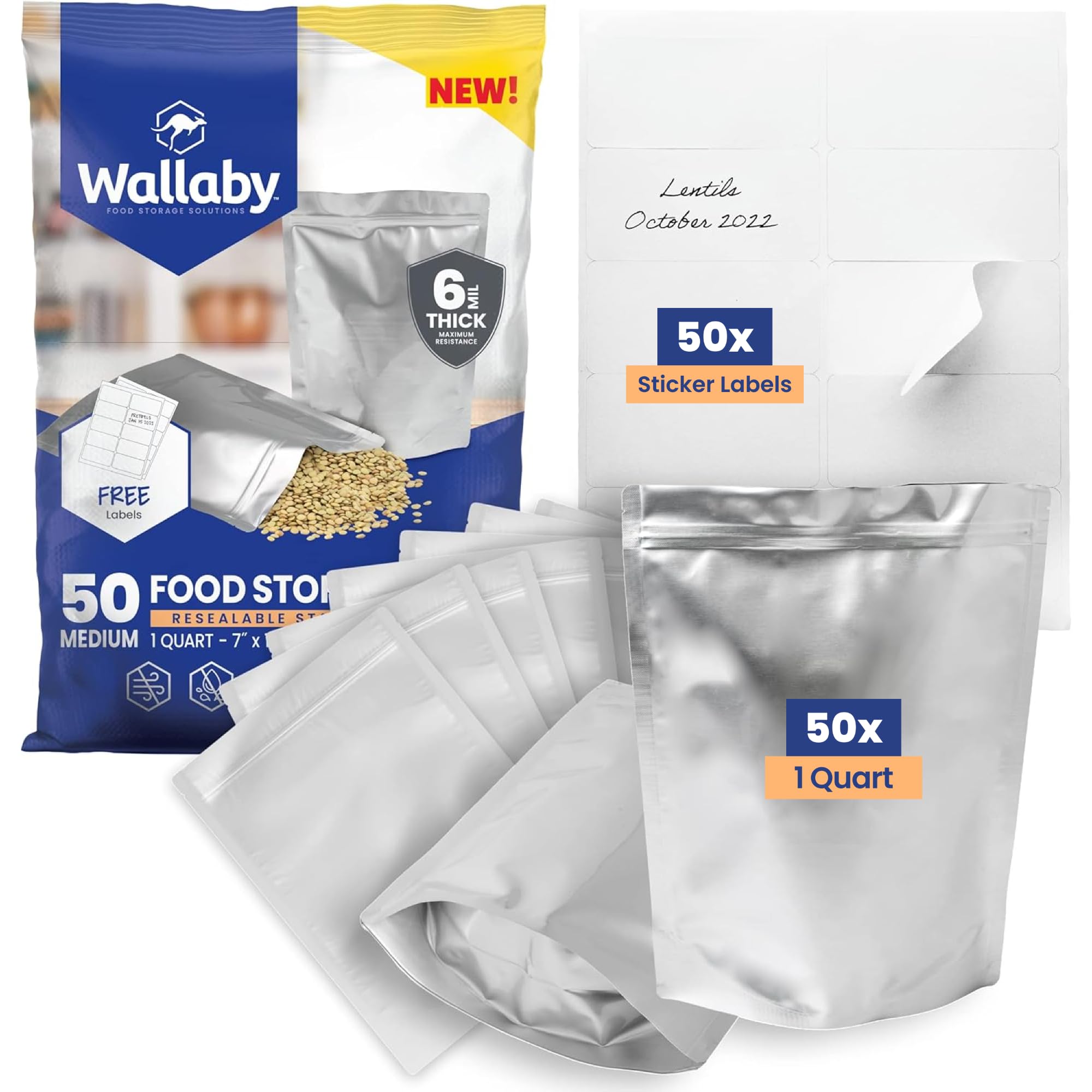
1. Wallaby 1-Quart Gusset Mylar Bags 50-Pack
Our pick — 4.5+★ from 850+ verified ratings; the strongest balance of quality and price.
The small-portion bag that stands up on its own while you fill it
This is the pick for anyone packing tea, instant coffee, or single freeze-dried meals into portions they’ll open one at a time. Each bag holds 1 liter and measures 15″W x 12″H, and the gusseted bottom lets it sit flat on the counter without a helper holding it open. A zipper closure means you can reseal a bag you’ve opened, which heat-sealed bags can’t do.
The construction is the real reason it takes the top spot. Wallaby builds in an added internal layer of aluminum for puncture resistance, and the film is rated at 6 Mil on each side — enough to keep light and air from working through while the bag sits in a bin for months. The film is BPA-free and food-grade, the minimum you want in contact with dry food. All 50 bags and 50 sticker labels come in the bundle, so you can date and label as you pack.
The honest catch is that you buy absorbers separately — Wallaby recommends 200-300cc — and the seal is a zipper rather than a fused heat seal, so a bag you plan to bury for a decade is better served by a heat-sealable bag. Also expect the bag to stay loose after absorbing: oxygen is only about 21% of air, so roughly a fifth of the volume disappears and the rest remains.
What earns it the top slot
- Gusseted base holds the bag upright while you fill and seal it
- Aluminum internal layer adds puncture resistance against other stored items
- Zipper lets you reopen and reseal a portion you’re working through
- 50 bags plus 50 labels in one bundle, sized at 1 liter each
Where it asks more of you
- Oxygen absorbers are sold separately at 200-300cc
- Zipper closure is not a fused heat seal for decade-long burial
- Bag does not shrink tight after absorbing — four-fifths of the air stays
Reach for this if: you portion dry goods into small, reopenable units and want the bag to stand up on its own during packing.
Look elsewhere if: you need a permanent heat-sealed seal for stock you won’t touch for years.
2. PackFreshUSA Quart Mylar Bags 100-Pack
Everything in one box so you’re not hunting for absorbers mid-pack
Where the Wallaby quart set leaves absorbers to you, this one arrives complete: 100 quart bags at 8″W x 12″H, 100 oxygen absorbers at 300cc in 10-packs, and a long-term storage guide. That pairing is the whole point of the kit — you open the box, fill, drop an absorber, and seal without a second order.
The film is built for rough handling. PackFreshUSA rates the film at 70 psi burst strength — the maker likens it to 2 1/2 cinder blocks per square inch — and rounds the corners so a full bag doesn’t jab its neighbor. Three layers with a thick foil laminate layer give it a low oxygen transmission rate, the measure of how fast oxygen creeps through the film. PackFreshUSA claims 25-plus years of protection once the bags are heat-sealed as directed.
Sealing is flexible — a vacuum sealer, an iron, or a hair-straightening iron all work, so you don’t need dedicated equipment. The trade-off is that every bag must be heat-sealed to get that protection; the kit has no zipper for reopening, so portion sizes need to be right the first time. Treat the 300cc absorber as matched to the quart bag and don’t stretch it to larger bags.
Why the kit lands: 100 bags and 100 absorbers arrive together with a storage guide, so the matching work is already done and you’re not guessing at absorber size.
What to plan around: heat sealing is mandatory here — the bags have no zipper, so a bag you open is a bag you finish.
The buyer this suits: a first-time packer who wants the correct bag-and-absorber pairing handed over in one purchase.
The buyer it doesn’t: anyone who wants to dip in and out of a container — this one is sealed for the long haul.
3. Vittles Vault Airtight Pet Food Storage Container

The 25-pound vault that turns a ripped kibble bag into a sealed, scoopable bin
If kibble lives in a torn bag on the garage floor, this is the fix. The Vittles Vault holds 25 pounds, equals 25 liters, and stands 12″L x 12″W x 13.25″H — a square footprint that tucks against a wall. Capacity is measured on the shape and density of kibble, and the maker advises rounding up to the next size when you’re between bag sizes.
What wins people over is the lid. Gamma Seal Technology uses a threaded locking system with double gaskets, so you twist it on and off rather than prying a lid, and the controlled moisture balance keeps food dry between scoops. The body is food-grade, BPA-free HDPE plastic, and it’s made in the USA. It works for cat food, goat feed, and bird seed too, though only the 40lb and 60lb versions stack.
One handling note that matters over years: the maker recommends storing it in climate-controlled spaces even though the vault is fine indoors or outdoors. So a shaded garage shelf works; a baking-hot shed door doesn’t. And while the airtight claim is for dry food, this is a scoop-and-close container — not a substitute for a heat-sealed Mylar bag when the goal is a sealed, untouched stockpile.
The standout: the threaded double-gasket lid is the differentiator — it seals on every twist without force, which is why it holds up to daily feeding duty.
The real limit: it needs a climate-controlled spot and it’s designed for dry kibble, so it isn’t a moisture-proof vault for anything wet or perishable.
Worth it for: households feeding pets from a 25-pound bag who want one twist-on lid between the food and the pests.
Better elsewhere: if your storage spot gets hot or damp, or you need a fused seal rather than a rescrewable lid.
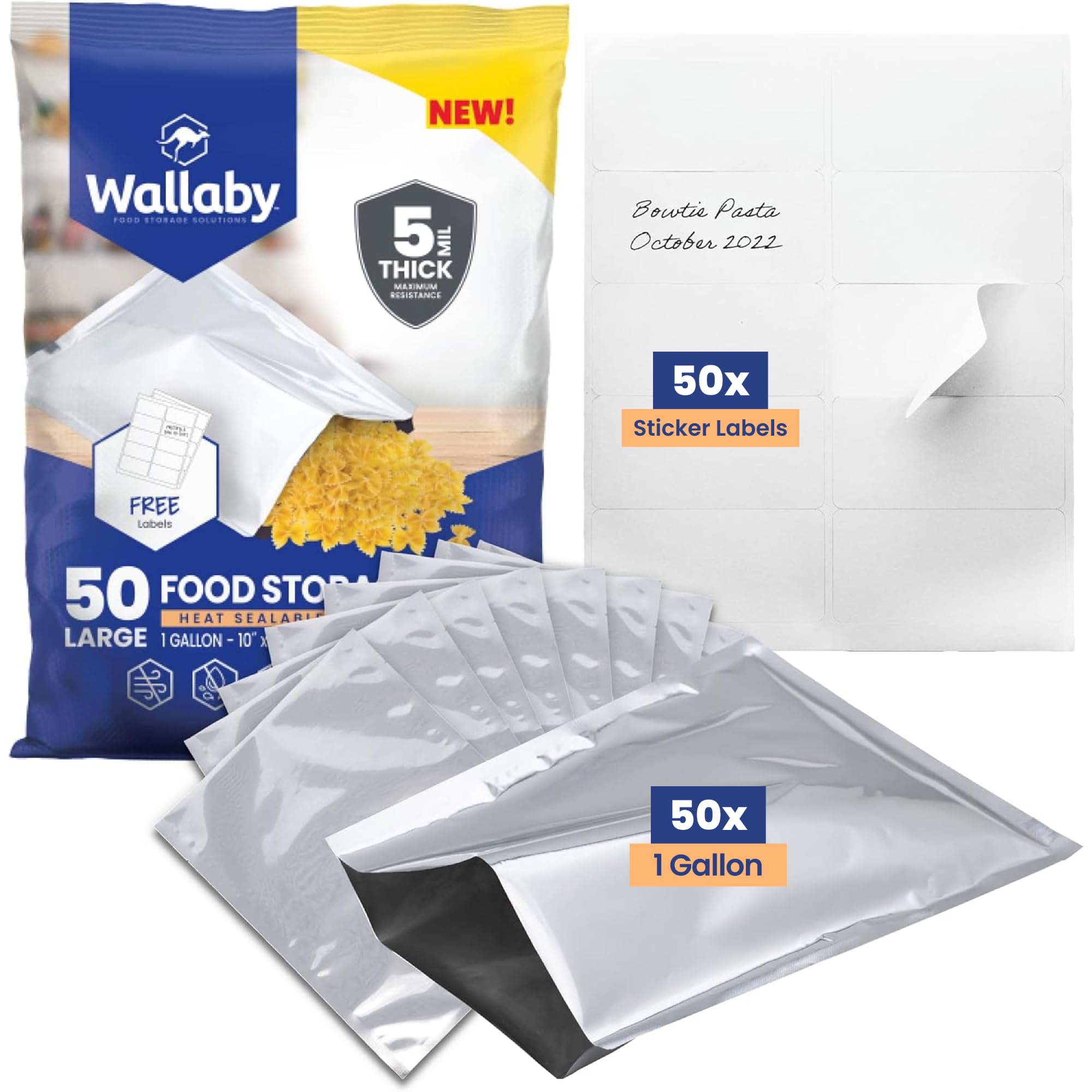
4. Wallaby 1-Gallon Open Top Mylar Bags 50-Pack
A gallon of room for rice, beans, and pasta in one heat-sealed bag
Scale up from the quart and you can pack a real meal base: the 1-gallon bag handles freeze-dried meals, rice, beans, and pasta, and the package carries a load capacity of 8.6 pounds. Each bag is 15″W x 12″H with a 5 Mil thickness per side, plus the same aluminum internal layer Wallaby uses across its line to resist punctures and block light.
The jump from quart to gallon changes what you can pack: a full meal base instead of a single portion. The gallon holds 1 gallon against the quart’s 1 liter, and it’s also far lighter per unit — the gallon bag weighs 18.14 g against the quart’s 200 g — mostly a reflection of how each is bundled and packed.
Quality is what people talk about with this bag, and it’s the thing to weigh against the sealing question. Some find the film hard to seal cleanly, so a proper heat sealer with a consistent bar gives you a cleaner result than a household iron. Absorbers are separate again, and Wallaby calls for 400cc here — double the quart’s recommendation, which makes sense given the larger headspace.
Reasons the gallon earns its place
- Holds 8.6 pounds of load — enough for a full batch of beans or rice
- 5 Mil per side plus aluminum layer blocks light and resists tears
- 50 sticker labels let you date and identify every bag
- Bigger bag pairs with the 400cc absorber Wallaby recommends
What you’ll have to handle
- Sealing takes care — a weak iron pass leaves a gap that lets air in
- Oxygen absorbers aren’t included at 400cc
- Bag won’t pull tight like a vacuum bag after absorbing
Pick this when: your stored food comes in meal-sized batches and you want one bag per batch with a label already in hand.
Think twice if: you only have a household iron — a dedicated heat sealer gives a far more reliable seal on this thicker film.
5. House Naturals 5 Gallon Food Grade Buckets 3-Pack

Three 5-gallon buckets that hold a whole grain harvest and screw shut
Five gallons is a serious amount of food, and this three-pack gives you three of them in aqua, blue, and gray so you can color-code what’s inside. Each bucket is 12″L x 12″W x 14.75″H, made from food-grade BPA-free HDPE plastic, and built in the USA. The lids screw on and off easily, which is the point — you’re not fighting a pry-off lid every time you want a cup of grain.
Where this beats a rigid bin is the sheer volume — 5 gallons per bucket against the Wallaby gallon bag’s 1 gallon, so one bucket covers what five bags would. That ratio matters when you buy oats or wheat in bulk and want one container instead of a wall of bags. The maker lists it for food storage as well as fermentation, cleaning, water, and wash duty, so the bucket has a second life once the pantry is cleared.
The honest limit is that a screw lid is airtight by threading and gasket, not fused like Mylar. For flour, grains, and dry goods you’ll use, that’s plenty. For a sealed stash you don’t intend to touch for years, you’d want a Mylar liner inside the bucket so the food gets both barriers. Also note the buckets are round, which costs shelf area compared with a square bin.
Where it shines: the combination of 5 gallons per bucket, three buckets, and easy screw lids turns bulk grain buying into a manageable pantry job.
The trade-off to know: a screw lid seals by gasket rather than fusion, so long-term sealed storage is better served by adding a Mylar liner inside.
Best matched to: anyone buying oats, wheat, or rice in sacks and needing a big, reopenable, easy-to-clean home for it.
Not the one for: a sealed and forgotten stockpile where you’ll never reopen the container.
6. VITEVER 92oz Glass Jars with Airtight Lid (3-Pack)

Tall enough for spaghetti, pretty enough to leave on the counter
Spaghetti is the reason these exist. Each jar stands 30cm high and holds 92oz, sized taller than some 26cm jars so full-length pasta drops in upright, and the square body lines up neatly side by side on a shelf. The 4.5″L x 4.5″W footprint is small for the volume, so three jars claim little counter space while holding a great deal.
The seal is the decision-maker: a trigger latch presses a thick glass lid with a silicone ring down for an airtight, leakproof close. It takes little force to work, and it keeps moths and moisture away from what’s inside. All the glass is high-quality, food-grade, lead-free, and thick-bodied, which is where the durability comes from — thick glass resists chips better than thin. The wide mouth is deep enough to reach a hand to the bottom or drop in a scoop.
What owners love is how they look doing the job — these get left out on display, not hidden in a cupboard. The recurring gripe is glass thickness in the opposite direction: heavy glass handles storage well but is glass, so it wants careful handling and a spot away from the counter edge. The jars are versatile enough for pickling, flour, cereal, coffee, and dog treats, though they’re a display-and-dip container, not a multi-year sealed vault.
The grab: 92oz of clear, thick glass with a one-finger latch and a silicone gasket — that’s an airtight pantry jar you don’t mind showing off.
The honest note: thick glass is sturdy until it isn’t; a hard knock can crack a jar, so store them where they won’t get tumbled.
Right for: kitchens where pasta and cereal should stay fresh and look good doing it on an open shelf.
Wrong for: deep storage in a hard-used garage or a spot with cramped, drop-prone shelving.
7. ShieldPro 5-Gallon Mylar Bags 10-Pack

Ten 5-gallon bags built for the food you won’t touch for a decade
This is the largest Mylar option here and the one made for a real stockpile. Each bag holds up to 35 pounds of food at 5 gallons, and the set is 10 Mil total — 5 Mil per side — of genuine Mylar film that the maker says is the only genuine Mylar used by an Amazon manufacturer. Each bag ships with absorbers adding 2000cc of absorption, either as one 2000cc pack or four 500cc packs.
The barrier claim is the standout: ShieldPro claims its oxygen and moisture barrier outperforms the best poly vacuum bag by 100 times. Whether or not you take that number at face value, the material matters — the film is aluminum-based and BPA- and PFAS-free. Heat sealing is how you activate the protection, and the bags are built specifically for long-term storage. The 5-gallon bags also mean one bag handles a full 35-pound sack of grain rather than many smaller ones.
The real caution is in the finish. Some units have arrived with holes in the bag, so inspect each one against a light before you pack it — a pinhole defeats the whole barrier and is the one defect that matters here. Weight is 3.1 pounds for the pack, which makes bulk shipping to yourself easy, but the bag itself is not puncture-proof against sharp food edges, so check seams and corners as you fill.
What the deep-storage set delivers
- 35 pounds of food per 5-gallon bag — a whole sack in one seal
- 2000cc of absorber per bag included, ready to use
- Genuine Mylar aluminum film, BPA- and PFAS-free
- Heat sealable for a barrier the maker rates far above a poly vacuum bag
The checks you should run
- Occasionally a bag arrives with a hole — inspect before packing
- Heat sealing requires a sealer; a weak seal wastes a 5-gallon bag and its absorber
- Sharp food edges can puncture the film if you’re not careful loading
Go with this for: a long-term stash of grain or rice bought by the sack, where one sealed 35-pound bag per crop makes sense.
Pass if: you haven’t got a heat sealer or you’re storing small weekly portions rather than bulk sacks.
Know the Specs
Mylar thickness measured in mil
One mil is a thousandth of an inch of film. Bags here list per-side thickness — 5 Mil per side on the gallon Wallaby and ShieldPro bags, 6 Mil per side on the quart Wallaby — because the film is laminated in layers. The aluminum layer inside blocks light, and the total thickness determines how well the bag resists punctures and tears. A thicker bag is slower to damage but still not a suit of armor; seams and corners are where wear starts.
Oxygen absorbers measured in cc
A cc is a cubic centimeter of absorption capacity, and it’s how absorber packs are sized to a bag. The quart PackFreshUSA kit includes 300cc absorbers, the Wallaby gallon calls for 400cc, and ShieldPro’s 5-gallon bags ship with 2000cc. Absorbers pull oxygen only — not the full volume of air — so a sealed bag still looks loose, with about a fifth of the volume gone. Match the absorber to the bag size; undersizing leaves oxygen behind.
Load capacity in pounds
Load capacity tells you how much food weight the container handles. The gallon Wallaby bag lists 8.6 pounds, the ShieldPro 5-gallon bag lists 35 pounds, and the VITEVER jar set lists 5.8 pounds. These are useful limits, not targets — pack to the food you actually use, and leave a little headspace on Mylar so the absorber can work.
Closures: heat seal vs. latch vs. screw lid
A heat seal fuses the bag shut and is the most airtight of the options, which is why Mylar bags use it. A latch with a silicone ring, like the VITEVER jars, presses a lid down and reseals every time. A threaded screw lid on the House Naturals buckets and the Gamma Seal on the Vittles Vault seal by gasket and thread torque. Pick the closure by how often you open the container: heat seal for set-and-forget, latch or screw for daily scooping.
Common Questions
Will Mylar bags work for storing flour and rice for a year or more?
Do I need oxygen absorbers, and what size should I use?
Will the Mylar bag shrink tight like a vacuum bag?
Can I reuse a Mylar bag after opening it?
What’s the difference between the Vittles Vault and a glass or Mylar container for dry goods?
Are the 5-gallon buckets airtight enough for grain storage?
How much food does a 5-gallon Mylar bag actually hold?
Can glass jars hold pasta long enough for storage, or should I use Mylar?
What should I check before packing food into a Mylar bag?
The Bottom Line
For a pantry that packs and reopens in small portions, the Wallaby 1-Quart Gusset Mylar Bags are the strongest all-rounder — a zipper that reseals, an aluminum layer against punctures, and 50 bags with 50 labels in the bundle. If you’d rather have the absorber pairing handed to you, the PackFreshUSA quart kit includes 100 bags and 100 absorbers with a guide. And when the stash runs to sacks of grain, the ShieldPro 5-gallon bags give you 35 pounds of food per seal, absorbers included. Match the container to how often you open it and where you’ll keep it — these three cover small portions, complete kits, and bulk sacks.
How we choose
We do not accept paid placement. Every pick is matched to a real buyer and a real use-case; we do not hands-on test units.
Sources
Specifications: manufacturer listings and product documentation. Review insights: verified customer reviews, as of November 2026. Pricing: not shown on this page (it changes often); check the current price via the retailer link.
As an Amazon Associate, My Heart Lives Here earns from qualifying purchases. This does not affect which products we feature.