Heads up: This post contains affiliate links. As an Amazon Associate I earn from qualifying purchases, at no extra cost to you. Learn more
Specs are compiled from manufacturer listings and verified buyer reviews and can change over time — please confirm the key details on the product page before buying.
The hardest part of buying battery cable isn’t finding it — it’s figuring out whether the wire is actually the gauge printed on the jacket. Thin copper-clad aluminum sold as “4 gauge” will heat up, sag voltage, and leave you guessing why your winch or inverter keeps cutting out. What you want instead is a cable that matches your amperage draw, arrives with the lugs already sealed, and bends without fighting you through a battery compartment. That’s the filter used here, and it narrows a messy shelf down to seven picks worth your time.
This guide is built by comparing the manufacturers’ published specifications and the patterns across verified customer reviews, so you get each pick’s real strengths and trade-offs instead of marketing spin.
Heat is the tell. A cable that runs cool under load is doing its job; one that warms up is undersized or aluminum inside. Below you’ll find the gauge, lug size, and conductor material that separate a cable you fit once from one you replace twice, all in one honest look at battery cables.
Top Picks


How To Choose The Best Battery Cables
Start with the load, not the length. A cable only has to do one job: carry the current your starter, winch, or inverter pulls without getting hot. Everything else — lug shape, jacket colour, how neatly it coils — is secondary to that.
Match the gauge to the amps you’ll actually draw
Gauge is a wire’s thickness, and the lower the number the fatter the wire. A 4 AWG cable is thinner than a 2 AWG, which is thinner again than a 1/0. The fatter the conductor, the more current it can pass before resistance turns into heat. If you’re running a big inverter or a winch, you want headroom here.
Pure copper versus copper-clad aluminum
Copper-clad aluminum (CCA) has an aluminum core with a thin copper skin. It’s lighter, cheaper, and perfectly fine for shorter runs and lighter loads. Pure copper carries more current for the same gauge and resists corrosion better over the long run. On a heavy winch or a long inverter run, pure copper is the safer bet.
Check the lug size before you buy
The lug is the metal ring that bolts to your battery post or terminal. Get the hole size wrong and you’re either drilling it out or sending it back. Common sizes are 5/16 in and 3/8 in, and matching that to your post takes ten seconds now and saves a return later.
Length is resistance
Every extra foot of cable adds resistance and drops a little voltage. Buy the shortest run that reaches cleanly — not the longest “just in case.” A 25 ft pair run across a trunk will lose more voltage than a 5 ft pair in the same spot.
Side-by-Side Comparison
| Model | Best For | Gauge | Conductor | Length / Lugs | Amazon |
|---|---|---|---|---|---|
| TUELETFU 4 AWG 5FT★ Best Overall | Everyday inverter & solar runs | 4 AWG | Pure copper | 5 ft, 3/8 in lugs | Amazon |
| A ABIGAIL 2 AWG 2FTMost Compact | Tight battery-to-battery links | 2 AWG | Pure copper | 2 ft, 5/16 in lugs | Amazon |
| GEARit 4 Gauge 25FT | Long amp & power/ground runs | 4 AWG | CCA | 25 ft each, no lugs | Amazon |
| A ABIGAIL 4 AWG 6FT | Jump starts & dual-battery setups | 4 AWG | Pure copper | 6 ft, 3/8 in lugs | Amazon |
| Ruikarhop 1/0 Gauge 40FT | Big winch & truck power runs | 1/0 AWG | CCA | 40 ft, lugs + heat shrink | Amazon |
| iGreely 2 AWG 10FT | Marine & outdoor pure-copper work | 2 AWG | Pure copper | 10 ft, 10 lugs + heat shrink | Amazon |
| WindyNation 2 AWG 10FT | Heavy-duty dual-battery installs | 2 AWG | Pure copper | 10 ft, 10 lugs + heat shrink | Amazon |
Detailed Reviews
1. TUELETFU 4 AWG Battery Cable, 5FT, 3/8 in Lugs
Our pick — 4.5+★ from 850+ verified ratings; the strongest balance of quality and price.
The do-it-once pick: tinned copper 3/8 in lugs, heat-shrink-sealed ends, and 5 ft per cable to reach most inverters without slack.
This is a 4 AWG pair — one red, one black, 5 feet each — with a tinned copper lug at both ends of both cables. Those lugs are 3/8 inch rings, which bolt straight to most battery posts and inverter terminals without drilling. The tinning is the detail that matters over time: it’s a thin coating that keeps the copper from greening out in damp engine bays or a boat bilge.
Every lug end comes sealed in heat-shrink tubing. That’s a shrink-to-fit sleeve that already covers the crimp joint, so there’s no exposed bare wire to corrode and no need to buy a roll of tubing separately. That pre-sealed crimp means no bare copper to corrode and no separate tubing to buy.
Where this earns its keep is the middle ground: power inverter runs, solar collection, golf-cart lithium upgrades, car audio amplifier feeds. For inverter, solar, and amplifier feeds, the pure-copper conductor and pre-sealed lugs justify the price. The honest catch is stiffness — a fair number of users find these cables on the stiff side, which makes tight routing through a firewall or a packed battery box more of a wrestling match than a gentle bend.
What’s sealed in the bag
- Tinned copper lugs resist corrosion in damp, salty, or road-splashed bays
- Both ends pre-shrunk, so no bare crimp to wrap yourself
- 5 ft reaches most inverter and solar installs without extra slack
- Works across automotive, marine, RV, and motorcycle use
Where it asks patience
- Stiffer than flexible welding cable, so tight-bend routing takes effort
- 4 AWG is the limit — a heavy winch needs a fatter conductor
Fits best: an inverter, solar panel, or golf-cart upgrade where you want the lugs already done and the 3/8 in rings match your posts.
Think twice if: your run needs a sharp bend through a firewall — you’ll fight the stiffness.
2. A ABIGAIL 2 AWG Battery Cable, 2FT, 5/16 in Lugs
Two feet of fat copper for the short, high-draw hop between batteries.
Short runs are where a fat conductor pays off. This is 2 AWG (a thicker wire than 4 AWG) rated for a maximum current of 176 A, and it’s cut at 2 feet per cable. That’s the ideal length for linking two batteries together or bridging a battery to a nearby inverter or disconnect — short enough to keep resistance low, long enough to reach.
Compare it to the 4 AWG 6FT pick above: that one is thinner and longer, built for reaching across a bay. This one is fatter and shorter, built for a tight, direct connection. If your two terminals sit close together and you’re moving serious amps, the thicker 2 AWG is the one that stays cool.
The lugs here are 5/16 inch rings, so check that against your posts — a 5/16 in hole is smaller than the 3/8 in lugs on several picks in this list. The conductor is pure copper with tinned lugs, and the PVC jacket is described as flexible, waterproof, and flame retardant, with heat-shrink sealing the ends. Buyers praise the crimped ends and heavy-duty build; the recurring complaint is the 5/16 in lug hole, so measure your stud first.
What carries the day: proper crimped ends and heavy-duty build — this feels like a cable rated for the current stamped on it, and 176 A is real headroom for a battery-to-battery bridge.
The thing to check first: those 5/16 in lugs. They fit many posts but not every inverter or marine terminal, so verify your stud size before you commit.
Reach for this if: you’re joining two batteries or bridging a short gap and want the thickest conductor that still fits the space.
Look elsewhere if: your terminals use 3/8 in studs — the 5/16 in rings here won’t slip over them.
3. GEARit Battery Cable, 4 Gauge, 25FT Each Black/Red

Twenty-five feet of each colour for the jobs that span a trunk, a trailer, or a full solar array.
Most cables on this list are cut short and finished with lugs. This one hands you two long 25 ft reels — one red, one black — and lets you measure, cut, and terminate to fit. That’s the right tool when the run is long: an amplifier in the trunk, a distribution panel across a workshop, or a solar feed that has to travel.
The conductor is copper-clad aluminum (CCA), meaning an aluminum core under a copper skin. It bends more easily than solid copper and costs less, which is exactly why it’s offered in this length. It’s fine for appropriate 4 gauge work where pure copper isn’t required — but it’s not the pick for a max-draw winch that’ll live at the edge of the gauge’s limit.
Its 186 fine strands are why it snakes easily through panels and amp racks, though the CCA core limits it to moderate loads. Note what isn’t in the bag: no lugs and no terminals, so you’ll buy those separately or reuse what you have. For a long custom run where you want to cut your own length, this is the practical choice.
Why the length sells it
- 25 ft red plus 25 ft black covers long amp, inverter, and solar runs
- 186 fine strands make it easy to snake through tight panels and racks
- Colour-coded red/black keeps power and ground runs easy to trace
- Cut-to-length freedom for a custom install
What you’ll add yourself
- No lugs or heat shrink included — budget for those separately
- CCA conductor, not pure copper, so it’s not the pick for extreme-draw use
Built for: the long, custom run where you need to cut your own length and terminate at the end.
Not for: anyone who wants lugs in the box or needs pure copper for a maximum-load circuit.
4. A ABIGAIL 4 AWG Battery Cable, 6FT, 3/8 in Lugs
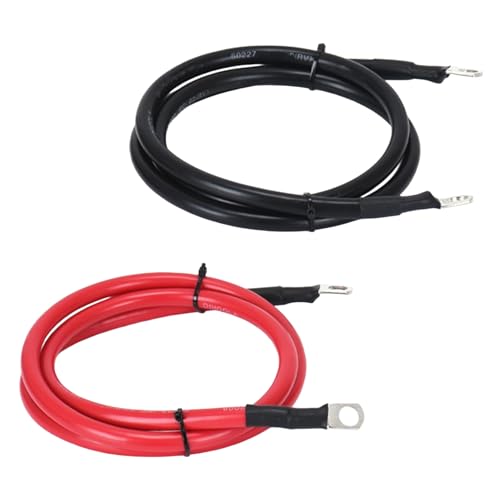
A pure-copper 4 AWG pair with a little extra reach and 3/8 in rings that fit most posts.
Take the 5 ft TUELETFU pick from position one, add a foot of length, and you land here. It’s the same 4 AWG pure copper construction with tinned 3/8 inch lugs and heat-shrink-sealed ends, cut at 6 feet per cable. That extra foot is what lets it reach between batteries in a dual-battery setup or jump a dead one without stretching taut.
What makes this cable feel substantial is the weight: 0.97 kg for the pair, slightly heavier than the 4 AWG 5FT pick at 0.9 kg — the extra length and copper account for the difference. Heavier here is good; it means more metal carrying the current. It works for battery-to-battery linking, jump-starting, and inverter feeds across automotive, marine, RV, and golf-cart duty.
The recurring nitpick is length and lug size — a few buyers find the 6 ft run either a touch long or the 3/8 in rings not quite matching a particular terminal. Nothing defective, just a fit question. Measure your gap and your stud size and this becomes a clean, dependable buy for a mid-length pure-copper job.
The strength that shows: it functions exactly as promised — solid connections, no heat drama, tinned ends that hold up. The 0.97 kg of copper speaks for itself once you’re moving amps through it.
Measure before you order: 6 ft is generous for a short hop, so confirm your gap first. If your terminals need 5/16 in, look at the compact 2 AWG pick instead.
Go here if: you want pure copper and 3/8 in lugs with a bit more length for a dual-battery or jump-start layout.
Skip the extra foot if: your terminals sit close — the shorter 5 ft TUELETFU pair is the tighter fit.
5. Ruikarhop 1/0 Gauge Battery Cable, 40FT, Lugs & Heat Shrink

The heavy hauler: 1/0 gauge, 250 A rated, forty feet of red-and-black for the truck build.
This is the fattest wire here. It’s 1/0 gauge (also written 0 gauge), which is dramatically thicker than the 4 AWG picks, and it’s rated to a maximum current of 250 A — the highest amp rating in this list. Compare it to the 2 AWG compact pick’s 176 A: this one is built to move far more current, which is exactly what a truck winch, a big inverter, or a full solar bank demands.
You get 20 ft red plus 20 ft black — 40 ft total — along with matching lug terminals and 3:1 heat-shrink tubing, so it’s a complete kit with nothing extra to buy for the connection. The PVC jacket is described as rugged and impact-resistant with clear red/black polarity marking. The conductor is CCA, not pure copper, which is how a cable this long and this fat stays within reach.
Two honest notes. First, CCA is more economical but won’t carry quite what the same gauge in pure copper would, so run it within its stated 250 A. Second, a few buyers find 1/0 overkill for lighter jobs like a golf cart — this is a cable sized for heavy trucks and relocating an RV battery bank, and it’s happiest in that weight class. For that role it’s excellent value, offering a lot of cable for the outlay.
Where the heft pays off
- 1/0 gauge rated to 250 A — top current capacity in this lineup
- Complete kit: 40 ft of cable plus lugs and 3:1 heat shrink
- Rugged impact-resistant PVC jacket with clear polarity colours
- Ideal for winch, truck, and RV battery-bank relocation runs
The trade-offs up front
- CCA conductor, not pure copper — stay within the 250 A rating
- Serious overkill for a golf cart or a light-duty circuit
Match made for: a winch, truck power feed, or RV battery relocation where 1/0 gauge and 250 A give you real headroom.
Overkill for: a small golf cart or a light circuit — you’d be paying for copper you can’t use.
6. iGreely 2 AWG Welding Battery Cable

Welding-grade copper that coils like rope instead of fighting you like rebar.
The number that defines this cable is 1070 — as in 1070 fine strands of 0.2 mm copper, an ultra-fine stranding that makes it drape and bend where stiffer battery cable resists. That flexibility is a real advantage in a boat, a marine bay, or any tight compartment where a fat conductor has to turn a corner. It’s 2 AWG, rated to 205 A, and cut 10 ft red plus 10 ft black.
Pure copper is the conductor, wrapped in a tough EPDM jacket described as solvent-resistant, so it stands up to an engine environment better than a basic PVC sheath. The kit includes 5pcs of 5/16 in lugs and 5pcs of 3/8 in lugs — both stud sizes, so you’re covered whichever your posts use — plus red and black heat-shrink tubing. The lugs are tinned pure copper with a closed-end design, suitable for crimping or soldering, and rated for outdoor and marine use.
The 1070-strand pure copper and solvent-resistant EPDM jacket suit a careful marine or outdoor install that has to bend around tight corners. The one caveat is depth of track record — this is a newer listing, so it hasn’t piled up the long history some picks here have. If you want the flexiest pure-copper cable in this list, this is it.
The flex story: 1070 strands of 0.2 mm copper in a solvent-resistant EPDM jacket — this bends and re-straightens rather than kinking, which matters in a cramped engine bay.
The kit you actually get: both 5/16 in and 3/8 in tinned copper lugs plus red and black heat shrink in the bag, so you’re not ordering terminals separately.
The one to grab if: flexibility and pure copper matter more than length — a marine or outdoor install that needs to bend cleanly around a tight corner.
Consider the bigger players if: you want a long-proven track record and slightly more length for the money.
7. WindyNation 2 AWG Battery Cable, 10FT, 10 Lugs & Heat Shrink
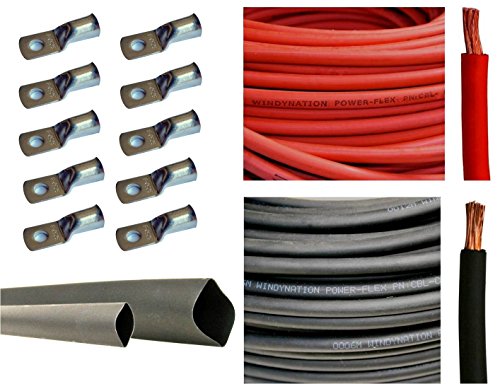
The full-install kit: annealed pure copper, ten lugs, and heat shrink in one box.
If you’re doing a dual-battery install and don’t want to buy lugs, tubing, and cable in three separate orders, this is built for you. The 13-piece kit is 10 ft red plus 10 ft black of 2 AWG pure copper, ten tinned copper lugs with a closed-end design, and 3 feet of black heat-shrink tubing. The conductor is fully annealed — a heat treatment that softens the copper so it bends without hardening or cracking at the bend.
The lugs are tinned for corrosion protection and closed-end to keep moisture, acid, and solvents away from the wire end, which is why they suit outdoor and marine work. The heat shrink is rated to 600 volts and holds up across a wide temperature range, so it seals the joint and stays sealed. Cable, lugs, and 600 V heat shrink are matched, so the install is one afternoon instead of three store runs.
Buyers rate the annealed copper and tinned lugs highly, but this is the most expensive route in the list once you count the ten lugs and heat shrink. For a single small connection that’s more kit than you need. For a real dual-battery project where you want every part matched and ready, it saves the back-and-forth of sourcing each piece separately.
Why the kit earns its place: annealed pure copper plus ten tinned lugs plus 600 V heat shrink — everything matched, everything in one box, so the install is a single afternoon rather than three store runs.
Where it’s more than some need: this is the premium, all-in route. On a single small link, the 5 ft pure-copper pick above gets you connected for less.
Made for: a full dual-battery or marine install where you want pure annealed copper and every terminal and sleeve in the same box.
Not the pick if: you only need one short connection — the kit is more than a single link requires.
Know the Specs
AWG gauge and what the number means
AWG stands for American Wire Gauge, the standard sizing system for electrical wire, and the number runs backwards from intuition: lower numbers mean thicker wire. So a 2 AWG is fatter than a 4 AWG, and a 1/0 (also written 0 gauge) is fatter still. Thicker wire carries more current with less resistance, which means less heat and less voltage drop over a run. If your load is heavy — a winch, a big inverter — you want to be at the fatter end of this list.
Pure copper versus CCA
CCA stands for copper-clad aluminum: an aluminum core wrapped in a thin copper skin. It’s lighter and more economical, and it’s fine for shorter runs and moderate loads where the wire is comfortably sized. Pure copper conducts better for the same gauge and resists corrosion more durably, which is why marine and heavy-duty installs lean toward it. The trade is straightforward — CCA saves on cost and weight, pure copper gives you more current-carrying metal per foot.
Lug size: 5/16 in versus 3/8 in
The lug is the metal ring that bolts your cable to a battery post, terminal, or bus bar, and the hole size has to match the stud. A 5/16 inch hole is smaller than a 3/8 inch hole, and the two are not interchangeable without drilling. Check the stud you’re bolting to before ordering. Some kits, like the iGreely pick, include both sizes so you’re covered either way.
Length, resistance, and voltage drop
Every foot of cable adds a little resistance, and resistance costs you voltage across a long run. That’s why the shortest cable that reaches cleanly is usually the best: a 2 ft link between two batteries loses less than a 25 ft run across a trunk. Buy for your actual distance rather than extra slack you’ll coil up and never use.
Common Questions
What gauge battery cable do I need for a winch?
Will 3/8 inch lugs fit my battery posts?
Is copper-clad aluminum cable as good as pure copper?
How do I keep battery cable ends from corroding?
Can I use welding cable for a battery cable?
Is a longer battery cable worse than a shorter one?
What is a 1/0 gauge cable and why is it thicker?
Do these cables come with lugs and heat shrink included?
Can I use one battery cable for both positive and negative?
The Bottom Line
For most people the battery cables answer is the TUELETFU 4 AWG 5FT pair — pure copper, tinned 3/8 in lugs, both ends pre-sealed, and a length that reaches most inverters, solar setups, and golf-cart upgrades without leaving slack coiled in a corner. If your terminals sit close together and you want a fatter conductor, the compact A ABIGAIL 2 AWG 2FT nails the short high-draw bridge at 176 Amps. And when the job is a truck winch or a full RV battery bank, reach for the Ruikarhop 1/0 gauge kit with its 250 Amp rating and complete lugs-plus-shrink bundle.
How we choose
We do not accept paid placement. Every pick is matched to a real buyer and a real use-case; we do not hands-on test units.
Sources
Specifications: manufacturer listings and product documentation. Review insights: verified customer reviews, as of November 2026. Pricing: not shown on this page (it changes often); check the current price via the retailer link.
As an Amazon Associate, My Heart Lives Here earns from qualifying purchases. This does not affect which products we feature.