Heads up: This post contains affiliate links. As an Amazon Associate I earn from qualifying purchases, at no extra cost to you. Learn more
Specs are compiled from manufacturer listings and verified buyer reviews and can change over time — please confirm the key details on the product page before buying.
You want the bees gone from the siding, the porch beam, or the garden wall — and you want it done without paying someone in a van to do what a squeeze of dust can do. The short answer: pick a powder that stays put in the crack, keeps killing long after you walk away, and comes with an EPA registration, because anything that kills bees is a pesticide and the label is the rulebook. Below are four bee killer powders buyers actually bring home, ranked and explained in plain English.
This guide is built by comparing the manufacturers’ published specifications and the patterns across verified customer reviews, so you get each pick’s real strengths and trade-offs instead of marketing spin.
Not every dust works on the same insects, and the label decides which one fits your nest. This walkthrough covers how each powder is applied, how long it lingers, and which surfaces it tolerates so you can choose the right one for the best bee killer powder job.
Top Picks
How To Choose The Best Bee Killer Powder
A bee problem is almost never on a flat, open surface. It lives in a gap — under a fascia board, behind a shutter, inside a wall void, in a hole in the garden soil. That is why the delivery method matters as much as the poison itself, and why the four powders here are judged first on where they can go and how long they stay there.
Match the powder to the bee and the place
Carpenter bees, ground bees, wasps and hornets are different targets, and no single label covers every one in every state. Read the target-species list on the bag before you buy. Then read the use-site list: a powder labeled for crack and crevice treatment inside a home is a different tool from a powder labeled for garden and plant use. If your nest is inside a wall, you need a dust that flows into a void, not a liquid that drips back out.
Residual time tells you how many treatments you face
Residual means how long the powder keeps working once it is down. One powder here is labeled for up to 8 months when left undisturbed. Another is labeled for up to 6 months. A longer residual matters most in a wall void or under siding you do not want to open again, and least on a garden bed you water weekly. Longer usually means a stronger active ingredient, so weigh that against where you plan to put it.
The active ingredient and the EPA registration
Two of these powders use synthetic pyrethroid actives — cyfluthrin and deltamethrin — which are the long-residual insecticides. One uses silica particles and plant oils, which is a different approach entirely. Every one of these products carries an EPA registration, which means the label is legally binding: the approved sites, the approved insects, and the approved application method are all listed on it. Buy the label you can actually follow, and check the state restrictions before you order, because some of these powders are not sold in every state.
Side-by-Side Comparison
| Model | Best For | Active Ingredient | Residual (Labeled) | Unit Count | Amazon |
|---|---|---|---|---|---|
| Atticus Tirade 1% Dust★ Best Overall | Whole-property bee and wasp control | Cyfluthrin | Lasting residual | 20 Ounce | Amazon |
| Dr. Killigan’s Dust to Dust | Garden and plant-side use | Silica and plant oils | Up to 6 months | 10 Oz | Amazon |
| Delta Dust with Puffer Duster | Long-term wall void treatment | Deltamethrin | Up to 8 months | 1 LB | Amazon |
| Delta Dust + JT Eaton Duster | Hard-to-reach crevice work | Delta Dust | — | 16 Ounce | Amazon |
Detailed Reviews
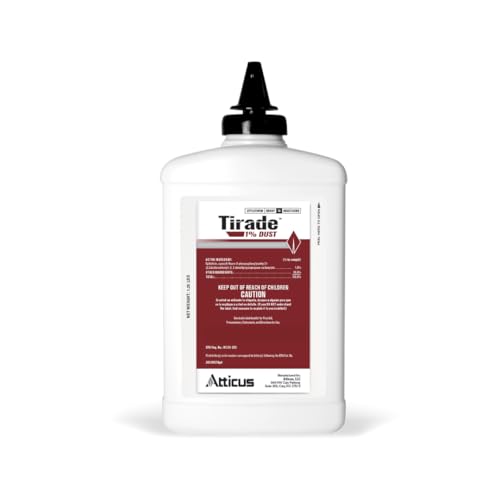
1. Atticus Tirade 1% Dust Insecticide
Our pick — 4.5+★ from 1,000+ verified ratings; the strongest balance of quality and price.
The broadest hitter here — one bottle, 20 ounces, and a kill list over 50 insects long.
Start with the number that decides the whole job: this bottle holds 20 ounces of powder. That is the largest fill on this list by a clear margin. The Delta Dust with the puffer duster comes in at 1 LB, so you are pouring out noticeably more powder per can with the Tirade. For anyone treating siding, a porch beam, and a garden wall in the same afternoon, that extra volume means fewer stops to refill.
The active ingredient is cyfluthrin at 1%, the same class of synthetic pyrethroid as the leading brand’s dust. It is labeled for flying, crawling, and wood-infesting insects — wasps, bees, ants, roaches, and spiders among the 50-plus named. Where this one separates itself from the Delta Dust bottles is the use-site list. The label allows kitchens, living areas, pet kennels, outside barrier treatment, upholstery for bed bugs, and ant mounds for fire ants. In plain terms, it travels from the garden to the guest room without you buying a second product.
Applying it is a matter of no measuring and no mixing. The powder comes ready to use and is meant for cracks, crevices, and hard-to-reach gaps. It is listed low-odor and non-staining, so an application under a kitchen cabinet does not announce itself. The catch worth knowing up front: this powder is not sold in Alaska, California, Hawaii, Puerto Rico, or Vermont. Check that before you plan the weekend around it. What wins buyers over is that it works: effectiveness comes up again and again in reviews, and several note it costs far less than hiring a professional.
Where it pulls ahead
- 20-ounce bottle carries more powder than the 1 LB Delta Dust cans
- Cyfluthrin at 1% covers flying, crawling and wood-infesting pests
- Label spans indoor kitchens and pet kennels plus outdoor barrier work
- Ready to use, low-odor and non-staining
The fine print you should read
- Not available for sale in five states and Puerto Rico
- Requires reading and following the label before any application
Reach for this if: you want one dust that handles bees on the siding and ants at the mound without a second bottle.
Check your state first: the label restrictions rule it out for buyers in those five states.
2. Dr. Killigan’s 10 Oz Powder Insect Killer

The plant-oil powder you can put on a tomato stem — with a real honesty caveat attached.
If your bees are in the garden rather than the wall, this is the only one of the four built for that spot. The formula is silica particles plus essential oil technology, not a synthetic pyrethroid, and the label allows direct application on plant stems and under leaves. For a homeowner who wants something to dust along the greenhouse bench, that is a genuinely different tool from the Delta Dust bottles.
Application flexibility is the second reason to consider it. You can use it dry as a dust, or mix one part powder with eight parts water and spray it through a trigger sprayer. The residual is labeled up to 6 months from a single application, which is shorter than the 8 months on the Delta Dust but still long enough to cover a full bug season. The maker also claims kill times up to 50% faster than diatomaceous earth and lime-based powders — a manufacturer’s claim, not an independent measurement.
Here is the catch, and it is a big one for bee work. The silica-and-oil approach is not the fast knockdown that cyfluthrin and deltamethrin deliver, and the feedback on effectiveness is genuinely split, which is why this lands at 4.0+ rather than higher. Families and pet owners tend to love the safety story and the pleasant smell, and those are the strongest positives. But if your goal is a carpenter bee hole in a fascia board that must be closed out fast, this is the wrong pick. It suits the gardener who wants a plant-side product, not the homeowner fighting an established nest.
Where it earns its place: the only one of the four labeled for direct application on plant stems and under leaves, and the only one that goes down dry or mixed into a spray. Buyers who want their dust to be people-friendly and pet-friendly reach for it for exactly those reasons.
What you give up: the effectiveness story is not clean — the results divide people, and the science here works slower than the pyrethroid powders. Treat it as a garden product, and set expectations accordingly.
Suits the gardener: plant-side bees, greenhouse benches, and households that weigh non-toxic handling heavily.
Look past it if: you need a fast knockdown on an established nest in wood or a wall void.
3. 1 LB Delta Dust Pest Insecticide w/Puffer Bellow Hand Duster

Eight months of kill from one application — the wall-void specialist with its own duster.
The number that matters here is 8. Delta Dust is labeled for up to 8 months of residual when left undisturbed, which is the longest stated duration of any powder on this list — the Dr. Killigan’s bottle claims up to 6. The active is deltamethrin, a synthetic pyrethroid aimed squarely at crawling insects. Deltamethrin is an established long-residual ingredient, and it is what the dry barrier sits on when you treat a crawlspace and forget about it.
The powder itself is described as odorless and non-staining, and the label says it does not clump or absorb moisture — both of which matter in a damp wall cavity. The kit arrives as a 1-pound bottle plus a puffer bellow hand duster, and the duster is the piece that changes how the job goes. You fill it no more than halfway, up to two-thirds at most, so there is air space for the dust to form a cloud you can aim into a hole or a seam. The instructions are specific about squeezing gently and pulling the duster away before you release it, so it does not suck lint or moisture back through the nozzle. A clogged tip unscrews and the rod clears it.
What wins buyers over is effectiveness — the most-discussed point in reviews — with reviewers repeatedly noting how quickly the problem resolves once the dust goes down. The honest parts are about the kit rather than the chemistry. A little dust goes a long way, which is good, but several describe the powder going everywhere during application, and some report the puffer bellows breaking. The value question also splits: some call it good for the money and some find it steep. None of that changes the fact that this is the one to buy when the nest is inside a wall and you want to open it once and not again.
The durability angle: up to 8 months of residual from a single application, odorless, non-staining, and labeled as not clumping or absorbing moisture — the traits that matter in a cavity you cannot easily reach again.
Two practical gripes: the puffer duster has a reported breakage problem, and the powder tends to travel beyond the target when you squeeze. A light hand and a careful fill solve most of it.
Best fit: homeowners treating a wall void, crawlspace, or crevice setup where one application needs to hold for months.
Handle with care: and budget for the duster potentially being the weak link in the kit.
4. 1 LB Delta Dust Insecticide and 1 JT Eaton Hand Duster

Same dust, different duster — the reach kit for corners and cracks that nothing else fits.
This is the Delta Dust bottle paired with a JT Eaton hand duster instead of the puffer bellow, and that swap is the whole point. The 1-pound bottle of Delta Dust is the same deltamethrin powder used in the kit above. If you already know Delta Dust is what you want, this is a different handle on the same workhorse. The unit count listed is 16 ounces, so check what you are actually getting when you compare it against the 1 LB kit.
What this duster buys you is the reach list straight from the label: wall voids, cracks and crevices, and hard-to-reach areas, indoors and outdoors. That is the bee and wasp job in a sentence — an active nest in a siding seam or a gap under an eave, out of the way of a spray can. The setup is deliberately simple: pop the top, fill the powder duster half full, put the lid back on. No pump, no hose, no box mods. The target list is spelled out as carpenter bees, bees, wasps, fleas, silverfish, scorpions, sowbugs, millipedes and other pests, plus bedbugs and dust mites, black ants, caterpillars, fire ants, and houseplant insects.
Where this one honestly trails the other Delta kit is the feedback trail. But if the duster is the piece you actually care about, and you want the Delta Dust residual with a different application tool, it belongs on your shortlist.
What you are buying: a 1-pound bottle of Delta Dust plus a JT Eaton hand duster, spec’d for wall voids, cracks and crevices, and hard-to-reach areas inside and out.
The trade-off: the shortest review record of the four, and the listed unit count reads 16 ounces — verify the fill before you compare it against the other Delta kit.
The right call if: you want Delta Dust but prefer the JT Eaton duster’s simple fill-halfway routine.
Less proven: than the other three on review history, so bring some label-reading patience.
Know the Specs
Active ingredient and EPA label
The active ingredient is the chemical or material doing the killing. Three of these powders use synthetic pyrethroids — cyfluthrin in the Tirade, deltamethrin in the Delta Dust. One uses silica particles and plant oils. The EPA registration on the bag makes the label binding: the insects listed and the surfaces listed are what the product is cleared for. Never apply a dust to a site the label does not name.
Residual and application form
Residual is how long the powder keeps working after it is down. Deltamethrin in Delta Dust is labeled up to 8 months undisturbed; the Dr. Killigan’s powder is labeled up to 6. Application form decides where it goes — a dry dust slides into a crack, a wettable powder mixed with water sprays onto foliage and stems. Match the form to the surface: dry dust for cracks, wettable powder for foliage and stems.
Common Questions
Can I use bee killer powder on carpenter bees in a wooden fascia board?
How long does a bee killer powder keep working after application?
Do I need a hand duster, or can I just sprinkle the powder?
Is Dr. Killigan’s Dust to Dust safe to use around vegetables and pets?
Why isn’t Atticus Tirade sold in my state?
Does Delta Dust clump or absorb moisture in a damp wall?
How full should a puffer hand duster be filled?
Can I spray bee killer powder mixed with water, or is it dust only?
Should I use a dust or a spray for bees nesting inside siding?
The Bottom Line
For most bee problems around a house, the Atticus Tirade 1% Dust is the straightforward answer. It carries the largest fill at 20 ounces, uses the cyfluthrin active on a 50-plus insect list, and covers indoor kitchens, pet kennels, outdoor barriers and ant mounds in one bottle — barring those five states where it can’t be shipped. If the nest is buried in a wall void and you want to open it once, the Delta Dust with the puffer duster is the one to reach for, with its 8-month labeled residual. And if the bees are on your tomato plants rather than your siding, Dr. Killigan’s Dust to Dust is the plant-side pick — bought with clear eyes about the slower, silica-based kill.
One honest nudge before you choose: read the state restrictions and the target-species list on the bag first. A powder that can’t ship to your state or doesn’t name your bee is not a bargain at any value tier, and a powder that names your bee but the wrong surface is just wasted effort.
How we choose
We do not accept paid placement. Every pick is matched to a real buyer and a real use-case; we do not hands-on test units.
Sources
Specifications: manufacturer listings and product documentation. Review insights: verified customer reviews, as of November 2026. Pricing: not shown on this page (it changes often); check the current price via the retailer link.
As an Amazon Associate, My Heart Lives Here earns from qualifying purchases. This does not affect which products we feature.