Heads up: This post contains affiliate links. As an Amazon Associate I earn from qualifying purchases, at no extra cost to you. Learn more
Specs are compiled from manufacturer listings and verified buyer reviews and can change over time — please confirm the key details on the product page before buying.
You want a 9V battery that stops the constant run to the shop before the smoke alarm starts its low-battery chirp at 2 a.m. Buy a rechargeable 9V with a built-in USB-C port: it charges from your phone cable, so no separate battery charger sits on the shelf. The list below ranks six real options by what actually matters: how much charge they hold, how many times they recharge, and how well they fit the devices you already own.
This guide is built by comparing the manufacturers’ published specifications and the patterns across verified customer reviews, so you get each pick’s real strengths and trade-offs instead of marketing spin.
The six picks below are ranked on capacity, cycle count and fit.
Top Picks
How To Choose The Best 9 Volt Rechargeable Battery
The first thing to settle is what you are actually powering. A smoke alarm treats a 9V cell gently and sips power for a year, while a multimeter or a walkie-talkie drains it in bursts. A cell that suits both needs enough mAh for the drain and a steady voltage that holds near the end of the charge.
Match capacity in mAh to your device
Capacity is written in mAh, which stands for milliamp-hours — a plain measure of how much juice the cell stores. A 1400mAh cell holds more than twice the charge of a 600mAh one, so it runs longer between trips to the charging cable. For an alarm, modest capacity is fine. For a metal detector, a toy robot, or a wireless mic, the higher number earns its keep.
Count your charge cycles, not the label on the pack
Recharge cycles are how many times a cell can be refilled before it wears out. The cells here range from several hundred to well past a thousand cycles. At one alarm change a year, 1000 cycles covers a decade of swaps from a single pack.
Check that it fits the battery bay
Every 9V cell is a rectangular block, but the plastic shell around the cell varies. A fatter shell can refuse to slide into a recessed bay on a wireless transmitter or a body pack. Measure the battery bay once before buying a multi-pack, or a fat shell will not slide in.
Side-by-Side Comparison
The three columns below are the figures that change the buying decision: how much charge the cell stores, how many times it recharges, and how many cells come in the pack.
| Model | Best For | Capacity | Recharge Cycles | Pack Count | Amazon |
|---|---|---|---|---|---|
| HW 9V Batteries 1400mAh USB-C 4 Pack★ Best Overall | High-drain gear like metal detectors | 1400 mAh | Up to 1000 | 4 Count | Amazon |
| EBL Rechargeable 9V Lithium 5400mWh 2 PackFastest Recharge | Fast top-ups from one USB port | 5400 mWh | 1600+ | 2 Count | Amazon |
| Quzmo 3-Pack 1300mAh 9V | Smoke alarms and multimeters | 1300 mAh | More than 1200 | 3 Count | Amazon |
| Quzmo 8-Pack 1300mAh 9V | Whole-home alarm changeovers | 1300 mAh | More than 1200 | 8 Count | Amazon |
| BOANV 4PCS 1300mAh 9V | Charging on the go, no wall adapter | 1300 mAh | Up to 1500 | 4 Count | Amazon |
| POWEROWL 9V 600mAh 4 Pack | Cold-weather and low-temperature devices | 600 mAh | — | 4 Count | Amazon |
Detailed Reviews
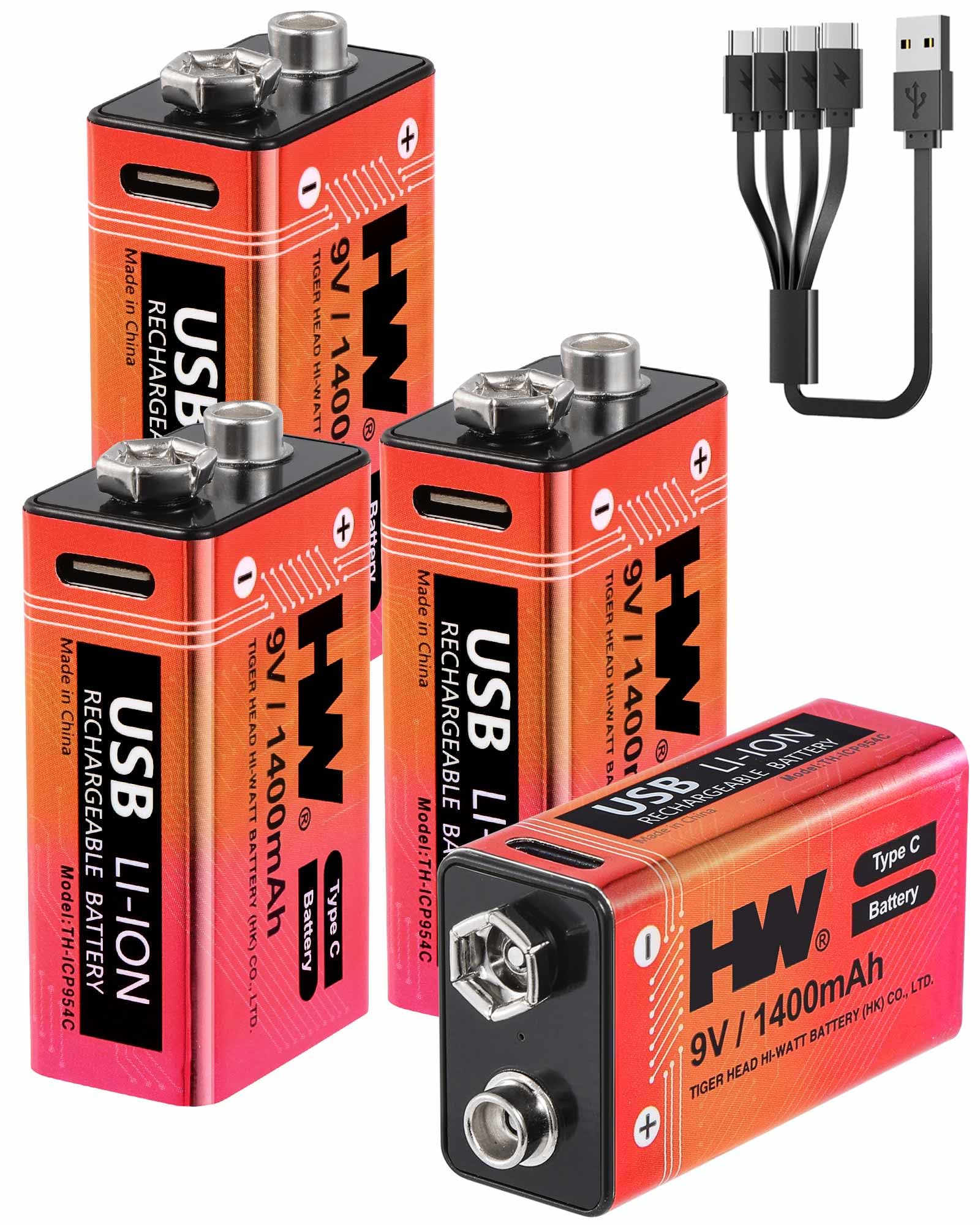
1. HW 9V Batteries 1400mAh USB-C 4 Pack
Our pick — 4.5+★ from 300+ verified ratings; the strongest balance of quality and price.
The biggest charge in the roundup, built for tools that drink power fast.
Start with the number that decides everything else here: 1400mAh. That is the capacity, the measure of how much charge the cell carries, and it beats the POWEROWL pack’s 600mAh by a wide margin. Put simply, you get far more runtime before the charging cable comes out, which matters most in a metal detector, a toy, or a walkie-talkie that gets used every weekend.
The pack holds 4 cells, each with a USB-C port molded into the top and a 4-in-1 cable in the box, so there is no charger to hunt for. A small LED tells you when each one has finished. In a smoke detector this is the no-fuss setup people want: pull the old cell, plug the new one into the cable, drop it back in. The manufacturer rates the cells for up to 1000 recharge cycles, so one set covers a long run of alarm changes.
The honest catch sits with battery life. Running time is the most-discussed subject in the feedback, and it splits — a solid stretch between charges for some users, a fast drain for others depending on the device. There is also real heft: at 128 g for the pack of four, these are noticeably heavier cells than the POWEROWL set at 24 g, which is simply what the extra 800mAh of stored charge weighs. Four built-in protections cover overcharge, over-temperature, overload and short-circuit, and a 2-year manufacturer warranty backs the pack.
What earns it first place
- 1400mAh capacity — the largest here, so the longest runtime between charges
- USB-C port on every cell, plus the 4-in-1 cable in the box
- Up to 1000 recharge cycles and a 2 Year manufacturer warranty
- Four built-in protections against overcharge, overheating, overload and short-circuit
Where it asks for patience
- Runtime reports split between long-lasting and fast-draining
- Heavier cells at 128 g for the pack, so they feel dense in the hand
- Dark tools that sip power get less benefit from the big capacity
Go with this one if: you run high-drain gear like metal detectors or toys and want the most charge in a single cell with a cable in the box.
Better look elsewhere if: the device is a featherweight wall clock and you would rather have a light, slim cell.
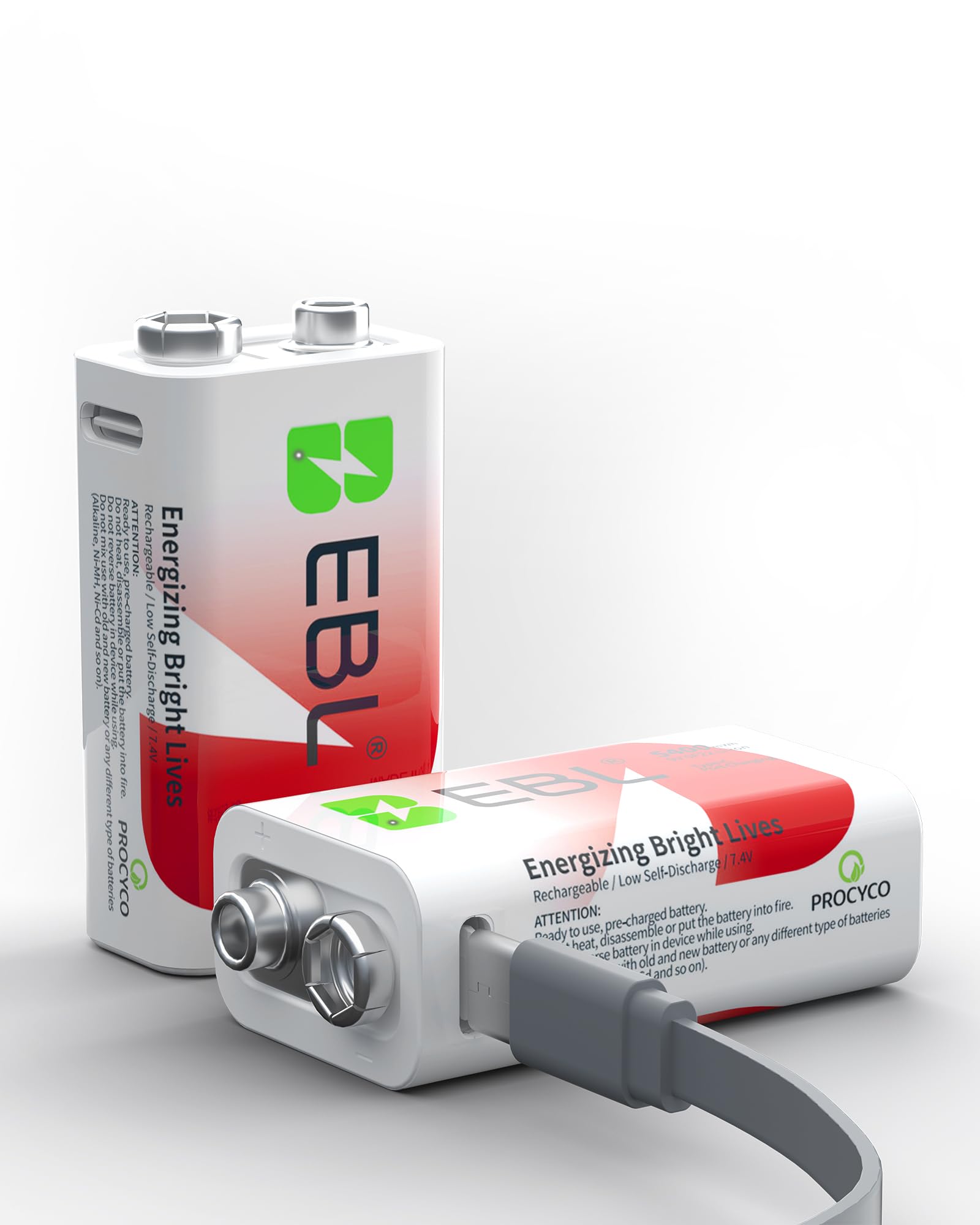
2. EBL Rechargeable 9V Lithium Battery 5400mWh 2 Pack
Two hours from empty to full, from a cable you already carry.
If waiting around for a charge is what puts you off rechargeables, this EBL pair answers it directly: about 2 hours to full on the included Type-C cable. That speed is the reason to pick it over the slower-filling packs here. The cells rate at 5400mWh, energy measured in milliwatt-hours, and pair with 1600+ recharge cycles — the highest cycle count on this list. Fewer replacements, less waste in the drawer.
There is a good trick worth knowing. Because each cell carries its own USB-C port, you can plug several into one multi-port USB hub and charge them all off a single wall socket — exactly the sort of setup people praise in the reviews for its convenience. The cells also hold a stable voltage right down to the end, which keeps a smoke alarm or a microphone working until the charge finally runs out rather than fading early.
With 2 cells in the pack, this is a spare-and-primary setup rather than a whole-house kit. They are light at 26 g each, so they slide into small device bays without fuss. Construction carries UL/CE/FCC certification and intelligent protection against over-charge, over-discharge and short circuit. A 1 year limited warranty and 30-day money-back offer cover the pack, though the published spec lists the unit count as 4 Count against 2 batteries required — worth a glance before you order if exact pack size matters to you.
Why it climbs the list: 2-hour charging with a Type-C cable and 1600+ cycles make it the quickest and longest-lived pair here.
The realistic trade-off: only 2 cells in the pack, so it suits a spare-plus-primary routine rather than a full alarm overhaul.
Top of the pile for: anyone who wants the fastest refill and the highest cycle count, especially for a pair of frequently swapped cells in microphones or toys.
Hold off if: you are changing eight alarms in one go and need a bulk pack, not a spare pair.
3. Quzmo 3-Pack 1300mAh 9V USB-C Rechargeable

Three cells that cover the alarms, the meter and the toy box.
One number sizes up the job here: 1300mAh. That is a substantial store of charge for a 9V cell, enough to power a smoke alarm for a long stretch or feed steady use in a multimeter. The 3 count also lands neatly in the middle — enough for a couple of alarms plus a spare, without buying a pack you will never finish charging.
The built-in USB-C port means a 2-in-1 cable handles the refill, and a small LED shows you when each cell is topped up. Quzmo rates the cells for more than 1200 recharges, and the Grade A+ cells carry no memory effect — meaning you can charge a half-full cell without shortening its life. Steady voltage holds until the whole cell is spent, so an alarm keeps working instead of fading quietly. Compared with the 3-Pack’s sibling 8-Pack, the only real difference is how many cells you get — same 1300mAh capacity, same cycle rating.
Charging is where the story gets mixed. The USB-C design is convenient to some owners and a sticking point for others who hit charging trouble, so treat the 30-day money-back and 24-hour reply support as your safety net if a cell misbehaves. Over-temperature, over-charge, over-load and short-circuit protection are all built in, which is the reassurance you want for a battery sitting inside a bedroom smoke alarm.
Right for a small household: 1300mAh across 3 cells covers a couple of alarms plus a spare, with more than 1200 recharges per cell.
Bear in mind: charging is the one point the feedback splits on, so buy from a seller who will stand behind a dud.
This is your pick when: you want a tidy middle pack that handles two or three alarms and a meter with a spare left over.
Look elsewhere when: you need eight fresh cells in one purchase for a full house changeover.
4. Quzmo 8-Pack 1300mAh 9V USB-C Rechargeable

The full-house changeover: eight cells, one cable, done.
When the task is swapping every alarm in the house at once, the 8 count here earns its place. Eight 1300mAh cells out of one pack means you can refresh a whole property without running back to the shop for extra. And because each cell holds 1300mAh, the runtime is the same solid stretch you would get from a smaller Quzmo pack — you are simply buying more of them together.
Each cell has the USB-C port built in and takes a charge from the supplied 2-in-1 cable, no dedicated charger needed. The LED readout on each one tells you the charging state at a glance. Grade A+ cells carry no memory effect, so a partly-used cell can go straight back on the cable. Over-temperature, over-charge, over-load and short-circuit safeguards are built into every cell.
The practical note is that this is a lot of cells to keep track of. If you only have two alarms and a torch, half the pack will sit idle — a smaller 3-pack covers the same ground. Charging is also the mixed point, with the USB-C convenience balanced against reported trouble for some, so the 30-day money-back and 24-hour reply line matter. Within this list it is the biggest single purchase of cells, sized for a whole-home routine rather than a spare in the drawer.
Built for the whole-house swap
- 8 cells in one pack at 1300mAh each, enough for a full alarm refresh
- USB-C port on every cell, so one 2-in-1 cable charges the lot
- More than 1200 recharges per cell, no memory effect
- Over-temperature, over-charge, over-load and short-circuit protection
The reason to size down
- Overkill for a home with only two or three alarms
- Charging feedback splits, so check each cell on arrival
- Keeping eight cells tracked and topped up takes a little routine
Made for: big homes or landlords refreshing every alarm in one pass who want one pack and one cable to finish the job.
Too much for: a single alarm and a clock — the smaller Quzmo 3-Pack does that job without the spare-cell clutter.
5. BOANV 4PCS 1300mAh 9V USB Fast Charging
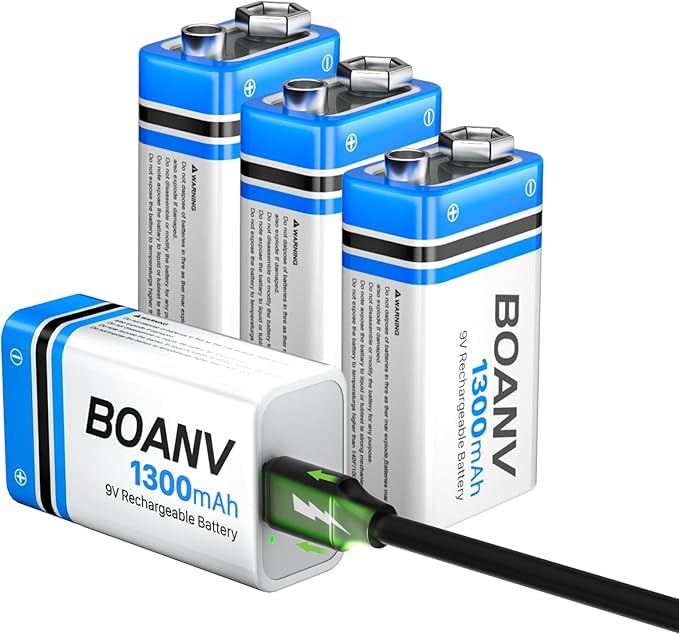
A 2-in-1 cable and four cells that refill from any USB port.
The draw here is portability. Every BOANV cell has its own USB-C port, and the pack brings a 2-in-1 cable, so you can top the whole set up from a car USB port or a power bank — no wall charger, no proprietary dock. For a walkie-talkie kit or a gadget bag kept in the van, that convenience is the reason to reach for it.
Capacity sits at 1300mAh, the same solid store the Quzmo packs offer, and the cells carry a 200 A amperage figure alongside a 46 g item weight. The Grade A+ cells are rated for up to 1500 efficient charge cycles. Construction is PC+ABS plastic with a red/green LED display, plus over-charging, over-current and over-heat protection, and the smart chip stops the charge automatically once a cell reaches full.
The one thing to watch is reliability of the charge itself. The feedback splits between cells that hold charge very well and cells that sometimes refuse to take a charge at all — so test each of the 4 cells on arrival while the 12-month warranty and 30-day refund are still fresh. Some owners are happy with the value, others less so, which tends to track with whether every cell in their box worked. A steady voltage output keeps a multimeter or alarm reading true when the cells are good.
Where it shines: four cells with individual USB-C ports and a 2-in-1 cable, so the whole set charges from any USB source while out of the house.
The one caution: cell-to-cell charge reliability varies, so charge-test all four the day the box arrives.
Best suited to: gadget bags, vehicles and jobs away from a wall socket where a phone cable is the only power source around.
Something to weigh: if perfect charge consistency matters more than portability, a set with a more even record is the safer call.
6. POWEROWL 9V 600mAh Lithium-ion 4 Pack

The slim, cold-proof cell for the camera bag and the cabin.
This POWEROWL pack takes a different route to the others. Capacity is 600mAh, well below the 1300mAh and 1400mAh cells here, but each cell weighs just 24 g — the lightest in the roundup, and a fraction of the HW pack’s 128 g. The low-self-discharge design means a cell kept in a drawer or a cold camera bag holds its charge while it waits, so it is ready when you finally need it.
Cold is where it earns its keep. POWEROWL builds in low-temperature performance, and the pack is aimed at tactical lights, walkie-talkies, battery lanterns and cameras in winter conditions. A temperature control valve opens above 70 degrees Celsius to release internal gas pressure, and three large-area fan-shaped vents help vent that gas quickly. For a device left in an unheated shed or a vehicle through a cold snap, that design is worth noting.
Two honest limits come with the low capacity. First, the running time per charge is shorter than the bigger cells, so high-drain gear will want more frequent refills. Second, size: the shell is fat enough that some buyers report it not fitting inside wireless transmitters and receivers, so measure the bay before committing. Charging performance is another split point, with some cells holding charge well and a few failing to charge at all — keep the return window in mind. Working range is listed at -10 to +45℃.
Its best argument
- Light at 24 g per cell, keeping a gadget bag or pack down in weight
- Low self-discharge, so a stored cell is charged when you reach for it
- Built for cold use, down to the listed -10℃ working range
- Temperature control valve and fan-shaped vents for internal pressure release
What to sort before you buy
- 600mAh is the lowest capacity here, so shorter runtime per charge
- The shell is fat and can fail to fit tight wireless transmitter bays
- A few cells reportedly do not take a charge, so test on arrival
Reach for this when: your devices live in the cold or sit unused for months and you want a light cell that wakes up ready.
Choose differently if: you want maximum runtime per charge or a slim cell for a recessed transmitter slot.
Know the Specs
Capacity in mAh and mWh
Capacity tells you how much charge a cell stores, and it comes in two forms on these packs. Some list mAh (milliamp-hours, the charge stored) and some list mWh (milliwatt-hours, the energy stored). A 1400mAh cell runs longer than a 600mAh one, which is why the HW pack tops the list on runtime and the POWEROWL pack trades that away for a lighter build. Match the number to your device: modest capacity for a gently-used alarm, higher capacity for a toy or a metal detector that drains fast.
Recharge cycles and self-discharge
Recharge cycles count how many times a cell can be refilled before it wears out, and the packs here range from up to 1000 to 1600+. Higher cycles mean fewer replacement purchases over the years. Self-discharge is how quickly a cell loses its charge while sitting untouched — a low-self-discharge cell keeps its power in a drawer or a cold bag, so it is ready when a device suddenly asks for one. Check both figures on the spec sheet rather than the label graphic.
Common Questions
Will a rechargeable 9V work in my smoke detector?
How long does a rechargeable 9V hold its charge between uses?
Do rechargeable 9V batteries fit the same slots as standard ones?
Is 1400mAh better than 600mAh for a multimeter?
Can I charge a USB-C 9V battery from a phone charger or power bank?
How many recharge cycles should I expect before replacing a cell?
Why is a rechargeable 9V rated at 7.4V instead of 9V?
Are these batteries safe to leave in a device long-term?
What is the difference between the Quzmo 3-Pack and the Quzmo 8-Pack?
Do rechargeable 9V batteries work in cold weather?
The Bottom Line
For most people, the 9 volt rechargeable battery winner is the HW 9V Batteries 1400mAh USB-C 4 Pack because it carries the most charge here at 1400mAh, ships with its own USB-C cable, and is rated for up to 1000 recharge cycles — the most runtime per refill in the roundup. If fast top-ups and a spare pair matter more, the EBL 5400mWh 2 Pack charges in about 2 hours with 1600+ cycles. For a whole-house alarm changeover, the Quzmo 8-Pack puts eight 1300mAh cells in one box.
Buy one pack and stop feeding disposable cells into a drawer. Pick the pack that matches how many devices you actually own — the 1400mAh HW set for a few high-drain tools, or a smaller 3-pack for a couple of alarms and a spare. Either way, a USB-C cell refills in about two minutes of hands-on time.
How we choose
We do not accept paid placement. Every pick is matched to a real buyer and a real use-case; we do not hands-on test units.
Sources
Specifications: manufacturer listings and product documentation. Review insights: verified customer reviews, as of November 2026. Pricing: not shown on this page (it changes often); check the current price via the retailer link.
As an Amazon Associate, My Heart Lives Here earns from qualifying purchases. This does not affect which products we feature.