Heads up: This post contains affiliate links. As an Amazon Associate I earn from qualifying purchases, at no extra cost to you. Learn more
Specs are compiled from manufacturer listings and verified buyer reviews and can change over time — please confirm the key details on the product page before buying.
Want coffee that never picks up a plastic taste? Then the metal has to be metal all the way through — body, basket, stem and lid. That single point decides most of these picks. A percolator brews by cycling hot water up a tube and raining it back over the grounds, so every part that touches that water shapes the flavour. The seven models below are the ones worth your attention, sorted by what each is genuinely good at.
This guide is built by comparing the manufacturers’ published specifications and the patterns across verified customer reviews, so you get each pick’s real strengths and trade-offs instead of marketing spin.
A 36-cup camp pot and a 10-cup electric warmer solve completely different problems, so match the size and heat source to your kitchen before anything else. Here is how to read an all stainless steel coffee percolator listing without getting fooled by a shiny photo and a hopeful description.
Top Picks


How To Choose The Best All Stainless Steel Coffee Percolator
Start with heat source, not brand. A stovetop moka pot and an electric percolator brew differently, and picking the wrong one means fighting your own kitchen every morning. After that, the cup count, the grind and the lid material decide whether you actually enjoy the result.
Stovetop, campfire or plug-in
A stovetop pot sits on gas, electric or induction — check the induction line specifically, because not every steel base is built for a magnetic hob. An electric percolator plugs in, brews on its own and holds the coffee warm afterwards. A camp model like the GSI is meant to sit over a fire or a stove and feed a crowd.
If you brew before work and want to walk away, the plug-in route suits you. If you want one pot that works on a rented cabin hob and a propane burner, the stovetop route is the flexible one.
Cup ratings are not mug ratings
A “12-cup” moka pot almost never fills twelve mugs. The Italian standard counts a small espresso cup at about 50 ml, so a 600 ml pot fills roughly twelve espresso shots and a couple of generous mugs. Electric percolators count closer to a 5-ounce cup. Read the millilitre or ounce figure on the listing and compare it to your own mug before you commit.
Watch what the lid is made of
The pot body can be stainless steel while the knob on top is clear plastic. That plastic sits directly in the steam path. If an all-steel build is your reason for buying, look for a glass or steel top and check whether the basket and stem are steel too — those are the parts the water actually travels through.
Grind and water level
Percolators want a medium-coarse grind so the water can pass through without dragging silt into the cup. Moka pots want a finer, espresso-style grind. Never fill past the maximum mark on an electric model, and never pack the basket tight on a stovetop one — both mistakes push water where it should not go.
Side-by-Side Comparison
| Model | Best For | Capacity | Brew Type | Weight | Amazon |
|---|---|---|---|---|---|
| GSI Outdoors Glacier Stainless Percolator★ Best Overall | Group camping and cabins | 36 cups | Stovetop / campfire | 3.6 pounds | Amazon |
| DITOSH 12 Cup Moka PotTop Performer | Espresso at home on induction | 12 cups (600 ml) | Stovetop moka | 1.27 kg | Amazon |
| Bialetti Venus Induction | Small kitchens, induction hobs | 6 cups (7.9 oz) | Stovetop moka | — | Amazon |
| APOXCON Electric Percolator | Set-and-forget warm coffee | 10 cups | Electric, 1000 W | 2.7 pounds | Amazon |
| Presto 02811 Stainless Percolator | Big crowds, fast refills | 12 cups | Electric | 2.9 pounds | Amazon |
| Cuisinart Classic PRC-12N | Pouring without spills | 4 to 12 cups | Electric | 3 pounds | Amazon |
| Cuisinox Roma COF-10R | Mirror finish and daily moka | 10 cups | Stovetop moka | 2.8 pounds | Amazon |
Detailed Reviews
1. GSI Outdoors Glacier Stainless Coffee Percolator, 36 Cup
Our pick — 4.5+★ from 750+ verified ratings; the strongest balance of quality and price.
Thirty-six cups of camp coffee from one pot that shrugs off a fire.
This is the big one — a stainless steel percolator built to sit on a campfire or a stove and feed a whole campsite. The 36-cup capacity is the headline. Compare that to the 10-cup electric APOXCON below and you are looking at a very different scale of job, and the numbers back it: 36 cups versus 10 cups is a 3.6x gap in capacity.
Being lightweight for its size is real: 30.4 oz, which is roughly 1.9 pounds before anything goes in it. The PercView glass dome lets you watch the brew cycle rather than guessing at it. That matters when you are cooking over an open flame and the heat is far less predictable than a hob.
What holds up for most buyers is the build itself — the steel takes knocks and the pot keeps going, and the brew quality lands without a mouthful of grounds. It works as well at a cabin or a retro farmhouse kitchen as it does on a riverbank. The catch is size. A 36-cup pot is genuinely a group object, and a MIXED signal on capacity shows some people found it bigger than they expected. A solo camper will be pouring away more than they drink.
What earns it the top spot
- 36-cup capacity feeds a campsite from one pot
- Glacier stainless steel resists corrosion and takes impacts
- PercView glass dome shows brew progress
- 30.4 oz body keeps it carryable
- Pour spout cuts dripping
Where it asks something of you
- Big for a single drinker — some find the size more than they need
- Heavier at 3.6 pounds than every electric model here
Built for: camp groups, cabin weekends and anyone brewing for a crowd over a fire or a stove.
Think twice if: you brew one mug a day — a 36-cup pot will run rings around your needs.
2. DITOSH 12 Cup Thickened 304 Stainless Steel Moka Pot
The handle is steel too, so you are never watching it come loose.
Most moka pots fit a plastic or bakelite handle that eventually rattles free. This one is 304 stainless steel from body to handle, and that is the change most buyers notice. It sits at 4.9 inches wide and 10.2 inches tall, brews a 600 ml / 20 oz pot in about five minutes, and it is dishwasher safe — the only pot here that says so outright.
The DITOSH also runs on essentially any heat: gas, induction, ceramic, electric, alcohol and propane camping stoves. That is the widest compatibility in this list. Three-ring precision threads and a pressure-resistant safety valve handle the seal. A frosted, sandblasted interior is not aluminum — a deliberate choice that adds texture and durability.
Watch the cup count language, though. The 12-cup figure is an industry reference, not twelve mugs of coffee; the real pour runs slightly lower depending on water, grind and taste. Size is a mixed signal in the review pages — fine for two people, small for others. The bigger honesty note: the coffee can spew over the stove if you overfill or overheat, and the lid attachment is a weak point worth checking when you first unbox. Keep the heat low and pull it off as soon as it gurgles.
Value read: A dishwashable, all-steel moka pot that handles induction and camping stoves for a fair mid-range outlay — genuinely hard to match for spread of heat sources.
The honest edge: First use can smell odd; the maker says to rinse with tea, orange peel or detergent a few times before your first brew.
Your pick if: you move between an induction hob, a gas flame and a camping stove and want one pot for all three.
Move on if: you want a brew you can set and forget. This pot rewards you for watching the heat and the fill level.
3. Bialetti Venus Induction Stovetop Coffee Maker, 6 Cups

A small Italian pot that has won over a very large crowd.
The Venus is the crowd favourite here, and it earns that on 18/10 stainless steel and a rich, full-flavoured 7.9 oz espresso pour. It is made from 18/10 stainless steel and brews 7.9 oz across 6 espresso cups. At 4 x 5 x 7.5 inches it is far more compact than the DITOSH — roughly half the footprint in two directions — so it lives happily on a crowded hob or in a small cupboard.
Rinsing with plain water is the whole cleaning routine. No detergent, no dishwasher. That is not laziness on Bialetti’s part; detergent strips the seasoning that builds up and changes the taste. What people rave about is the finish — the steel keeps a lustrous look, and the espresso comes out rich and full-flavoured. Induction hobs are covered.
The trade-off is durability, which is the one mixed-to-negative thread in the reviews. Hand-wash only and treat the threads with care, and it lasts well; abuse it or leave it soaking and it will show. Owners also flag that the cup rating reads larger than the actual pour — six espresso cups is a modest amount, so measure before you plan a morning around it.
Why it wins hearts
- 18/10 stainless steel with a lasting lustrous finish
- Rinse-only cleaning — no detergent, no dishwasher
- Compact 4 x 5 x 7.5 inches footprint
- Works on induction and standard hobs
The honest limits
- 6 espresso cups is a small pour for the money
- Hand-wash only — detergent and the dishwasher damage it
Suits you if: you want two good espressos from a pot that fits a tiny kitchen and an induction hob.
skip it if: you need a full mug each — the 7.9 oz capacity runs out fast.
4. APOXCON Electric Coffee Percolator 10 Cup
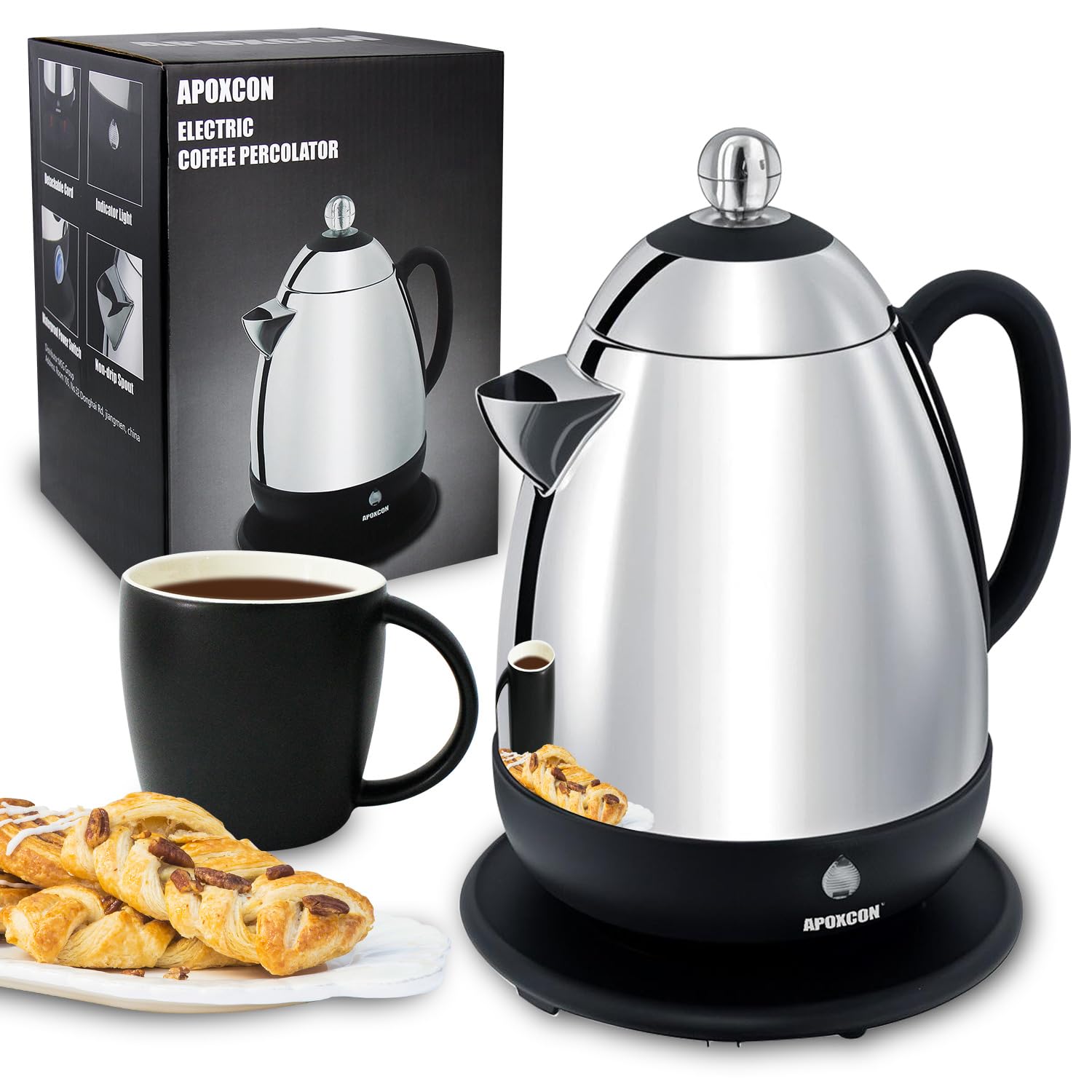
A plug-in pot that brews fast and then holds the heat for you.
If the stovetop ritual is not for you, this is the entry route to electric brewing. A 1000-watt heating element brings the water up to temperature quickly, and the automatic keep-warm function holds it there so the pot is still drinkable an hour later. That is the point of a plug-in model — the 1000-watt element brews and the keep-warm cycle holds it without a flame to watch.
The 10-cup stainless body has a clear brew-progress knob so you watch the strength build up, plus a no-drip spout and a permanent filter basket you never have to buy again. A detachable cordless base lets you carry the full pot to the table without the lead trailing behind you. An indicator light and a plain on/off switch keep the whole thing simple.
The one honest caveat is the lid — it is clear plastic sitting over a stainless body. If you wanted steel in every single component, note that up front. Some also find durability a little behind the established names, so treat the base gently. On grind and water, the maker’s own advice is the correct move: medium-coarse grind, and start with cold or room-temperature water for the best extraction. It holds about 8.07 x 6.5 x 10.24 inches of counter space.
What it does for you: fast heat plus an automatic warm cycle means a full pot stays hot without your hand on the dial — the reason most people buy electric at all.
The catch worth knowing: the clear top is plastic, so an all-metal build is not what you get here.
Reach for this if: you want hot coffee waiting after a slow morning rather than a pot you have to stand over.
Look elsewhere if: a fully steel lid matters more to you than the keep-warm convenience.
5. Presto 02811 Electric Coffee Percolator
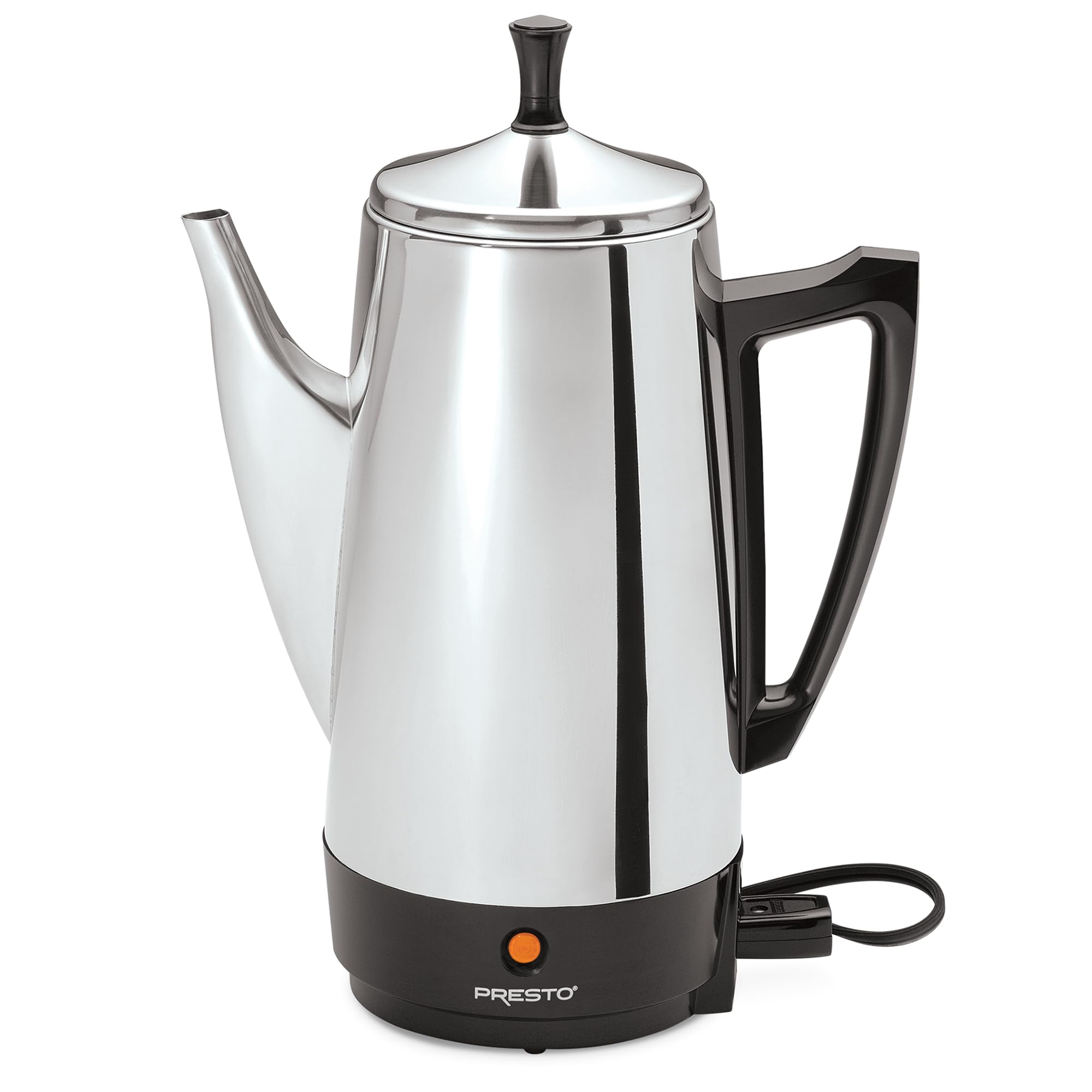
The one people tend to keep in the family for the coffee urn at gatherings.
Its 4.0+ stars across 20,000+ owners rest on brew speed and the automatic temperature control that keeps 12 cups hot. It brews 2 to 12 cups, with a cup counted as about 5 ounces of brewed coffee, so the full pot genuinely fills a table. Brew speed lands roughly around a cup a minute, and a signal light flips on the moment coffee is ready.
The stainless steel construction cleans up quickly, and the stay-cool handle and easy-pour spout make serving simple. An automatic temperature control system keeps the brew hot without any dial-fiddling on your end. Presto also backs it with a 1-year limited warranty — the only pick in this list that names a warranty term.
On the honesty side, durability is the one split note. Most people get years of use out of it; a smaller set report problems, so keep the water level inside the marked range and treat the element kindly. It is heavier than the APOXCON at 2.9 pounds versus 2.7, which is a negligible difference for a pot that pours 12 cups instead of 10. For a table of twelve, its 2-to-12-cup range and cup-a-minute brew make it the safest pick.
Why the crowd loves it
- Brews 2 to 12 cups with a cup counted as about 5 ounces
- Brews about a cup a minute; signal light shows when it is ready
- Automatic temperature control keeps coffee hot
- Stay-cool handle and easy-pour spout
- Backed by a 1-year limited warranty
What to watch
- Durability splits the room — treat the element and water level with care
- Stainless look does not mean a fully steel top, so check the parts before first use
Yes if: you host a group regularly and want a classic pot that pours fast and stays warm.
Not your pick if: you brew only one or two cups a day and want the smallest pot possible.
6. Cuisinart Classic 12 Cup Percolator, PRC-12N

The long, tapered no-drip spout is the reason to look at it — it fills a cup without a splatter trail.
A long, tapered, precision no-drip spout makes the Cuisinart the tidiest server here — you fill a cup without a splatter trail across the counter. The brew window on top is transparent, so you watch the cycle progress instead of guessing. Capacity flexes from 4 to 12 cups, which is useful when it is just you on a Tuesday and a crowd on a Sunday.
The stainless steel housing gives the classic tall-carafe look, and the comfortable handle makes pouring a full pot feel controlled. Coffee comes out tasting good and stays warm — a less bitter cup than other brew methods, in the words of the review pages. It sits at 6.25 x 9.25 x 12.25 inches, so measure your cabinet before you buy.
Here is the part to weigh honestly. Durability is the heavier note in the feedback, and some reviewers report the top breaking or the unit stopping within a short window. That is a small slice next to the pile of happy buyers, but it is worth knowing before you buy — this is a pot for people who want the cleanest pour, not the ruggedest build. Some also mention plastic components despite the stainless exterior.
Stands out on: the precision no-drip spout — this is the least messy pour in the lineup, hands down.
Fair warning: build reliability is the weak spot in the reviews, so treat it as a countertop pot rather than a workhorse.
Right for you if: a clean, spill-free pour matters and you brew at home on a counter.
Wrong pick if: you want one pot to survive a cabin cupboard and a decade of knocks.
7. Cuisinox Roma Stovetop Espresso Maker COF-10R, 10 Cup

A 10-cup moka pot in mirror-polished stainless that owners say keeps its showroom look.
The Cuisinox Roma gives you a 10-cup moka pot with a mirror-polished exterior that owners say keeps its showroom look. It is made from high-quality stainless steel that resists rust and corrosion, and it works on gas, electric and induction hobs. That spread of heat sources makes it a good match for a kitchen that changes stoves or a holiday let you do not control.
The build has a detachable structure that makes it easy to clean — and it stays free of a metallic taste in the cup, which is the whole reason to go stainless over aluminium in the first place. A heat-resistant handle and a precision spout make pouring safe. It sits at 7 x 7 x 10 inches and weighs 2.8 pounds, a touch lighter than the 3.6-pound GSI despite the very different job it does.
Value is a mixed note here — some feel it is a fair outlay for a premium moka pot, some do not. That is honest pricing tension rather than a flaw in the coffee, which comes out rich and full. If you want the most pots for your money, the DITOSH offers induction for less; if you want the finish that keeps heads turning on the kitchen counter, that is what the Roma is for.
Worth knowing: the mirror finish is the standout — a moka pot that does not fade into the cupboard.
Question to ask yourself: a 10-cup moka pot fills a lot of small cups; if you drink one large mug, size down.
Best fit for: someone who wants a durable, good-looking moka pot for induction brewing and does not mind paying for the finish.
Check first if: value tops your list — there are cheaper induction moka pots on the list that brew just as well.
Know the Specs
Stainless steel grades — 18/10 vs 304
Both 18/10 and 304 describe the same class of stainless steel — a mix of chromium and nickel that resists rust and does not react with coffee acids. The point for you is taste: a true stainless pot will not turn your coffee metallic the way an aluminium moka pot can once its coating wears. When a listing calls the body stainless but the handle or lid is a different material, that part is a compromise, not a core spec.
Cup capacity ratings
A “cup” is not a mug. Italian moka pots count a cup as roughly 50 ml of espresso, while electric percolators count a cup as roughly 5 ounces of brewed coffee. That is why a 12-cup moka pot barely fills two mugs while a 12-cup electric percolator sits on a table for twelve. Always check the millilitre or ounce figure on the listing and compare it to your own mug before you buy.
Induction compatibility
An induction hob heats the pot by magnetic induction, so the base needs to be magnetically responsive. Stainless steel bases vary. A pot that lists gas, electric and induction covers every common home surface; a pot that lists only gas and electric will need a plate adapter on an induction hob. If your next kitchen has an induction hob, buy the pot that names induction now.
Wattage and keep-warm
On electric percolators, wattage tells you how fast the water heats. A higher-wattage element reaches temperature faster, and the keep-warm function holds the brew at serving heat afterwards. On stovetop pots, none of this applies — you control the heat yourself with the flame, and the pot’s own thermal conductivity decides how fast it brews.
Grind-size requirements
Percolators want a medium-coarse grind so the water can pass through without pulling grounds into the cup. Moka pots want a finer, espresso-style grind. Use the wrong grind on the wrong pot and you get either weak coffee or a gritty cup — the pot’s basket is not designed to filter fine powder.
Glass versus plastic lid knobs
The knob on top sits directly in the steam path, so its material is not cosmetic. A glass dome like the GSI’s PercView lets you watch the brew and avoids any plastic contact with the steam. A plastic knob is cheaper and lighter but sits over a hot, wet environment — if you want an all-steel or glass top, check that line on the listing before you commit.
Common Questions
What does 304 stainless steel mean on a moka pot?
Will a stainless steel percolator work on an induction hob?
How many cups does a 12-cup moka pot really make?
Why does my percolator coffee taste bitter or burnt?
Can I put a stainless percolator in the dishwasher?
What grind size should I use in a stainless percolator?
Is a moka pot the same as a percolator?
How much coffee should I put in a 36-cup camp percolator?
Does a stainless steel percolator change the coffee’s taste compared with aluminium?
Can I use an electric percolator on a camping trip?
The Bottom Line
For most buyers, the winner in this all stainless steel coffee percolator list is the GSI Outdoors Glacier Stainless 36-Cup Percolator. It handles the hardest job here — 36 cups for a whole campsite over a fire or stove — and the Glacier stainless steel takes knocks without denting the brew. Want one pot that works on induction, gas and camping at once? Reach for the DITOSH 12-Cup Moka Pot. Short on counter space with a small espresso habit? The Bialetti Venus Induction keeps the counter clear and washes by rinsing alone. And if you want hot coffee waiting without the flame, the crowd favourite Presto 02811 earns its 4.0+ stars across 20,000+ owners on the strength of it.
How we choose
We do not accept paid placement. Every pick is matched to a real buyer and a real use-case; we do not hands-on test units.
Sources
Specifications: manufacturer listings and product documentation. Review insights: verified customer reviews, as of November 2026. Pricing: not shown on this page (it changes often); check the current price via the retailer link.
As an Amazon Associate, My Heart Lives Here earns from qualifying purchases. This does not affect which products we feature.