Heads up: This post contains affiliate links. As an Amazon Associate I earn from qualifying purchases, at no extra cost to you. Learn more
Specs are compiled from manufacturer listings and verified buyer reviews and can change over time — please confirm the key details on the product page before buying.
You want a saw that cuts baseboard, crown molding and 2x4s at a true angle, and you want it to fit on a bench without a dedicated shop. A 7-1/4-inch sliding compound miter saw is the answer — the smaller blade and slide rails let the head travel forward for wide crosscuts while the whole unit stays compact enough for a garage shelf. The catch most buyers miss is that “sliding compound” is not a guarantee of capacity: crosscut width, miter range and whether you get bevel both ways change dramatically from saw to saw. Below are the nine worth your money, sorted by what they actually do well.
This guide is built by comparing the manufacturers’ published specifications and the patterns across verified customer reviews, so you get each pick’s real strengths and trade-offs instead of marketing spin.
Cordless models free you from the outlet and the cord, but add battery cost and a few pounds. Match the saw’s crosscut width and bevel direction to the widest board and steepest bevel you actually cut, not to a spec sheet wishlist.
Top Picks


How To Choose The Best 7 1/4 Sliding Compound Miter Saw
The first decision is not brand, it is cord or no cord. A corded saw runs all day off a wall outlet and costs less up front. A cordless saw lets you trim a room with no extension cord snaking across the floor, but the battery and charger are often sold separately, so check the included components line before you commit.
Crosscut capacity beats blade size
A 7-1/4-inch blade is the size class, not the cut size. What actually limits you is the crosscut width at 90 degrees and at 45 degrees — the widest board the sliding head can reach. A saw with an 8-inch crosscut handles shelving; one with 11.5 inches handles wide casing in a single pass. Look at both numbers before anything else.
Single bevel or dual bevel
Single bevel tilts the blade one direction only, usually left. Dual bevel tilts both ways so you never flip the workpiece to cut an opposite angle. For baseboard and crown work where you cut both left and right miters, dual bevel saves time. If you mostly cut one direction, single bevel keeps the saw simpler and lighter.
Miter range and detents
Miter is the swing left and right across the table; that is how you cut the angled ends of trim. Positive detents are the click-stops at common angles like 0, 15, 22.5 and 45 degrees, so you land on a true angle without squinting at a scale. More detents means faster repeatable trim cuts.
Bench space and rail design
A sliding saw needs room behind it for the rails to travel. A fixed compact rail system keeps the head moving on rails that do not extend far past the base, so the saw can sit flush against a wall. Measure your bench depth and the wall behind it before you buy.
Side-by-Side Comparison
| Model | Best For | Power Source | Miter / Bevel | Cutting Angle | Amazon |
|---|---|---|---|---|---|
| DEWALT 20V MAX* 7-1/4-Inch Miter Saw (DCS361M1)★ Best Overall | All-day cordless trim work | 20V MAX* battery (included) | 11 positive stops / bevel scale | 48 degrees | Amazon |
| RYOBI ONE+ 18V Cordless 7-1/4 in. Sliding Compound Miter SawMost Versatile | Big crosscuts on a battery platform | 18V ONE+ battery (sold separately) | Sliding compound | 45 degrees | Amazon |
| CRAFTSMAN V20 Cordless Sliding Miter Saw 7-1/4 inchComplete Kit | Cordless kit with battery included | V20 20V MAX* 4.0Ah battery (included) | 9 casted detents / single bevel | 90 degrees | Amazon |
| BOSCH GCM18V-07SN PROFACTOR 18V 7-1/4 In. | Picture frames and deep crown | 18V PROFACTOR battery (bare tool) | Bevel detents / single bevel | 45 degrees | Amazon |
| SKIL 10 Amp 7-1/4″ Single Bevel Miter Saw (MS6306-00) | Tight benches against a wall | 10 Amp corded, 4,800 RPM | Miter 0–47° left / 0–50° right | 45 degrees | Amazon |
| WEN MM0713 9.5-Amp 7.25-Inch Sliding Compound Miter Saw | Wide crosscuts on a budget corded saw | 9.5 Amp corded | Miter 45° both ways / bevel 45° left | 45 degrees | Amazon |
| Evolution R185SMS+ Sliding Miter Saw | Cutting wood, plastic and metal on one blade | 10 A corded | 45° bevel / 50° miter | 45 degrees | Amazon |
| ONEAND 18V Cordless 7-1/4 in. Compound Miter Saw (P553) | Light tool-only cordless option | 18V battery (sold separately) | Compound miter | 45 degrees | Amazon |
| Hoteche 7-1/4-Inch Miter Saw 7.5A Single Bevel Chop Saw | Laser-guided cuts on a starter budget | 7.5 A corded, 5000 RPM | Positive stops 0°/15°/22.5°/30°/45° | 45 degrees | Amazon |
Detailed Reviews
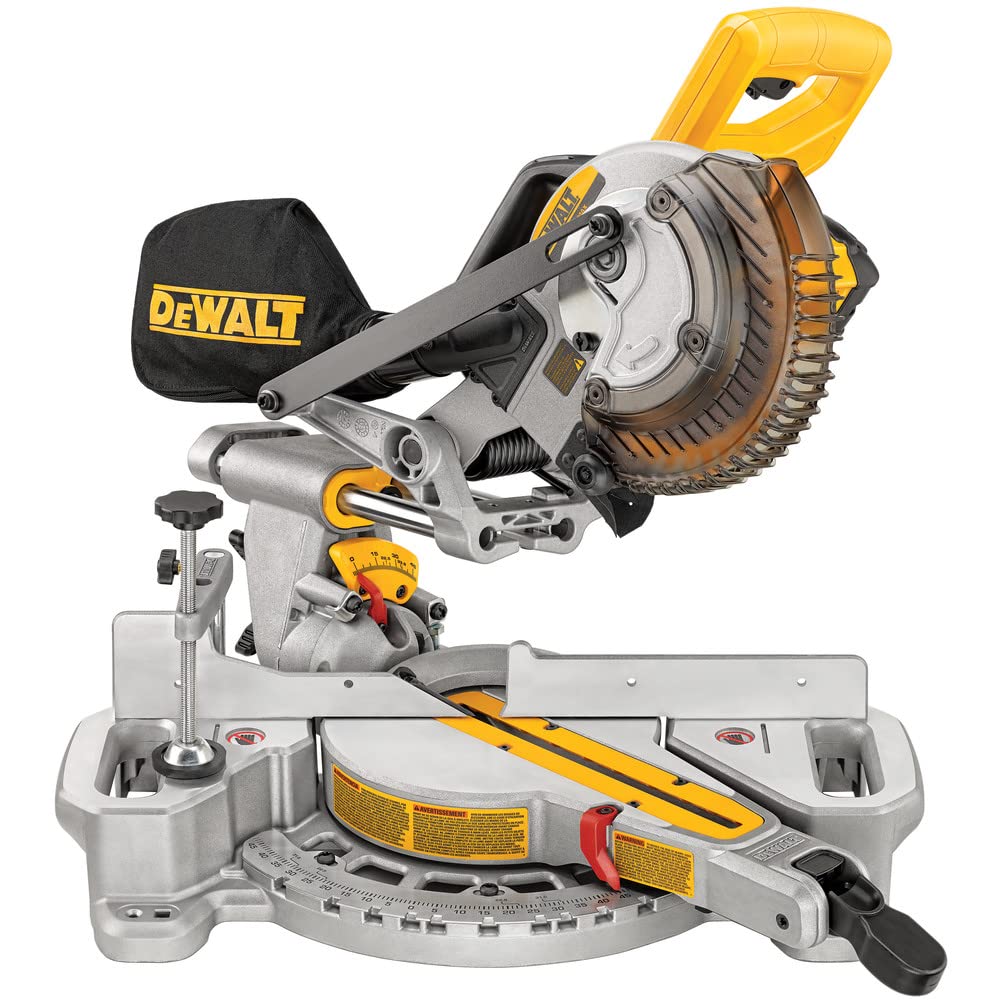
1. DEWALT 20V MAX* 7-1/4-Inch Miter Saw, Cordless (DCS361M1)
Our pick — 4.5+★ from 800+ verified ratings; the strongest balance of quality and price.
The cordless saw that trims a whole room on one battery.
What makes this the pick to beat is the runtime per charge. DEWALT rates the included DCB204 20V MAX* battery at an average of 183 cuts of 2×4 pine, or 275 cuts of 3-1/4 pine baseboard. That is a full day of trim work away from any outlet, which is the whole point of going cordless in the first place.
Then there is the accuracy side. A cut-line cross-cut positioning system gives you an adjustment-free line of cut, so you see exactly where the blade will land before it drops. The stainless steel miter detent plate carries 11 positive stops, and the oversized bevel scale is sized for easy reading when you tilt the head. Capacity reaches 3-5/8″ nested crown and 3-1/2 base vertically.
The trade-off is simple: it is a compact 7-1/4-inch saw, so very wide shelving boards still need a bigger blade. The other thing to know is that it weighs 31.6 lbs, which is fine to carry to a job but not a one-hand lift. As owners put it, the battery “provides on average 183 cuts of 2×4 Pine or 275 cuts of 3-1/4 pine baseboard” — and the design is genuinely built around that portability. It is the crowd favorite here at 4.5+ stars across 800+ owners.
cordless jobsite freedom
- 183 cuts of 2×4 pine or 275 cuts of 3-1/4 baseboard per charge on the included DCB204 battery
- 11 positive stops plus an oversized bevel scale for repeatable angles
- Cut-line cross-cut positioning system needs no adjustment
- Cuts 3-5/8″ nested crown and 3-1/2 base vertically
battery sold separately
- 31.6 lbs makes it a two-hand carry between rooms
- 7-1/4-inch blade limits crosscut width on wide boards
framing without outlets: you trim rooms where a cord would be a trip hazard and you need the battery in the box.
cutting thick stock: you plan to crosscut wide shelving — that wants a bigger blade and a deeper slide.
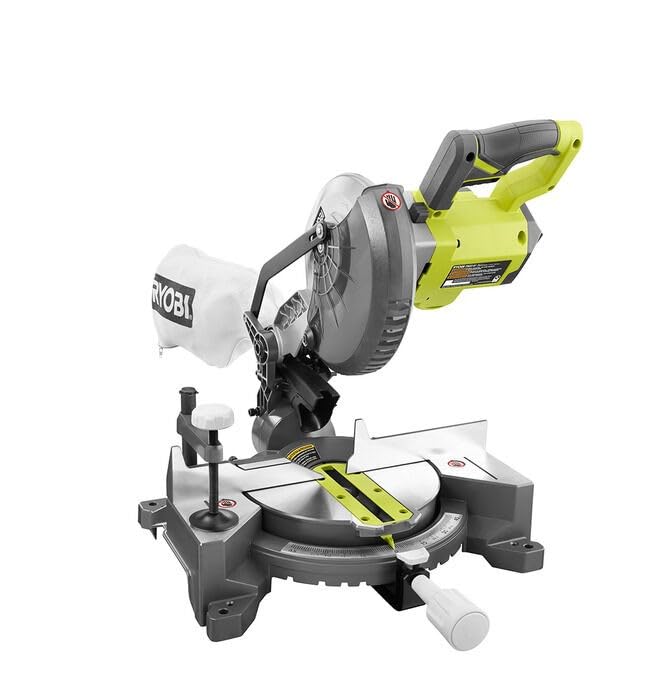
2. RYOBI ONE+ 18V Cordless 7-1/4 in. Sliding Compound Miter Saw
A slide-capable cordless that eats wide boards and stacks cuts.
If you already keep RYOBI ONE+ batteries in the garage, this saw gets you onto a cordless miter saw with the least fuss. It runs up to 800 cuts per charge, so a full day of trim work can go by without a battery swap. The brand claims top-tier 2X10 cross cut capacity (the sliding head reaches a wide board most compact saws cannot). The platform matters too: over 260 ONE+ tools all run on the same 18V battery, so one pack covers your drill, trimmer and saw.
The things that land well in use are function and build. Owners find it handles 90% of mitering tasks without complaint, and 2x4s cut easily. It weighs 30.2 lbs, so it is a bench-and-carry saw rather than a one-handed grab, and the battery and charger are sold separately — factor that into the plan if you do not already own the packs.
sliding capacity value: you are paying for slide capacity and platform compatibility. Cutting performance holds up on dimensional lumber and trim, and the 800-cuts-per-charge figure gives you real headroom on a battery.
plastic detents wear: without a battery in the box, the real cost depends on what you already own. The plastic handle material also tells you this is a home-shop saw, not an industrial one.
budget trim work: ONE+ owners who want a wide crosscut without hunting for a cord.
daily pro use: budget for the battery and charger, since they ride along separately.
3. CRAFTSMAN V20 Cordless Sliding Miter Saw
Battery, charger and blade in the box — no surprise extras.
This is the cordless saw that removes the fine print. You get the CMCS714 saw, a CMCB204 V20 20V MAX* 4.0Ah lithium-ion battery, a fast charger, a carbide-tipped blade, blade wrench, material clamp and dust bag in one purchase. Claimed runtime is up to 585 cuts in 3-1/4-inch MDF baseboard on a single charge, which is real headroom for a room-by-room trim job.
Cross cut is 8 inches at 90 degrees and 5-1/2 inches at 45 degrees, and the sliding head can nest 3-5/8-inch crowns and 3-1/2-inch baseboards vertically. The 3,800 RPM motor is built for 2X dimensional lumber, hardwoods, baseboard and trim. Nine casted miter detent stops skip the guesswork, and an LED cut line positioning system marks your line for the blade drop.
Where it lands against the DEWALT above is runtime-per-charge: 585 MDF baseboard cuts here, but the DEWALT’s 31.6 lbs carries a different balance and this one is 21.8 lbs, so it is easier to lift to the bench. The honest catch is the 8-inch crosscut at 90 degrees, narrower than the slide-heavy RYOBI. Owners find it cuts all day on a charge, and it holds 4.5+ stars across 700+ owners.
homeowners with V20: anyone buying their first cordless miter saw who wants every part in one box.
precise angle work: your regular board is wider than an 8-inch crosscut — this one tops out there at 90 degrees.
4. BOSCH GCM18V-07SN PROFACTOR Miter Saw

Picture-frame corners and tall crown come easy on this mobile saw.
Crown molding and picture frames are where this saw shows its intent. It delivers 3-3/4 in. nested crown cutting with 45° left against the fence and an 8-1/4 in. crosscut, and the tall fence design supports taller material so an upright molding sits against a real rail. If your week is full of angled joinery, that tall fence is the part you feel every single cut.
The brushless motor and drive-train are built to take full advantage of the extra power from core18v high power batteries — which, note, are sold separately, because this is a bare tool. Precisely centered sliding bars make the slide feel smooth, and the bevel scale has detents at the common angles for quick tilts. It weighs 26 lbs with the handle there for carrying, and the dust bag or vacuum hookup keeps the bench clean behind you.
The trade-off: bare tool means no battery and no charger, so the real outlay depends on what 18V gear you already run. Owners rate the build quality highly and single out the light weight as a reason it stays mobile. Bosch backs it with a 180-day no-questions-asked return guarantee and a five-year limited warranty.
single bevel accuracy: crown cutting depth at 3-3/4 in. plus an 8-1/4 in. crosscut, in a saw that stays on the move.
pro trim crews: crown and frame work fills your calendar and you already own Bosch 18V batteries.
tight budgets: the battery and charger are not in the box, and the bevel is single-sided.
5. SKIL MS6306-00 Miter Saw

A bench saw that behaves like a wall-hugger.
Small shops and tight benches are the reason the fixed compact rail system exists. The head rides on rails that do not need a long runway behind the base, so the saw works flush against a wall while minimizing its benchtop-to-wall footprint. On a bench that only has a couple of feet of depth, that is the difference between cutting indoors and cutting in the driveway.
For accuracy there is an LED shadow line (a light that casts the blade’s shadow on the board), which shows the actual kerf of the blade (the width of the cut it makes) rather than a laser dot. That means baseboards, casing, crown molding and shelf planks all get a cut line you can trust with your eye. The 10 Amp motor spins to 4,800 RPM (revolutions per minute), so it holds speed through thicker stock. The miter range (the angle of the cut across the board) runs from 0 to 47 degrees left and 0 to 50 degrees right, with detents (notches that click the saw into set angles) at 0, 15, 22.5, 31.6 and 45 degrees on both sides. Crosscut capacity reaches 2×10 at 0 degrees and 2×6 at 45 degrees left/right, with up to 3-1/2-inch crown nested (molding laid flat against the fence).
The things people like most here are quality and value, and the shadow line gets its own praise — frames come out perfect when the line is true. Weighing under 25 lbs, it is the easiest of the corded saws to move. The honest catch is the single bevel: it tilts 0 to 45 degrees left only, so you cannot bevel to the right without flipping the stock. Score sits at 4.5+ stars across 100+ owners.
compact bench footprint
- Fixed compact rail system lets it cut flush against a wall
- Wide miter swing of 0–47° left and 0–50° right with five detents each side
- LED shadow line traces the real blade kerf, not a laser dot
- Under 25 lbs for easy transport and storage
fence flexes on cuts
- Single bevel tops out at 45 degrees to the left
- Accuracy feedback is mixed, so square up the fence before trim work
small shop space: a narrow bench against a wall and trim that needs a visible cut line.
long crown runs: you regularly bevel to the right — this one only tilts left.
6. WEN MM0713 Miter Saw

Big crosscuts from a saw that folds flat to the wall.
The headline here is reach: a 9.5-amp motor crosscuts boards up to 11.5 inches wide and 2.5 inches thick. That is the widest cut in this group, and it is the number to check if you regularly break down shelving or wide casing. A dual-rail slide system lets the head travel that far forward while the base stays compact enough to sit flush against a wall.
Angles are flexible: miter 45 degrees in either direction across 9 miter stops, or bevel 45 degrees to the left. An onboard LED cutline guide lights the line of cut so the blade drop is easy to see in a dim garage. The package includes a 7.25-inch 40-tooth carbide-tipped blade with a 5/8-inch arbor, two table extensions, a clamp assembly, a dust port, a carrying handle, a dust bag and a two-year warranty.
Where it differs from the SKIL above is the swing: both directions on miter here, but bevel is left-only. The blade quality and functionality are what land best with owners, and the hold-down clamp works well for holding stock steady. The catch is weight — at 14.7 kg it is the heaviest saw here, so treat it as a bench-mounted tool and not a carry-around.
light hobby cuts: wide boards and two-way miters on a corded budget saw.
finish carpentry: bolt it down or leave it in place — this is not a saw you carry room to room.
7. Evolution R185SMS+ Sliding Miter Saw

The one saw that swaps wood for metal without changing a blade.
Most miter saws are wood tools. This one is a multi-material cutter, which is the whole reason to pick it over the rest. The included tungsten carbide tipped blade slices wood, plastic, metal and more, and the 10 A motor gives it power the Hoteche’s 7.5 A motor does not reach. It bevels 45 degrees and miters up to 50 degrees, and the slide runs on 210 mm of travel.
Performance is exactly what owners talk about, and cutting performance backs it up — wood goes through like butter and metal cuts without drama. Value gets its own share of the credit, since the saw does the work of two tools. The included dust bag catches chips, and the thing is sized at 48″L x 24″W x 12″H — a full-size bench footprint, not a compact one.
Honest caveat: accuracy divides opinion. Some find it very accurate, others report a lack of precision, and durability and blade-locking have their own gripes. The 4-inch blade length in the spec sheet is a listing quirk, so measure the actual blade before you trust that number. Owners who treat it as a versatile workhorse rather than a precision trim saw are the happiest ones.
multi material blade: one blade that cuts wood, plastic and metal is a real convenience, but buyers report mixed accuracy — good for framing and general work, less so for finish carpentry that needs a perfect miter close.
steel and wood: your projects mix wood and metal and you would rather buy one saw than two.
fine trim only: perfect trim accuracy is the job — this saw’s reported precision is not its strongest suit.
8. ONEAND P553 Compound Miter Saw
The lightweight cordless for small jobs and small spaces.
At 19 pounds this is the lightest saw in the group, and that is the whole argument. A carbide-tipped 7-1/4-inch blade, an 18V cordless body and a 45-degree cutting angle in a package you can lift onto a bench with one hand. That matters when you are working in a closet, a finished room, or anywhere the saw has to move often.
The battery and charger are sold separately, so plan for that if you do not already run the 18V platform. The ABS handle material keeps the weight down, and a 30-day limited warranty is the coverage — short enough that you want to test it early on the first job. Owners say it is portable and easy to move, and that it handles smaller jobs and versatility well.
The honest bite is the 7-1/4-inch capacity: it will not crosscut wide shelving or nest deep crown. That is the nature of a 7-1/4-inch compact saw — it is not the tool for wide shelving or deep crown. The 4.5+ star rating across 400+ owners says most people get the tool they expected.
owners with ONEAND: someone with an 18V battery who needs a light saw for trim in tight rooms.
first saw buyers: tool-only means no battery, no charger, and only a 30-day warranty to catch problems.
9. Hoteche 7-1/4-Inch Miter Saw
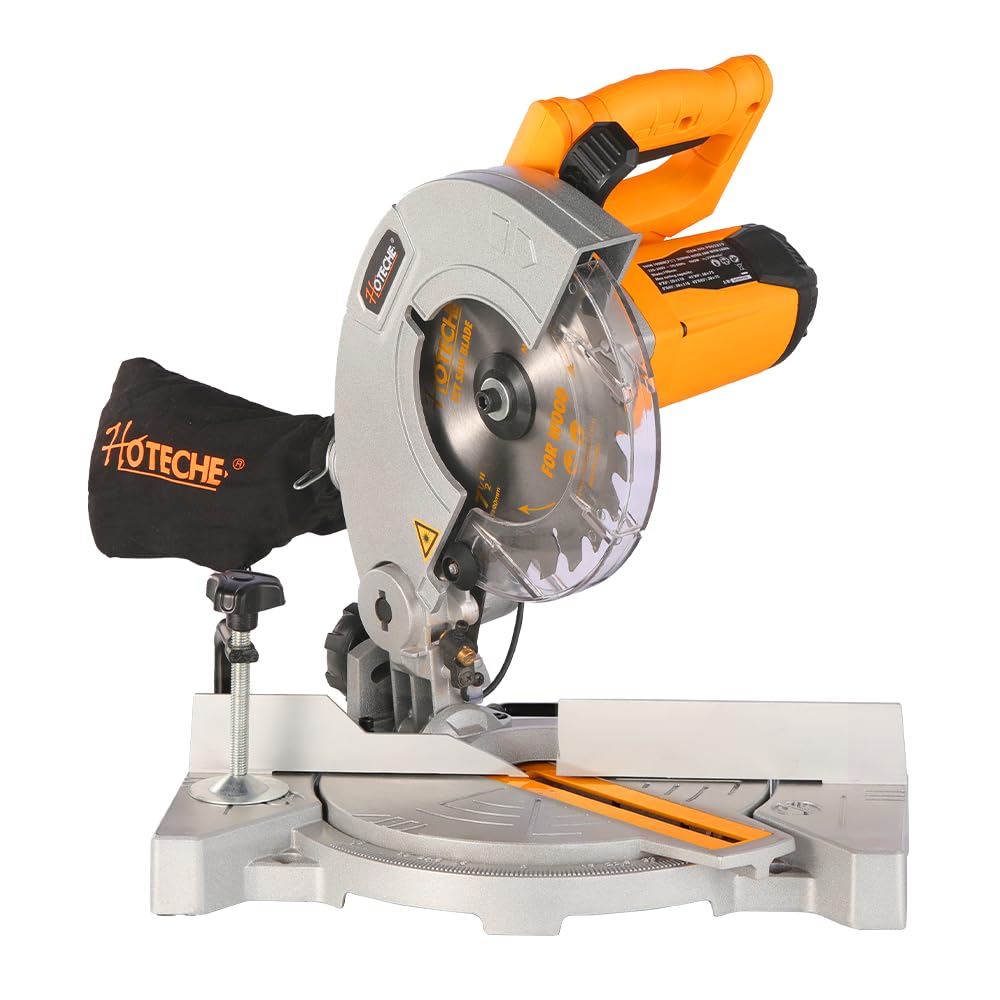
A laser line and a full accessory kit at the entry level.
This is the saw for the buyer who wants guidance built in from day one. A laser guide shows the cut line on the board, which is a real help for baseboards, crown molding and picture frames when you are still learning where the blade lands. The 7.5 A copper motor spins at 5000 RPM and is rated for hardwood, PVC, aluminum trim and soft metals.
Cut capacity is listed clearly by angle: 120mm x 45mm at 90 degrees, 85mm x 45mm at a 45 bevel, and 120mm x 22mm on compound miters. Positive miter stops at 0, 15, 22.5, 30 and 45 degrees cover most furniture and flooring angles. The kit is generous: extension bars for wide workpieces, two hex wrenches, a dust bag, a spare pair of carbon brushes, and an aluminum base with rubber feet that holds the saw still.
Set against the SKIL above, the bevel range is comparable at 45 degrees, but this one runs 7.5 A to the SKIL’s 10 A and carries an older positive-stop set without the 31.6-degree detent. It plugs into 110-120V and runs. The honest note is that it is an entry-level saw: check square and fence alignment when it arrives and keep the blade fresh.
simple crosscuts: you want a laser-guided first saw and a kit with the spare brushes and extensions included.
steep bevels: you need dual bevel or the extra detents — this one stops at 45 degrees and a five-stop miter set.
Know the Specs
Crosscut capacity at 90 and 45 degrees
This is the widest board the sliding head can reach, measured with the blade at square (90 degrees) and at an angle (45 degrees). A saw with an 11.5-inch crosscut handles wide shelving in one pass; one with 8 inches tops out sooner. Check the 45-degree number too, because angled cuts are narrower than square cuts on every saw.
Amps and RPM for a corded saw
Amps describe the current the motor draws from the wall; RPM is how fast the blade spins. A 10 A motor turning 4,800 RPM is built for dimensional lumber and trim. A 7.5 A, 5000 RPM motor trades amperage for speed. Higher amps generally mean more torque under load, which matters when the blade meets hardwood.
Cuts per charge for a cordless saw
Cordless saws quote runtime in cuts, not minutes, and the number depends on the material and the battery. The DEWALT rates its included battery at an average of 183 cuts of 2×4 pine or 275 cuts of 3-1/4 pine baseboard. CRAFTSMAN claims up to 585 cuts in 3-1/4-inch MDF baseboard. Read the material in the claim, because MDF and pine behave differently.
Single bevel vs dual bevel
The bevel tilts the cutting head sideways to make an angled cut through the thickness of a board. Single bevel tilts one direction (usually left); dual bevel tilts both. For crown and baseboard where you cut opposite angles, dual bevel saves flipping the stock. For one-direction work, single bevel keeps the saw lighter and simpler to adjust.
Miter detents and miter range
Miter swings the table left and right to cut the angled ends of trim. Positive detents are the click stops at common angles, so you land on 0, 15, 22.5, 31.6 or 45 degrees without reading a scale. A wider miter range reaches harder angles; more detents make repeat cuts faster and more consistent.
Rail system and bench footprint
A sliding saw needs rail travel for the head to reach forward. Traditional rails extend behind the base and need clearance from the wall. A fixed compact rail system keeps the travel shorter and the base compact, so the saw can sit flush against a wall. Measure your bench depth against the saw’s footprint before you buy.
Common Questions
Will a 7-1/4-inch sliding miter saw cut a 2×10 board?
Do cordless miter saws come with a battery and charger?
Can a sliding compound miter saw cut crown molding standing up?
Is a laser or an LED shadow line better for cutting trim?
What is the difference between single bevel and dual bevel on a miter saw?
How many cuts can a cordless 7-1/4-inch miter saw make per charge?
Can a 7-1/4-inch miter saw cut metal or plastic?
How heavy is a 7-1/4-inch sliding compound miter saw?
Does a compact rail system really let the saw sit flush against a wall?
Is a 7-1/4-inch miter saw enough for cutting baseboard and trim?
The Bottom Line
The 7 1/4 sliding compound miter saw worth starting with is the DEWALT DCS361M1. Its included 20V MAX* battery delivers 183 cuts of 2×4 pine or 275 cuts of 3-1/4 pine baseboard, so you can trim a whole room on one charge. The 11 positive stops (fixed angle notches) keep trim angles repeatable, so every corner piece matches. If you want a slide that reaches a 2X10 board, the RYOBI ONE+ 18V is the one to reach for. And for a narrow bench against a wall, the SKIL MS6306-00 with its fixed compact rail earns the spot. Whichever you pick, check that its crosscut width, bevel direction and battery platform fit the cuts you make most.
How we choose
We do not accept paid placement. Every pick is matched to a real buyer and a real use-case; we do not hands-on test units.
Sources
Specifications: manufacturer listings and product documentation. Review insights: verified customer reviews, as of November 2026. Pricing: not shown on this page (it changes often); check the current price via the retailer link.
As an Amazon Associate, My Heart Lives Here earns from qualifying purchases. This does not affect which products we feature.