Heads up: This post contains affiliate links. As an Amazon Associate I earn from qualifying purchases, at no extra cost to you. Learn more
Specs are compiled from manufacturer listings and verified buyer reviews and can change over time — please confirm the key details on the product page before buying.
Here is the thing nobody tells you about a 220V solar generator: a big battery is the easy part, but 240V output is what actually runs your well pump, dryer, or furnace. All five picks below deliver 120V/240V split-phase output, from the 77.2-pound wheeled Jackery to the 132.3-pound Anker SOLIX F3800. If you want the shortest answer, the Jackery HomePower 3600 Plus is the safest all-round buy for most homes — 4.5+ stars across 200+ owners, a luggage-style body on wheels, and a 2-hour full recharge.
This guide is built by comparing the manufacturers’ published specifications and the patterns across verified customer reviews, so you get each pick’s real strengths and trade-offs instead of marketing spin.
Voltage, wattage, and battery chemistry decide which of these units you can actually live with, and the details below explain what each number means in plain terms. Here is how to match a 220v solar generator to your home, your heavy appliances, and the way you plan to recharge it.
Top Picks


How To Choose The Best 220V Solar Generator
The first question is not capacity — it is which appliances you want running when the grid drops. A fridge moves on 120V. A dryer, a well pump, and most central air systems need 240V split-phase, which is why every unit here offers dual-voltage output. Pick the appliance list first, then buy the battery that feeds it.
Dual Voltage Before Capacity
240V output is what separates a true home-backup unit from a camping battery. Volt, watt, and a real current rating in amps all matter here: the current rating tells you how much load the outlet can carry without tripping. Check that number against the breaker size on the circuit you plan to feed.
Capacity And How It Stacks
Capacity is measured in Wh (watt-hours — think of it as the size of the fuel tank). A unit’s given capacity decides how many hours of fridge or furnace you get. Equally important is expansion: some of these units add extra battery packs or a second station to grow the tank later, which is how you reach whole-home levels without replacing the first unit.
Chemistry, Cycles, And Recharge Speed
LFP (lithium iron phosphate) cells are the current standard for backup power because they tolerate deep cycling better than older chemistries. Cycle ratings in the thousands mean the battery is meant to be used, not stored. Recharge methods matter just as much — AC wall charging is fast, solar is slow but free, and a hybrid AC-plus-solar setup is the fastest of all.
Side-by-Side Comparison
| Model | Best For | Capacity | AC Output | Voltage / Current | Amazon |
|---|---|---|---|---|---|
| Jackery HomePower 3600 Plus★ Best Overall | Most homes | 3584Wh | 3600W | 120V/240V | Amazon |
| Anker SOLIX F3800EV-Ready Pick | EV and RV owners | 3,840Wh (expandable to 26.9kWh) | 6,000W | 120V/240V · 25 A | Amazon |
| EF ECOFLOW DELTA Pro 3 | Whole-home quiet backup | 4096Wh (expandable to 48kWh) | 4000W (6000W X-Boost) | 120V/240V · 30 A | Amazon |
| OUPES G5 Extra Battery | Guardian 6000 owners | 4608Wh | — | Guardian 6000 only | Amazon |
| OSCAL PowerMax 6000 | Fast recharge and high output | 3600Wh (expandable to 57.6kWh) | 6000W (Surge 9000W) | 120V/240V | Amazon |
Detailed Reviews
1. Jackery HomePower 3600 Plus Power Station
Our pick — 4.5+★ from 200+ verified ratings; the strongest balance of quality and price.
The luggage-style backup that rolls from the kitchen to the garage without a second set of hands.
Most backup units this size stay where you park them. This one has wheels and a telescopic handle, and at 77.2 pounds it is the piece you can actually move yourself. Compare that to the Anker SOLIX F3800, which sits at 132.3 pounds — the Jackery is dramatically lighter, no matter how you slice it.
Inside, you get 3584Wh of capacity and 3600W of AC output (7200W in parallel), which runs pumps, heaters, and dryers. Dual voltage covers 120V and 240V in parallel, so a dryer or well pump is on the menu, not just a fridge. Capacity stacks too: 21kWh per unit and 43kWh across multiple units, which Jackery frames as more than two weeks for a three-person household.
What wins people over is build confidence. Owners describe the unit as reliable in real outages, and the review pages sum it up with a scene worth noting: “Customers find the power station reliable, with one mentioning it powers their gas furnace, fridge, and freezer for up to 12 hours.” Recharging is the other headline — 0–100% in about 2 hours on hybrid AC+DC, or AC alone in 2.5 hours.
Where It Delivers
- Cabin on wheels at 77.2 pounds — the lightest 3.6kWh LFP station according to the brand
- Fast refill: 2-hour hybrid AC+DC recharge, 4 hours on solar
- LFP cells rated 6,000 cycles, with a stated 10-year lifespan
- Ceramic membrane cells tested to 302 °F for thermal-runaway resistance
What To Weigh First
- One unit gives you 3584Wh — a multi-day whole-home run means adding batteries
- Only 2 outlets on the main body, so a power strip earns its keep
- Wheels help, but staircases still need a helper
Reach for this if: you want one box that handles a furnace, fridge, and freezer, and you need to roll it between rooms.
Think twice if: your plan is weeks-long off-grid living — that takes the expandable battery path, not a single unit.
2. Anker SOLIX F3800 Portable Power Station
A 6,000W powerhouse that charges your EV from the same NEMA 14-50 port you already know.
If you own an EV or an RV, the outlet lineup is the reason to look here. The NEMA 14-50 port lets you charge your car directly at 6,000W without extra grounding hardware. The same port, plus an L14-30, plugs into your RV’s power inlet and runs the appliances together. That 6,000W figure also leads the Jackery’s 3600W by a clear margin (6,000W vs 3600W).
On the power side you get 3,840Wh from the start, expandable to 26.9kWh with up to six battery packs. A second F3800 plus twelve battery packs is what Anker pitches as two weeks of capacity. Dual voltage covers 120V/240V, and the current rating is 25 A — enough to carry heavy household loads, though the DELTA Pro 3 sits higher at 30 A.
What buyers keep coming back to is raw performance — it powers all crucial loads, and the versatility of the port array is the recurring theme. The side note you should know: the charging and value aspects split opinion, and some runs report the battery lasting only a few hours. Treat those as load-dependent, and size your battery packs against what you actually want to run.
The EV angle: direct 6,000W charging from a NEMA 14-50 port is a capability the other picks here do not advertise.
The honest trade-off: at 132.3 pounds it stays wherever you set it down, and the app-dependent settings mean a small learning curve for remote control.
Best matched to: EV owners and RV travelers who want one station that handles the driveway and the campsite.
Not the first choice if: you need to carry the unit up stairs alone — this is a set-and-stay machine.
3. EF ECOFLOW DELTA Pro 3 Portable Power Station

Whole-home backup that hums at 30 dB — quiet enough to sit beside your bed through an outage.
The number that stands out is 30 dB, the low end of EcoFlow’s X-Quiet operation. For a unit this powerful that is close to a whisper, which matters if you sleep in the same room as your backup power. It also handles 120V/240V and 4000W output (6000W with X-Boost), enough for a 3-ton central AC or a 1 HP water pump.
Capacity is 4096Wh, the largest built-in battery on this list, and it expands to 48kWh with extra batteries or smart generators. EcoFlow quotes the 48kWh maximum as 2–4 days of whole-home backup. Recharge routes run wide: 7 unique methods and 18 combinations, from AC wall outlets and solar to gas generators and EV charging piles. The 30 A current rating is also the highest here, ahead of the Anker’s 25 A.
The 10 ms switch-over is the feature that keeps a NAS or desktop running through a flicker before you notice it. Build confidence reads strong — performance and reliability are what buyers praise, and homes get powered whole. The honest caveat: the weight draws criticism, and battery life reports split, with some seeing 24 hours and others far less. That variance tracks how much load you attach, not a defect.
Why the numbers work: 4096Wh, 30 A, and 30 dB together make this the best-balanced whole-home pick for a quiet room.
What to plan around: 115 pounds means wheels or a fixed spot; and IP65-rated CTC battery packs are the reason it is rated for tougher conditions.
Pick this when: you want a whole-home unit that stays silent in an occupied room and can grow to 48kWh.
Look elsewhere if: you plan to wheel it around — at 115 pounds this is a placement decision, not a carry-around.
4. OUPES G5 Extra Battery 4608Wh
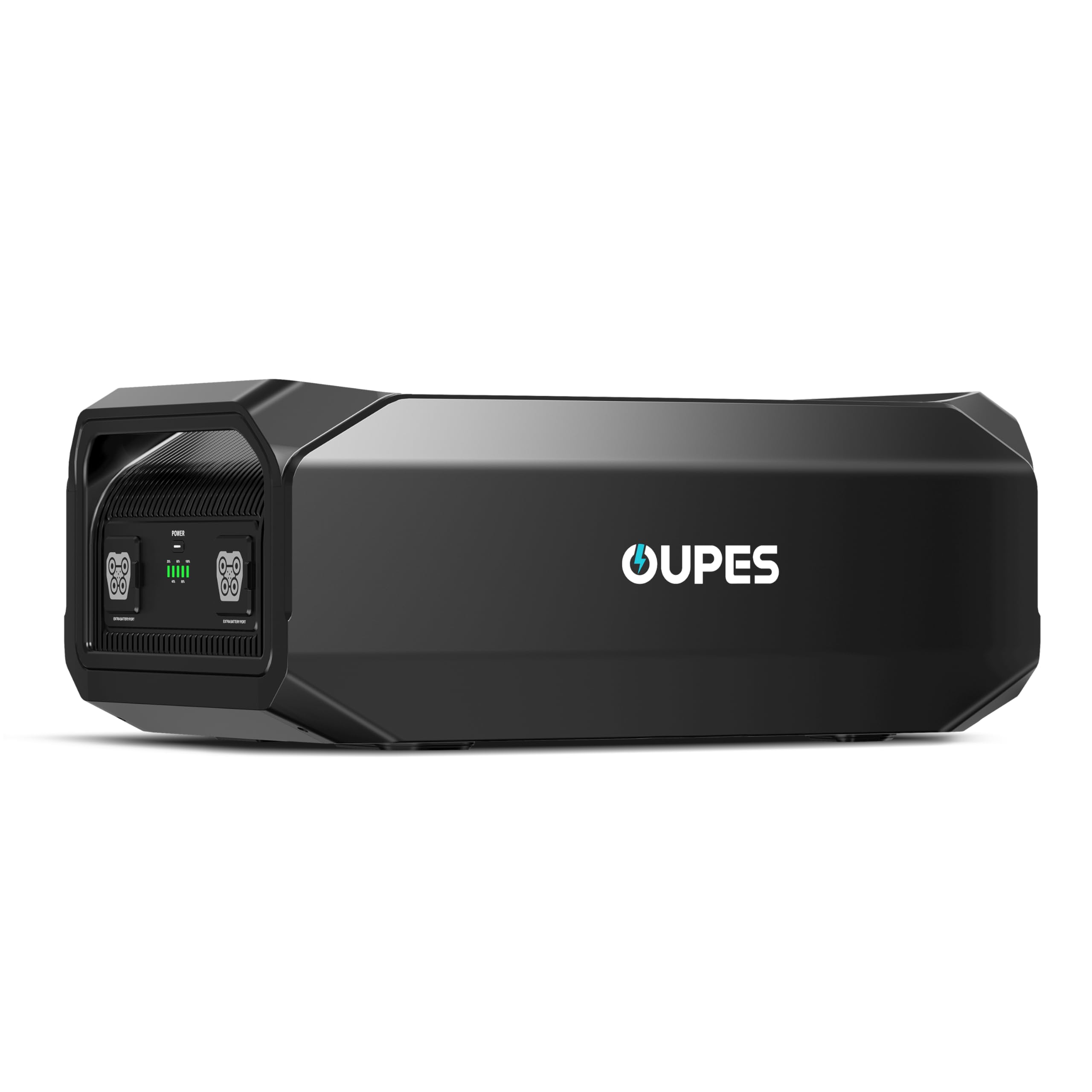
The add-on battery that doubles a Guardian 6000’s runtime — and holds more capacity than the Jackery itself.
This one is a specific tool, not a station: it only works with an OUPES Guardian 6000, which you already need to own. What it delivers is 4608Wh of extra LiFePO4 capacity through a simple plug-and-play link. That is the largest single battery block in this lineup, and it beats the Jackery HomePower 3600 Plus’s 3584Wh built-in figure.
The scaling story is the real point. Add up to 8 G5 batteries total for a 41,472Wh (41kWh) home-backup ecosystem. At 80 pounds, it is closer in weight to the Jackery than to the Anker, so it stacks on shelves more easily than a full second station. It connects to the Guardian’s power management system for balanced charging and unified app monitoring.
What buyers praise most is performance — it powers a whole house minus the HVAC, which is the honest ceiling for a single station plus this pack. The caveat is connectivity: WiFi pairing draws complaints, and battery reports split, with some seeing 18 hours across multiple fridges and others stalling at a partial charge. Expect the app to need patience.
What It Brings
- 4608Wh of LiFePO4 — the largest add-on capacity here
- Scales to 41,472Wh with up to 8 batteries
- LiFePO4 cells rated 4000+ cycles, quoted at a 10+ year lifespan
- Automatic balance-sharing with Guardian 6000’s management system
Before You Buy
- Only useful if you already own a Guardian 6000
- WiFi connectivity is the weak spot
- Charging can stall below full, so top-ups take monitoring
Makes sense for: a Guardian 6000 owner who wants to double runtime without buying a second station.
skip it if: you are starting from scratch — this battery needs a Guardian 6000 to plug into.
5. OSCAL PowerMax 6000 Solar Generator
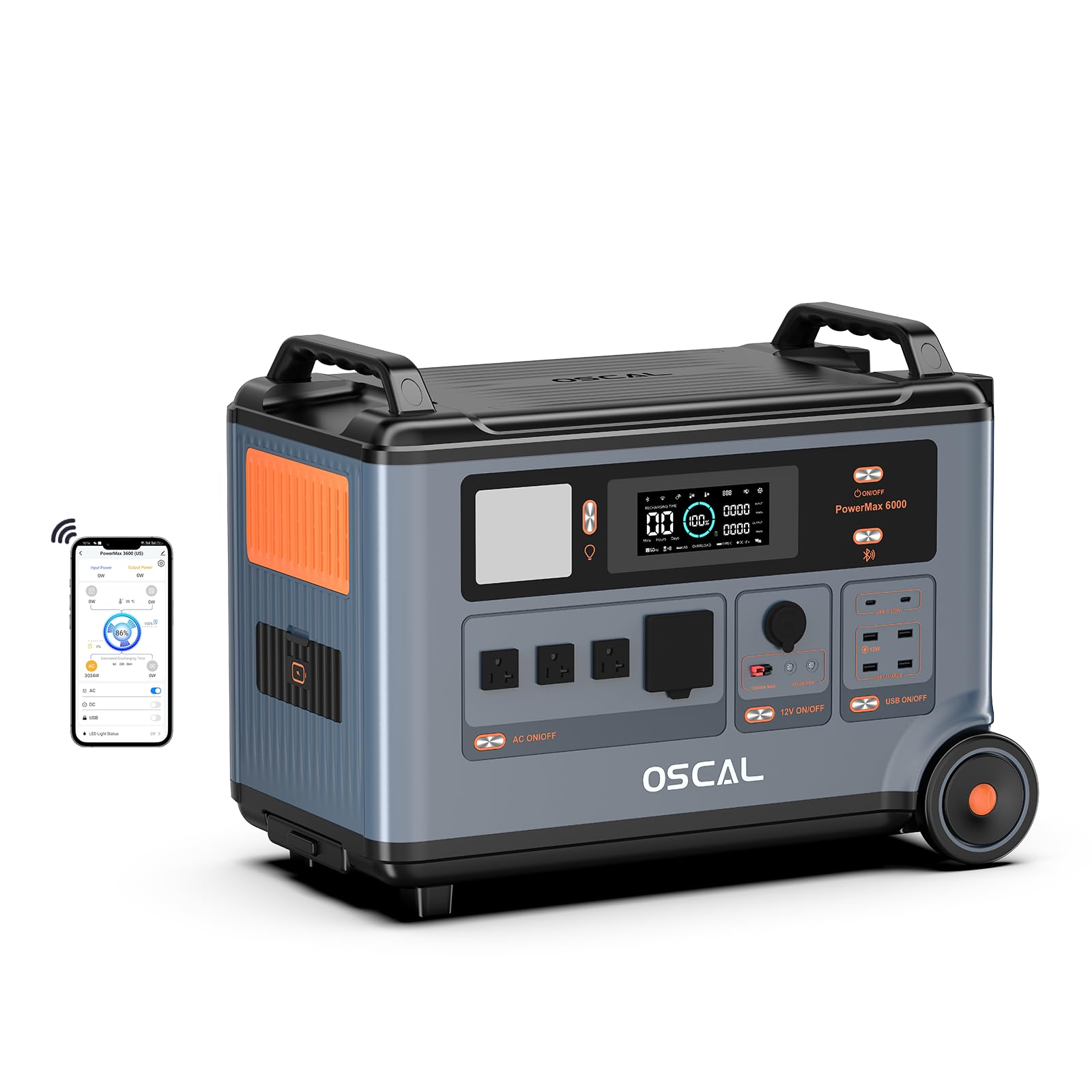
A 6000W unit that refills from empty to full in 1.44 hours on AC-plus-solar input.
Recharge speed is where this unit makes its case. Drop 2200W of AC input and 2400W of solar together and you go 0–100% in 1.44 hours. On AC alone, the 2200W bi-directional inverter gets you there in 1.96 hours. Capacity is 3600Wh of LFP, with a 6000W output and 9000W surge across 4 AC outlets and 14 outlet sources in total.
The 120V/240V split-phase output keeps heavy appliances in play, and the EPS feature switches over in 5–8 ms during an outage. Battery chemistry is LFP, rated for 3500 charge-discharge cycles with an eight-layer BMS protecting against overcharge, over-discharge, over-voltage, over-current, short circuits, and temperature swings. Expansion reaches 57.6kWh.
Build confidence is what buyers report most — the unit feels well-made in hand. The honest follow-up question is solar connectivity: complaints cluster around limitations in how panels connect, so budget time to sort that before you rely on it off-grid. The Smart Life app handles monitoring and remote commands.
The standout: a 1.44-hour AC-plus-solar recharge means a fast turnaround between outages.
Where it needs care: 45.5 kg is heavy enough to demand a fixed home spot, and solar panel connection is the weak link to plan for.
Fits best: buyers who want a high-output 6000W station and the fastest refill of the group.
Weigh the risk if: solar is your main recharge route — plan the panel connection carefully first.
Know the Specs
Capacity in Wh
Watt-hours are the size of the fuel tank. Higher Wh means more hours before a recharge, but the number you care about is how many hours your specific appliance list needs. Expandable units let you add capacity later, while a fixed unit locks in its tank from day one.
AC Output and Surge
Output wattage is what the unit can run continuously; surge is the brief spike a motor draws at startup. A 6000W output with a 9000W surge handles more demanding startup loads than a 3600W unit. Match both against the label on your appliance.
Dual Voltage and Current Rating
120V/240V split-phase is what makes a dryer or well pump possible. The current rating in amps shows how much load the outlet carries safely — 30 A for the DELTA Pro 3 versus 25 A on the Anker. Check it against your breaker before you connect a hardwired circuit.
Chemistry and Cycle Life
LFP (lithium iron phosphate) cells tolerate deep cycling and are the standard for home backup. Cycle ratings in the thousands are the manufacturer’s claim of how many full charges the battery endures before capacity drops. A higher number means a longer usable window, if the unit is kept in reasonable conditions.
Common Questions
Does a 220V solar generator run a well pump or dryer?
How long will a 4096Wh unit actually run my fridge?
Can these charge from solar panels directly?
What does split-phase 120V/240V output mean for me?
How long does a LiFePO4 battery last in daily use?
Can I charge these with my EV charger?
Will it switch over fast enough for computers and a router?
Can I add batteries later instead of buying a bigger unit?
Are these safe to keep inside the house overnight?
How much does a 220V solar generator weigh to move around?
The Bottom Line
The strongest all-round match for a typical home is the Jackery HomePower 3600 Plus. It combines 120V/240V dual voltage with a 3584Wh capacity, a 2-hour hybrid recharge, and a wheeled 77.2-pound body you can actually move. For EV and RV owners, the Anker SOLIX F3800 wins on the NEMA 14-50 port and its 6,000W output. If you want the quietest whole-home unit and can reach 48kWh, the EF ECOFLOW DELTA Pro 3 is the one to reach for. For fast refill and high output, look at the OSCAL PowerMax 6000; and if you already own a Guardian 6000, the OUPES G5 is the straightforward way to double runtime. Budget your capacity against your actual appliance list, and any of these will keep the lights on when the grid drops.
How we choose
We do not accept paid placement. Every pick is matched to a real buyer and a real use-case; we do not hands-on test units.
Sources
Specifications: manufacturer listings and product documentation. Review insights: verified customer reviews, as of November 2026. Pricing: not shown on this page (it changes often); check the current price via the retailer link.
As an Amazon Associate, My Heart Lives Here earns from qualifying purchases. This does not affect which products we feature.