Heads up: This post contains affiliate links. As an Amazon Associate I earn from qualifying purchases, at no extra cost to you. Learn more
Specs are compiled from manufacturer listings and verified buyer reviews and can change over time — please confirm the key details on the product page before buying.
If your tap water tastes off, smells of chlorine, or you simply do not trust what comes out of the municipal line, you have two honest paths: filter the water you already have, or pull moisture straight out of the air. The nine machines below split cleanly into those two camps. Reverse osmosis purifiers push tap water through a membrane that strips out dissolved solids, leaving near-zero. True atmospheric generators condense drinking water from humidity with no plumbing at all. The right one for you depends on where you live and what you are trying to escape.
This guide is built by comparing the manufacturers’ published specifications and the patterns across verified customer reviews, so you get each pick’s real strengths and trade-offs instead of marketing spin.
Each model below earns its counter space for a different reason, and each comes with its honest catch spelled out. The question is which one fits your kitchen, your climate, and your patience. This guide to the altitude water machine lays that out plainly so you can choose with confidence.
Top Picks
How To Choose The Best Altitude Water Machine
The first decision is not brand or button count — it is whether you have a water line worth filtering at all. A reverse osmosis system needs a feed tank you refill with tap water, so it only makes sense where the tap supply exists and runs. An atmospheric generator skips the tap entirely and harvests humidity, which is the only real option for an off-grid cabin, a boat, or a disaster kit. Answer that question first and half the list eliminates itself.
Match the machine to your climate, not the brochure
An atmospheric water generator’s output is tied directly to the air around it. The Pure AirWater A10 is rated to work best above 40% relative humidity and above 59°F, and its maximum 10L per day assumes 86°F with 80% humidity. In a dry, cold room you will get far less. If you live somewhere humid, a generator is genuinely practical; in a desert climate, a filter system is the safer buy.
Read the pure-to-drain ratio before you commit
Every RO system wastes some water to flush its membrane. A 3:1 ratio sends three cups of clean water through for every one cup down the drain, while a 5:1 ratio pushes that further in your favor. On a metered water bill this adds up over a year, and in a drought-prone area it matters more than any cosmetic feature.
Decide how much daily water you actually drink
A pitcher-based purifier that holds a couple of liters suits one or two people. A system with a 5L feed tank and a removable pitcher suits a family filling bottles all day. Generators sit at the low end — a 10L-per-day ceiling that you share across cooking and drinking — so be honest about your household’s real consumption before you pay for the technology.
Side-by-Side Comparison
| Model | Best For | Capacity | Install Type | Weight | Amazon |
|---|---|---|---|---|---|
| VonWater CT910 7-Stage RO★ Best Overall | Families filtering tap water | 528 gallons | Countertop | 15 pounds | Amazon |
| LifeWell S20 Atmospheric GeneratorNo Plumbing Needed | Off-grid and no-plumbing setups | 10 liters | Countertop | 17.1 kg | Amazon |
| DREO WF511 7-Stage RODual Pitcher Setup | Dual-pitcher convenience | 5 liters | Countertop | 14.6 pounds | Amazon |
| Aigerri UV 5-Stage RO | Efficient 5:1 water use | 529 gallons | Countertop | — | Amazon |
| H2o Labs Stainless Distiller | Purest possible water | 1 gallon | Countertop | — | Amazon |
| SimPure Y9A UV Alkaline RO | Fast remineralized water | 300 gallons per day | Countertop | 16.5 pounds | Amazon |
| Avalon A52 Bottle Filler | Offices and high-traffic rooms | 1500 gallons | Freestanding | 46 pounds | Amazon |
| Avalon A51 Wall Fountain | Wall-mounted cooling station | 1500 gallons | Wall Mounted | 72.2 pounds | Amazon |
| Pure AirWater A10 | Humid climates and RVs | 2.6 gallons | Desktop | 32 pounds | Amazon |
Detailed Reviews
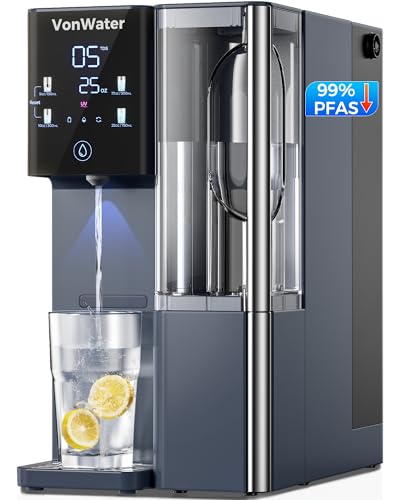
1. VonWater CT910 7-Stage Countertop RO System
Our pick — 4.0+★ from 300+ verified ratings; the strongest balance of quality and price.
A twelve-month filter that turns a refilled tank into pitcher-after-pitcher of clean water, no plumber required.
For a renter who wants bottled-water taste without drilling a hole in the counter, this is the machine to beat. The CT910 purifies water down to 0.0001μm — that is a tenth of a micron, small enough to catch dissolved salts and metals — and carries NSF 372, 53, 42, and 58 certification. In plain terms, the four independent checks cover lead reduction, contaminant removal, and lead-free materials. It holds a 528-gallon filter that the maker says lasts up to 12 months, and a 3:1 pure-to-drain ratio means only one cup is wasted for every three you drink.
What wins people over is the taste and the total absence of install hassle. The tank fills from the tap, and the system starts producing automatically the moment you plug it in. The detachable 1.2L pitcher lets you carry purified water to a bedroom or office desk instead of standing at the counter. Five volume settings — 4oz, 8oz, 12oz, 17oz, and unlimited — make filling a glass or a bottle a one-press job. The real-time TDS display (total dissolved solids, a readout of how many particles are still in the water) is the quiet hero here. It tells you at a glance whether the membrane is still doing its job instead of leaving you to guess.
The catch is the pump noise and the refill rhythm. You are trading a fixed plumbing connection for a tank you top up manually, and the 5.5L feed tank empties faster than you expect if the whole family is drinking from it. Set it next to a sink so refilling is a ten-second job and this becomes a non-issue. It sits at 15 pounds and stands 15.3 inches tall, so plan a spot with a little headroom above the lid.
Where it earns the crown
- NSF 372, 53, 42, and 58 certification on a single all-in-one filter
- 528-gallon filter life rated up to 12 months, with a twist-and-lock swap
- 3:1 pure-to-drain ratio wastes less than typical RO units
- 1.2L detachable pitcher lets you pour away from the machine
- Real-time TDS readout removes the guesswork on filter health
What to plan around
- Manual tank refills — no permanent water line
- Pump cycles audibly while producing water
- Needs a little vertical clearance for the lid
Reach for this if: you want certified tap-water filtration on a countertop with zero plumbing and a pitcher you can carry room to room.
Look elsewhere if: you need an unlimited supply fed straight from a water line rather than a tank you refill.
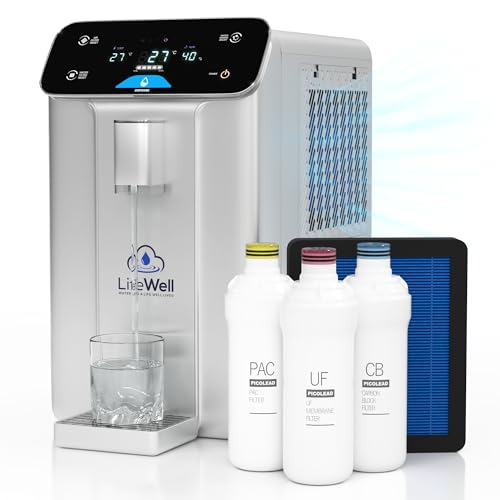
2. LifeWell S20 4-Stage Atmospheric Water Generator
This is the true “altitude water machine” of the list — it makes drinking water straight from the air around it.
If you have no water line — a trailer, a boat, a clinic in a remote spot, a cabin off the grid — the S20 is doing something no filter on this list can do. It draws moisture from the air, runs it through a four-stage purification chain including UV treatment, and produces up to 10 liters (2.64 gallons) per day in optimal conditions. That 10 liters is the whole daily ceiling, so treat it as a small household’s supply, not a whole building’s. You plug it into a standard 110V outlet and it runs itself.
The automation is the point. Built-in alarms flag any fault so you are not left guessing why production stopped, and the interface stays simple enough to run without a manual. It measures 12″ long by 26″ wide by 19″ tall and weighs 17.1 kg, so it wants a dedicated counter or floor corner rather than being shuffled around daily. For disaster prep or an RV where bottled water takes up precious storage, that trade of space for self-sufficiency is usually worth it.
Understand what “optimal conditions” means before you buy. Output depends on how much moisture is in the air, so a humid coastal room performs very differently from a dry mountain one. The S20 earns its place for the buyer whose situation rules out a tap-water filter entirely. That buyer should expect to manage output expectations rather than treat 10 liters as a guarantee any day of the year.
Self-reliant by design: no plumbing, no cartridges tied to a municipal supply, and a UV stage that adds a layer beyond plain carbon filtration.
The honest caveat: daily output is climate-dependent, and portability is limited by the 17.1 kg frame — plan where it lives before it arrives.
Buy it for: off-grid, RV, boat, or emergency use where there is no water line to filter.
Hold off if: you are in a dry climate or want a guaranteed daily volume regardless of weather.
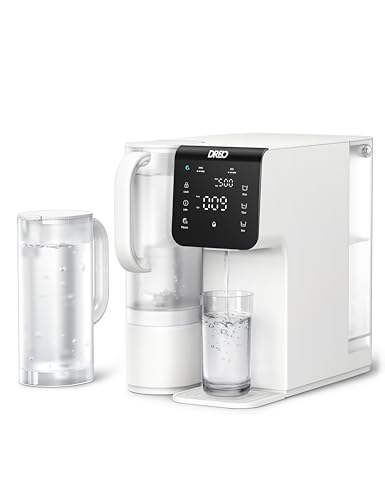
3. DREO WF511 7-Stage Reverse Osmosis Water Filter
Two pitchers, one auto-refilling in the background, so the next glass is always waiting.
DREO solves the one annoyance every pitcher-based purifier has: running dry mid-pour. You get two BPA-free pitchers, and while you drain one, the second refills itself behind the scenes. The filtration is a genuine 7-stage chain with a 0.0001μm reverse osmosis membrane that the maker says was independently tested by SGS to remove 99.99% of 1,000+ contaminants including heavy metals and fluoride. Reviewers focus on effectiveness and taste — the chlorine note people complain about in tap water simply vanishes.
The footprint is the practical difference here. At 15.91″ long by 9.06″ wide by 13.07″ tall, it is a more compact counter guest than the VonWater, which measures 8.2″ long by 13.4″ wide by 15.3″ tall. Weighing 14.6 pounds, it is also marginally lighter than the VonWater’s 15 pounds. Filter life is rated up to 1,050 gallons per set of one RO and two PPC filters, a figure DREO equates to roughly 8,000 single-use bottles avoided. The child lock and auto-flush round out the safety picture for a household with kids.
The recurring gripe is value: some buyers feel the filter cost over time is steep relative to what they expected, and a handful have hit leak issues. Both are worth weighing if you are on a tight budget, though the majority of users land firmly on the satisfied side and the appearance draws its own compliments. If you want the convenience of a standing pitcher plus filtered water on tap, this is the dual-pitcher specialist to pick.
Why the dual-pitcher idea works
- Second pitcher auto-refills so you never run dry mid-pour
- 7-stage chain with a 0.0001μm membrane rated for 99.99% removal
- Compact 15.91″ x 9.06″ x 13.07″ frame at 14.6 pounds
- Real-time TDS readout plus a filter-life indicator
- Auto-flush and child lock built in
The fair trade-offs
- Replacement filters add running cost some find steep
- A handful of units have leaked
- 5L capacity means frequent refills for large households
The pitcher-perfect pick for: small households that want grab-and-go filtered water without waiting on a single tank to refill.
Weigh the filter math first if: long-term cartridge cost is your deciding factor.
4. Aigerri UV Reverse Osmosis Countertop System

A 5:1 ratio that wastes the least water per glass of any RO system here, with UV stacked on top.
For anyone on a metered supply or in a region where every drop counts, this is the efficiency leader. The 5:1 pure-to-drain ratio means five cups of clean water for every one that flushes away — a more frugal setup than the 3:1 systems that dominate the countertop RO field. It pairs a 5L feed tank with a separate 2L purified tank so you always know how much drinking water is actually ready, and the pre-installed PPC and RO filter set is rated up to 529 gallons.
Where it pulls ahead: 529 gallons against the VonWater’s 528 gallons is a wash, but the filtration brings UV treatment into the chain, adding a sterilization stage that carbon and membrane alone do not cover. Owners cite the compact footprint and the easy tank removal for refills as reasons they stick with it.
The honest downsides show up in the reviews too. A share of users report leakage over time, and filter durability draws divided opinions, with some finding it long-lasting and others seeing a failure inside a year. Value is also a mixed note. None of that disqualifies the machine — it is a performance-first unit and the majority of owners are clearly happy. But if you want a low-maintenance filter with zero maintenance attention, know going in that you will need to watch the seals now and then.
Efficiency is the headline: 5:1 beats 3:1 on wastewater, and the 5L-plus-2L tank split makes it easy to see exactly how much is ready to drink.
Where to stay alert: check the seals periodically and keep an eye on the filter-life indicator, since leakage and cartridge lifespan are the two recurring notes in the feedback.
Choose this when: water efficiency and UV sterilization matter more to you than a pitcher you can carry away.
Think twice if: you want a maintenance-light unit and would rather not keep an eye on connections.
5. H2o Labs Stainless Steel Water Distiller
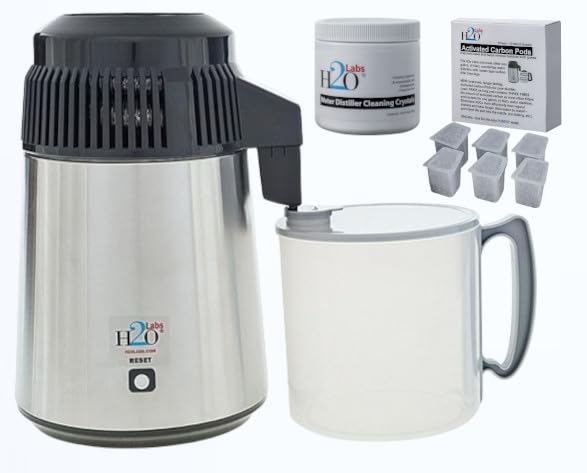
Distillation done the old way — a steel steam chamber, a single button, and water stripped to almost nothing.
Distillation is a different route to purity than reverse osmosis: instead of pushing water through a membrane, it boils water into steam and condenses it back, leaving nearly everything behind. The entire steam chamber — bottom, sides, and dome — plus the full length of the condensing coil is 100% stainless steel, grade 304 (also called 18/8), which keeps the boiling environment all-metal rather than plastic-lined. The 565-watt heating element is deliberately sized, because the maker argues a bigger element boils too fast and can carry contaminants into the steam.
It comes ready to run: a one-gallon carafe, a jar of cleaning crystals for hard-water scale, and a year’s supply of the maker’s activated carbon pods are all in the box. Startup is a single button, and it shuts off automatically when a cycle finishes. That simplicity suits someone who wants pure water and zero programming. Owners keep coming back to the build quality of the all-steel chamber.
Taste divides people more than anything else about distillation: some love the dead-clean, flat profile, others find distilled water tastes empty because the minerals are gone. It also runs one gallon at a time, so a thirsty household will cycle it often. If maximum purity from an all-steel chamber is the goal and you are fine with smaller batches, the H2o Labs is a considered, old-school choice that does exactly one thing without compromise.
Why the steel build appeals
- Full steam chamber and condensing coil in grade 304 stainless steel
- Single-button operation with automatic shut-off
- Carafe, cleaning crystals, and a year of carbon pods included
What to keep in mind
- One-gallon batch size means frequent cycles
- Mineral-free taste is a matter of personal preference
- Needs periodic descaling from hard-water scale
Made for: buyers who want the purest water possible and prefer an all-steel chamber with no digital settings.
Not the fit for: anyone who wants large volumes at once or dislikes the flat taste of mineral-free water.
6. SimPure Y9A UV Countertop Reverse Osmosis Filter

The glass-filling machine — eight ounces in eighteen seconds, with minerals added back in.
Waiting is what people hate about countertop RO (reverse osmosis, a membrane filter that strips dissolved solids from tap water), and this one is built to end it. Under standard conditions of 60 psi (pounds per square inch, the water pressure pushing through the line) and 77°F, the Y9A produces about 4.4 ounces in 10 seconds and fills an eight-ounce glass in 18 seconds. Most countertop RO units only manage 50 to 75 gallons per day and take over a minute for the same pour. Its own ceiling is 300 gallons per day. That speed is the entire reason to pick it over a slower pitcher-style system.
The second differentiator is the post-mineralization filter, which puts calcium, magnesium, and potassium back into the water and lifts it to 50-80 ppm after mineral addition. That gives you a taste closer to natural spring water rather than the flat, stripped flavor plain RO produces. The 6-stage chain uses a 0.0001μm membrane rated to cut TDS by up to 99.88%, and it targets PFAS, PFOA, PFOS, lead, chlorine, nitrates, and fluoride. Its side-mounted, see-through tank lets you refill without dragging the unit forward, and at 16″ long by 9.3″ wide by 14.3″ tall it fits under standard cabinets with 18 inches of clearance.
One thing to understand: because the alkaline stage adds minerals back, the TDS number will read higher than a non-remineralizing system. That is normal, not a filter failing. Filter swaps are recommended every 6 months for the PPC and ALK filters and every 9 months for the RO membrane — a steady upkeep rhythm to plan for. For the buyer who wants fast, mineral-rich water from a modern apartment counter, the speed and the taste make the maintenance cadence easy to accept.
Speed you will notice daily: 4.4 ounces in 10 seconds means no standing around, and the remineralizing stage gives you calcium, magnesium, and potassium instead of stripped-flat water.
Plan the upkeep: PPC and ALK filters every 6 months plus an RO swap every 9 months — budget for that cadence and the machine will keep pouring fast.
Ideal for: impatient households that want a fast pour and prefer water with minerals added back.
Skip if: you want the lowest possible TDS reading, since the alkaline stage intentionally raises it.
7. Avalon A52 Freestanding Bottle Filler
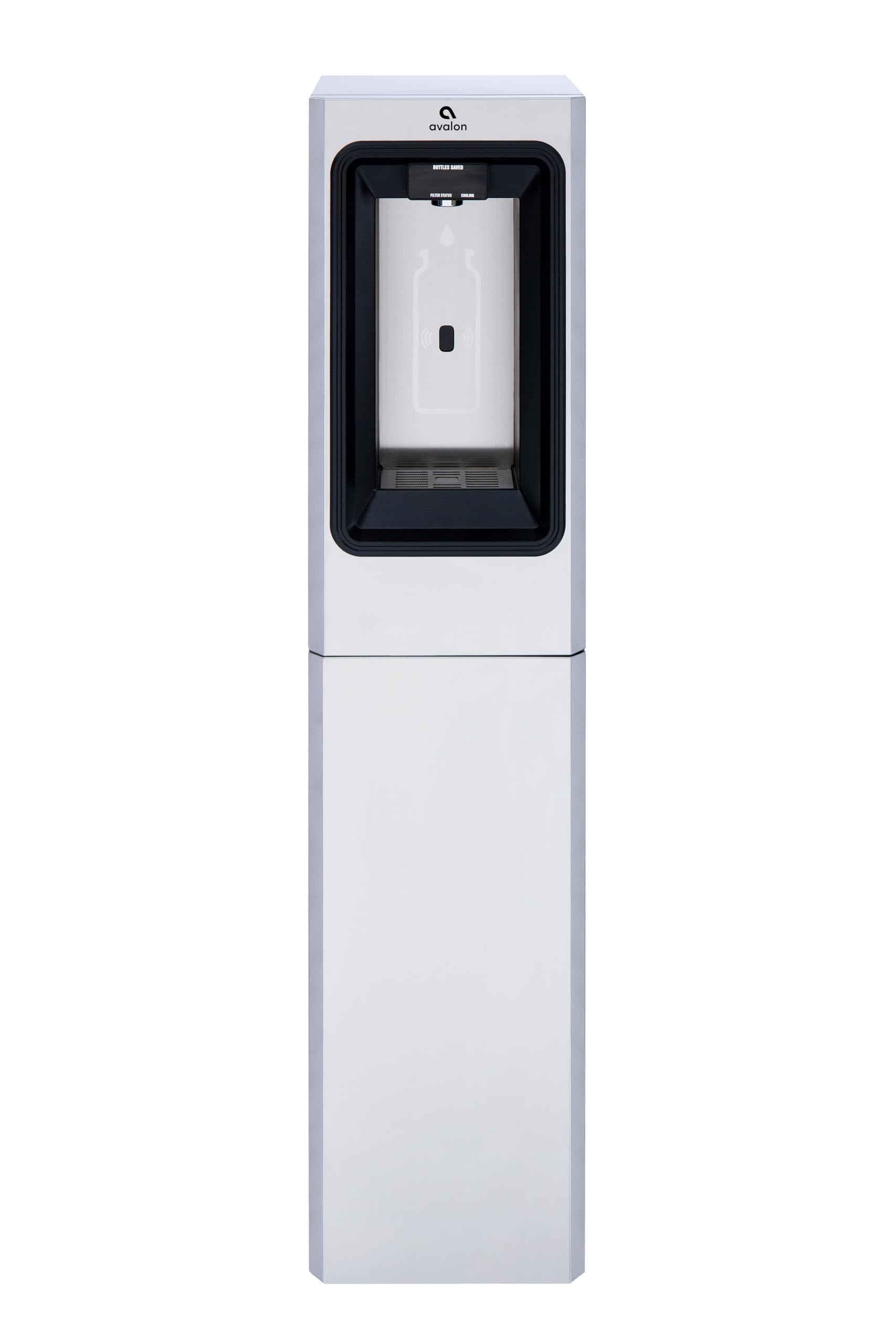
A hands-free bottle station that fills, counts the bottles saved, and phones home when the filter is due.
A kitchen purifier is the wrong tool for a breakroom or a gym — you want a station people can walk up to and fill a bottle without touching a thing. The A52 does exactly that: an infrared sensor starts the flow the moment your bottle is in the zone, so no hands, no cross-contact, no spilled cups. The dispense area is built for real bottles at 3.25 by 8 by 12 inches with 11.5 inches of clearance below the spout, which fits the large refillable flasks office workers actually carry.
Two features keep it honest over months of heavy use. First, a digital display tracks bottles saved so the whole room sees the impact, and a replace-filter indicator lights up right when it should. Second, WiFi ties it to the Avalon app so you can check usage and filter life from wherever you are — handy when the machine is on another floor. Filtration is a patented dual setup with a sediment filter and a carbon block that last 6 months or 1500 gallons, and a self-cleaning cycle handles sanitizing between swaps.
This is the freestanding model, so it stands on its own at 48.5 inches tall and 46 pounds rather than lending itself to being moved often. It is not a cooling unit — it filters, it does not chill — so if you specifically need cold, look at the wall-mounted Avalon below. For a waiting room or a busy office that wants clean, touchless filtered water and simple filter management, this is a sensible workhorse.
Built for shared spaces: the touchless sensor, the bottles-saved counter, and the app-connected filter alerts all reduce the daily upkeep for whoever manages the room.
Set expectations: it filters and sanitizes but does not cool the water, and at 46 pounds it is a fixed fixture rather than a portable one.
Made for: offices, clinics, gyms, and waiting rooms where many hands fill many bottles each day.
Look to the A51 instead if: you want chilled water and a wall-mounted footprint.
8. Avalon A51 Wall Mounted Water Fountain with Bottle Filler

Cold filtered water off the wall — touchless, self-cleaning, and built to ADA clearances for public spaces.
When the priority is chilled water for a building, this is the one that delivers it. Its high-capacity cooling runs on a hermetically sealed compressor with a copper-tube winding cooling tank, so it produces genuinely cold water for a steady stream of users rather than a small reservoir that runs warm by midday. The touchless infrared sensor lets anyone fill a bottle or their hand-held bottle hands-free, and the self-cleaning cycle sanitizes the unit between uses.
It shares the same proven filtration as its freestanding sibling. That means a patented dual setup with a sediment filter and a carbon block that last 6 months or 1500 gallons, plus the same bottles-saved digital counter and replace-filter indicator. Because it mounts to the wall at 19″ deep by 17.5″ wide by 39″ tall, it keeps floor space clear. That matters in a hallway or a gym where floor area is at a premium. At 72.2 pounds it needs a solid wall connection to hang safely.
Honesty on the reliability picture: water quality is what owners praise, but reliability draws split feedback, with some reporting it works well and others finding it less dependable long-term. That is worth weighing for a commercial install where downtime hits hard — but it does not erase the fact that this is a fully featured, ADA-compliant fountain with cold water and dual filtration. Choose it if you want cooling and a legal-clearance wall mount in one unit.
The cold-water angle: a compressor and copper-tube cooling tank keep water chilled for high traffic, and ADA compliance makes it a fit for public-facing buildings.
Weigh the dependability debate: reliability feedback is genuinely mixed, so factor in service support if the fountain runs all day in a busy facility.
Right for: offices, schools, or gyms that need chilled, ADA-compliant, touchless filtered water in a wall-mounted format.
Consider carefully if: long-term dependability is your top concern and you cannot afford service interruptions.
9. Pure AirWater A10 Atmospheric Water Generator
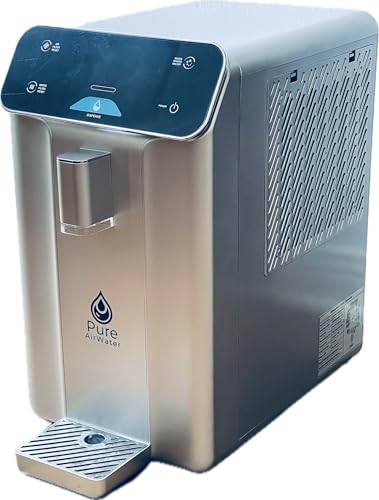
The go-anywhere generator that can run off solar, for places where a water line will never reach.
For the boater, the trailer owner, or anyone planning for emergencies, this machine’s value is independence. It extracts moisture from the air and runs it through PAC treatment (powdered activated carbon, which pulls out odors and chemicals), ultrafiltration (a fine membrane that traps tiny particles), a carbon block filter, and UVC-LED sterilization (ultraviolet light that kills microbes). Then it stores the water in a food-grade polypropylene tank. No plumbing, no tap water, no installation. Plug it into an outlet, or connect it to solar panels paired with a power station or battery bank, and it keeps making water where the grid and the pipe do not go.
Understand its working envelope before you count on it. It performs best above 40% relative humidity and above 59°F, and its maximum output of 2.64 gallons (10 liters) per day assumes 86°F and 80% humidity. In cooler, drier air you will see less. Reviewers praise its effectiveness — it pulls humidity out of the room and produces clean, good-tasting water — and call setup straightforward. A 32-pound, 14.5″ by 10″ by 17.5″ desktop footprint means it needs a committed spot.
Capacity is the honest trade-off: some users find it takes longer to produce water than they expected, which is simply the physics of condensation. Treat the listed maximum as an ideal-weather figure and plan your drinking around the real humidity where you are. For a humid-climate household or an off-grid setup, this is a legitimate drinking-water source that needs no infrastructure at all — just patience on a slow, dry day.
Where the independence shines
- No plumbing, no tap water — just power and air
- Solar-compatible for off-grid and emergency setups
- Layered purification with PAC, ultrafiltration, carbon block, and UVC-LED
- Food-grade polypropylene tank
Real limits to accept
- Output depends on humidity and temperature
- Slow production on cooler, drier days
- 32 pounds is fixed, not portable
Turn to this when: you have no water line at all and need a self-contained source for a humid climate, an RV, a boat, or a disaster kit.
Look past it if: you live somewhere dry or cold, where a filter system will simply produce more water.
Know the Specs
Pure-to-Drain Ratio
This number tells you how many cups of clean water you get for every cup the system flushes away to keep its membrane healthy. A 3:1 ratio wastes one cup per three clean; a 5:1 ratio wastes only one per five. On a water meter the savings add up, and in a drought region the ratio can matter more than any screen or button. Two picks here run 3:1 and one runs 5:1, so compare before you commit to a model.
Gallons Per Day vs Gallons Per Filter
These two figures get confused constantly. Gallons per day (like the SimPure’s 300 GPD) is how fast the machine makes water — its throughput. Gallons per filter (like the VonWater’s 528 gallons or the Avalon’s 1500 gallons) is how much total water one cartridge set will clean before a swap. Speed and lifespan are separate numbers; a fast system can still have a short filter life, and a slow one can run a long stretch between changes.
Micron Rating and TDS
A 0.0001μm rating is the membrane’s pore size — small enough to block dissolved salts and metals, not just visible particles. TDS stands for total dissolved solids, the minerals and salts left in water, and a TDS display reads that level in real time so you know the filter is still working. Watch one nuance: systems that add minerals back, like the SimPure, will show a higher TDS on purpose, because the minerals are supposed to be there.
Humidity and Temperature for Generators
Atmospheric generators pull water from the air, so their output is bound to the climate around them. The Pure AirWater’s rated ceiling of 2.64 gallons per day assumes 86°F and 80% humidity, and the machine works best above 40% humidity and 59°F. In a dry or cold room the same machine yields less — not because it is broken, but because there is less moisture to harvest. Match a generator to a humid setting or expect to wait longer.
Common Questions
What actually is an altitude water machine?
Do atmospheric generators work at high altitude or in dry air?
How much water does an atmospheric generator really make in a day?
Is a distiller or a reverse osmosis filter better for pure water?
How often do I need to replace the filters?
Why does my TDS reading go up after adding a filter?
Do these machines need plumbing or a permanent installation?
Will an RO system fit under my kitchen cabinets?
Can a generator run on solar power off the grid?
How much counter space does one of these machines take?
The Bottom Line
The strongest all-rounder here is the VonWater CT910. It brings NSF 372, 53, 42, and 58 certification (independent safety and contaminant-reduction standards), a 528-gallon filter rated up to a full year, a frugal 3:1 pure-to-drain ratio (three cups of clean water for every one sent down the drain), and a 1.2L pitcher you can carry to another room. That is most of what a household needs in one countertop box. It tops this list without carrying the highest price tag of the group.
If carrying filtered water away is your priority, the DREO WF511 and its two BPA-free pitchers make grabbing a glass easy. Want the fastest pour and minerals added back? The SimPure Y9A fills a glass in seconds and puts calcium, magnesium, and potassium back in. Efficiency-minded buyers should lean toward the Aigerri with its 5:1 ratio, and anyone chasing maximum purity will appreciate the all-steel H2o Labs distiller.
For a room full of people rather than a single kitchen, the two Avalon stations handle the traffic. The A52 freestanding filler suits bottle-through traffic, and the A51 wall fountain gives you chilled water on the wall. If there is no water line at all, go straight to the generators. Pick the LifeWell S20 for standard indoor use, or the solar-ready Pure AirWater A10 for off-grid and emergency setups. In a humid climate especially, a generator frees you from the tap entirely.
How we choose
We do not accept paid placement. Every pick is matched to a real buyer and a real use-case; we do not hands-on test units.
Sources
Specifications: manufacturer listings and product documentation. Review insights: verified customer reviews, as of November 2026. Pricing: not shown on this page (it changes often); check the current price via the retailer link.
As an Amazon Associate, My Heart Lives Here earns from qualifying purchases. This does not affect which products we feature.