Heads up: This post contains affiliate links. As an Amazon Associate I earn from qualifying purchases, at no extra cost to you. Learn more
Specs are compiled from manufacturer listings and verified buyer reviews and can change over time — please confirm the key details on the product page before buying.
Which screen actually delivers the crisp, blur-free motion you are paying for? That is the real question behind every 1ms Response Time TV search, and the honest answer is that a low millisecond figure on the box tells you very little on its own. What matters is how fast the panel changes each pixel, how high the refresh rate goes, and whether the display handles fast action without smearing. This guide walks you through eleven screens that get that motion job done — from value Mini-LED sets to OLED monitors with near-instant pixel switching — and shows you exactly which one fits how you watch.
This guide is built by comparing the manufacturers’ published specifications and the patterns across verified customer reviews, so you get each pick’s real strengths and trade-offs instead of marketing spin.
You want fast motion to stay clear, so each pick below shows how quickly the screen reacts and what that means when a ball flies across the field or a camera whips around a corner. These 1ms response time tv options cover living-room and desk setups without the hype.
Top Picks

How To Choose The Best 1ms Response Time TV
The single biggest mistake buyers make here is treating one millisecond as a magic number that guarantees smooth motion. Response time describes how quickly a pixel shifts from one color to the next, measured in milliseconds — a lower figure means less ghosting, the faint trail that follows a fast-moving object. But a screen can have a fast pixel and still look soft if its refresh rate is low, so you need to read both numbers together.
Response Time vs Refresh Rate
Refresh rate is how many times per second the screen redraws the picture, written in hertz (Hz). A 144Hz panel redraws 144 times a second, while a 240Hz panel does it 240 times. Response time and refresh rate work as a pair: a fast pixel on a slow panel still leaves gaps between frames. For sports and action movies, a high refresh rate keeps the ball trackable and the camera pans steady.
Panel Type: OLED vs Mini-LED LCD
OLED pixels make their own light, so they can switch off completely for true black — that is why OLED screens often list response times like 0.03ms. Mini-LED LCDs use a backlight behind the panel, which needs local dimming zones to darken parts of the image. More zones mean tighter control and less blooming, the halo that can glow around a bright object on a dark background.
Ports and Gaming Features
If a console or gaming PC is part of the plan, check for HDMI 2.1 ports, which carry the higher frame rates modern consoles output. Variable Refresh Rate (VRR) lets the screen match its refresh to the frame rate of the game, cutting stutter and tearing. Auto Low Latency Mode (ALLM) drops the TV into its low-delay game setting the moment a console wakes up.
Brightness, Glare, and Room Light
A bright room punishes a dim screen. Anti-glare coatings reduce reflections from windows and lamps, and a higher brightness rating in nits (a measure of light output) keeps the picture punchy in daylight. If your set sits opposite a window, prioritize an anti-reflection finish over a slightly deeper black level.
Side-by-Side Comparison
| Model | Best For | Screen Size | Response Time | Refresh Rate | Amazon |
|---|---|---|---|---|---|
| Roku 55″ Plus Series★ Best Overall | Everyday living-room streaming | 55 inches | — | — | Amazon |
| Samsung Odyssey G7 (G70D)Best for Consoles | Desk gaming with smart apps | 27 inches | 1ms (GtG) | 144Hz | Amazon |
| MSI MPG 321URX QD-OLEDFastest Pixels | Fast OLED gaming and work | 32 inches | 0.03ms | 240Hz | Amazon |
| Samsung Odyssey OLED G5 | Deep blacks on a budget desk | 27 inches | 0.03ms (GTG) | 180Hz | Amazon |
| TCL 55″ QM64L | Sports and console gaming | 55 inches | — | 144Hz native | Amazon |
| Hisense 55″ U6 Pro | Bright rooms and glare-heavy spaces | 55 inches | — | 144Hz native | Amazon |
| iFFALCON 65″ U85 | Big-screen gaming and hospitality | 65 inches | — | 144Hz (VRR to 288Hz) | Amazon |
| Hisense 55″ U7 | Brightness and frame-rate ceiling | 55 inches | — | 165Hz native | Amazon |
| Roku 55″ Pro Series | Wall-mounted Roku living room | 55 inches | — | 120Hz | Amazon |
| LG 32GX850A-B UltraGear | Dual-mode 4K and esports play | 32 inches | 0.03ms (GtG) | 165Hz / 330Hz | Amazon |
| LG 39GX90SA-W UltraGear | Wide curved cinematic gaming | 39 inches | 0.03ms (GtG) | 240Hz | Amazon |
Detailed Reviews
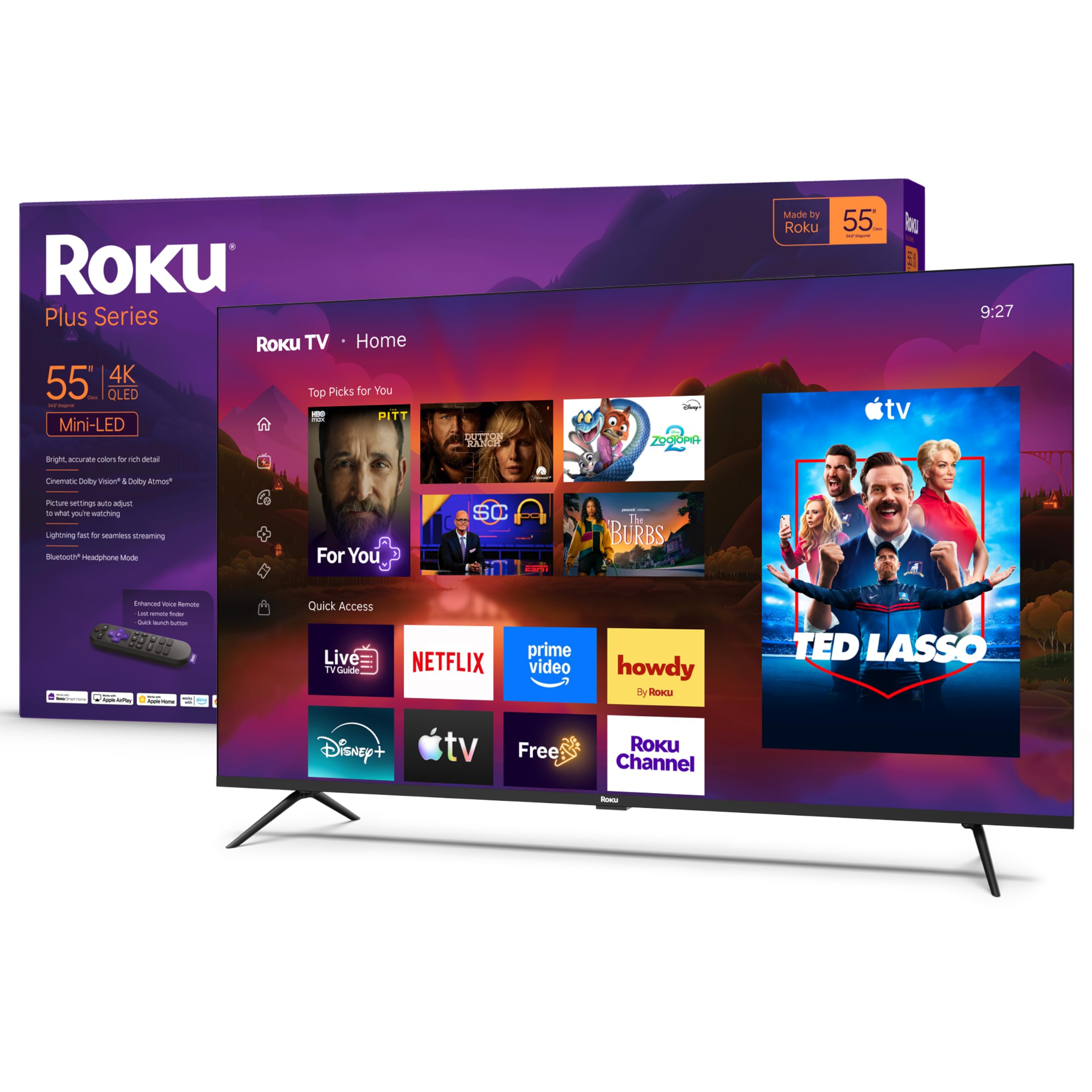
1. Roku 55-Inch Plus Series Smart TV
Our pick — 4.5+★ from 800+ verified ratings; the strongest balance of quality and price.
A 55-inch 4K QLED Mini-LED set with Dolby Vision and a Roku interface the whole household can navigate.
Here is the crowd favorite of this whole list — 4.5+ stars across 800+ ratings, and the one most people should start with. It pairs a 55-inch 4K QLED panel with Mini-LED backlighting, which means a grid of small lights behind the screen can brighten and dim in sections rather than as one flat sheet. The practical result is real depth in dark scenes and bright highlights that still look controlled.
Setup is genuinely quick, and the Home Screen is uncluttered in a way that matters if more than one person in the house has to use it. The uncluttered remote does everything without a wall of buttons, and the lost-remote finder means the deepest couch cushions stop being a crisis. Dolby Vision handles the color and highlight work, and Roku Smart Picture Max uses AI to clean up incoming signals and refine color and sharpness as scenes change.
What wins people over most is the overall build and picture package together — the pair of strengths that dominate the feedback. Value runs a close second in how owners talk about it. The honest caveat: functionality and the remote both draw mixed feelings in the review pages, so expect a small learning curve if you are coming from a different smart platform. Roku Voice, Siri, Alexa, and Google Assistant all work for voice control, and Apple AirPlay lets you push photos and video from an iPhone straight to the screen.
For motion, this is the everyday option. There is no listed response-time figure on the spec sheet, so judge it on the 55-inch canvas and the Mini-LED contrast rather than a millisecond claim.
What earns it the top spot
- 55-inch 4K QLED panel with Mini-LED backlighting for controlled highlights
- Dolby Vision plus Dolby Atmos with a built-in subwoofer
- Bluetooth Headphone Mode keeps late-night audio private
- Roku Voice, Siri, Alexa, and Google Assistant all supported
Where it asks patience
- No published response-time figure to compare against the gaming screens here
- Remote and some functions split opinion in owner feedback
Best for: Anyone who wants a big, bright 55-inch Mini-LED picture with a smart system the whole household can navigate.
Think twice if: You need a documented 1ms pixel response for competitive play — the gaming-focused panels below are the honest answer there.
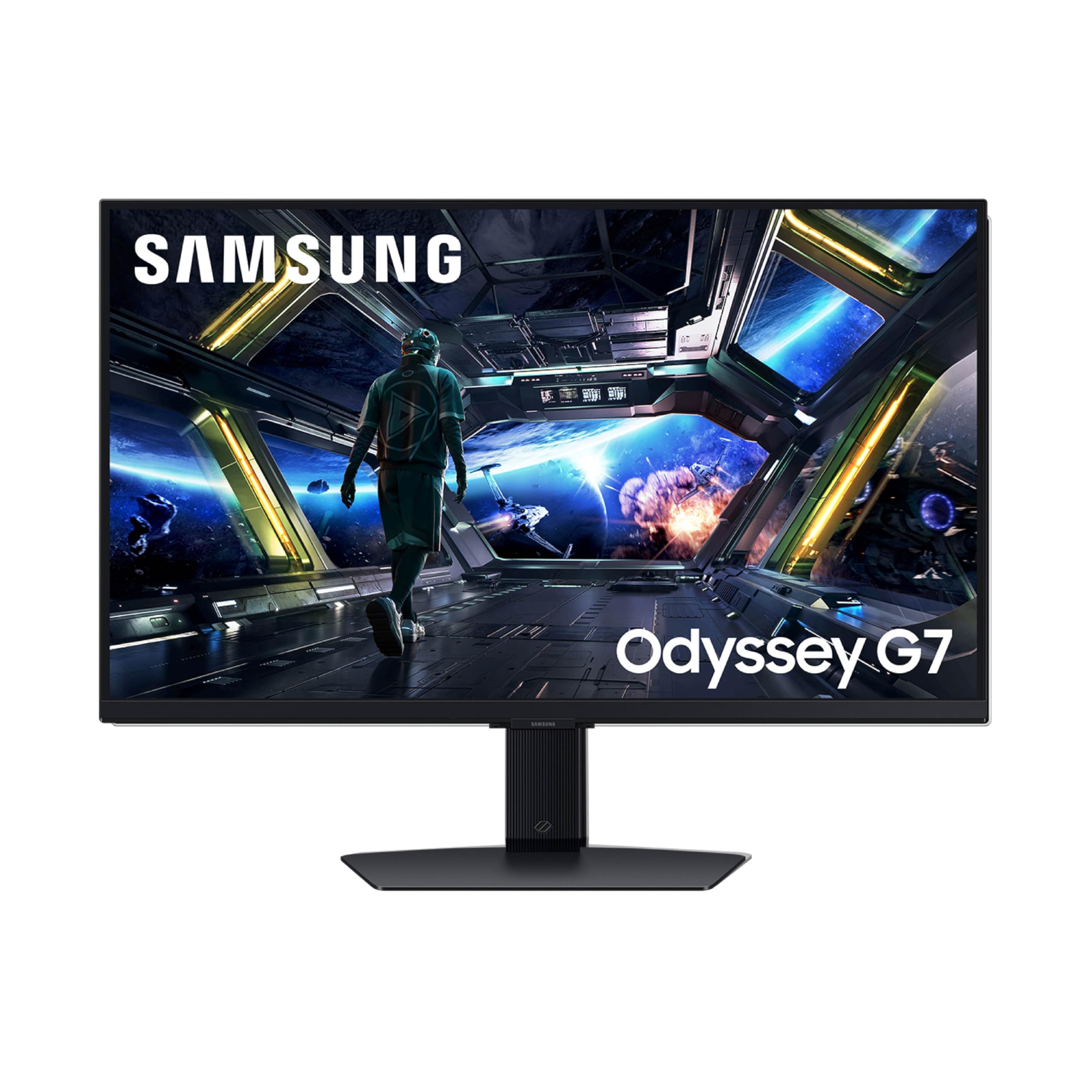
2. Samsung 27” Odyssey G7 (G70D) 4K UHD IPS Gaming Monitor
A 27-inch desk screen that carries the 1ms label this whole list is named after.
This is the literal answer to the search: a 1ms (GtG) response time, meaning the pixel grey-to-grey transition is rated at one millisecond, so fast camera moves leave far less of a trail. It sits on a Fast IPS panel at 3840 x 2160 pixels, and that is 50 percent more resolution than the 2560 x 1440 Odyssey OLED G5 below. For a desk you sit close to, that sharpness shows up in text and fine detail, not just games.
This Samsung wins on brightness and versatility. It has DisplayHDR 400 (a brightness standard for HDR content) at 350 candela per square meter (a unit of brightness), so a bright room stays watchable. A 178-degree viewing angle keeps colors steady when you sit off to the side. Gaming Hub lets you stream apps and use consoles without a PC attached. The refresh rate runs to 144Hz (144 screen updates per second), and the contrast ratio is listed at 1000:1 (the difference between the brightest white and darkest black). Compared with the G5’s 1000000:1, that is a huge gap in black depth, so expect the OLED to look noticeably deeper in dark scenes.
The recurring tension in owner feedback is that the monitor tries to be both a gaming display and a smart TV, and not everyone wants that overlap. The adjustable stand swivels, tilts, and raises, and the Dynamic Black Equalizer brightens shadows automatically so you can spot what is hiding in a dark corner. G-Sync compatibility and AMD FreeSync Premium both work to cut tearing.
The motion pitch: One millisecond grey-to-grey on a 144Hz 4K panel is a genuinely fast combination — quick enough that ghosting stops being the thing you notice during a firefight.
The honest trade-off: At 1000:1 contrast this IPS panel cannot match the OLED entries for black depth, and the smart-TV layer adds menus some buyers would rather not navigate.
Reach for this if: You want a documented 1ms 4K screen that doubles as a streaming hub for an Xbox or PC setup.
Look elsewhere if: Inky blacks matter more to you than peak brightness — the OLED picks handle that better.
3. MSI MPG 321URX QD-OLED 32″ 4K Gaming Monitor
Thirty-two inches of QD-OLED that switches pixels in 0.03ms and refreshes at 240Hz.
Compare the two numbers side by side and the gap is stark: this panel’s 0.03ms response time against the Samsung G7’s 1ms is a dramatic difference in how fast each pixel changes state. On a 240Hz refresh rate — versus the G7’s 144Hz — the screen redraws far more often per second, so high-speed racing and first-person shooters keep a cleaner edge on moving objects.
The 31.5-inch UHD panel runs 3840 x 2160 and covers DCI-P3 at 99 percent with a Delta-E of 2 or lower, which in plain terms means colors land close to what the creator intended. It carries VESA DisplayHDR True Black 400 certification and a listed brightness of 250 nits. A 90W USB Type-C port means one cable can charge a laptop while it feeds the display, and KVM support lets two computers share the same keyboard and mouse.
The build quality is what people talk about most, with color and image quality right behind it in the feedback. Performance is the split point — most find it excellent, a few hit issues. The 4-way adjustable stand and Mystic Light cover the desk-setup side, and HDMI 2.1 plus DP 1.4a keep modern consoles and PCs connected without adapters.
Picture in a sentence: 1.07 billion colors at 10-bit on a QD-OLED panel is the kind of color depth that makes a graded film look like it was meant to.
Worth knowing: At 250 nits this is not a sunlit-room champion — it is a dim-room showcase where the deep blacks carry the picture.
The right buyer: Competitive players and creators who want the fastest pixel switching on a 4K desk screen and can control the room light.
Skip the upgrade if: Your desk faces a bright window all afternoon — the brighter Mini-LED sets serve that room better.
4. Samsung 27” Odyssey OLED G5 (G50SF) QHD Gaming Monitor

QD-OLED blacks and a 0.03ms response at the most approachable desktop tier here.
If you want OLED motion without stretching to the biggest desktop screens, this 27-inch QHD model is the entry point. The contrast ratio is listed at 1000000:1 — set that against the Odyssey G7’s 1000:1 and the difference is the whole reason people chase OLED: blacks that switch fully off instead of glowing grey. The 0.03ms (GTG) response time and 180Hz refresh rate keep fast pans clean.
OLED Safeguard uses a Thermal Modulation System to help prevent burn-in by keeping the panel cool, which is the concern that keeps cautious buyers away from OLED. Glare Free technology cuts reflections so an afternoon session does not turn into a mirror. Pantone Validated coverage reproduces 2100+ colors, and HDR10 adds brighter highlights and finer shadow detail.
What wins people over here is the overall quality of the package, with value for money close behind — this is an OLED that does not feel like a compromise. Brightness and refresh rate both draw mixed reactions, so a buyer chasing peak brightness should look at the Mini-LED televisions instead. Auto Source Switch+ swaps between connected devices without you hunting through menus, and G-Sync compatibility plus AMD FreeSync work to reduce lag and tearing.
Why it earns a spot
- 1,000,000:1 contrast for true black levels
- 0.03ms (GTG) response time at 180Hz
- Burn-in protection built into the cooling system
- Pantone Validated with 2100+ colors
Points to weigh first
- Brightness splits opinion — some find it dim for a sunlit room
- QHD resolution, not 4K, on a 27-inch panel
Go for it when: You want true OLED black levels and a near-instant response time on a desk budget that stops short of the premium tier.
Hold off when: Your room is bright all day and you need a panel that fights glare with raw output rather than a matte finish.
5. TCL 55″ QM64L QD-Mini-LED 4K Smart Fire TV
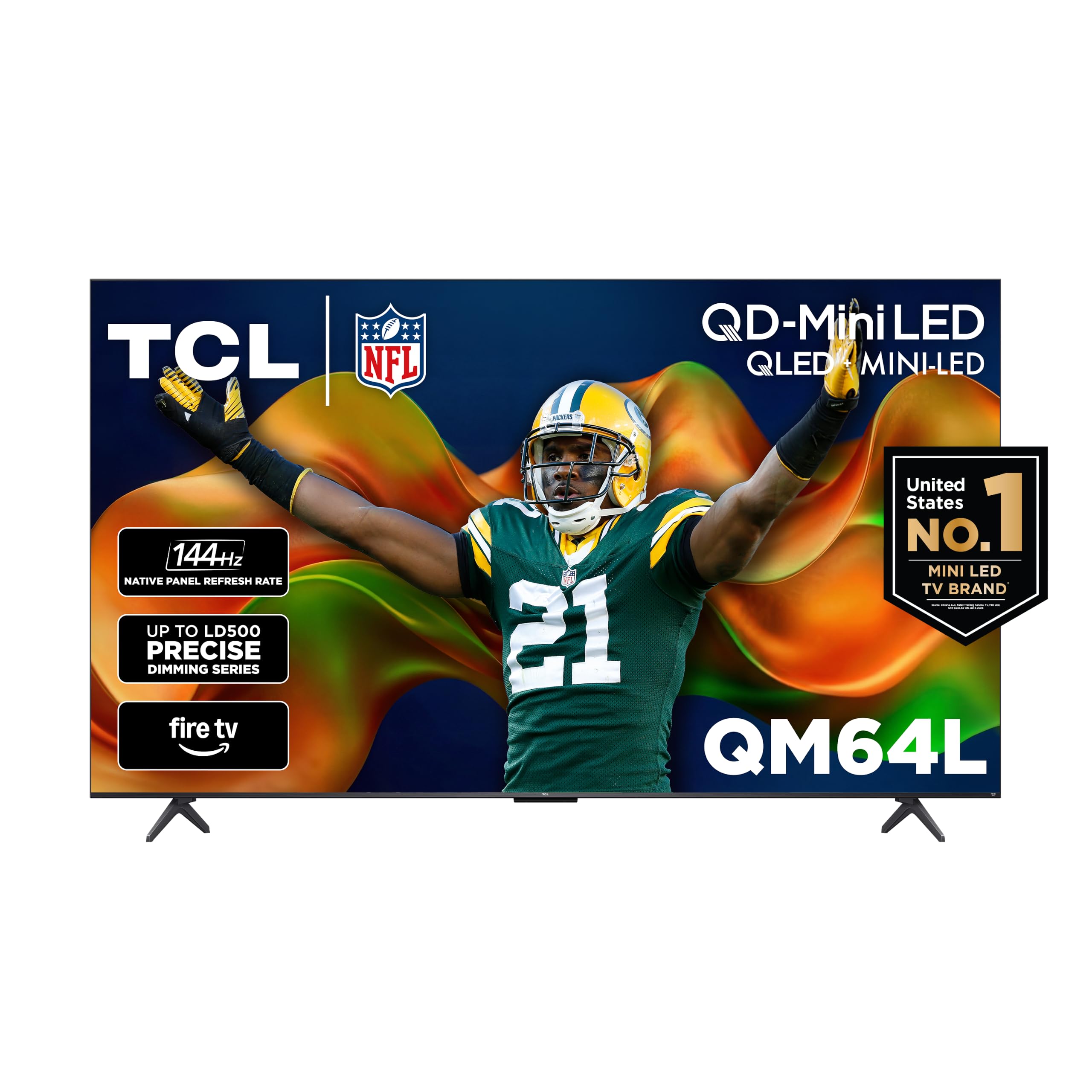
A 55-inch panel built around native 144Hz and up to 500 local dimming zones.
Follow the puck without the blur. A native 144Hz refresh rate means the screen redraws 144 times a second, so a fast break or a hard slap shot stays readable instead of smearing. TCL pairs that with Motion Rate 480 and Game Accelerator, and the Motion Rate figure is the maker’s own smoothing index rather than a second physical refresh spec. VRR and ALLM round out the gaming side so a console switches to low-latency mode on its own.
The backlight uses QD-Mini LED with up to 500 local dimming zones and Halo Control Technology, which tightens the light around bright objects to cut the halo effect known as blooming. On a dark scene, that means stars stay points of light instead of grey blobs. The 55-inch size here is double the 27-inch Samsung G7’s canvas, which is why this one lands in the living room rather than on a desk.
Picture quality and value both come through strongly in how owners talk about it, and the bezel-less design keeps the frame thin so more of what you see is picture. Sound comes from an Onkyo 2.1 system with a 20W subwoofer, so dialogue and bass land without a soundbar. The honest note: reliability and performance both show up as the mixed side of the feedback, so buy with a warranty in mind. Alexa+ handles voice search, and Dolby Vision, HDR10+, HDR10, and HLG cover the HDR formats.
The color story: Enhanced QLED color reaches up to 1.07 billion colors, and the AiPQ Pro Processor adjusts color, contrast, and clarity scene by scene for movies and streaming.
The caveat: Burn-in is a non-issue on Mini-LED, but the brand’s reliability record is the question mark to price in.
Ideal for: Sports fans and console gamers who want a big 144Hz screen with deep blacks and no OLED burn-in worry.
Second-guess it if: You want a track record of long-term reliability above all — the premium Hisense sets below carry more praise on that front.
6. Hisense 55″ U6 Pro Series Mini-LED ULED 4K Fire TV
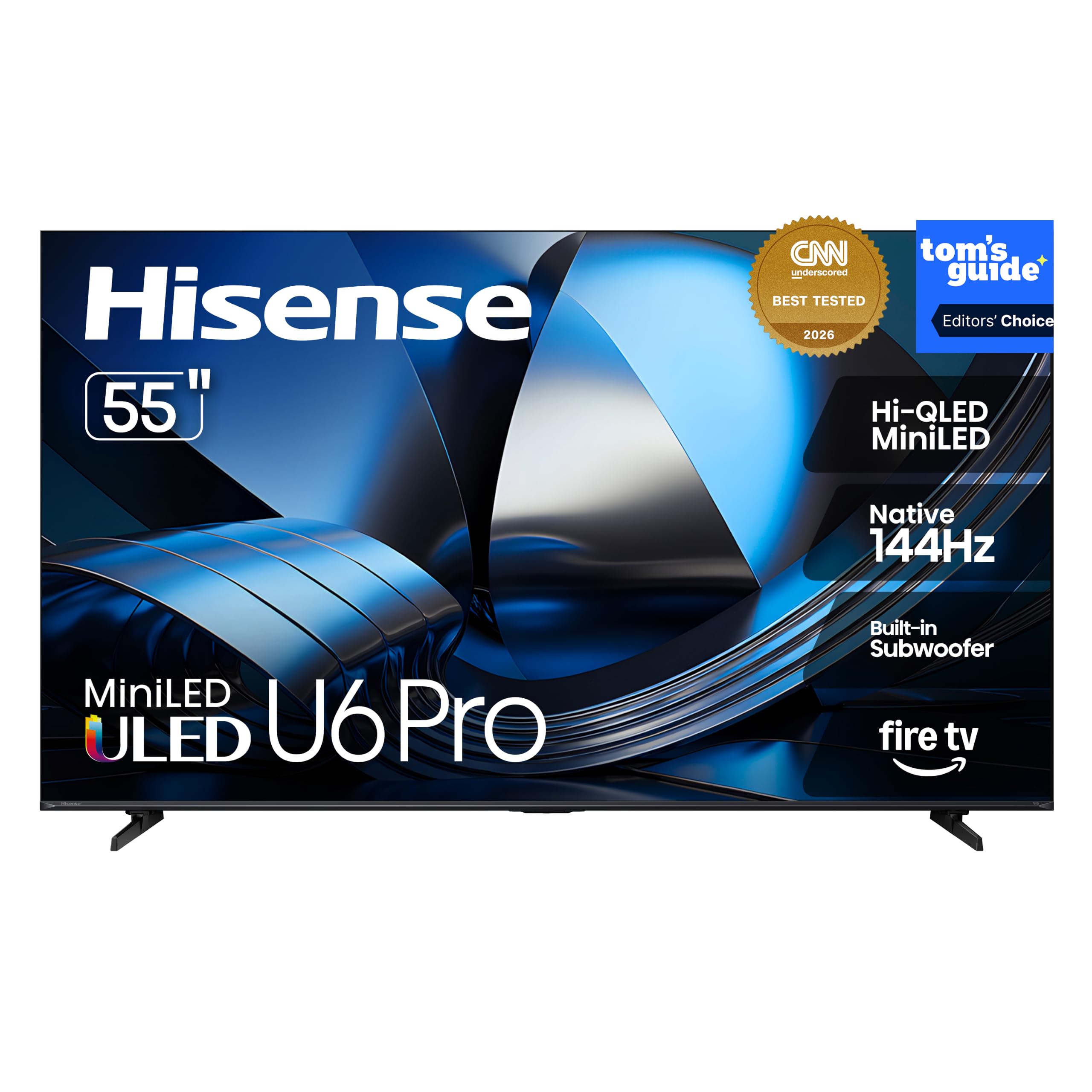
The glare-fighting 55-incher for a room where the sun refuses to behave.
If your TV faces a window, the anti-reflection and glare-free layer here does more for your viewing than any response-time figure. It keeps the picture clean when daylight hits the panel. Behind that sits Mini-LED backlighting with hundreds of precise light zones, paired with Hi-QLED color and Pantone validation for skin tones and team uniforms that look right.
Motion comes from a native 144Hz refresh rate with Motion Rate 480, so live sports and fast camera moves stay crisp. The Hi-View AI Engine adjusts the picture automatically as content shifts from a movie to a game to a broadcast. It supports Dolby Vision IQ, HDR10+ Adaptive, HDR10, and HLG — that is the full HDR set — plus IMAX Enhanced certification for compatible titles.
Owners consistently rate this one above expectations, with picture quality compared to pricier models and brightness singled out. Sound gets its own praise, helped by a built-in subwoofer and Dolby Atmos. Reliability is the mixed note in the feedback, which is worth knowing before you commit. Bluetooth 5.3 covers wireless headphones, and Alexa+ lives inside the Fire TV interface for voice search.
Standout spec: A native 144Hz panel with a glare-free finish is an unusual pairing at this tier — usually you pick one or the other.
Fair warning: The slim unibody design looks great, but reliability feedback suggests buying with coverage rather than assuming years of trouble-free service.
Pick this one for: A bright living room with windows, where glare control and a 144Hz panel matter more than OLED black depth.
Pass if: You want the deepest possible blacks — that is an OLED job, not an LCD one.
7. iFFALCON 65″ 4K MiniLED Smart TV (65U85)
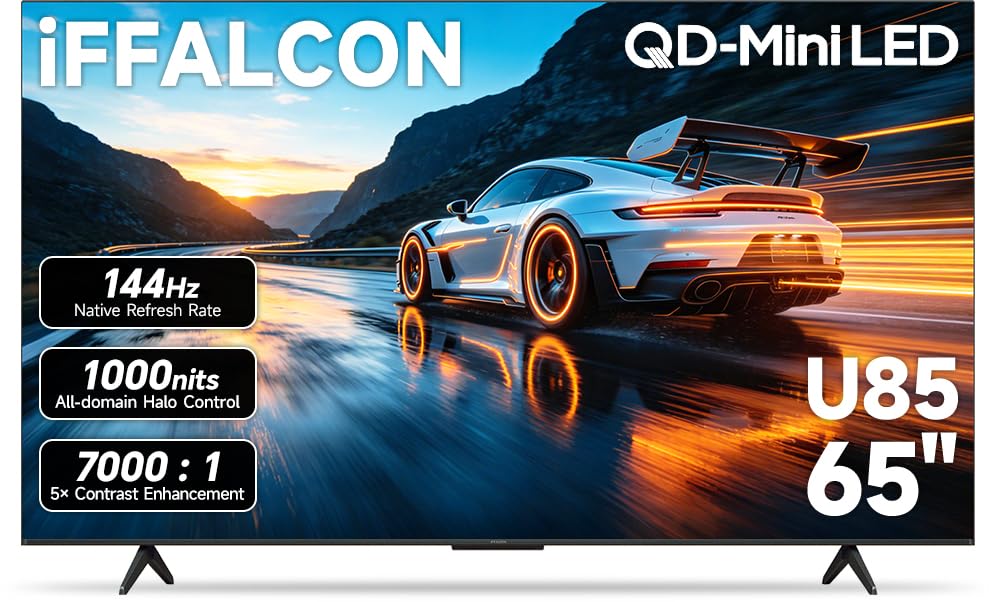
Sixty-five inches, four HDMI 2.1 ports, and Variable Refresh Rate that reaches 288Hz.
The port count is the quiet hero here. Four HDMI 2.1 inputs mean a PS5, an Xbox, a gaming PC, and a soundbar can all stay plugged in at once. Two of those ports run 4K at 144Hz for consoles and PCs, while the other two handle 4K at 60Hz for streaming boxes. Auto Low Latency Mode drops the set into game mode the instant a console wakes, so you never go menu-diving mid-match.
Motion comes from a native 144Hz panel with Variable Refresh Rate spanning 4K at 48 to 144Hz and reaching up to 288Hz. FreeSync Premium Pro reduces tearing and input lag. Bright HDR luminance up to 1000 nits, local dimming, and a 7000:1 contrast ratio give the picture real punch. On the 65-inch canvas, that is double the diagonal of a 27-inch desk monitor — this is a room-filling screen, not a desktop one.
Picture quality is the thing owners praise most, with color and sound close behind. Audio runs 50W through a 2.1-channel setup — two 15W tweeters and a 20W woofer — with Dolby Atmos passthrough and DTS Virtual:X, and eARC on HDMI 4 feeds lossless audio to a soundbar. The catch worth naming: this set also ships hotel mode, an IR blaster, and IP control, features aimed at Airbnb and commercial installs. If you only want a home TV, you are paying for capability you may not use. Google TV with Alexa and Google Assistant handles streaming, and AirPlay 2 plus Chromecast cover casting.
The compelling case: A 65-inch Mini-LED with four HDMI 2.1 ports is the multi-console household’s dream — everything stays connected.
The fine print: Commercial-grade controls add cost and menus a pure home viewer will never touch.
8. Hisense 55″ U7 Mini-LED ULED 4K Fire TV (55U7SF)
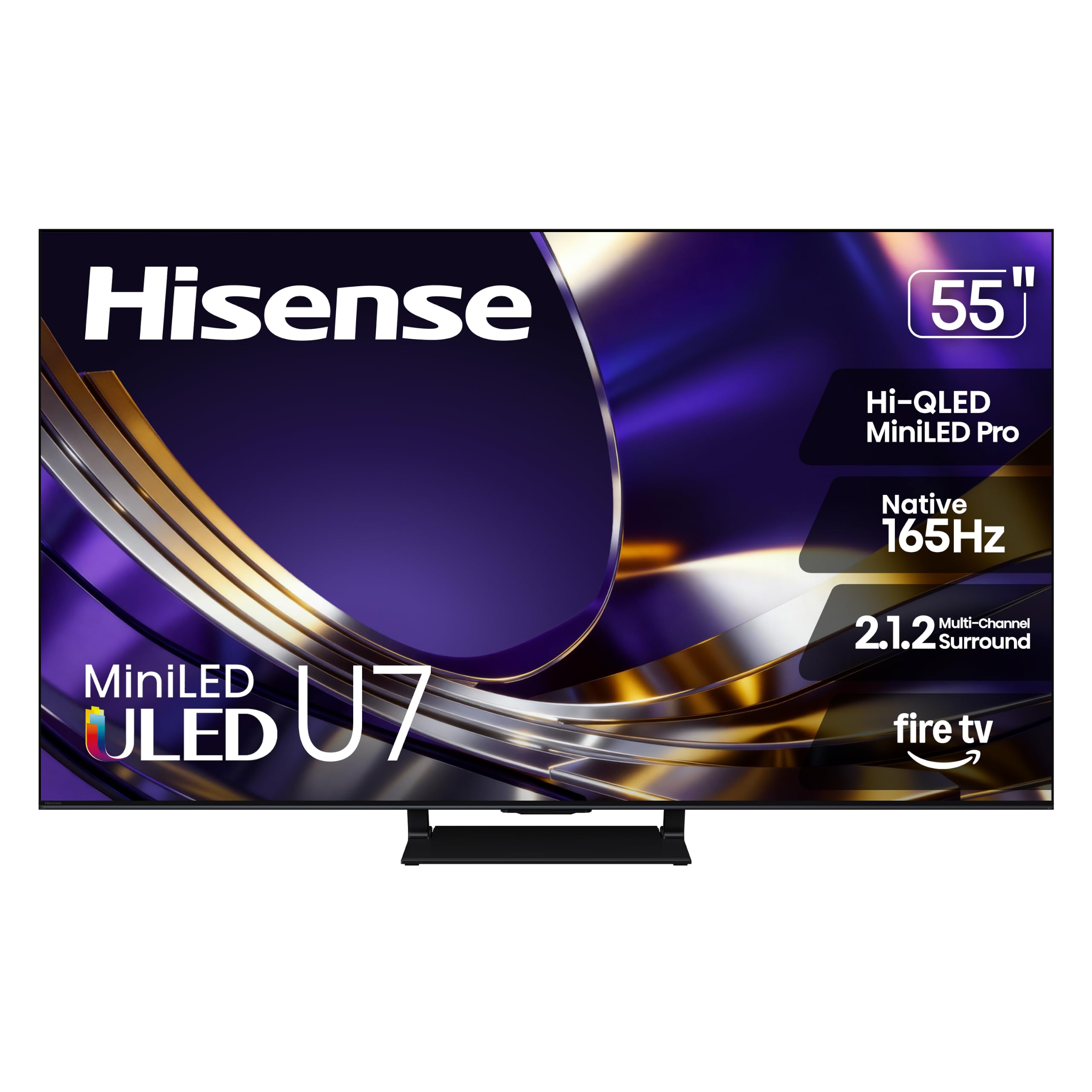
A 165Hz panel with up to 3000 local dimming zones and up to 3000 nits of peak brightness.
Sheer output is the headline. Up to 3000 nits peak brightness (a unit of brightness) and up to 3000 local dimming zones (areas that dim independently for deeper blacks) put this well above the U6 Pro’s zone count. That combination lets a bright room stay watchable while dark scenes keep their detail. The native 165Hz refresh rate (165 screen updates per second) edges past the 144Hz sets around it, so fast pans and high-frame-rate games land a touch smoother.
Thousands of MiniLED backlights work with Hi-QLED color for accuracy and intensity, and the Hi-View AI Engine Pro analyzes each scene and adjusts color, contrast, and detail automatically. The anti-reflection treatment is a dual-layer design, going beyond a single-layer coating so windows and overhead lights stop dominating the screen. For a living room with a lot of daylight, that is a practical difference you feel every afternoon.
Owners call it a beast for sound and picture, with vivid colors and deep blacks earning the most praise — quality first, picture quality second, value close behind. The anti-glare work gets its own credit for bright rooms. Sound runs a 2.1.2 multi-channel surround setup tuned by Devialet, with Dolby Atmos for height effects. The honest counterweight: all that brightness and dimming tech is aimed at a light-filled room, so in a dark home theater you may find yourself turning it down.
The case for it
- Up to 3000 nits peak brightness for sunlit rooms
- Up to 3000 local dimming zones for tight contrast control
- Native 165Hz refresh rate with VRR 330
- 2.1.2 Devialet-tuned audio with Dolby Atmos
The catch
- Brightness this high can feel overpowering in a dark room
- Still an LCD, so black levels fall short of OLED
Suits you if: Your TV lives in a bright, daylight-soaked room and you want maximum punch plus a 165Hz panel.
Not for you if: You watch mostly at night in a dark room — the brightness advantage becomes less relevant.
9. Roku 55-Inch Pro Series Smart TV
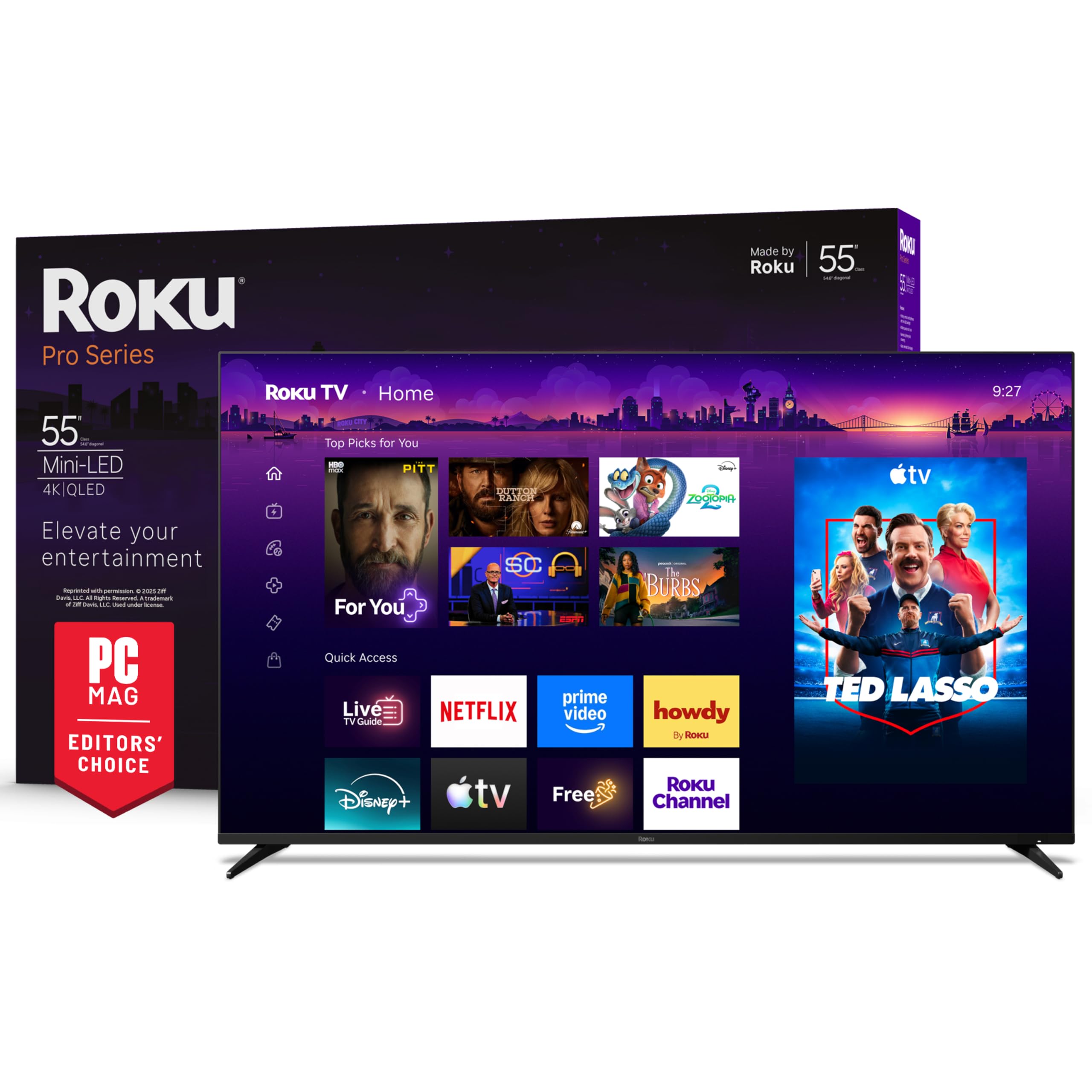
The Roku that steps up to 120Hz and adds a rechargeable, backlit voice remote.
The jump from the Plus Series is mostly about speed and sound. A 120Hz refresh rate follows live sports and gaming with fewer gaps between frames, and FreeSync Premium Pro, ALLM, and VRR keep console play tear-free. Thousands of mini-LEDs sit behind the QLED screen, so highlights and darks stay controlled on the 55-inch panel. Dolby Vision IQ reads the room light and adjusts the picture to match.
The remote is genuinely nicer than most: fully rechargeable, backlit buttons, hands-free voice, and a remote finder that plays a sound when it goes missing. Stands mount tool-free at two heights, and a cable management system keeps the back tidy. Sound comes from side-firing speakers in Roku’s Soundstage Audio array with Dolby Atmos, and Bluetooth Headphone Mode keeps late-night viewing quiet.
Owners are consistently happy with the picture and sound, and the near-OLED black levels come up as a genuine surprise on a Mini-LED set. Controls are intuitive, setup is quick, and the tool-free feet mean no screwdriver hunt. The trade is tier: this is the premium Roku, so you are paying more for the 120Hz panel and the upgraded remote rather than a bigger screen.
Motion read: 120Hz is a step up from the Plus Series but short of the 144Hz and 165Hz sets here — fine for sports, not the fastest gaming option.
The pleasant surprise: Black levels that approach OLED on a Mini-LED panel are the reason this one gets recommended.
Built for: Roku loyalists who want the better remote, 120Hz motion, and room-filling sound with the same familiar interface.
Look past it if: You want the fastest gaming refresh rate — the 144Hz and 165Hz televisions here go further.
10. LG 32GX850A-B 32″ UltraGear 4K OLED Gaming Monitor
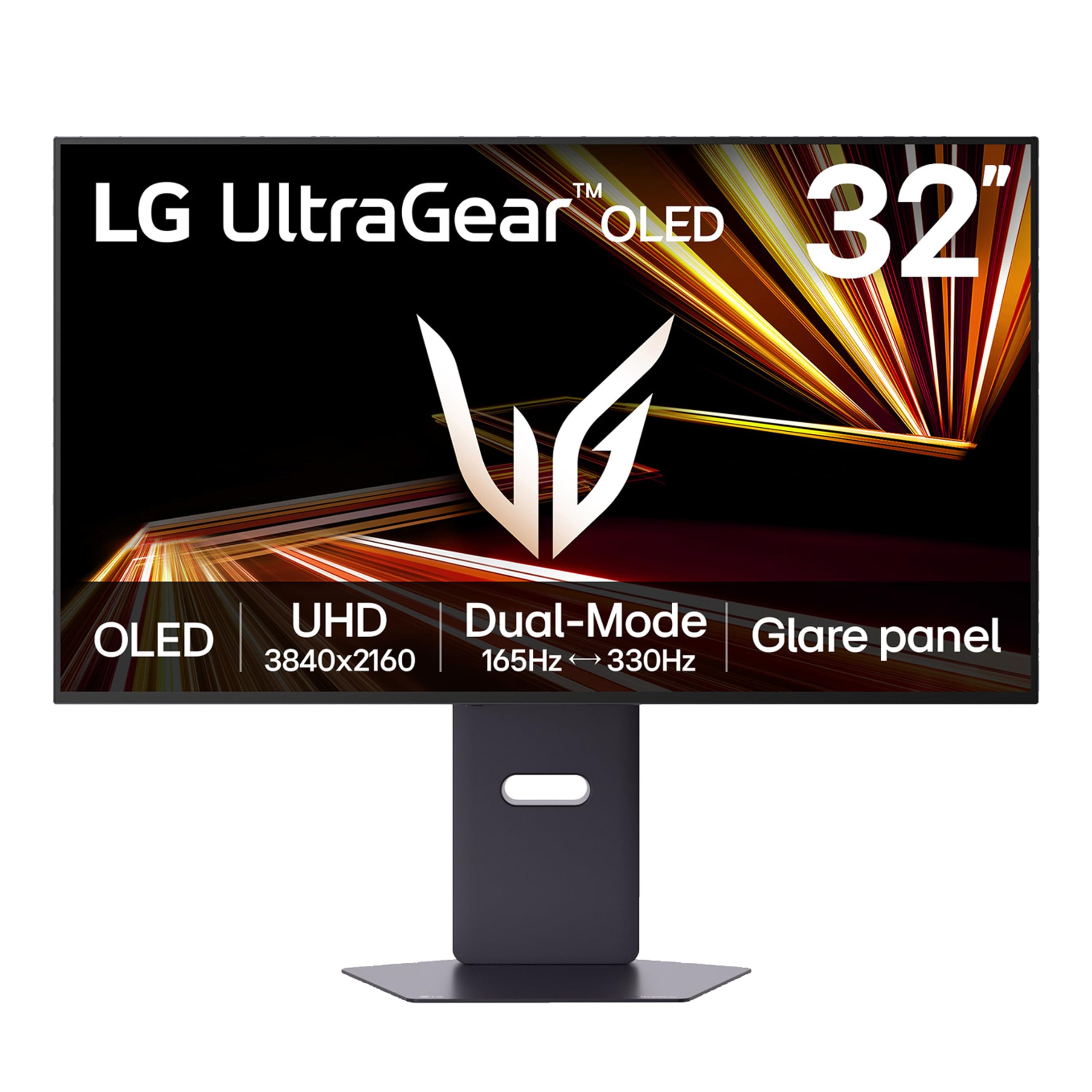
One screen that switches between 4K at 165Hz and Full HD at 330Hz on a hotkey.
The dual-mode trick is the reason to look here. Run graphically rich story games at 4K UHD up to 165Hz, or tap a hotkey and drop to Full HD at 330Hz for fast shooters and racing titles. Response time is a nearly instant 0.03ms (GtG), which is the same 33-times-faster figure the OLED monitors on this list share against the Samsung G7’s 1ms. The 32-inch glossy OLED panel runs 3840 x 2160 for sharp detail in a room you control.
Contrast is listed at 1.5M:1 with VESA DisplayHDR True Black 400 certification and DCI-P3 coverage up to 98.5 percent. Micro Lens Array+ technology pushes typical brightness to 275 nits, brighter than earlier UltraGear OLED displays. NVIDIA validates it as G-SYNC Compatible, and AMD FreeSync Premium Pro handles team-red cards.
What wins people over is the display quality itself — crisp colors, clean resolution, and a design that skips the usual gamer styling. Brightness splits opinion, with glare in a lit room the sticking point, and a small number report flickering lines. Three UL certifications cover anti-glare, flicker-free, and low blue light. Dynamic Action Sync cuts input lag, Black Stabilizer lifts shadows, and the stand adjusts height, tilt, swivel, and pivot.
Your screen if: You play both cinematic 4K titles and twitchy competitive games and want one monitor that handles both modes.
Reconsider if: Your desk sits in a bright room — the glossy finish shows reflections, and the OLED brightness is modest.
11. LG 39GX90SA-W 39″ UltraGear Curved OLED Gaming Monitor
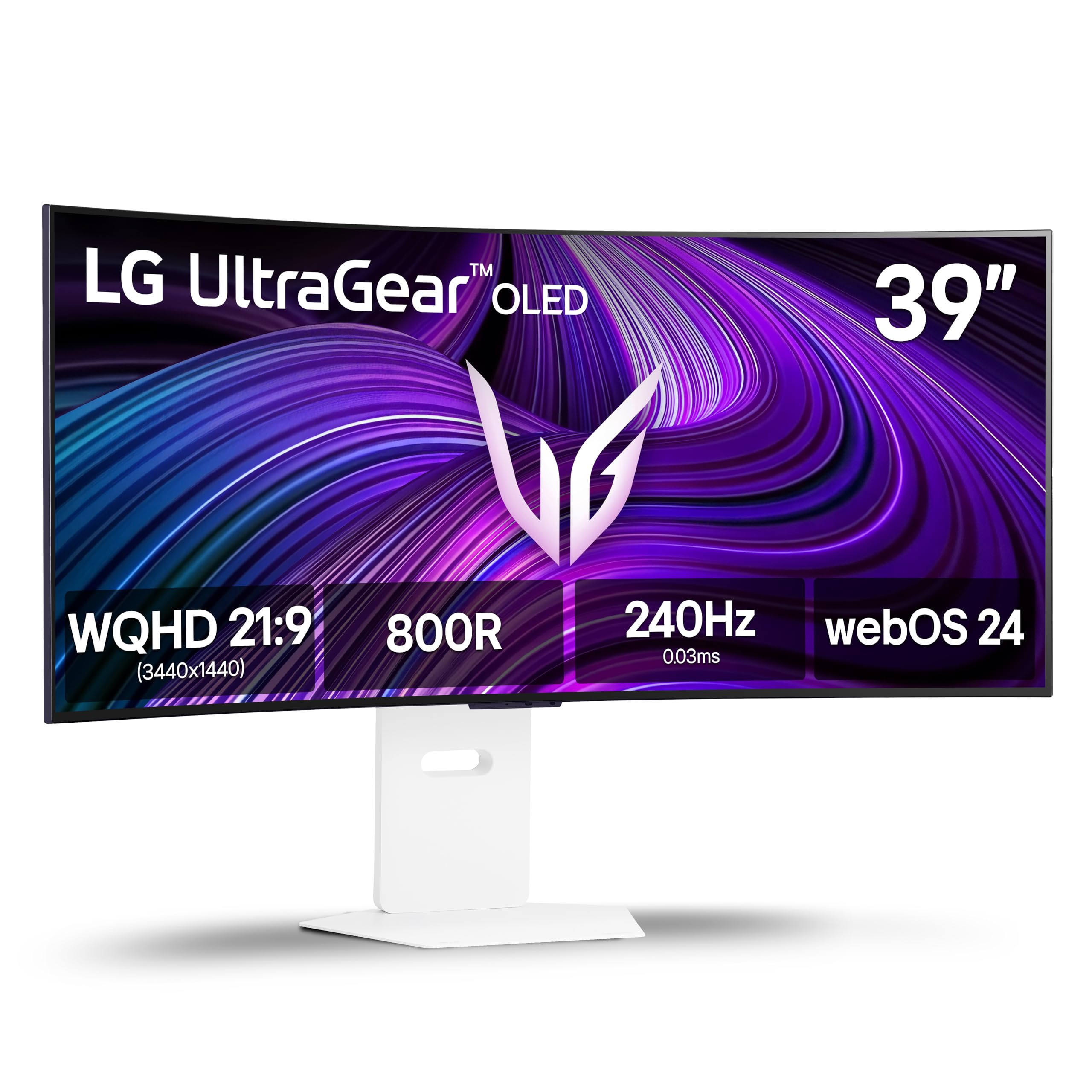
A 39-inch WQHD OLED on an 800R curve, running 240Hz through a 0.03ms response.
The curve is the defining feature. That 800R figure describes a tight bend that wraps the edges toward you, pulling the action into your peripheral vision. It is a 39-inch panel at 3440 x 1440, wider than the 16:9 screens here for a more wraparound field of view. Refresh runs 240Hz with a 0.03ms (GtG) response time, so motion stays clean at speed.
OLED does the contrast work at 1.5M:1 with DisplayHDR True Black 400 and DCI-P3 coverage up to 98.5 percent. Peak brightness is listed at 1300 nits for highlights. webOS24 is built in, so Netflix, Prime Video, the Apple TV app, Disney+, and HBO Max all run from the monitor itself, plus over 300 free LG Channels. Cloud gaming services connect directly, so a PC or console is optional.
Display quality is what people praise most on this screen, with picture quality and color behind it. Some report visible lines on the panel, so inspect on arrival. The anti-glare surface keeps reflections down, and OLED Care tools including pixel cleaning help maintain the display over time. A 2-year limited warranty covers key components including the OLED panel, which matters for anyone worried about long-term OLED health.
Why it stands out: Streaming apps and cloud gaming built into the monitor mean the screen is entertainment on its own, no computer required.
The one thing to check: Panel uniformity gets mixed reports, so a quick check at power-on is worth the minute.
Made for: Gamers who want an rich curved OLED and built-in streaming without a separate device.
Wrong pick if: You need a screen that edits color with total uniformity — the flat panels above are safer there.
Know the Specs
Response Time in Milliseconds
Response time is how long a pixel takes to change color, measured from one grey shade to another (GtG). A lower number means less ghosting, the trailing image that follows fast movement. OLED panels can switch pixels near-instantly, often quoted around 0.03ms, while LCD panels typically quote 1ms or more. This figure describes the pixel, not the frame rate, so it tells you how clean each frame looks.
Refresh Rate in Hertz
Refresh rate is how many times per second the screen draws a new frame. A 144Hz panel redraws 144 times a second. Higher refresh rates keep fast motion smoother and make the gap between frames smaller. For sports and shooters, refresh rate often matters more than the millisecond figure, because it dictates how often your eye gets a fresh image.
Local Dimming Zones
Mini-LED screens light the picture from behind using zones that can brighten or darken independently. More zones mean tighter control, which reduces blooming — the halo that can appear around a bright object on a dark background. A set with up to 500 zones and one with up to 3000 zones both do this job, just with different precision.
VRR, ALLM, and HDMI 2.1
Variable Refresh Rate (VRR) syncs the screen’s refresh to the frame rate of a game, reducing stutter and tearing. Auto Low Latency Mode (ALLM) switches the set to its low-delay game setting automatically. HDMI 2.1 ports carry the higher frame rates modern consoles output, so more of these ports mean more devices can stay connected at full speed.
Common Questions
Is 1ms response time actually better than 0.03ms?
Does a 1ms response time TV make live sports look sharper?
Can I use one of these as a TV and a gaming monitor?
Will a 4K 144Hz screen work with a PS5 or Xbox Series X?
How many HDMI 2.1 ports do I need for multiple consoles?
Is OLED or Mini-LED better for fast-moving games?
Do I need to worry about OLED burn-in on a gaming screen?
What does GtG mean in a response time spec?
Will VRR stop screen tearing on my console?
Does a glossy OLED screen show too many reflections?
How many local dimming zones should a Mini-LED TV have?
The Bottom Line
For most people, the winner among these 1ms response time tv options is the Roku 55-Inch Plus Series. It gives you a 55-inch 4K QLED Mini-LED picture with Dolby Vision (a high-dynamic-range format) and an interface the whole household can use, all at a value tier that makes it the sensible first stop. If documented pixel speed is what you came for, the Samsung Odyssey G7 carries the actual 1ms (GtG) rating (gray-to-gray pixel response time) on a 4K 144Hz panel. And for a bright, window-facing living room, the Hisense 55″ U7 with up to 3000 nits and up to 3000 dimming zones is the one to reach for.
Whichever way you lean, check the response time and refresh rate together rather than trusting either number alone — that pairing is what you actually see when the action gets fast.
How we choose
We do not accept paid placement. Every pick is matched to a real buyer and a real use-case; we do not hands-on test units.
Sources
Specifications: manufacturer listings and product documentation. Review insights: verified customer reviews, as of November 2026. Pricing: not shown on this page (it changes often); check the current price via the retailer link.
As an Amazon Associate, My Heart Lives Here earns from qualifying purchases. This does not affect which products we feature.