Heads up: This post contains affiliate links. As an Amazon Associate I earn from qualifying purchases, at no extra cost to you. Learn more
Specs are compiled from manufacturer listings and verified buyer reviews and can change over time — please confirm the key details on the product page before buying.
You want a radio pair that still cuts through when the campsite is three valleys over and your phone has been dead since noon. The honest truth up front: no handheld hits 100 miles through trees and hills — that number only appears over open water or ridge to ridge with a clear line of sight. What you can buy is a pair that maxes out its legal wattage, holds a charge for days, and survives a drop on rock. The picks below are ranked by real-world reach, battery runtime and durability.
This guide is built by comparing the manufacturers’ published specifications and the patterns across verified customer reviews, so you get each pick’s real strengths and trade-offs instead of marketing spin.
Trees, ridges and buildings eat range fast, so judge each radio on tested reach, not the box number. This breakdown covers the 100 mile long range walkie talkies that come closest in practice.
Top Picks
How To Choose The Best 100 Mile Long Range Walkie Talkies
The first thing to settle is the license, because it decides which radios you are even allowed to switch on. FRS radios (Family Radio Service — the license-free channels anyone can use) are the easy entry point. GMRS radios (General Mobile Radio Service — a higher-power service that legally requires a paid license from the FCC) reach further and can use repeater stations, which is how buyers report talking across 21 miles of ridgeline.
Wattage and antenna length set your ceiling
Power is capped by law, so a handheld tops out at 2 watts on FRS and 5 watts on GMRS. More watts push a signal further, but the antenna does just as much work. A longer antenna catches and sends signal better, which is why the Expedition ships with a 7.5cm antenna pre-installed and a 17cm option for open country.
Battery life decides how many days you stay out
A weekend trip needs a pack rated for at least two days away from a charger. Capacity is measured in mAh (milliamp-hours — roughly how much charge the pack holds), so a 2000mAh pack outlasts an 800mAh one by a wide margin. Match rated runtime to trip length: an 8-hour FRS pair suits a day hike, while a 4- or 5-day lithium-ion pack suits a backcountry push.
Water and shock ratings keep it alive
An IP67 rating means the radio survives being dunked up to 1 meter underwater. IP56 handles splashes and snow but not a full dunk. MIL-STD-810H is a military durability benchmark that means the unit was tested against drops, dust, temperature swings and vibration — worth checking if the radio lives clipped to a pack in bad weather.
Side-by-Side Comparison
| Model | Best For | Service / Power | Channels | Battery | Amazon |
|---|---|---|---|---|---|
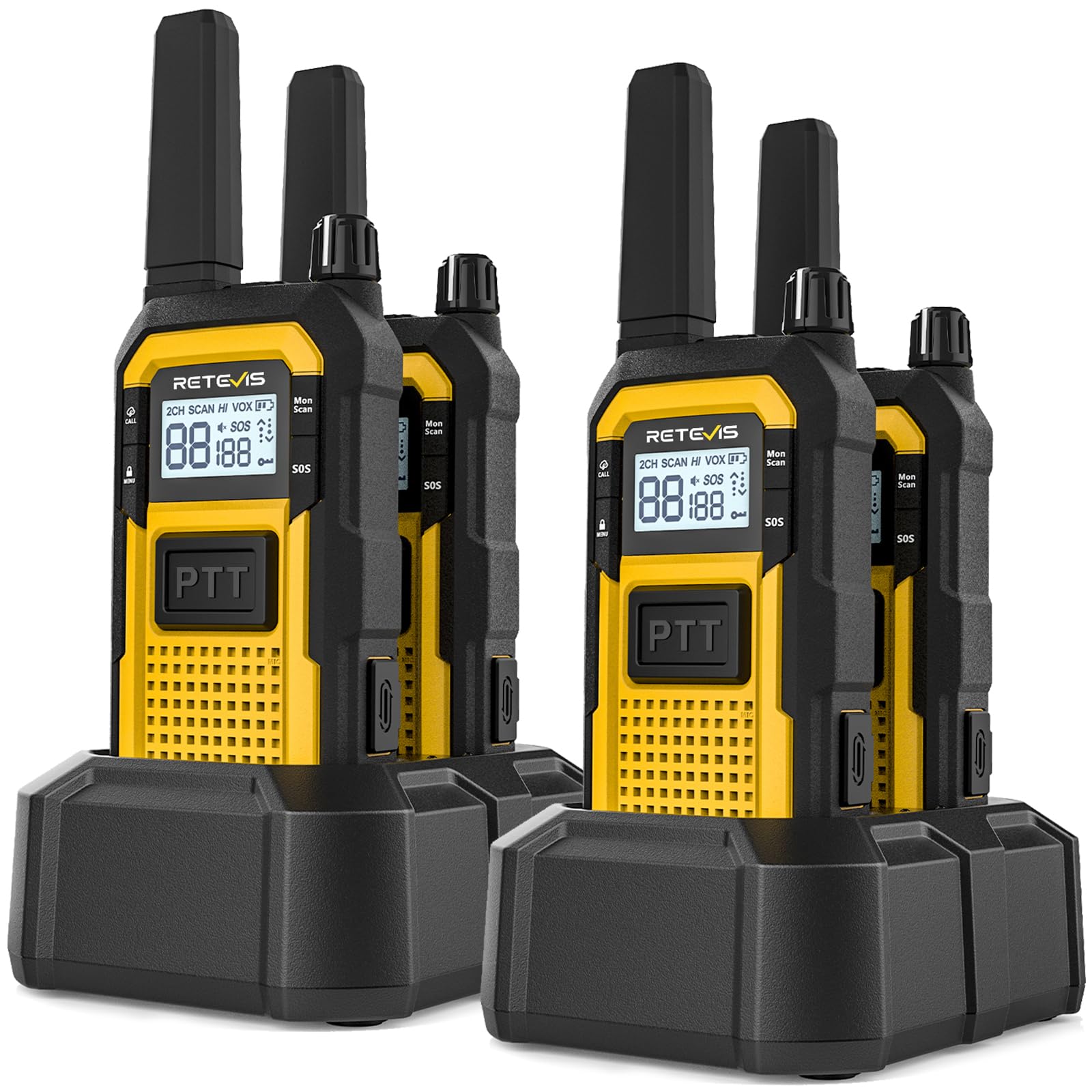
| Retevis RB48 (4 Pack)★ Best Overall | Job sites and multi-floor buildings | FRS, license-free | — | 2000mAh / 18 hours | Amazon |
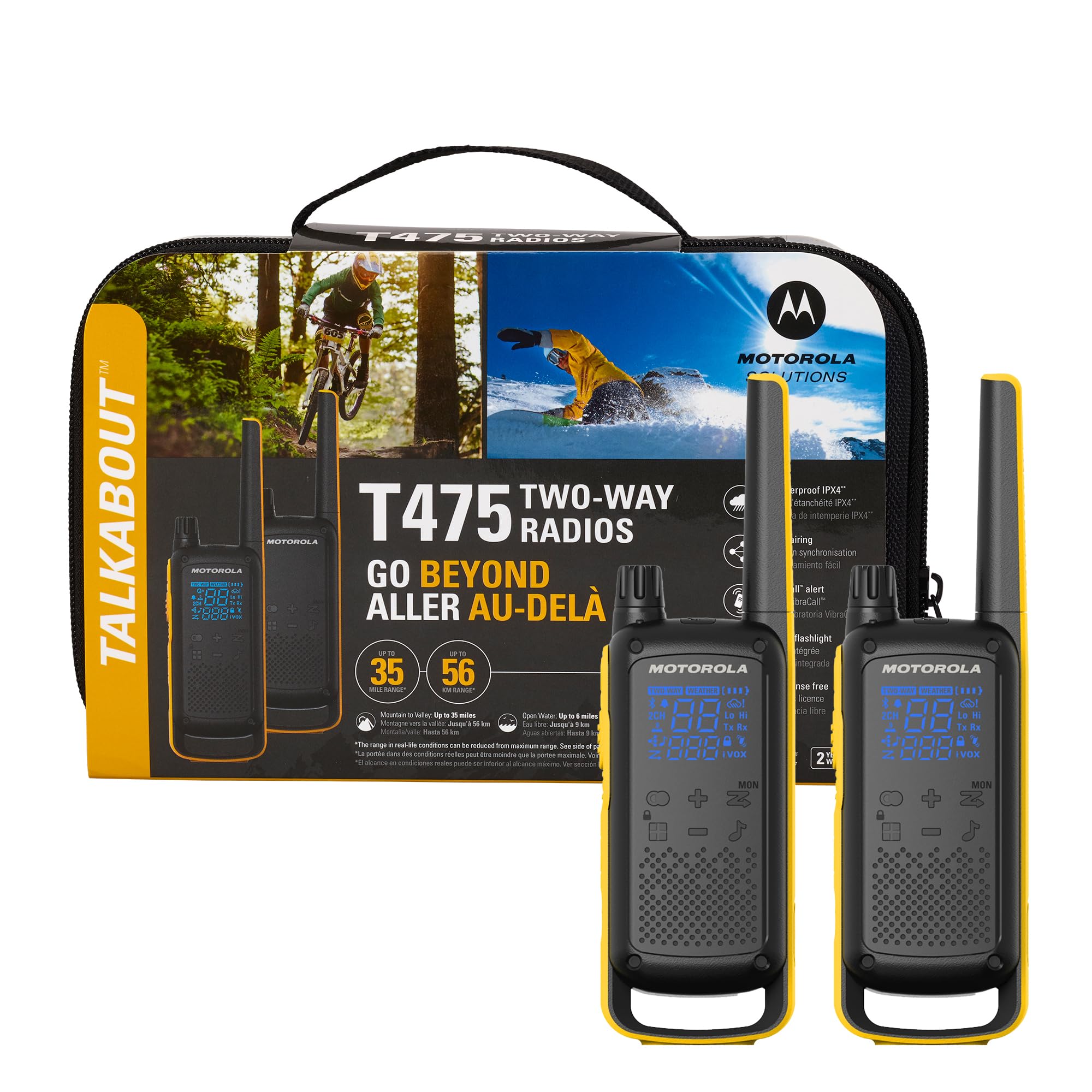
| Motorola Talkabout T475Best Value | Family cruises and casual outings | FRS, license-free | 22 | 800mAh / 8 hours | Amazon |
| FPCN30A (SAMCOM) | Shift crews on shared frequencies | UHF, 5W | 20 | 1500mAh / 24+ hours | Amazon |
| Retevis RT68 (10 Pack) | Equipping a whole team on one order | FRS, license-free | 16 | 14 hours | Amazon |
| globalptt G0 (2 Pack) | Nationwide reach over cell networks | LTE PoC | 2 | 7 days | Amazon |
| Mountain Radio (2 Pack) | Backpacking and cold-weather trips | FRS, 2W | 128 | 4 days | Amazon |
| Expedition 5 Watt (2 Pack) | Repeater-assisted long-haul GMRS | GMRS, 5W | 22 | 1800mAh / 5 days | Amazon |
Detailed Reviews
1. Retevis RB48 Walkie Talkies
Our pick — 4.5+★ from 550+ verified ratings; the strongest balance of quality and price.
The four-pack built like a tool, not a toy, that crews pass around a concrete site.
Start with the durability certification, because that is what you are paying for. The RB48 carries MIL-STD-810H (a globally recognized military benchmark for testing a device under extreme conditions), and it cleared 19 separate tests that include temperature shock, salt fog, sand and dust, vibration, immersion and rain. For a radio that rides in a truck bed or a tool bag, that test list is the real warranty.
The battery is a 2000mAh Li-ion pack rated up to 20 hours of use. Next to the Motorola Talkabout T475’s 800mAh pack, that is 2.5 times the capacity and a rated 18 hours versus the Motorola’s 8. If your shift runs long and nobody remembers to dock the radios, that gap is the difference between a working channel and silence at hour nine.
What wins people over is the build and the reliability — the shell is what buyers single out most, with the metal-grade quality landing 65 mentions and reliability right behind at 61. The large front PTT button (push-to-talk — the button you hold to speak) works with gloves on, and vibration alerts cover a noisy site. Retevis also rates coverage across up to 300,000 square feet and 25 floors, which is the multi-story office and warehouse scenario this radio was drawn for. Owners do flag range as the mixed spot, so treat the open-air figure as generous.
Where the RB48 pulls ahead
- MIL-STD-810H with 19 passed tests, including salt fog and immersion
- 2000mAh battery rated to 18 hours — 2.5x the Motorola T475’s 800mAh
- IP67 waterproofing and a 5-year warranty with 30-day returns
- Glove-friendly dual PTT plus vibration and NOAA weather alerts
The honest limits
- Range is the one aspect buyers split on — the 300,000 square feet figure assumes good conditions
- Four radios in one box is more than a solo hiker needs
- 730 g for the set means it is not a featherweight to pocket
Reach for this if: you run crews across job sites, warehouses or multi-floor buildings and need radios that get knocked around and keep talking.
Look elsewhere if: you only need a pair for weekend trail walks — four heavy radios is more kit than you will carry.
2. Motorola Talkabout T475 Two-Way Radio Two Pack
The familiar yellow-and-black pair that families grab for a ship deck or a theme-park day.
Channel choice is where the T475 does its best work. It runs 22 FRS channels with 121 privacy codes for 2,662 total combinations, which is how you find a quiet line when a hundred other families are on the same cruise. That is more channels than the Retevis RT68’s 16, so crowded places favor this pair.
Two features earn their keep on a family trip: a built-in flashlight for finding the cabin keyhole, and VibraCall (a silent vibration alert) so a call reaches you without a speaker squawking in a quiet space. Dual power means you can run the included 800mAh NiMH rechargeable packs or standard AA batteries when the charger is nowhere near. Weather-proof IPx4 handles a splash, and NOAA weather radio and alerts keep you aware of a storm rolling in.
Buyers praise build quality most — it is the top positive aspect at 83 mentions, with ease of use next at 22. The honest catch is runtime and reach: battery life lands at 8 hours and range is one of the mixed aspects. So plan to dock these nightly and keep expectations to neighborhood and resort distances rather than open-country miles. It is a light-duty companion, not a backcountry lifeline.
The pairing trick: Easy Pairing lets you sync a fresh radio to the group without menu-diving, which matters when a kid or a grandparent is handed one for the first time.
Runtime to plan around: At 8 hours on the 800mAh pack, this is a day-use radio — bring the charger or spare AAs for a second day out.
Suits: cruise passengers, resort families and casual day-trippers who want the most channel combinations and weather alerts in a light package.
Not for: anyone counting on a full backcountry day — the mixed range and 8-hour battery will fall short on a long trail.
3. FPCN30A Walkie Talkies 2 Pack

The business-grade pair you program to your own frequency before the shift starts.
This is the one that works between floors. The FPCM30A pushes 5 watts of UHF power (ultra-high frequency — the band that gets through walls better than open-air VHF), and Sancom rates it at roughly 1-2 miles inside a building and up to 5 miles line of sight. That wall penetration is why it suits a parking garage, a church campus or a construction site with concrete between you.
Where it beats a fixed-channel radio is flexibility. Twenty channels get written from a PC, so the pair joins the UHF business frequencies your team already runs instead of forcing a switch. That said, this is not the buy for a hiker who wants a radio working on day one from the start. The FCC certification expects a license for professional use, so confirm your permit before transmitting.
The other side of a shift is battery, and a 1500mAh pack is rated at 24+ hours, with both radios charging on one dock overnight. A dual PTT (an extra push-to-talk button) keeps a private line live while the group channel stays open. Signal quality is the headline for buyers, with clear audio in drywall and cooler-door conditions the recurring win. The battery is the one mixed note — some packs arrive not charging, which points to checking both docks in the first week rather than a design flaw baked into the radio.
What earns the shift badge
- 5W UHF signal that holds through concrete and steel
- 1500mAh battery rated 24+ hours on a single charge
- PC-programmable 20 channels so your team keeps its existing frequency
- Dual PTT and a 6.7-inch high-gain antenna included
What to weigh first
- Needs programming and, for professional use, a license — not plug-and-play
- Battery is a mixed aspect; test both charging docks early
- Only 2 radios per box, so larger crews need multiple sets
Built for: security, church, custodial and construction teams that want to run their own business frequency with strong indoor reach.
Pass if: you want a grab-and-go trail radio with no programming or licensing steps.
4. Retevis RT68 Walkie Talkies 10 Pack
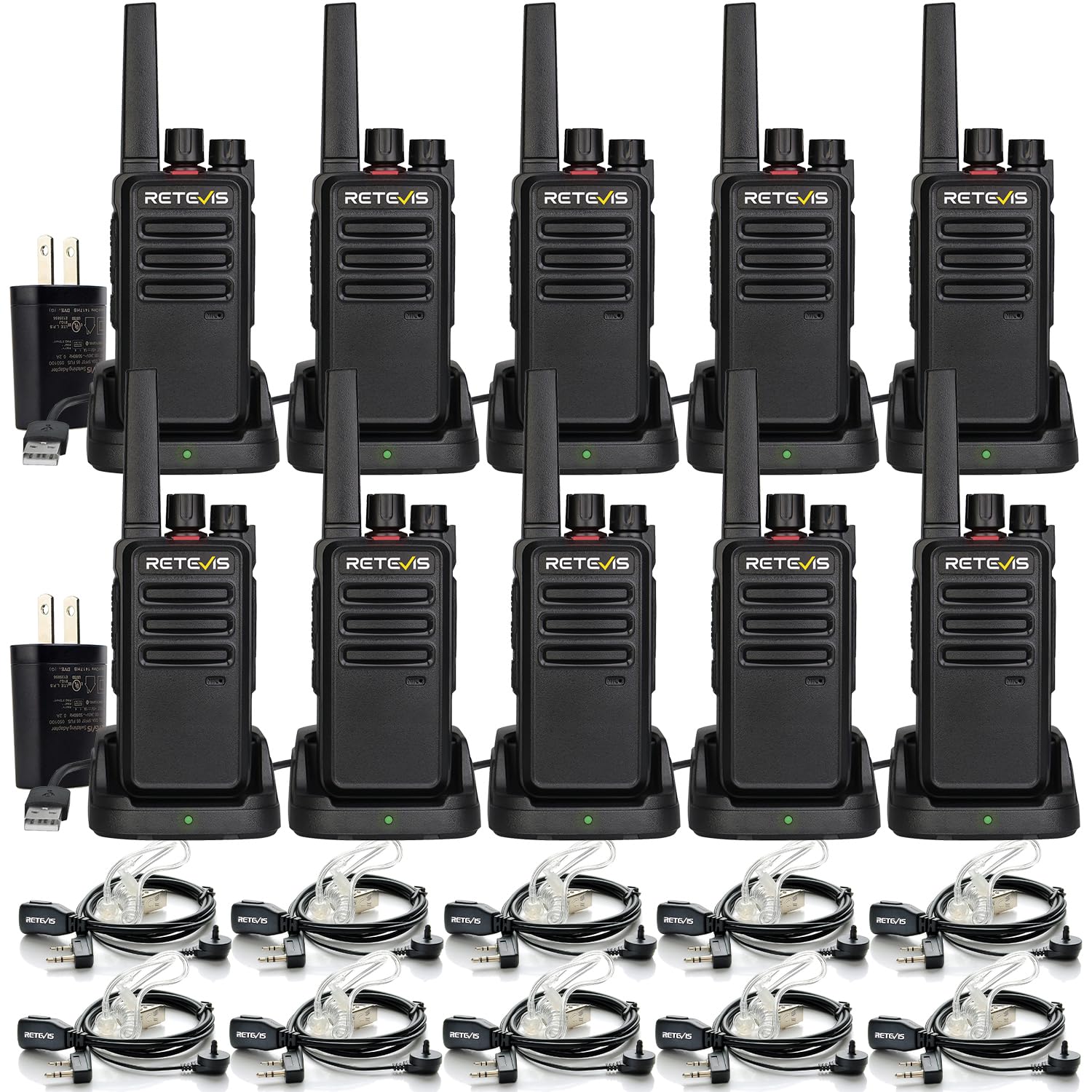
Ten palms-sized radios and earpieces in one box so the whole staff is on channel by noon.
The pitch here is sheer count. Ten FRS radios land at once with 16 channel combinations, and the short and light build slips into an apron pocket — each unit runs about 4.56 inches tall. For a school office, a security desk or a warehouse floor that needs everyone wired up on day one, one order covers the roster.
Small frame, real features. VOX (voice-activated transmit — speak and it sends without pressing a button) keeps hands free for scanning or shelving. A 0-9 squelch setting (a mute threshold that blocks background hiss) keeps audio clear in a noisy hall, and it also stretches battery runtime. The 500mW speaker pushes loud, clear output.
Value is the reason buyers choose the RT68 after quality, with the build holding up through the normal drops a shared radio takes. Two edges to know: the range is one of the mixed aspects, so expect indoor-friendly distances rather than long-haul reach; and durability drew the most negative noise of the list. As a six-to-ten-person indoor crew set it holds up fine, but do not treat these as a backcountry tool. The 14-hour battery makes a full workday without a mid-shift dock.
Where it earns its keep: One low-noise 35 db unit for the pocket, a shared dock, and earpieces included — a whole team gets hands-free comms without a follow-up shopping list.
The durability question: The mixed durability marks are the honest limit here; budget-tier build in a light shell means treat them with reasonable care.
Right for: managers equipping a full indoor team — schools, retail, hospitality — in a single purchase.
Wrong for: rough outdoor work or long-range mountain use, where the mixed range and durability marks show through.
5. globalptt Walkie Talkies 2-Pack

The pair that skips radio waves entirely and talks state to state over the cell network.
Forget line of sight with this one. PoC (push-to-talk over cellular) runs your voice over 4G LTE data networks, so reach is wherever there is a cell signal — the maker’s own listing cites communication across 5000 miles. That is the direct answer to anyone chasing the century mark: instead of shouting across a valley, you dial up a tower. Both radios come with 365 days of unlimited high-speed data from activation, so you are covered across the first year.
The trade is dependence. When you walk out of coverage in deep backcountry, the G0 has nothing to send on, so it cannot replace a real radio in the wilds. Plan it for security, logistics and event teams working across a city or region where towers are everywhere. The listing also rates battery performance for extensive field operations, and specs cite 7 days, which covers long shifts without a charger.
Setup is the pleasant surprise. It works from the start, with a web portal to manage your radios, and the reception lands crisp — cross one state to another and the channel still comes through. The 2.4″ x 1.5″ x 4″ body at 350 g sits easy in the hand, and the bright display keeps controls quick to reach. Number of channels is listed at 2, so treat it as a talk-group device, not a scanner.
Why it rewrites the range rule
- Ties to 4G LTE so distance depends on towers, not terrain
- 365 days of unlimited data included at purchase
- Ready to use from the start with a web portal for management
- Clear reception and a bright display for fast controls
Where radio still wins
- Dead with no cell signal — a real FRS/GMRS radio keeps talking off-grid
- Only 2 channels, so no wide channel selection
- You must renew the data service through globalptt after the first year
Choose it when: your people are spread across a city or region with solid cell coverage and you want one channel regardless of distance.
Skip it when: the plan involves canyons or wilderness where the signal bar drops to zero.
6. Mountain Radio 2 Pack
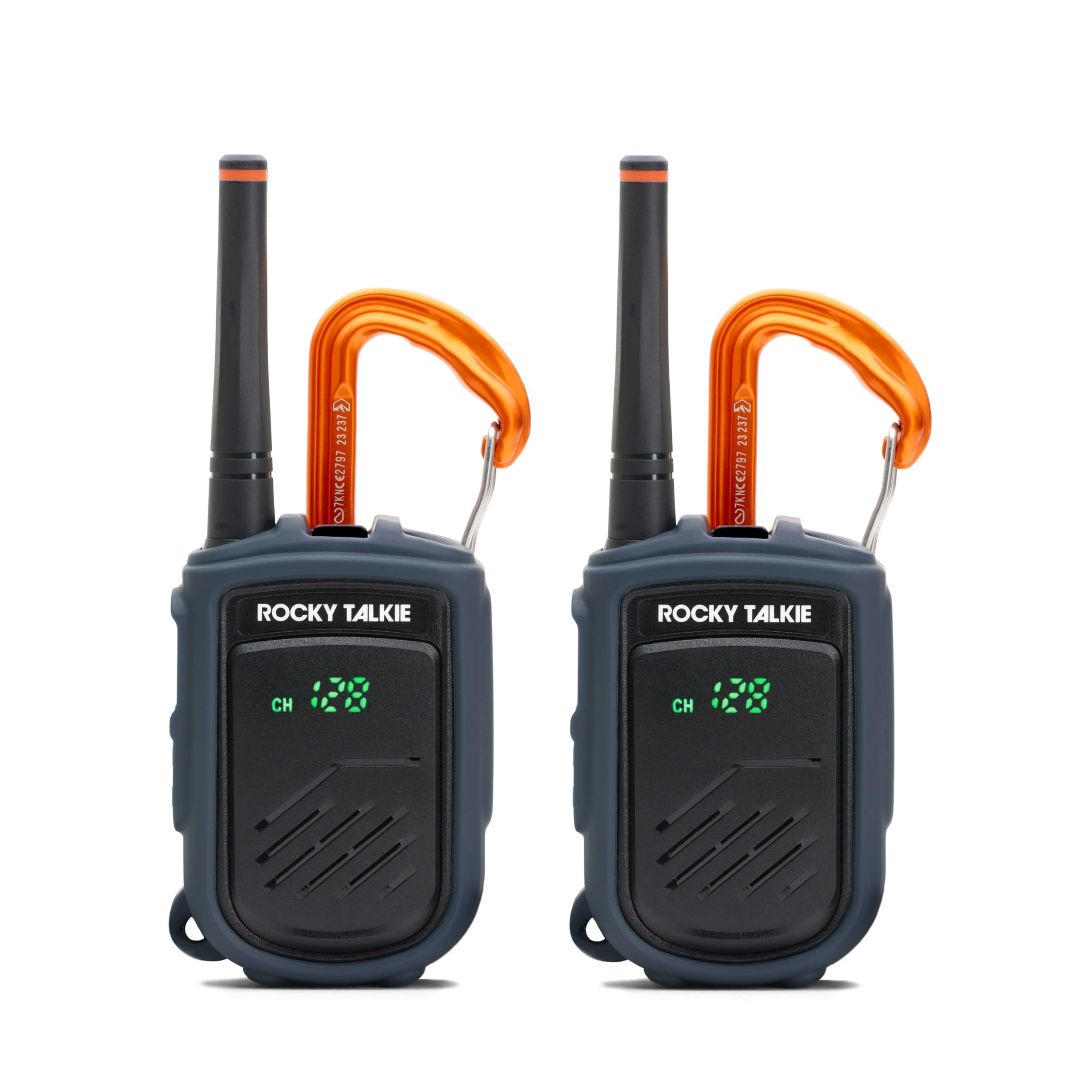
The climber’s radio that clips to a harness and keeps its charge through a cold night.
Four days on one charge is the reason backpackers pick this. The specialized rechargeable lithium-ion battery holds that runtime even in very cold conditions, and the packs are replaceable when they eventually wear. That is a far cry from the 8-hour day-use spec on the Motorola T475 — this is built for a multi-night trip without a wall outlet.
How it rides on a pack matters as much as how long it lasts. Instead of a fragile plastic clip, it hangs from a metal-reinforced leash and a Trango Quantum climbing-rated carabiner, so it secures to a harness or pack strap and stays put. The shatterproof LED screen sits under a thermoplastic protective covering, and the IP56 rating shrugs off splashes and snow. Operation is five buttons, zero configuration — switch on and talk.
Functionality is the top praise here, with quality right behind, and the range/clear-reception story holds up around hilly property and mountains. The honest ceiling: this is a 2-watt FRS radio, so the maker’s own spec puts typical backcountry range at 1 to 5 miles with a listed maximum of 35 miles. The upper figure assumes open air. The 128 channels and USB-C charging round out a pair that asks almost nothing of you setup-wise.
Cold-weather edge: The replaceable lithium-ion packs and 4-day runtime mean a winter summit push does not end in a dead channel.
The reach reality: A 2-watt legal cap and a 35-mile listing that shrinks to 1-5 miles in terrain — pick it for the pairing and ruggedness, not guaranteed cross-valley distance.
Made for: hikers, climbers and backcountry skiers who need a light, secure, cold-proof pair for multi-day trips.
Think twice if: you need repeater-assisted reach — this is license-free FRS with a 2-watt ceiling, not a GMRS long-hauler.
7. Expedition 5 Watt Radio 2 Pack
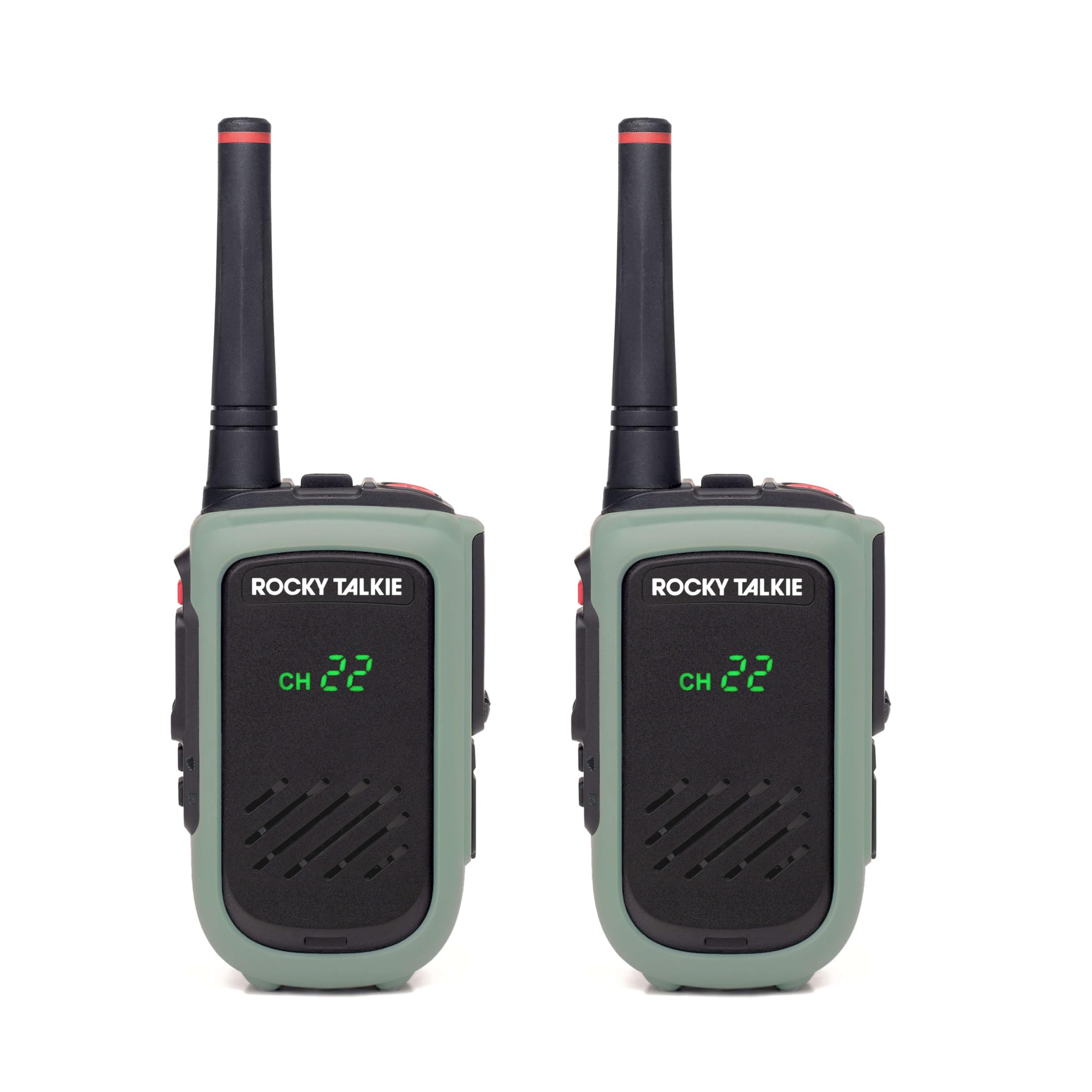
The top of the range ladder: 5 watts and repeater access for the longest real-world push.
Repeater access is the stand-out here. The Expedition runs the maximum 5 watts handheld GMRS power allowed, open up 8 repeater channels (relay stations that re-broadcast your signal from a high point), and fits a removable antenna. That combination is how owners mention reaching out to roughly 21 miles — a distance a license-free FRS pair simply will not close. Typical backcountry range is listed at 2 to 8 miles, with a maximum topping 35 miles in the open.
Staying out five days is the other half of the promise. A specialized 1800mAh lithium-ion pack averages 5 days on a charge, even in frigid conditions, and the packs are replaceable. For weather planning, it carries 11 NOAA weather channels with alerts plus dual-channel monitoring. Water is handled to IP67 — waterproof up to 1 meter of submersion — so a stream crossing or a downpour will not end the trip.
from the start it brings a complete kit: shatterproof screens, steel Gator Clips, metal-reinforced leashes, USB-C cables, and both a 7.5cm pre-installed antenna and a 17cm option for open terrain. GMRS operators report the quality and reliability first, and it ranks the highest-rated pick here on a smaller but enthusiastic base. Remember the license — GMRS is not license-free like FRS, so get your permit before keying up.
What puts it at the top
- 5-watt GMRS power with 8 open up repeater channels
- IP67 waterproof to 1 meter submersion
- 1800mAh pack rated 5 days, replaceable, cold-weather capable
- 11 NOAA channels plus a 17cm antenna option included
The terms to accept
- GMRS requires an FCC license before you transmit
- Highest tier of the group, so the least budget-friendly
- 22 channels limits choices next to a 128-channel FRS unit
Best fit: licensed GMRS users, overlanders and property owners who want the longest genuine handheld reach with repeater help.
Hold off if: you will not get a license or want a no-fuss license-free radio — the Mountain Radio or RB48 keeps you legal with zero paperwork.
Know the Specs
FRS vs GMRS — the license decision
FRS radios work license-free on channels anyone can use, and they cap power at 2 watts. GMRS radios reach further and offer repeater channels, but they legally require an FCC license before you transmit. Pick the service first, then the radio, or you may buy reach you cannot legally use.
Wattage and antenna length
Power pushes a signal out; a longer antenna catches and sends it better. The legal handheld ceiling is 2 watts on FRS and 5 watts on GMRS. A 7.5cm antenna suits most trails, while a 17cm option like the Expedition’s upgrade helps in open country where signal has to travel far.
Battery capacity in mAh and days
Capacity (mAh) tells you how much charge the pack holds, but check the rated runtime in hours or days. A 2000mAh pack is rated to 18 hours, a 1500mAh pack to 24+ hours, and some lithium-ion builds stretch to 4 or 5 days. Match runtime to trip length, and favor replaceable packs for multi-year use.
IP and MIL-STD durability ratings
IP67 survives a 1-meter dunk; IP56 handles splashes and snow but not submersion. MIL-STD-810H means the unit was tested against drops, dust, temperature swings and vibration. On a trail or a job site, the IP and MIL-STD-810H ratings decide whether the radio survives rain, dust and drops.
Line-of-sight vs real-world range
A big range figure assumes open air with nothing between the radios. Trees, ridges, buildings and even heavy rain cut distance fast, which is why trail users report far shorter usable miles. Judge a radio on indoor reach and clear-channel performance, not the box maximum.
Repeater channels and PoC
Repeaters are relay stations on high ground that re-broadcast your signal, which is how GMRS units stretch past what a handheld can do alone. PoC (push-to-talk over cellular) sidesteps radio entirely and runs over cell towers, trading off-grid reliability for near-unlimited distance where coverage exists.
Common Questions
Can a walkie talkie really reach 100 miles?
Do I need a license for a GMRS radio like the Expedition?
What is the difference between FRS and GMRS walkie talkies?
How long does the battery actually last on a full charge?
Will these radios work through concrete walls and between floors?
Can I link a Mountain Radio to a Retevis or Motorola radio?
How waterproof are these radios for rain and river crossings?
Is a cellular PoC radio better than a standard walkie talkie?
What does MIL-STD-810H actually mean for durability?
How many radios do I need for a team or family?
The Bottom Line
The Retevis RB48 earns the top spot in this lineup of 100 Mile Long Range Walkie Talkies because it combines a MIL-STD-810H military durability rating (a US military standard for surviving drops, dust and temperature swings) with a 2000mAh battery rated to 18 hours and IP67 waterproofing (sealed against dust and brief water immersion) — the toughest all-rounder for job sites and buildings. If you want repeater-assisted reach and the longest genuine handheld distance for a licensed user, the Expedition 5 Watt is the one, with its 5 watts and 8 repeater channels. For a cold-weather backpacking trip, the Mountain Radio clips on and runs 4 days. And if distance across a region matters more than off-grid survival, the globalptt G0 skips radio entirely and talks over cell towers. Buy for your terrain and your license, and the range you get will match what the radio can actually deliver.
How we choose
We do not accept paid placement. Every pick is matched to a real buyer and a real use-case; we do not hands-on test units.
Sources
Specifications: manufacturer listings and product documentation. Review insights: verified customer reviews, as of November 2026. Pricing: not shown on this page (it changes often); check the current price via the retailer link.
As an Amazon Associate, My Heart Lives Here earns from qualifying purchases. This does not affect which products we feature.