Heads up: This post contains affiliate links. As an Amazon Associate I earn from qualifying purchases, at no extra cost to you. Learn more
Specs are compiled from manufacturer listings and verified buyer reviews and can change over time — please confirm the key details on the product page before buying.
You want real watch hands on your wrist, but you also want to know how far you walked today. That used to mean choosing one or the other — a plain analog face with no data, or a glowing digital screen you did not want on your arm. It no longer does. Plenty of watches now blend a proper analog look with a pedometer tucked underneath, and some of the smartwatches here even run an analog face on a hidden screen. The trick is telling apart the ones that count steps reliably from the ones that only look the part.
This guide is built by comparing the manufacturers’ published specifications and the patterns across verified customer reviews, so you get each pick’s real strengths and trade-offs instead of marketing spin.
Below you will find the step-tracking watches that hold up in daily wear, ranked by what each one actually does well. Every spec is spelled out in plain words, so you can match a watch to your wrist and your routine before you commit to the analog watch with step counter that fits you best.
Top Picks

How To Choose The Best Analog Watch With Step Counter
Step counting sounds simple until you wear a watch for a week. A watch that over-counts every arm swing tells you nothing useful. A watch that needs charging every night ends up in a drawer. And a watch that looks like a gym gadget will not go with a shirt sleeve. So the right pick balances three things: step accuracy, analog looks, and battery life.
Analog hands or an analog face on a screen
There are two ways to get a classic look with step data. A hybrid watch uses physical hands over a hidden display that only lights up when you need it — the Garmin vívomove Trend works exactly this way. A smartwatch can also run an analog watch face on its screen, so it looks like a traditional dial while still showing your step count. Both are legitimate; pick hybrid if you want zero glow most of the day, and pick a screen-based analog face if you want to read notifications and health data at a glance.
How the step counter actually works
Most of these watches use an accelerometer — a tiny motion sensor that notices the rhythm of your arm as you walk. The G-Shock Casio Move line uses a 3-axis accelerometer, which means it reads movement in three directions instead of one, so a walk with your hands in your pockets still registers. Some watches also pull GPS from your paired phone, which is how they turn steps into distance, pace and route maps. If you only care about a daily step goal, the accelerometer alone is enough.
Battery life: the spec that decides whether you keep wearing it
Battery life here ranges from a claimed 30 hours to a claimed 10 days, and that gap matters more than any other number on this page. A watch with a big bright screen and always-on display drains faster. A hybrid with hands and a hidden screen stretches much further. Decide how often you are willing to put a watch on a charger, then buy inside that limit.
Case size, band width and comfort
Band width is given in millimeters — the measurement across the strap where it meets the case. A 20 mm band sits narrower on the wrist than a 22 mm band, and neither is better, just different. Case size matters too: a 40 mm case wears lighter than a 46 mm case, and a big rugged case with a steel bracelet has real heft. If you wear a watch through sleep tracking, comfort overnight is the deciding factor.
Side-by-Side Comparison
| Model | Best For | Battery (claimed) | Band Width | Display | Amazon |
|---|---|---|---|---|---|
| Samsung Galaxy Watch 8 Classic 46mm★ Best Overall | All-round daily smartwatch | 30 hours | — | Rotating bezel touchscreen | Amazon |
| Premium Smart Watch Men Women, 2.06″ AMOLEDBiggest Screen | Big screen on a budget | 7 days | 22 millimeters | 2.06″ AMOLED, 410×502 | Amazon |
| Amazfit Active 2 PremiumBattery Champion | Battery and GPS | 10 days | 20 millimeters | 1.32″ AMOLED | Amazon |
| G-Shock Casio Move GBA800UC | Rugged training | — | — | Analog-digital | Amazon |
| G-Shock Casio Tactical Move GBA900UU-3A | Outdoor color and MIP LCD | — | — | Memory in Pixel LCD | Amazon |
| ALPHAGEAR Commander | Metal build, long shifts | 12 days | — | 1.43″ AMOLED | Amazon |
| SOUYIE Luxury Smart Watch | Business dress look | 7 days | 22 millimeters | 1.43″ AMOLED, 466×466 | Amazon |
| Garmin vívomove Trend, 40mm | True hybrid with hands | 5 days smart mode | 20 millimeters | Hidden touchscreen | Amazon |
| Garmin Venu 3S, 41mm | Deep health tracking | 10 days | 18 millimeters | AMOLED touchscreen | Amazon |
Detailed Reviews
1. Samsung Galaxy Watch 8 Classic 46mm
Our pick — 4.5+★ from 950+ verified ratings; the strongest balance of quality and price.
A traditional-looking dial you twist with your thumb, standing on a 445 mAh battery.
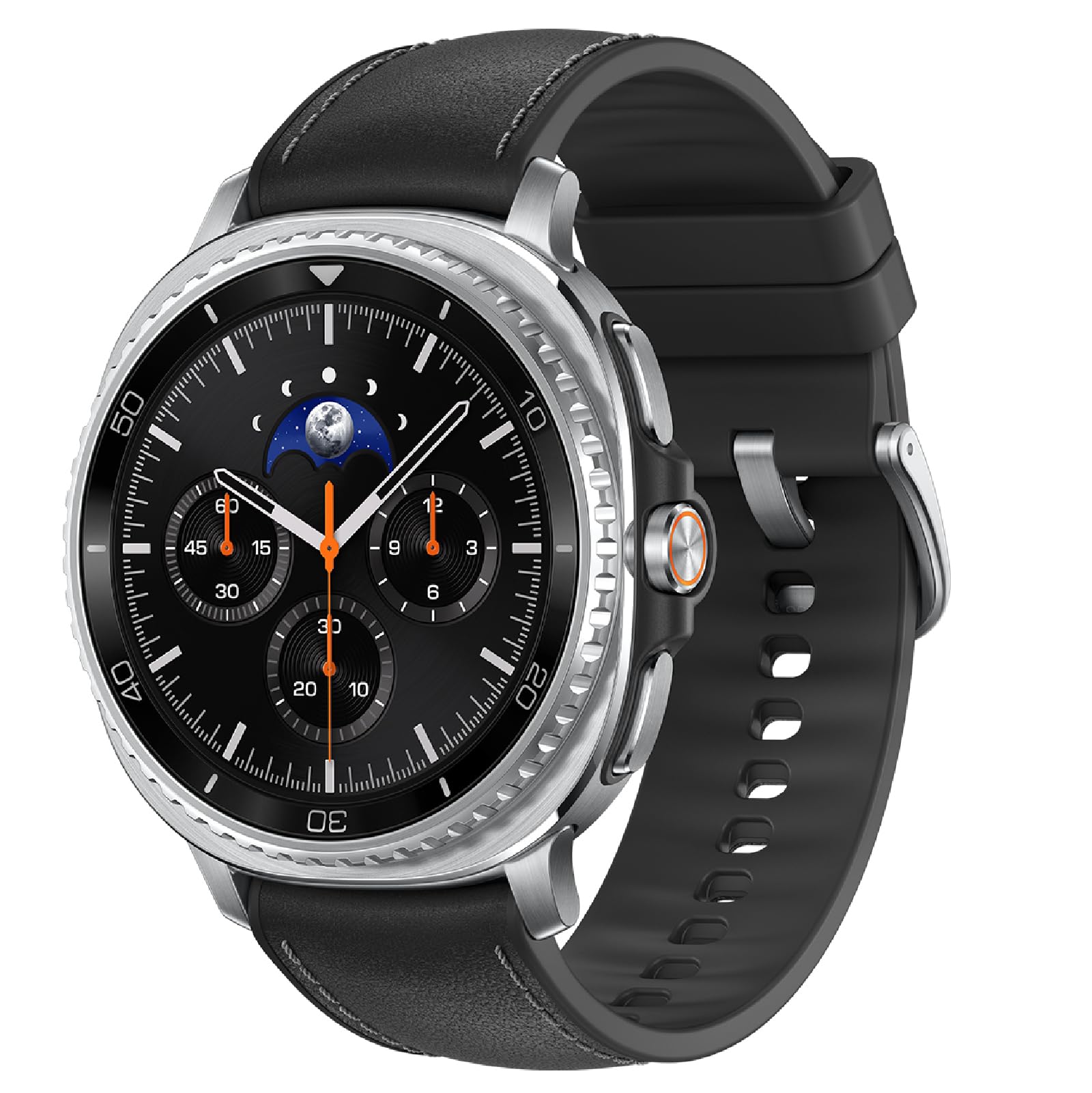
If you want a watch that reads as a proper timepiece first and a tracker second, this is the pick. The case carries a rotating bezel — a raised ring you spin to scroll through apps — which means you never have to smudge the screen to get to your step count. The band is eco leather (a leather-look material) and uses a buckle, so it dresses up for a meeting and holds up on a walk.
You get the biggest battery in this lineup at 445 milliampere-hours (a measure of stored charge), which is 445 vs the Amazfit Active 2 Premium’s 270 — a real lead if you run the always-visible display all day. Samsung rates it at 30 hours of average use, so plan on an overnight charge most nights. What wins people over is the look: the premium appearance is the single most-praised thing about this watch, and it is not hard to see why once the bezel turns under your thumb.
Beyond steps, it runs a full health suite — a daily Energy Score built from yesterday’s sleep, activity and heart rate, plus Running Coach that reads your age, weight, oxygen levels and heart rate to pace a run. It pairs with Samsung phones and other Android phones through the Galaxy Wearable and Samsung Health apps. The honest trade-off is that this is an Android-first watch, and battery life is the most-divided topic on its review pages, with some finding 30 hours short for their taste.
What earns it the top slot
- The rotating bezel makes navigation physical, so you are not tapping a glass dial with wet hands
- 445 milliampere-hour battery is the largest cell in this group
- A brighter screen plus the Now Bar puts weather, news and app shortcuts on the main watch face
- Energy Score and Running Coach turn step and sleep data into something you can act on
Where it asks for patience
- 30 hours of claimed battery means a nightly charging habit
- Built for Android pairing, so iPhone owners should look elsewhere
- The 46 mm case with eco leather is not the lightest thing to sleep in
Reach for this if: you want a watch that looks like a watch, counts your steps, and gives you a real health readout each morning.
Look elsewhere if: you refuse to charge overnight or you carry an iPhone.
2. Premium Smart Watch Men Women, 2.06″ AMOLED AOD
A 2.06-inch dial that shows analog hands, then hides your step count under them.
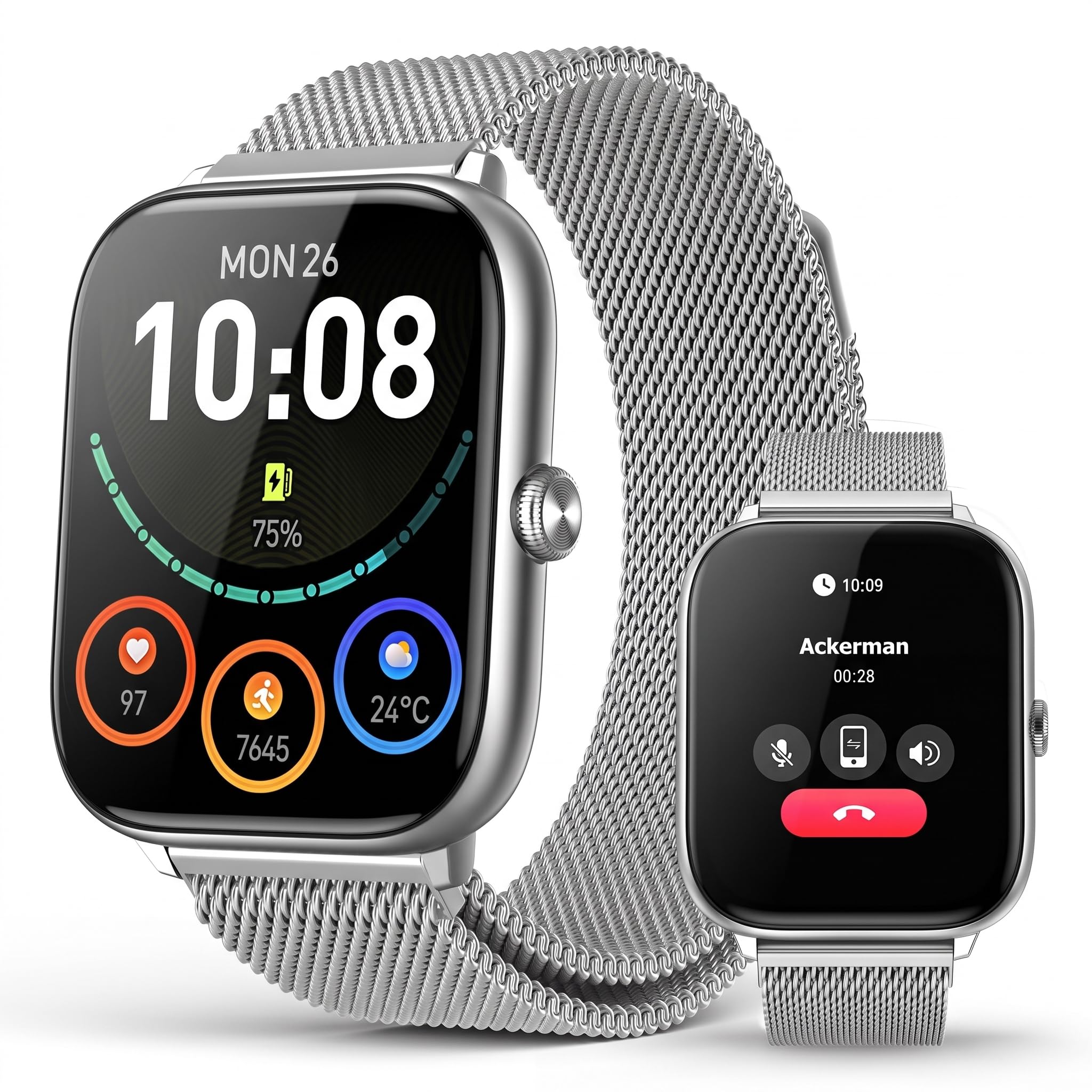
You get a classic-looking face on a very large screen, which solves the problem for most step-counter shoppers who still want a traditional look. The display is 2.06 inches across at 410×502 resolution — that is a wide, tall window for a wrist, and it stays readable in bright sun thanks to the 2.5D micro-curved glass edge (a slight rounded lip at the rim that reduces glare). You can pick from 300+ watch faces through the DaFit app, or load a photo of your own.
The step story is straightforward: 118 sports modes record steps, calories, distance and heart rate, and an IP68 rating (which means it survives dust and being dunked in water) covers sweaty workouts, rain and handwashing. The battery is a 340 milliampere-hour cell rated for 5-7 days of daily use. That figure is ahead of the Samsung’s claimed 30 hours and behind the Amazfit’s claimed 10 days — a middle position that suits a middle-size screen.
The band is the part people notice. It is a magnetic silver stainless steel strap, 22 millimeters wide and 23.3 centimeters long, that closes without a buckle in about a second. That length is the longest here, running 23.3 vs the Samsung’s 22 centimeters, so bigger wrists get more room. The catch: a magnetic clasp on a large case can shift slightly during hard exercise, and the watch carries only a light track record of reviews compared with the bigger names.
Wearability read: the zinc alloy case and steel band give it a formal look, and the Smart Digital Crown lets you twist through menus instead of tapping. A 2-hour charge refills it.
Second glance: the health readings are marked for reference only, not medical use, and there is no GPS built in — distance comes from the step count, not satellites.
Best fit: anyone who wants the largest possible dial and an analog face without paying smartwatch-brand money.
Think twice: if you need route mapping or a featherweight strap for gym work.
3. Amazfit Active 2 Premium Smart Watch
Ten days between charges, sapphire glass over the dial and a leather strap that dresses up.
Here is the number that changes daily life: up to 10 days of battery in typical use. That is 10 days vs the Prestige-style 2.06-inch watch’s 7 days, and it means you can leave the charger at home for a weekend trip. The battery cell itself is 270 milliampere-hours — smaller than the Samsung’s 445 — yet it runs longer, because the 1.32-inch AMOLED screen sips power rather than gulps it.
The build is where this one separates itself. The Premium version uses sapphire glass (a scratch-resistant crystal cover) over the display, plus a leather strap with a buckle and a free silicone sport band in the box for workouts. The stainless steel body keeps the classic round shape that makes analog faces look right. Quality is the thing buyers keep coming back to — it is the most-praised trait by a wide margin, with battery life right behind it.
For step data you get 160-plus workout modes and 5 satellite positioning systems for GPS — that means faster lock-on and more accurate distance when you walk, run, cycle or hike. There is a barometer for elevation and 50 m of water resistance, so swimming and skiing are fair game. It works with both iOS and Android through the free Zepp app, and there are no mandatory subscription fees. The honest caveat is app compatibility — the one topic that splits opinion — so check your phone model before you buy.
The case for it: long runtime, a scratch-resistant crystal and a strap that handles office and gym without a swap make this the most versatile watch in the group.
The catch: the charger is a magnetic base without a USB Type-C cable, so a lost puck is a real nuisance to replace.
Pick this if: you want to forget about charging and still get accurate step and GPS data for a week and a half.
Not for you if: you need a watch that survives deep water beyond a swim.
4. G-Shock Casio Move Analog-Digital Watch GBA800UC

Analog hands plus a digital window, with a step sensor that reads movement in three directions.
This is the watch for someone who wants to see actual hands sweep and still get a step number in the corner. The 3-axis accelerometer (a motion sensor that reads forward, sideways and up-down movement) keeps the step count going even when your hands are still in your pockets. It pairs with the CASIO WATCHES phone app, which lets you set a daily step target, view step logs across five exercise intensity levels, and calculate the calories you burn.
Training support goes deeper than most. A Multi-Timer lets you build up to 20 timer combinations of five timers each, and memory holds up to 200 lap records — enough for interval work without carrying your phone. The app can also send timer combinations back to the watch and store stopwatch data. An Auto LED Light lights the dial in dim rooms, which helps when you are checking pace on a night walk.
Fit details are unusually thoughtful. The band has back wings where it meets the case and a new band ring shape that stops it sliding, plus extra band holes for finer tightness adjustment. What wins people over is plainly how well it does its job — functionality is far and away the most-praised thing about it. The honest limit: the chunky case is heavy on the wrist, and the app-based setup is not everyone’s idea of simple.
What it does well
- Analog hands and a digital readout in one case
- 200 lap records and 20 timer combinations suit serious interval training
- Step logs split into five intensity levels inside the app
- Band wings and extra holes give a more secure fit
What to know first
- Programming through the app takes patience the first time
- No health-tracking display like the screen-based watches here
- The chunky case is not a dress watch
The one for you: if a real analog face and a bombproof training tool matter more than notifications.
Pass on it: if you want a slim profile under a cuff.
5. G-Shock Casio GBA900UU-3A

OD green with a high-contrast pixel display built to be read in the dark.
The draw here is the color and the screen. It comes in an OD green that reads as genuinely tactical rather than novelty, and the dial uses a Memory in Pixel LCD — a low-power screen that holds each pixel in place instead of refreshing constantly. Paired with a Super Illuminator backlight, the display stays visible when you turn off the lights. The band is soft urethane, which sits comfortably against skin through a long day.
For steps, this watch borrows its phone’s GPS for precision. You measure a specific span once with your smartphone over Bluetooth, then the watch handles that distance itself from then on. It shows distance, speed, pace and calories burned, with auto lap readings that log running times for set distances. Five stages of exercise intensity let you see whether a walk was a stroll or a real effort.
What people love is the appearance, and the OD green color earns its own share of the credit. There is a genuine caveat, though: readability splits opinion, and the digital display is on the small side for some eyes. If you need large numerals at a glance, the bigger AMOLED screens in this list serve you better. The trade-off is real but not fatal: the small MIP display is the only weak point on an otherwise capable training watch.
Best moment for it: a dusk run or a camping trip, where the MIP screen and Super Illuminator earn their keep.
Heads up: the digital readout is compact, so anyone with weaker close vision should look at the 1.43-inch AMOLED options instead.
Choose it because: you want a rugged outdoor look with a screen that never washes out.
Skip the color: if tonal green will not match anything you own.
6. ALPHAGEAR Commander Rugged Smartwatch
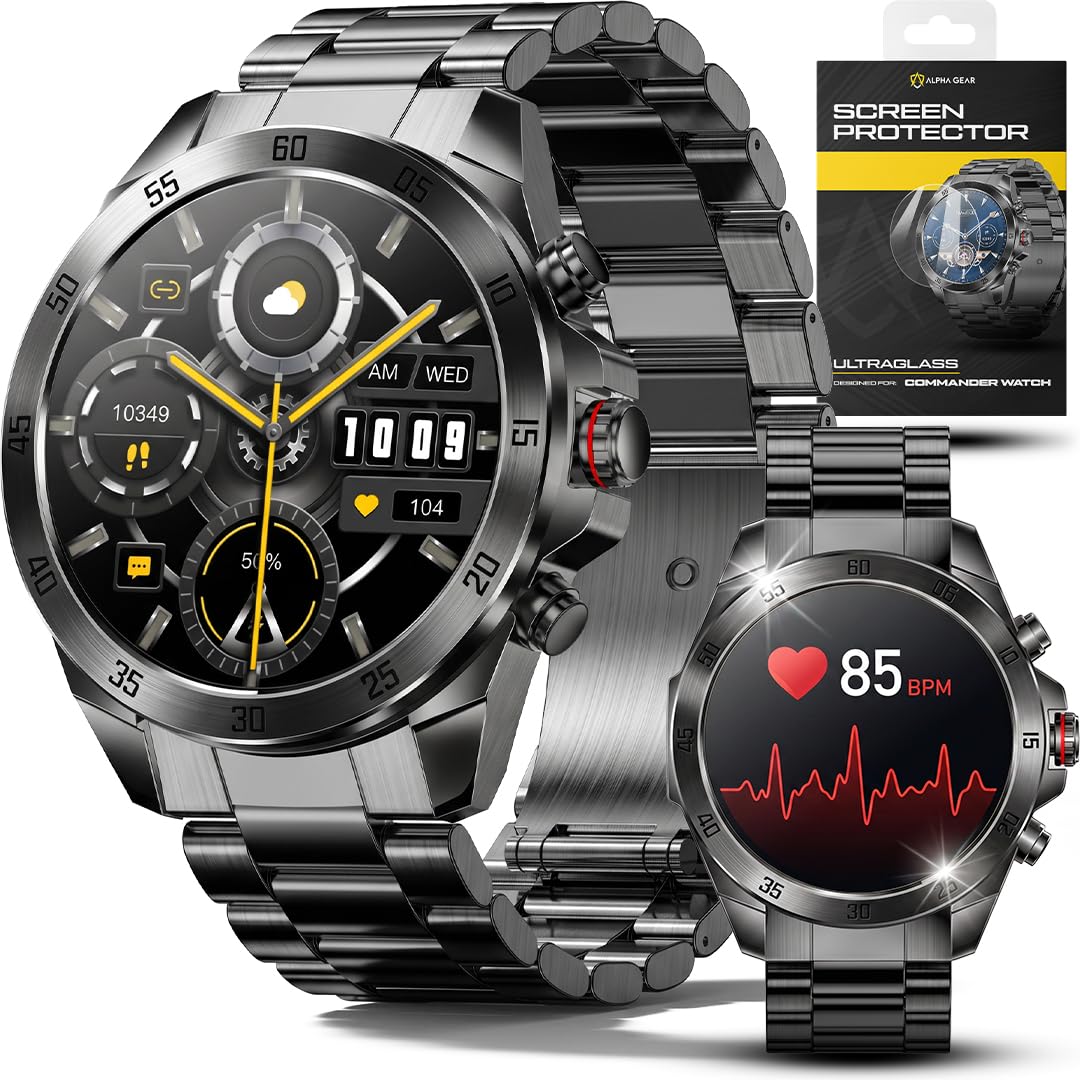
Twelve days off one half-hour charge, wrapped in a stainless steel case and link bracelet.
Built for long shifts away from an outlet, this watch claims up to 12 days on a single 30-minute charge — the longest runtime in this lineup. The body is stainless steel with a solid link bracelet, so it has the weight and presence of a proper metal watch rather than a plastic band. The screen is a 1.43-inch AMOLED, a bright round display you can read in daylight, and there are 200-plus watch faces to swap its look.
Ruggedness is the point. An IP68-rated metal body tested from -18F to 145F means cold mornings and hot vehicles are not a concern, and a comfortable strap keeps it wearable all day. Steps, heart rate, blood pressure, SpO2 and sleep all log to the FitCloudPro app for general fitness reference. Bluetooth calling lets you take a call on your wrist when your hands are full.
Quality is the aspect that earns the most praise, with the appearance close behind. The caveat worth knowing: reliability and battery life both split opinion, and the stainless link bracelet is heavy enough that it is not an overnight-sleep tracker for everyone. Since the band is a fixed metal bracelet, sizing it requires a link tool.
Who it suits: tradespeople and anyone who works a long shift and refuses to baby a watch.
The honest catch: a stainless link bracelet adds heft, and if you are sensitive to weight on the wrist that matters.
Reach for it if: you want a metal watch that survives a job site and still counts your steps.
Steer clear if: you need a light watch for sleep tracking.
7. SOUYIE Luxury Smart Watch for Men

Two straps in the box, so it goes from boardroom to jog without changing watches.
You get two straps in the box — a metal strap for work and a silicone strap for activity — plus a tool to swap them in about a minute. The body is full metal, the screen is a 1.43-inch AMOLED at 466×466 resolution (a fine, crisp grid of pixels) with anti-glare treatment for outdoor wear, and you get 15 pre-loaded watch faces plus 100+ more in the app. An analog-style always-on face keeps the classic look when the screen sleeps.
Steps come through 100-plus sports modes, with real-time heart rate, walking distance, speed and calorie data logged as you move. A 400 milliampere-hour cell charges in 2 hours and claims 7-10 days of use or up to 30 days of standby. That 22-millimeter band width is the same as the bigger Premium watch’s strap, so aftermarket bands will fit both. It handles handwashing and rain, though it is not built for swimming.
Build quality is the standout — it is praised more than any other trait, with value close behind. The parts that divide opinion are accuracy of the heart and blood pressure readings and the phone connection, so treat the health numbers as a general reference rather than a precise instrument.
Why people choose it
- Metal and silicone straps both included, no extra purchase needed
- 466×466 AMOLED resolution is the sharpest display in this group
- 400 milliampere-hour battery with 2-hour charging
- Bluetooth calling with a built-in microphone and speaker
Set expectations here
- Not suited to swimming, diving or sauna use
- Heart rate and blood pressure readings are a rough guide
- The phone connection works for most but is not flawless
Points in its favor: two straps and a crisp AMOLED make it the easiest watch here to dress up or down.
Points against: if you swim laps, this one stays on the shelf.
8. Garmin vívomove Trend 40mm

Actual hands that sweep over a screen you cannot see until you touch it.
This is the purest answer to the keyword on this page. There are no digital numerals on the dial — just real analog hands over a stainless steel bezel, with a full-dial touchscreen hidden behind them that lights up only when you move or tap. The case is 40 mm across and 11.9 mm thick, sized to fit wrists from 125 to 190 mm in circumference, so it works on a smaller wrist where a 46 mm watch would swim.
Battery is the trade-off to understand up front. Garmin rates it at up to 5 days in smart mode, plus one additional day in watch mode where the hands tell time only. That is well short of the Amazfit’s claimed 10 days, and the review pages show some people finding it needs a charge far sooner. If you want to set it on a nightstand once a week, look at the longer-running options instead.
Step and health data are Garmin’s strength. It tracks steps, floors climbed, calories and intensity minutes, plus continuous heart rate sampling, Body Battery energy levels, Pulse Ox, sleep score and stress. Safety features include incident detection and Assistance, which send your live location to emergency contacts when paired with a compatible smartphone. There is also Garmin Pay for contactless checkout and a 20-millimeter band width. What wins people over is how it looks — classy enough to dress up or down, which is exactly what a hybrid should be.
The trade you make: you give up screen-first convenience and get a watch that reads as jewelry on the wrist.
Read before buying: the hidden display only shows data when you engage it, so do not expect a glowing step count at a glance.
The right call for: anyone who wants real hands and a classic face with tracking underneath.
The wrong call for: long-trip travelers who want a week-plus between charges.
9. Garmin Venu 3S 41mm

A 41 mm case with a bright AMOLED dial that runs for up to 10 days.
You get the most complete package if you want to see your step count clearly and dig into the data behind it. The 41 mm case carries a bright, colorful AMOLED touchscreen, and the battery is rated for up to 10 days in smartwatch mode — the same claim as the Amazfit Active 2 Premium, but with a 400 milliampere-hour cell behind it. The silicone band is 18 millimeters wide, the narrowest here, which keeps the watch light on a small wrist.
The health suite goes wider than most. Body Battery tracks when you are charged up or need rest, built from sleep, naps, stress levels and workouts. You get a sleep score with personalized coaching, HRV status, morning report, fitness age and meditation tools. Automatic nap detection logs nap length and shows how it affects your energy reading. For training, workout benefit tells you how each session affects your body, and recovery time tells you how long to wait before the next one.
Functionality is the most-praised thing about this watch, with battery life second, and step and GPS accuracy also get consistent credit. It also goes beyond the others in one unusual way: a wheelchair mode tracks pushes instead of steps, with push and handcycle activities and preloaded workouts. Phone calls and voice replies work when paired to an iPhone or Android phone, and downloaded music plays through wireless headphones. The one honest friction point is value and usability — this is a premium pick, and the deep menus take learning.
Standout strengths
- Up to 10 days of battery with a bright AMOLED screen
- Sleep score, HRV status, Body Battery and nap detection in one place
- Wheelchair mode tracks pushes rather than steps
- Calls and voice replies from the wrist when paired to a phone
The honest limits
- The deepest menu system here, so expect a learning curve
- Music downloads need a premium subscription
- The 18 mm silicone band is narrow for people who prefer a wide strap
Worth it for: anyone who wants step data inside a full picture of sleep, recovery and training load.
Overkill for: a buyer who only wants a daily step number and nothing more.
Know the Specs
Accelerometer and step accuracy
An accelerometer is a small motion sensor inside the watch that feels the up-and-down rhythm of your arm as you walk. A 3-axis version reads movement in three directions, so a walk with your hands still in your pockets still registers steps. Watches that also pair with your phone’s GPS turn those steps into distance, pace and route data. If you only care about hitting a daily step goal, the accelerometer alone is enough — GPS matters when you want to see where you went.
Battery life and how it is measured
Battery life is quoted in two different ways on this list: hours of average use and days of typical use. A watch rated at 30 hours is expected to be charged most nights, while one rated at 10 days can go far longer between charges. Milliampere-hours (mAh) measures how much charge the cell stores, but a bigger number does not automatically mean longer life — the screen size and how often it lights up matter just as much. Always match the claimed figure to how you will actually wear the watch.
Hybrid hands versus analog watch faces
You get a traditional look every second of the day with a hybrid watch, which has physical hands over a hidden display. A smartwatch with an analog face draws those hands on its screen, which lets it show notifications, health tiles and step counts in the same window. Hybrids tend to run longer on a charge; screen-based watches tend to show you more. Neither is better in the abstract — decide if you want a dial that is always analog or one that can change.
Water resistance and IP ratings
An IP68 rating means the watch is sealed against dust and survives being dunked in water, which covers rain, handwashing and sweat. A 50 m water-resistance rating is deeper protection and generally allows swimming. Not every watch here makes that jump: one pick is explicitly noted as unsuitable for swimming, diving or sauna use. Read the rating before you get in the pool rather than after.
Band width and case size
Band width is the measurement in millimeters across the strap where it attaches to the case, and it decides which aftermarket bands will fit. A 20 mm band sits narrower than a 22 mm one, while an 18 mm band is the slimmest option here. Case size runs the other way — a 40 mm or 41 mm case wears lighter on the wrist, while a 46 mm case with a metal bracelet has real weight. Both matter for overnight wear.
Health sensors and what they can tell you
These watches read heart rate through the wrist, estimate blood oxygen, and log sleep stages. Some also estimate stress and offer a daily readiness score. Treat all of it as general fitness reference rather than clinical measurement — several makers state plainly that their readings are for reference only and the device is not a medical tool. Glance at the trends across weeks; do not read single readings as diagnosis.
Common Questions
Can an analog watch really count my steps?
How does a step counter know I am walking and not just waving my arm?
Will an analog step-counting watch work with my iPhone?
How many days should a step-counting watch last on a charge?
Can I swim with a step-counting watch?
Does a bigger battery mean longer battery life?
Is a hybrid watch better than a smartwatch with an analog face?
Do these watches need a subscription for step tracking?
Can I wear a metal-band watch to the gym?
What is an always-on display and does it drain the battery?
The Bottom Line
For most people, the analog step-counting watch that gets the balance right is the Samsung Galaxy Watch 8 Classic. The rotating bezel makes it feel like a real watch in your hand, the 445 milliampere-hour battery is the largest here, and the health suite gives you a reason to check it every morning. It also holds 4.5+ stars across 900+ ratings. If you want to disappear for a week without a charger, the Amazfit Active 2 Premium and its 10-day claim is the smarter buy, with sapphire glass on top. And if real sweeping hands are non-negotiable, the Garmin vívomove Trend is the only true hybrid on the list.
How we choose
We do not accept paid placement. Every pick is matched to a real buyer and a real use-case; we do not hands-on test units.
Sources
Specifications: manufacturer listings and product documentation. Review insights: verified customer reviews, as of November 2026. Pricing: not shown on this page (it changes often); check the current price via the retailer link.
As an Amazon Associate, My Heart Lives Here earns from qualifying purchases. This does not affect which products we feature.