Heads up: This post contains affiliate links. As an Amazon Associate I earn from qualifying purchases, at no extra cost to you. Learn more
Specs are compiled from manufacturer listings and verified buyer reviews and can change over time — please confirm the key details on the product page before buying.
Gluing plastic to rubber is one of the trickiest repairs in the shop, because smooth plastic shrugs off ordinary glue and rubber flexes until the bond cracks. The fix is not more glue — it is the right chemistry for two materials that resist bonding, plus a clean surface and enough clamp time. This guide covers seven adhesives that genuinely handle plastic-to-rubber work, from instant cyanoacrylates (fast-setting super glues) to contact cements and spray adhesives, and explains in plain words which one fits your exact job.
This guide is built by comparing the manufacturers’ published specifications and the patterns across verified customer reviews, so you get each pick’s real strengths and trade-offs instead of marketing spin.
You will see where each formula belongs, what it will not stick to, and how long it needs before you put load on it. By the end you will know which tube to reach for, and here is the short version of the best adhesive for plastic to rubber.
Top Picks

How To Choose The Best Adhesive for Plastic to Rubber
Two materials decide your glue before anything else: the plastic and the rubber. A general-purpose cyanoacrylate (super glue) will bond ABS or PVC to a rubber gasket well, but it slides right off polyethylene and polypropylene — the waxy plastics used in many jugs, bins, and car trim. Rubber is the second problem, because it bends under load, and a brittle glue line cracks when it flexes. Match the formula to those two surfaces first, then worry about speed and strength.
Match the adhesive family to the surfaces
Instant cyanoacrylates (CA glues) set in seconds and suit small, tight joints where the parts meet flush. Contact cement — a rubbery, solvent-based adhesive — stays flexible and suits larger sheets, headliners, and upholstery where the rubber needs to move. Acrylic cement is the specialist for acrylic and plexiglass, and it flows into seams. Spray adhesive covers broad flat areas at once. If your plastic is polyethylene or polypropylene, expect to need a primer or activator; the Loctite kit below is built around exactly that problem.
Check the cure time, not just the set time
Handling time (how long you hold the parts before they stay put) and full cure time (when the bond reaches final strength) are different numbers. A glue can grab in seconds yet need a full day before you load it. Check both before you plan a repair you need to use right away.
Respect the ventilation warning
Solvent contact cements and spray adhesives give off strong fumes. The Berkland cement label calls for gloves, safety glasses, and a well-ventilated area, and the spray adhesive below is marked for industrial or occupational use. Work near an open window or outdoors, and keep both away from heat or flame.
Side-by-Side Comparison
| Model | Best For | Form | Container Size | Full Cure Time | Amazon |
|---|---|---|---|---|---|
| 3M Scotch-Weld PR100★ Best Overall | Fast, precise instant bonds | Liquid (instant) | 20 g | 24 hours | Amazon |
| RH Adhesives S-18Best for Big Sheets | Large flexible sheets and headliners | Liquid (contact cement) | 4 oz | 24 hours | Amazon |
| Loctite Plastics Bonding System | Hard-to-bond plastics with activator | Liquid (two-part) | 2 g (2-pack) | 1 minute | Amazon |
| LEENEXUS Plastic CA Glue | Hairline cracks in 3D prints and models | Liquid (water-thin) | 40 ml | 24 hours | Amazon |
| Berkland Acrylic Bonding Cement | Clean acrylic and plexiglass seams | Liquid (water-thin) | 4 oz | 1 day | Amazon |
| Titebond PVC Trim Joint Adhesive | Permanent waterproof PVC joints | Liquid | 4 oz | 8 hours | Amazon |
| 3M Hi-Strength 90 CA Spray | Broad flat surfaces and large panels | Spray | 19.0 oz net wt | — | Amazon |
Detailed Reviews
1. 3M Scotch-Weld PR100 Adhesive
Our pick — 4.5+★ from 500+ verified ratings; the strongest balance of quality and price.
The bottle that grabs in under twenty seconds and refuses to drip down a vertical joint.
This is the one to start with if you want a single tube that handles plastic and rubber without guesswork. 3M builds it specifically for what they call difficult substrates — surfaces ordinary glue slips off. That list includes plastics, silicone rubber, and EPDM (a weather-resistant synthetic rubber used in seals and gaskets), plus plasticized PVC, ABS, Nylon, and Santoprene. If your repair involves a rubber gasket stuck to a plastic housing, this is the formula made for that job.
Speed is its second strength. Handling time is under 20 seconds on the label, so you press the parts together and they hold almost immediately — a real help on vertical surfaces where you cannot clamp. The bottle is a flexible squeeze container: pinch it for one precise drop, or squeeze for a steady bead along a seam. Bond lines come out thin, and 3M says it will not drip during vertical application. Full cure takes 24 hours, so leave a loaded repair overnight before trusting it.
The thing owners rave about is the raw holding power — bonding strength is far and away the most-discussed aspect of this product. The recurring gripe is cost: you get 20 grams, and plenty of buyers feel the volume is small for what they pay. Set that against a result that holds, and it reads as a specialist tube for repairs that matter rather than a bulk bottle for shop volume. Compare it to the Loctite kit below, which ships just 2 grams — the PR100 holds 20 grams, so a single bottle lasts considerably longer between buys.
Why It Earns The Top Spot
- Bonds hard cases by design: plastics, silicone rubber, EPDM, ABS, Nylon, and Santoprene
- Handling time under 20 seconds — no long clamping session
- Thin bond lines with no dripping on vertical joins
- Pinch-or-squeeze bottle gives drop-level control
What To Weigh Before Buying
- 20 grams goes fast on larger jobs, and the price per gram runs high
- Full cure needs a full 24 hours before load
- Marked for industrial or occupational use
Reach for this if: you need a fast, precise bond between a rubber seal or gasket and a plastic part, and you want it to hold the first time.
Look elsewhere if: you are bonding big flexible sheets where a rubbery contact cement or a spray will cover far more area per tube.
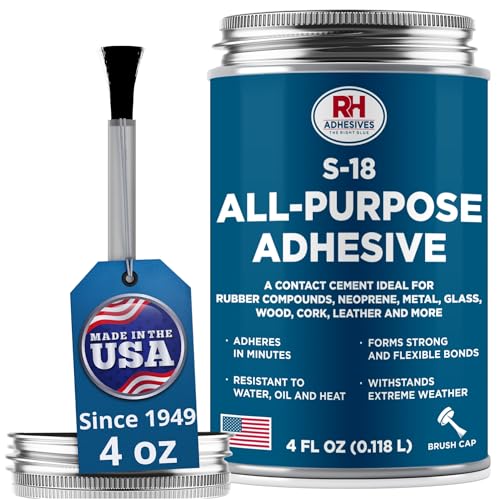
2. S-18 All-Purpose Adhesive 4 oz
A rubbery contact cement built for sagging headliners and the plastic-to-rubber jobs cyanoacrylate cannot flex with.
Here is the case where an instant glue is the wrong tool. Car headliners, upholstery, and any big rubber sheet bonded to plastic need an adhesive that bends with the material instead of cracking. S-18 is a neoprene contact cement — a rubber-based adhesive that forms a flexible film. The label lists rubber compounds, metals, ceramics, glass, felt, fabric, cork, and tile as compatible, with SBR rubber bonded to metal as a standard use. It also handles multiple plastic types to other materials, which is exactly the plastic-to-rubber overlap you may be facing.
Two properties make it useful outdoors or in a vehicle. It is water resistant, and RH Adhesives says it holds up in difficult temperatures and resists oil. Full cure runs 24 hours, so plan the repair for a day you can leave it alone. The trade-off is the smell. This is a solvent-based cement, and the strong odor is the most common complaint, which is normal for a contact cement but still means you want airflow.
Adhesion is a genuine split decision in the reviews. Rubber-to-rubber bonds come out perfect for many buyers, while a minority find it does not stick at all — usually a sign of poor surface prep or the wrong material pairing rather than a bad batch. Scuff both surfaces and follow the label and your odds improve sharply. What buyers consistently like is how easy it is to work with for a heavy-duty cement. Bonding rubber to metal and plastic to other surfaces is precisely where it shines.
Where it wins: flexible, water-resistant bonds across rubber, plastic, leather, felt, wood, and glass — the go-to for headliners, upholstery, and marine work.
The honest caveat: it smells strongly, and a handful of buyers found certain surfaces would not take. Prep both faces first and test a hidden spot before committing the whole sheet.
Built for: anyone re-gluing a headliner, laying rubber matting onto plastic, or bonding flexible material that must not crack when it moves.
Not the tool for: a tiny rigid joint where you want a hard, thin, instant bond — grab the PR100 instead.
3. Loctite Plastics Bonding System 2-Gram 2 Pack
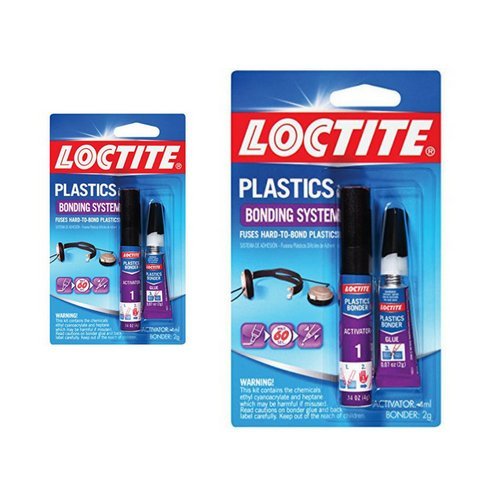
The two-step system for the plastics that laugh at ordinary glue — primes the surface, then locks it.
Polypropylene and polyethylene are the problem children of plastic bonding. These waxy, low-energy plastics are why some repairs fail no matter how much super glue you add. Loctite answers that directly: an activator primes those hard-to-bond surfaces, then a cyanoacrylate (super glue) sets in seconds with just one drop. The bond dries clear and sets without clamping, and the label notes resistance to water, most chemicals, and freezing temperatures — useful if the repair lives in a fridge, freezer, or cold garage.
You get a genuine two-part kit (resin and hardener you mix together), and it arrives as a 2-pack of 2-gram bottles. That is a precision tube for one small, specific fix, not a bulk supply: the Loctite kit works out to 2 grams per pack against the 3M PR100’s 20 grams. The stated full cure time is just 1 minute — the fastest on this list — so you prime, drop, and you are done. If you are gluing a large rubber-to-plastic surface, the bigger 3M PR100 suits you better; this one is for tight, quick repairs.
Effectiveness is the most-discussed topic in the reviews, and it is genuinely mixed: it works beautifully on some fridge plastics for some buyers, and does nothing on plastics for others. That split tells you this is not a universal glue — it is a targeted one. It tends to perform when the activator is used properly and the surfaces are clean, and it disappoints when applied like plain super glue. Durability opinions divide the same way. Buy it for the specific plastics it is made for, and treat it as a one-job specialist.
The specific win: the included activator makes genuinely hard plastics — polypropylene and polyethylene — bondable, which plain cyanoacrylate struggles with.
The fair warning: results vary by plastic. Test on a scrap corner first, use the activator exactly as directed, and keep expectations modest on unfamiliar materials.
Pick it when: you are repairing a fridge shelf, a bumper clip, or any waxy plastic that has already shrugged off plain super glue.
Pass when: you need volume or broad coverage — 2 grams is a small tube, and a bigger tube or a spray serves a full panel better.
4. Super Glue for Plastic 40ml
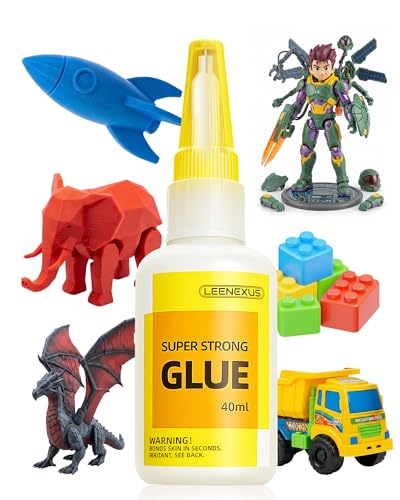
Water-thin glue that wicks into cracks you cannot reach, then dries clear enough to hide the repair.
A hairline fracture needs a glue that reaches the break, and a thick gel is the wrong pick because it sits on top and never gets in. This LEENEXUS formula is deliberately water-thin, so it flows in by capillary action (the way liquid creeps into a narrow gap on its own) and sets inside the joint. LEENEXUS lists PLA, ABS, PETG, PC, ASA, acrylic, PVC, metal, glass, leather, and rubber as compatible, and it sets in 10 to 45 seconds according to the seller, which leaves enough working time to align the pieces before they grab. It dries clear with no white residue, so a visible repair stays clean. skip it if you need to fill a wide gap or bridge a missing chunk, since a thin liquid cannot do that.
The 40 ml bottle is generous compared to the small tubes elsewhere on this list. LEENEXUS adds an anti-clog setup: a built-in cleaning needle to clear the tip, a dual-threaded cap to stop it cross-threading, and an air-tight seal against humidity. The label also rates it to 212°F (100°C) and calls the bond impact-resistant. There is one honest usage note on the box worth repeating: on glossy or smooth plastics like ABS and PC, lightly sand the surface first to give the glue something to grip.
Note the deliberate exclusions on the label: it does not work on polyethylene, polypropylene, silicone, or wet surfaces. That is not a defect — it is the same limit every cyanoacrylate shares — but it means this is not the tube for a waxy plastic bucket or a silicone mat. What buyers praise most is all-around functionality, and the practical application matters just as much: less is more with water-thin glue, so use one small drop and hold for about 30 seconds on a vertical face. It is a strong choice for 3D-print repair and model work.
The edge: water-thin flow reaches hairline cracks a gel cannot, dries clear, and the anti-clog tip assembly keeps it usable between jobs.
The catch: no grip on polyethylene, polypropylene, or silicone, and glossy plastics need a light sanding first or the bond will fail.
Made for: 3D-print repair, model kits, RC parts, and any fracture too tight for a gel to reach.
Skip it for: a waxy plastic or silicone that needs a primer-first system like the Loctite activator kit.
5. Berkland Acrylic Bonding Cement, 4 oz with Applicator Bottle
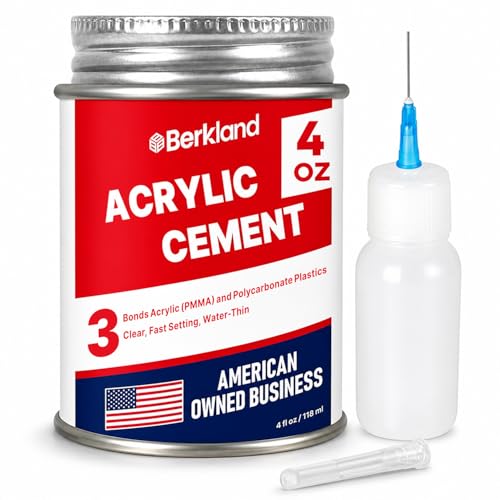
A needle-tipped cement that flows into acrylic seams and dries clear enough to disappear.
Acrylic and plexiglass need their own kind of glue, and this Berkland cement is built for exactly that. It is a water-thin acrylic cement (a solvent-style glue that softens the plastic slightly so the two faces fuse) rather than a general-purpose super glue. The applicator bottle comes with a needle and a dropper, so you get controlled, mess-free work on detailed projects like display cases, signs, and models. It sets in minutes and dries clear for smooth edges. Full cure is listed at 1 day, so leave fabricated pieces clamped overnight before you handle them. If you are bonding rubber to a non-acrylic plastic, this is not your tube.
Buyers report effectiveness as the most-praised aspect of this product, well ahead of anything else owners discuss, and bonding strength comes a close second. Owners mention it holds up over time. That is why it earns a spot even though it is pitched at acrylic specifically: if your job pairs a rigid plastic to rubber, this cement can bond the plastic side cleanly while you pick a flexible glue for the rubber. Just read the label limits, because it is not recommended for cross-linked acrylics or non-thermoplastics. Pick this one when the plastic half of your joint is acrylic; otherwise the LEENEXUS is the more versatile partner.
The trade-offs are real and worth knowing before you buy. Several buyers describe the cement as very thin, which is exactly what lets it seep into joints but makes it hard to control on a big open face. Leakage and surface irritation come up too, and the label is upfront about it: wear gloves and safety glasses, work in a well-ventilated area, keep it from heat and flame, and store below 80°F. Expect slight whitening in high humidity. Treat it as a bench tool, not a casual household glue.
What It Does Best
- Water-thin cement flows into tight acrylic joints for invisible seams
- Sets in minutes with a full cure in a day
- Needle-and-dropper bottle keeps application controlled
- Dries crisp for display cases and signs
What To Watch
- Very thin consistency is tricky on large surfaces
- Reports of leakage from the bottle
- Strong chemical nature — needs gloves and ventilation
- Not for cross-linked acrylics or non-thermoplastics
Choose it when: you are joining acrylic or plexiglass and want a clean, near-invisible seam on a display case, sign, or model.
Steer clear if: you want a glue for flexible rubber-to-plastic bonds — the rubber side needs a contact cement, not an acrylic solvent.
6. Titebond 4 Oz. PVC Trim Joint Adhesive

The outdoor specialist — a permanent, fully waterproof bond built for PVC joints in weather.
When the finished repair will sit outside in rain and sun, waterproofing becomes the deciding spec. Titebond’s PVC trim adhesive is 100% waterproof and makes a high-strength, permanent bond — the kind you want for decking, column wraps, and exterior trim. It is a single-component formula, meaning you open the tube and use it with no mixing, which makes it friendly for a one-person install. Its 8-hour cure is the shortest of the structural-style glues here, so you can load the joint the same day.
The label scopes it to PVC joints and column wraps, including miter, shiplap, and scarf joints. That is a narrower brief than a universal adhesive — if your plastic is PVC and it is going outdoors, this is the right call. Compared to the LEENEXUS CA glue above, which needs a clean, dry, indoor joint, this one shrugs off moisture by design. If the rubber you are bonding is an exterior weather seal or a trim gasket on PVC, this is where to start.
The most-praised quality in the reviews is raw effectiveness, particularly on decking boards, and buyers also like that it lets them bond fully and permanently along long edges. Adhesion and application speed come up positively as well. The split is on drying time and value — some find it dries fast and is a solid buy, others feel it is not the cheapest choice. Weigh that against a permanent, waterproof bond that stays put through weather, and the trade-off reads as worth it for exterior work.
The strength: 100% waterproof, permanent, and single-component with an 8-hour cure — purpose-built for PVC trim outdoors.
The scope note: it is tailored to PVC and trim, not a universal glue for every plastic. Read the joint types on the label before you commit.
Right for: exterior PVC trim, decking, and column wraps that must survive rain, with no mixing and a quick cure.
Wrong for: bonding a rubber gasket indoors where you want a flexible film — a contact cement covers that job better.
7. 3M Hi-Strength Spray Adhesive 90 CA

For when the repair is a whole panel, not a joint — high-tack spray that covers ground fast.
A tube cannot cover a full sheet of rubber laid onto plastic, and that is exactly what this can is for. 3M Hi-Strength 90 CA is a contact-type spray adhesive that bonds laminate, wood, concrete, metal, plastic, paper, cardboard, insulation, fabric, melamine, polyethylene, polypropylene, and SBR rubber. That material list is broad on purpose — it is built for large surface bonding of panels, laminates, and particle board as much as smaller craft work. The adjustable nozzle lets you choose a lace-pattern spray width to match the job.
Two details make it shop-friendly. Its low-VOC formula (under 25 percent) is CARB and SCAQMD compliant and GREENGUARD certified. And it resists moisture and high temperatures, which matters for interior construction, HVAC, and office partition work. This is a permanent, fast-tacking bond, so position parts carefully before you press — there is little forgiveness for repositioning.
The reviews are strongest on effectiveness and adhesive quality — laminate flooring comes up as a real success. Two honest caveats temper that. First, adhesion is a genuine split: some get strong results, others find it weaker than expected. Second, spray performance is the most-discussed frustration: cans that will not spray properly and stop dispensing partway through. Shake it well and use it fresh. It is also marked for industrial or occupational use, so treat the ventilation seriously.
Why it stands out: broad material compatibility including polyethylene, polypropylene, and SBR rubber, plus low VOC and a lace-controlled nozzle for large panels.
What to bear in mind: spray reliability can be a coin toss on some cans, and the permanent tack leaves no room for repositioning — dry-fit first.
The one for: covering large flat areas — bonding rubber matting or laminate onto plastic panels where a tube would take forever.
Not for: small precise joints; overspray and permanent tack make a niche repair harder than a drop of instant glue would be.
Know the Specs
Viscosity — Thin vs Gel
Viscosity describes how thick the glue is. A water-thin adhesive (like the LEENEXUS or Berkland) flows into hairline cracks and tight seams the way liquid seeps into a narrow gap. A thicker gel stays put on a vertical face but cannot reach a fracture you cannot open. Thin glue is harder to control, so it usually calls for sanding smooth plastics first to give it something to grip; thick glue is more forgiving but leaves a visible line. Pick thin for invisible seams, thicker for gap-filling.
Set Time vs Full Cure Time
Set time (or handling time) is how long you hold the parts before they stay put on their own. Full cure time is when the bond reaches its final strength. They are very different — a cyanoacrylate can grab in 1 minute yet still want 24 hours to fully cure, while Titebond lists 8 hours and the Loctite kit 1 minute. Never load a repair at set time; give it the full cure window or it may fail under strain.
Activators and Hard Plastics
Polyethylene and polypropylene are low-energy plastics that repel ordinary glue. An activator (a primer applied to the surface first) raises that energy so a cyanoacrylate can anchor. The Loctite Plastics Bonding System pairs an activator with a CA glue for exactly these materials — which is why it is a better bet than plain super glue on a waxy plastic part.
Form: Liquid, Contact Cement, and Spray
The form decides the job. Liquid cyanoacrylates suit small tight joints. Contact cement (a rubbery solvent adhesive that forms a flexible film) suits large sheets and joints that must flex. Spray adhesive covers broad flat areas quickly with an even coat. Match the form to the size and flexibility of your repair before you compare brands.
Common Questions
Will super glue bond plastic to rubber?
Why won’t glue stick to some plastics like polyethylene and polypropylene?
How long do I need to clamp plastic to rubber before it holds?
Can I use contact cement for plastic to rubber?
Is an acrylic cement the same as super glue?
How should I prep the surfaces before gluing plastic to rubber?
Will these adhesives hold outdoors in rain and heat?
Do I need gloves and ventilation when using these glues?
How much adhesive do I need for a full panel job?
Which is stronger for plastic to rubber, an instant glue or a contact cement?
The Bottom Line
For most plastic-to-rubber repairs, the adhesive for plastic to rubber winner is the 3M Scotch-Weld PR100 because it is purpose-built for both materials, grabs in under 20 seconds, and does not drip on a vertical joint. If you are re-gluing a headliner or laying flexible rubber onto a plastic panel, grab the S-18 Contact Cement. And for the waxy plastics — polyethylene and polypropylene — that reject ordinary glue, the Loctite Plastics Bonding System with its activator is the one to reach for.
Whatever you choose, the prep decides the outcome: clean both surfaces, sand glossy plastics, ventilate the room, and give the bond its full cure time before trusting it with load.
How we choose
We do not accept paid placement. Every pick is matched to a real buyer and a real use-case; we do not hands-on test units.
Sources
Specifications: manufacturer listings and product documentation. Review insights: verified customer reviews, as of November 2026. Pricing: not shown on this page (it changes often); check the current price via the retailer link.
As an Amazon Associate, My Heart Lives Here earns from qualifying purchases. This does not affect which products we feature.