Heads up: This post contains affiliate links. As an Amazon Associate I earn from qualifying purchases, at no extra cost to you. Learn more
Specs are compiled from manufacturer listings and verified buyer reviews and can change over time — please confirm the key details on the product page before buying.
You want a medicine formulated for children, dosed for your child’s age, and in a form they will actually take without a nightly negotiation. This guide covers nine kids’ allergy options and what each one is genuinely good at.
This guide is built by comparing the manufacturers’ published specifications and the patterns across verified customer reviews, so you get each pick’s real strengths and trade-offs instead of marketing spin.
Every pick here is children’s allergy medicine — chewables, syrups, and nasal sprays dosed for young kids rather than adult tablets. The pages below break down the nine strongest choices in allergy medicine for children.
Top Picks
How To Choose The Best Allergy Medicine for Children
The single biggest mistake parents make is grabbing their own adult allergy tablet and breaking it in half. Children’s formulas are dosed differently, come in kid-sized forms, and carry their own age cut-offs on the label. Start with your child’s age, then work outward from there.
Match the form to the child, not the other way around
Chewable tablets suit school-age kids who can chew and swallow properly, while an oral syrup works for younger children and for anyone who refuses tablets outright. A nasal spray is a different tool entirely — it targets nasal congestion and sneezing directly rather than working through the whole body. Pick the form your child will take without a fight — medicine that stays in the bottle helps nobody.
Read the dose on the label before anything else
Chewables for kids commonly come in a 5 mg strength, and dosing usually changes with age — often a single smaller chewable per day for the youngest kids and two for older children. Follow the exact directions printed on your bottle, and check with your child’s doctor if your child already takes other medicine.
Decide if you want 24-hour or 12-hour coverage
A 24-hour antihistamine is one dose and you are done for the day, which fits a school schedule neatly. A 12-hour liquid covers a shorter window but can be useful when you want relief timed to a specific part of the day. Both approaches work; the question is which one fits your morning routine.
Side-by-Side Comparison
| Model | Best For | Form | Active Ingredient | Ages | Amazon |
|---|---|---|---|---|---|
| Children’s Zyrtec Dye-Free Chewables★ Best Overall | All-day chewable relief | Chewable tablet | Cetirizine HCl 10 mg | 6+ | Amazon |
| Children’s Zyrtec Allergy Relief SyrupBest Value | Younger kids and syrup fans | Oral syrup | Cetirizine HCl 5 mg | 2+ | Amazon |
| Nasonex Children’s 24HR Nasal SprayBest for Congestion | Stubborn nasal congestion | Nasal spray | Mometasone furoate 50 mcg | 2+ | Amazon |
| Curist Kids Loratadine Chewable | Budget grape chewables | Chewable tablet | Loratadine 5 mg | 2+ | Amazon |
| Allegra Children’s 12-Hour Liquid | Fast one-hour onset | Oral liquid | Fexofenadine | 2+ | Amazon |
| Xyzal Children’s 24-Hour Liquid | Nightly liquid dosing | Oral solution | Levocetirizine dihydrochloride | 2+ | Amazon |
| Boiron RhinAllergy Kids Pellets | Multi-pack pellet supply | Dissolving pellets | — | 2+ | Amazon |
| Ohm Children’s Allergy Medicine | Picky eaters, dye-free | Chewable tablet | Loratadine 5 mg | 2+ | Amazon |
| Claritin 24 Hour Allergy Chewables for Kids | Bubblegum flavor fans | Chewable tablet | Loratadine | Kids | Amazon |
Detailed Reviews
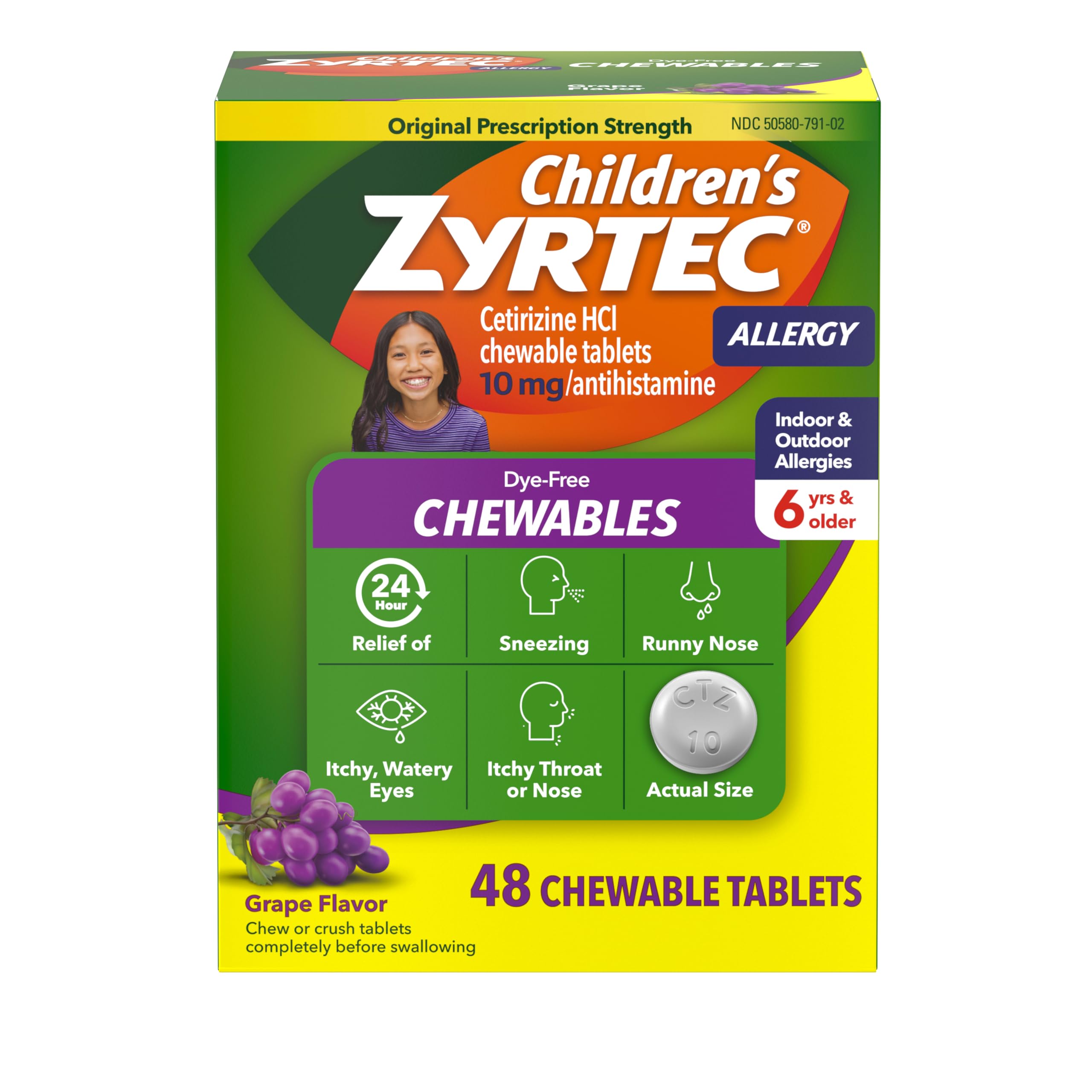
1. Children’s Zyrtec Chewables 48 ct
Our pick — 4.5+★ from 600+ verified ratings; the strongest balance of quality and price.
One grape chew, one full day of relief — no spoon, no spray, no argument.
This is the pick for a school-age kid who can chew a tablet and hates being chased with a medicine cup. Each dye-free chewable carries 10 mg of cetirizine hydrochloride — the same active antihistamine family as the brand’s liquid — and one chew covers a full 24 hours of sneezing, runny nose, and itchy, watery eyes. No dye means nothing artificial coloring the tongue or the shirt. At 1.76 ounces for the whole bottle, it slips into a backpack pocket far more easily than the syrup’s 6.24-ounce bottle the two share shelf space with.
It earns the top spot because it works on day one and, per the brand’s own claim, works even stronger on day two. Zyrtec is the #1 pediatrician-recommended brand among over-the-counter oral antihistamines. This chewable form has been on shelves only since May 2024 — a newer arrival than the brand’s syrup, which has been sold since 2009. It suits ages 6 and up, and it is HSA and FSA eligible (you can pay with pre-tax health savings or flexible spending accounts), so check your plan. For a mid-range chewable with a dye-free formula, it is tough to top on balance.
The one wrinkle: because it is a 10 mg chewable, it is not for the littlest kids — that age 6+ cut-off rules out toddlers and preschoolers who would need the liquid instead. If your child is under 6, the Zyrtec syrup below is the same brand at a lower per-dose strength and a lower age floor.
What lands with parents
- 10 mg cetirizine HCl in a single chewable — full 24-hour coverage from one dose
- Dye-free grape flavor designed for kids who balk at medicine
- 1.76-ounce bottle travels easily in a backpack or purse
- HSA and FSA eligible
Where it asks more of you
- Age 6+ only — not an option for toddlers or preschoolers
- A 10 mg chewable is a bigger dose than the brand’s 5 mg syrup, so match it to your child’s age
Best fit: School-age kids 6 and up who will chew a grape tablet and who need one-and-done daily dosing.
Not the one if: Your child is under 6 — that age floor is a hard line, and the syrup is the better route.
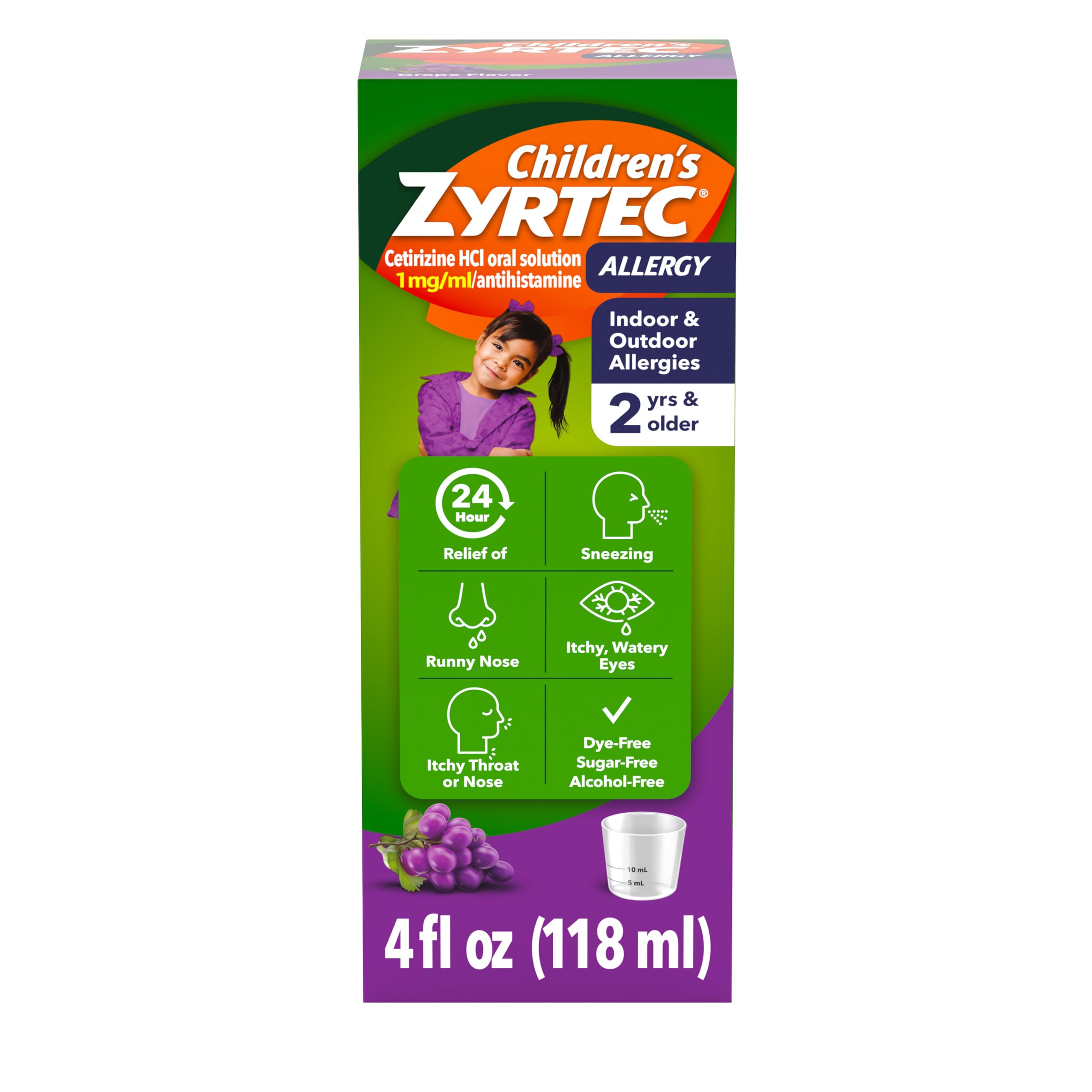
2. Children’s Zyrtec Syrup 4 fl. oz
The syrup that starts at age two, so the littlest kid in the house is covered.
When your child is too young to chew a tablet, this is the version that works. Each 5 mL (about one teaspoon) of the liquid carries 5 milligrams of cetirizine hydrochloride (the same allergy medicine as Zyrtec) — half the strength of the brand’s chewable — and delivers a full 24 hours of relief from runny nose, sneezing, itchy, watery eyes, and itchy nose and throat. It is dye-free, alcohol-free, and sugar-free, and it comes in a kid-friendly grape flavor. It suits children ages two years and up, it ships with its own dosing cup, and the directions vary by age — use only the enclosed cup.
The bottle is the heaviest thing on this list at 6.24 ounces, roughly 3.5 times the weight of the brand’s own chewables, so it is more of a leave-at-home medicine than a backpack one. But for the youngest kids, that extra bulk buys you the one thing that matters: it is the lowest age-floor Zyrtec option. It treats both indoor allergens like dust, mold, and pet dander and outdoor ones like tree pollen, weeds, and grasses. It is also HSA and FSA eligible.
What makes this the value play is simple — the same brand, the same active ingredient, a lower per-dose strength, and a lower age cut-off than the chewables. The trade-off is that you are measuring liquid into a cup every day rather than handing over a tablet. If your child is at least two and will take a spoon or cup, that is a small price for the flexibility.
Where it earns its keep: A 5 mg per-5 mL liquid with a dosing cup and a grape flavor, formulated for kids as young as 2.
What you give up: A 6.24-ounce bottle is not a pocket item, and daily liquid dosing takes more setup than a chewable.
The right call for: Parents of a two-to-five-year-old who cannot safely take a chewable yet.
Look past it if: Your child is already chewing tablets — the chewables are tidier for daily use.
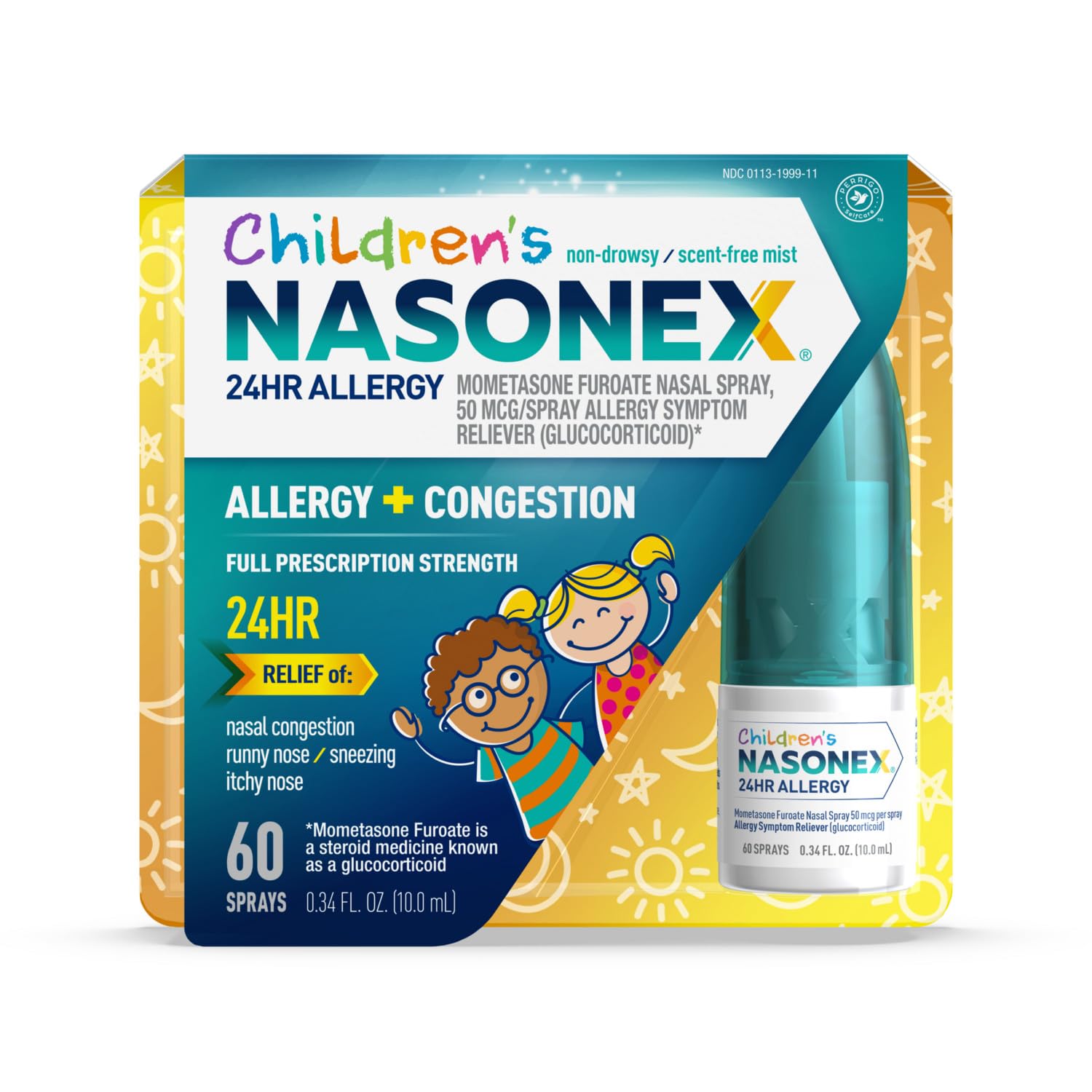
3. Nasonex Children’s Nasal Spray 60 Sprays
This one goes straight at the stuffy nose the chewables can only chip away at.
If your child’s worst allergy symptom is a blocked, runny nose rather than itchy eyes, a nasal spray is the smarter tool — it works right where the problem is. Each spray delivers 50 mcg of mometasone furoate, a glucocorticoid, at full prescription strength with no prescription needed, and the 60 metered sprays in the bottle last through a stretch of allergy season. It is non-drowsy and scent-free, so there is no medicated smell to make your child flinch. It is also HSA and FSA eligible.
Dosing is age-based: children 2 to 11 use 1 spray per nostril once daily with adult supervision, and ages 12 and up use 2 sprays per nostril daily. It is not for children under 2, and the brand directs using it for the shortest time necessary to achieve relief. Relief can start within 12 hours, but full effect takes several days of once-a-day use. Parents of allergy-prone kids consistently praise how well it works in season, and the one thing they call out most is that it does not sting a child’s nose — as owners put it, “The one nasal spray that works for my sons allergies in the spring. It does NOT sting his nose.”
The honest catch with a nasal spray is the commitment. You are spraying a young child’s nose once a day with supervision, and the benefit builds over several days rather than arriving in one chew. For a kid whose spring means a permanently blocked nose, though, it targets the symptom the tablets handle least well. It is the bulkiest item here at 4.88 x 5.5 x 11.15 inches — about 2.6 times the packed size of the brand’s chewables — so it lives on a shelf, not in a bag.
The angle that matters: 50 mcg per spray of mometasone furoate at prescription strength, targeted at congestion, runny nose, sneezing, and itchy nose.
What to know going in: Full effect takes several days of once-a-day use, and it is for ages 2+ only. The recurring gripes are dose patience and the daily supervised-spray routine, not the result.
Reach for this if: Nasal congestion is your child’s main allergy battle and you want a non-drowsy, scent-free spray aimed exactly there.
Think twice if: You need relief in the next hour — this one ramps up over several days, and it is not for kids under 2.
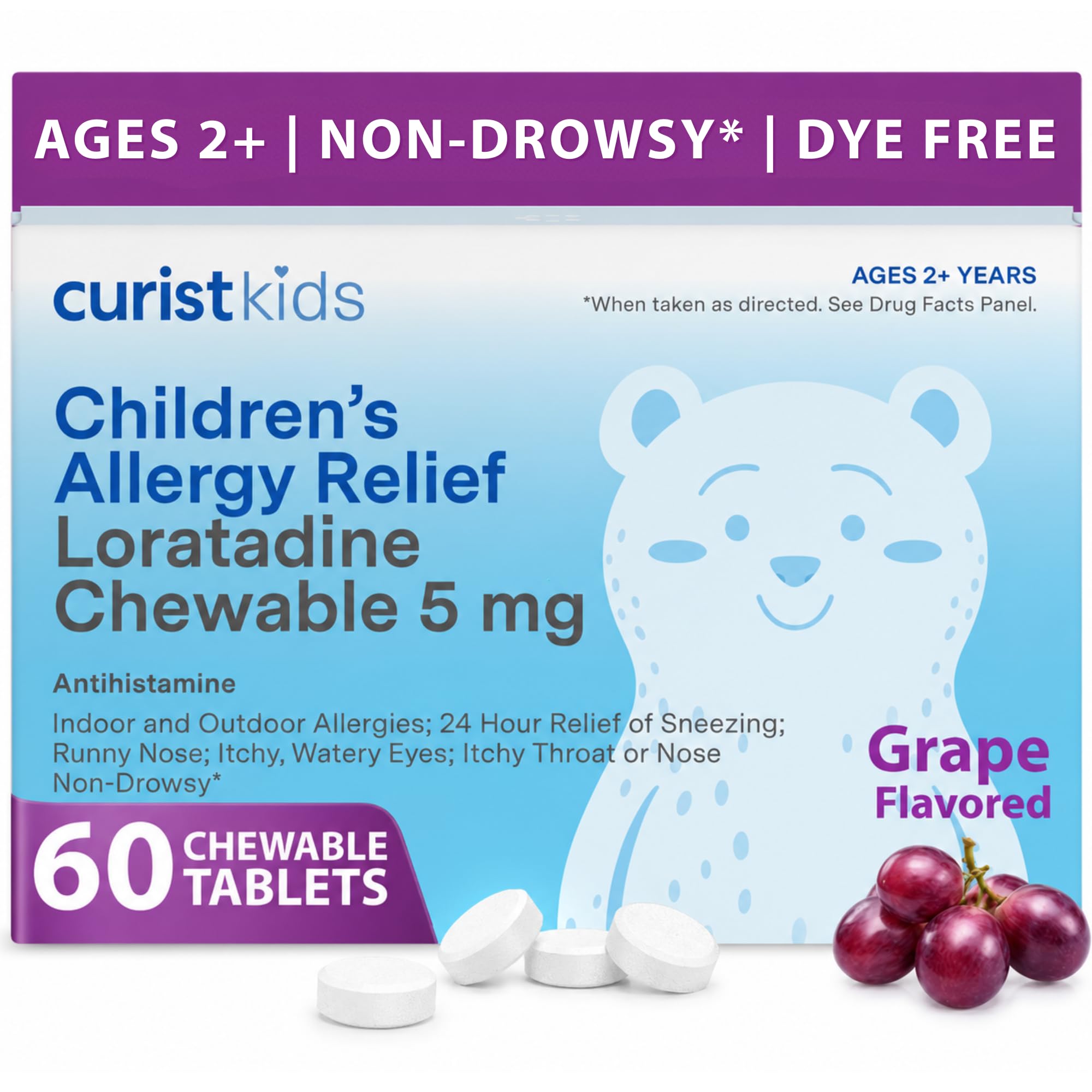
4. Curist Kids Loratadine Chewable 60 Count
Same active ingredient as the name brand, at a fraction of the fuss and cost.
If you want a shelf-stable chewable for a kid who is picky about medicine, this 60-count bottle of 5 mg loratadine chewables is the budget move. Each tablet is dye-free and grape-flavored, offering all-day non-drowsy relief from sneezing, runny nose, itchy, watery eyes, and itchy throat. It fights the usual suspects — pollen, dust, and pet dander — and the small tablet is designed for children ages 2 and up. Take 2 chewables to use it as an adult tablet, too.
The review pages are unusually specific about the flavor, because that is where this wins or loses with a child. Owners describe it as “indistinguishable from the name brand,” and one parent sums it up plainly: “My son likes the flavor and this seems to work best for his allergies.” What they talk about most is how close the taste comes to the expensive brand without the matching price tag, and how easy the tablets are to take. The 60-count bottle lasts through more than one allergy season.
There is one quirk worth knowing before you buy. The tablets come in individual packets that can be hard to open — handy for keeping a few in a backpack, but fiddly when you are rushing out the door in the morning. Buy it if you want name-brand-equivalent loratadine dosing without paying name-brand money.
The reasons parents reorder
- 5 mg loratadine — same active ingredient as the big-name chewable
- Dye-free grape flavor that kids accept without a fight
- A 60-count bottle that covers more than one season
Worth planning around
- Individually wrapped tablets take a moment to open when you are in a hurry
- Ages 2+ chewable format — not a liquid for kids who cannot chew
The match for: A parent who wants an affordable, grape, dye-free chewable that tastes like the brand-name version.
Not for: Kids too young to chew, or anyone who wants a liquid format instead.
5. Allegra Children’s Liquid 8 oz.

When you need the sneezing to stop before the school bell, this starts working in an hour.
Fexofenadine is the active ingredient here (the same allergy medicine as Allegra), and it is the reason this liquid is the pick when you want relief fast. It starts working in one hour against sneezing, runny nose, itchy, watery eyes, and itchy nose or throat. The formula is non-drowsy, with no brain fog to drag a kid down during a school day, and it covers both seasonal outdoor allergens like pollen, ragweed, grass, and trees and indoor ones like dust, mold, and pet dander. The grape flavor goes down smoothly, and an 8-ounce bottle suits children ages 2 and up.
The taste is the thing owners comment on most, and it is the reason this one tends to go over well with a stubborn child. A big draw, though, is that the same bottle does double duty — one adult who uses the children’s liquid notes that “a small dose of this medication get me through the day nicely. It also tastes good.” Parents of kids allergic to cats and dogs report it covering both the sneezing and the breakouts when other medicine feels like too much.
One caveat to flag honestly: this is a 12-hour formula, not a 24-hour one, so it asks for a second dose later in the day rather than a single morning dose. And while the flavor generally lands, the occasional child refuses it — allergy relief still depends on your kid actually swallowing it. If a one-and-done daily dose matters more to you than a one-hour onset, the chewables next to it on this list are the smoother routine.
Why it stands out: Fexofenadine in a non-drowsy grape liquid that starts working in one hour — fast relief when you cannot wait all morning.
Best for: A parent who needs fast, non-drowsy relief and does not mind a second dose in the day.
Skip if: You want a single daily dose — that is a 24-hour medicine’s job, not a 12-hour one.
6. Xyzal Children’s Liquid 10 oz.

Prescription-strength relief in a liquid, made to be taken at night and last all day.
This grape oral solution uses levocetirizine dihydrochloride, an antihistamine that delivers continuous relief from itchy, watery eyes and prescription-strength help against outdoor and indoor allergens like pollen, ragweed, grass, trees, dust, mold, and pet dander. The formula is sugar-free, alcohol-free, and dye-free, so it fits a family avoiding artificial additives. It starts working in 45 minutes and, per the brand, stays as effective at hour 24 as at hour one — one dose a day. It is made for kids ages 2 and up.
The one wrinkle is the routine: because it is a nighttime liquid, dosing is part of a calm, once-a-day bedtime habit rather than a grab-and-go morning chew. If your child is a toddler or preschooler and you want a single evening dose that covers the whole next day, this is the format built for that. It is not a chewable, so it will not suit a kid who insists on taking their own medicine.
What parents keep coming back for
- Levocetirizine-based liquid with relief that lasts a full 24 hours
- Sugar-free, alcohol-free, and dye-free
- Starts working in 45 minutes and lasts to hour 24
- Ages 2+ liquid — no chewing required
What to keep in mind
- Dosing is a once-a-day routine, often at bedtime, not a chew-and-go
- Liquid format, so it does not suit a child who prefers to take a tablet independently
The one for: A parent who wants one evening dose that handles a full 24 hours for a child aged 2 and up.
Look past it if: Your child insists on taking their own chewable — the liquid is for you to measure and give.
7. Boiron RhinAllergy Kids Pellets, 3 Count (240 Pellets)
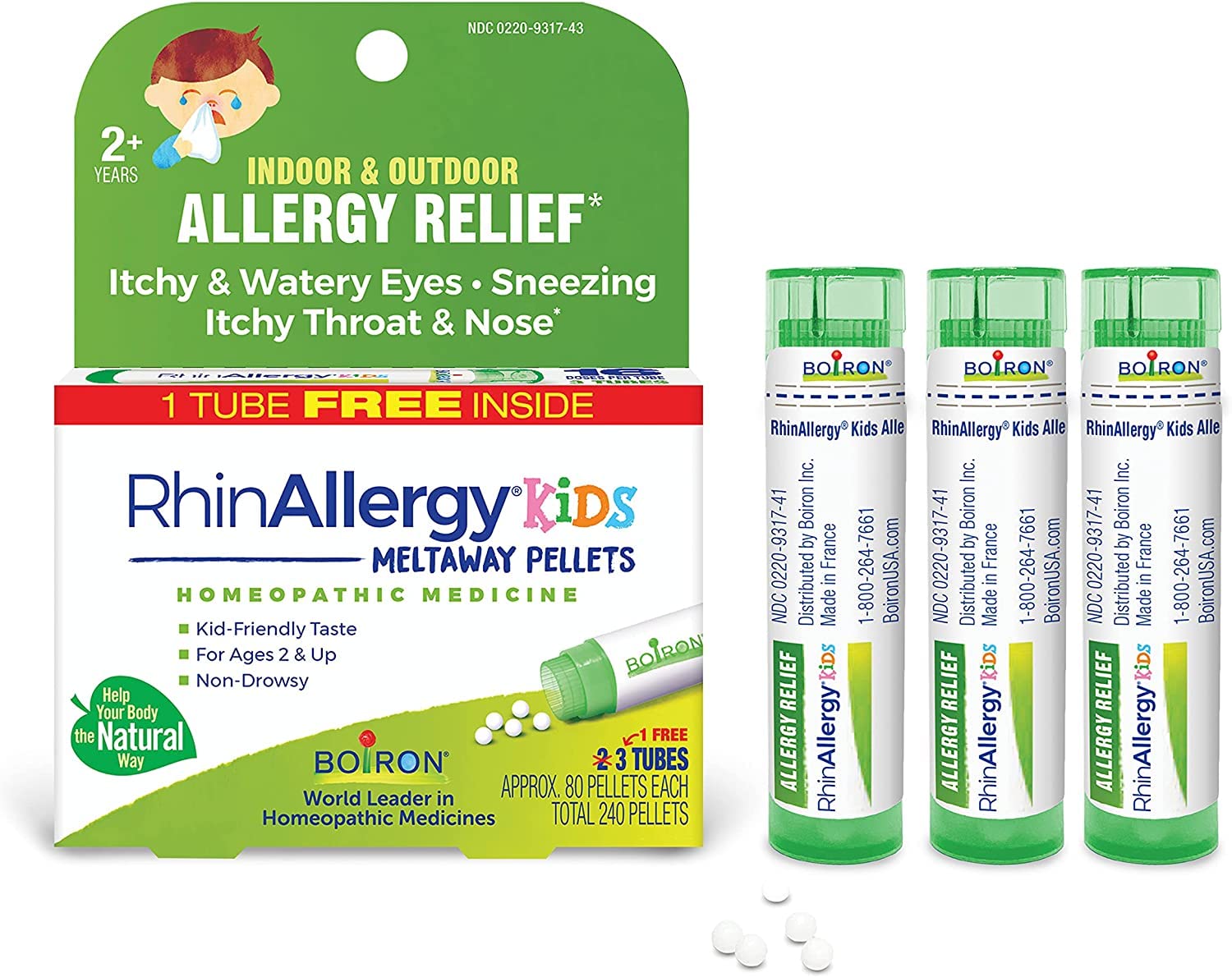
Tiny tasteless pellets for the child who fights every syrup and tablet.
These pellets are a different approach entirely — small, tasteless, and designed to dissolve rather than be swallowed with a drink. They temporarily relieve symptoms of upper respiratory allergies such as itchy and watery eyes, sneezing, runny nose, and itchy throat and nose. The pellets are non-drowsy, and the maker states there are no known drug interactions, which matters to parents juggling more than one medicine. The formula is for everyone age 2 and up, and the bundle ships as a 3-pack totaling 240 pellets.
The tasteless format is the whole point, and it is why this one sidesteps the daily bargaining that comes with flavored syrups and chews. Parents of a 4-year-old with seasonal allergies report it working well, and one parent of a 5-year-old describes a months-long, unresponsive cough clearing within two days of starting the pellets, with no taste complaint from the child. For a kid who flatly refuses anything flavored, that no-taste angle can be the deciding factor.
Here is the catch worth weighing: because dosing follows the bottle’s directions, following them strictly can use the pellets up quickly — some families simply take the recommended amount once or twice a day instead. The 3-pack softens that, since 240 pellets total go further than a single tube would. It is a smart fit for a picky child, less so if you want a fixed, once-daily chewable.
Why it has a following: Tasteless non-drowsy pellets that avoid the flavor battles syrups cause, in a bundle of 240 pellets across 3 tubes.
Worth it for: A child who refuses flavored medicine and will take a tiny dissolving pellet instead.
Less ideal if: You want a fixed once-daily dose with no counting — strict dosing can run through a tube quickly.
8. Ohm Children’s Loratadine 60 Count
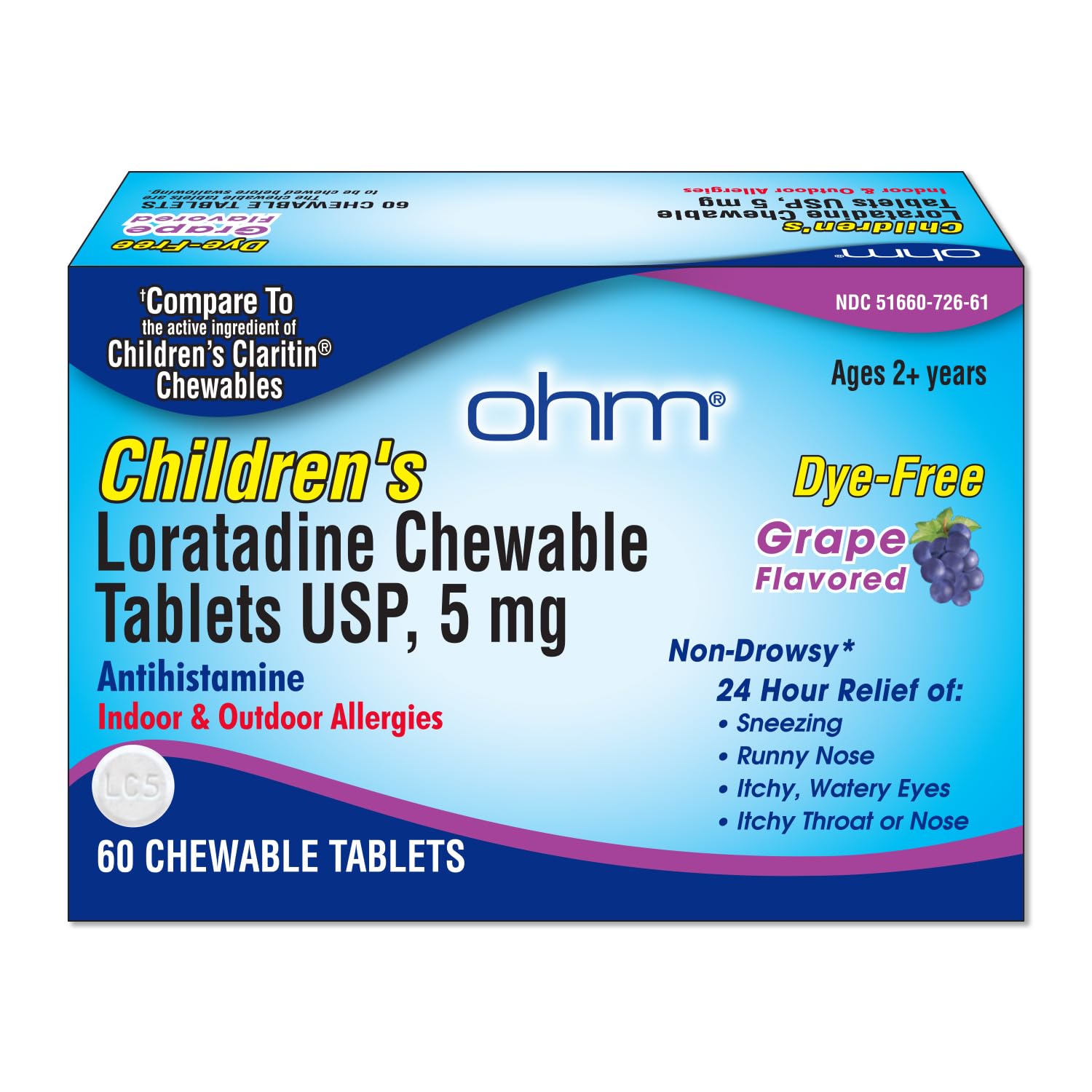
A grape chewable built for the kid who inspects every flavor before committing.
This is another 5 mg loratadine chewable (the same allergy medicine as Claritin), but the pitch here is a child’s sensitive palate. The grape-flavored tablets are formulated without dyes or unnecessary additives, and each 60-count pack gives a full season’s worth of chewables. They deliver 24-hour relief from runny nose, sneezing, itching of the nose or throat, and watery eyes, for kids ages 2 and up, with dosing that changes by age — 1 tablet per day for children 2 to 5, and 2 tablets per day for ages 6 and older. The tablets are designed to be fully chewed or crushed before swallowing.
What owners consistently report is that the taste carries the day. The reviews keep circling back to how well it goes over with kids who are picky about flavors, and how closely it mirrors the results of the name brand for a fraction of the cost. As one parent puts it, “My 8 yr.old takes it daily and it keeps those allergy symptoms at bay. We love the no artificial color and she says it tastes fine.” The small, easy-to-dissolve tablet is a recurring point in its favor.
The honest note is on consistency: a couple of parents found the formula simply did not work as well for them as the old chewable they used to buy, which is a reminder that any single antihistamine does not fit every child. It also asks for two chewables a day once your child hits age 6, so the bottle goes faster for older kids. Available in grape and bubblegum, it is a solid dye-free pick for a taste-sensitive kid.
What wins people over
- 5 mg loratadine chewable, dye-free and additive-light
- 60-count pack covers a full allergy season
- Grape and bubblegum flavors to pick from
Where it asks for a little more
- Older kids need 2 tablets a day, so the bottle drains faster
- The formula does not suit every child the same way — one antihistamine rarely fits all
Ideal for: A parent of a flavor-sensitive child who wants a dye-free loratadine chewable in a big count.
Look elsewhere if: Your child is under 2 — this one starts at age 2 and no younger.
9. Claritin Chewables for Kids 30 Count

The flavor trick that ends the morning standoff: bubblegum, not grape.
For the child who has already rejected every grape medicine on the shelf, this chewable switches the flavor to bubblegum — and that single change is what turns a daily argument into a daily routine. Each chewable provides 24-hour relief from sneezing, runny nose, itchy, watery eyes, and itchy throat or nose, and the non-drowsy formula means no daytime fog. The 30-count box is compact enough to tuck into a backpack or a travel bag.
The flavor story here is genuinely the product’s strongest selling point. A parent whose 5-year-old son fought the grape version every single day reports that the same child declared the bubblegum one so tasty he did not even need water afterward — an exact turnaround from the same kid refusing the grape. That is the whole reason this pick exists: same 24-hour relief, different flavor, and a child who takes it without a struggle.
Two small things to know. The packaging includes a tough protective membrane that some find awkward to peel off — a handful of buyers resort to a razor to open the sealed sheet. And a rare unit arrives with a damaged exterior, though the contents inside have been fine. The chewable itself suits older kids and, in a pinch, serves adults who want a lower dose. If bubblegum is what makes medicine go down in your house, this is the one to grab.
The decisive detail: Bubblegum flavor turns a daily grape standoff into a chew your child looks forward to.
One practical snag: The protective membrane on the packaging can be fiddly to peel, and an occasional box arrives dented on the outside.
Grab it if: Your child has rejected grape and you want 24-hour non-drowsy relief in a flavor they will actually take.
Consider another if: You need a liquid or a bigger count — this is a 30-count chewable box.
Know the Specs
Strength in mg (the dose per tablet)
The number of milligrams tells you how much active antihistamine is in each tablet or each measure of liquid, and it decides which age group the medicine is built for. A children’s chewable often carries a higher mg per dose than the brand’s own syrup, which is why the chewable sits at an older age cut-off while the syrup starts younger. Never split an adult tablet to approximate a kids’ dose — pick a product dosed for your child’s age and follow the label.
Age cut-off (who the medicine is for)
Every children’s allergy product prints a minimum age, and it usually pairs with a specific dosing schedule that changes as the child grows. One product might start at age 6 while another starts at age 2, so the age floor is often the first thing that eliminates an option. Check it against your child’s age before you compare flavors or formats — a great-tasting medicine they are too young to take is no help at all.
Common Questions
What age can a child start taking allergy medicine?
Is liquid or chewable allergy medicine better for a young child?
Does children’s allergy medicine make kids drowsy?
How long does children’s allergy medicine take to work?
Can a child take allergy medicine every day during allergy season?
Is dye-free allergy medicine better for kids?
What is the difference between cetirizine, loratadine, and fexofenadine?
Can a nasal spray be used alongside a chewable allergy medicine?
Do kids’ allergy chewables ever get refused over taste?
Are children’s allergy medicines HSA and FSA eligible?
The Bottom Line
For most families, the winner is the Children’s Zyrtec Dye-Free Chewables because a single 10 mg grape chew covers a full 24 hours for kids 6 and up, with no dye and no cup to wash. If your child is younger or will not chew a tablet, grab the Children’s Zyrtec Allergy Relief Syrup, which starts at age 2 with a 5 mg liquid dose. And for the child whose main battle is a stuffed nose, the Nasonex Children’s 24HR Nasal Spray is the one to reach for. Whichever you choose, match it to your child’s age and follow the dose on the bottle — that is what turns a good pick into the right one.
How we choose
We do not accept paid placement. Every pick is matched to a real buyer and a real use-case; we do not hands-on test units.
Sources
Specifications: manufacturer listings and product documentation. Review insights: verified customer reviews, as of October 2026. Pricing: not shown on this page (it changes often); check the current price via the retailer link.
As an Amazon Associate, My Heart Lives Here earns from qualifying purchases. This does not affect which products we feature.