Heads up: This post contains affiliate links. As an Amazon Associate I earn from qualifying purchases, at no extra cost to you. Learn more
Specs are compiled from manufacturer listings and verified buyer reviews and can change over time — please confirm the key details on the product page before buying.
If one room in your house never gets warm and the far end of a long dryer run keeps clogging, the duct is usually fine — the air pressure just dies before it arrives. A booster fan adds a push partway down the run so the air actually reaches the register. The trick is matching the fan to your duct size and to how much static pressure (the resistance air fights through a long or bendy duct) your system already has.
This guide is built by comparing the manufacturers’ published specifications and the patterns across verified customer reviews, so you get each pick’s real strengths and trade-offs instead of marketing spin.
Every pick below is a real inline or booster fan with published airflow, duct size, and noise figures, and each one is labeled for the job it actually fits. Whether you are chasing a cold bedroom, a smoky laser booth, or a dryer that takes two cycles, this breakdown of the air duct booster fan category shows which airflow number matters for your run.
Top Picks
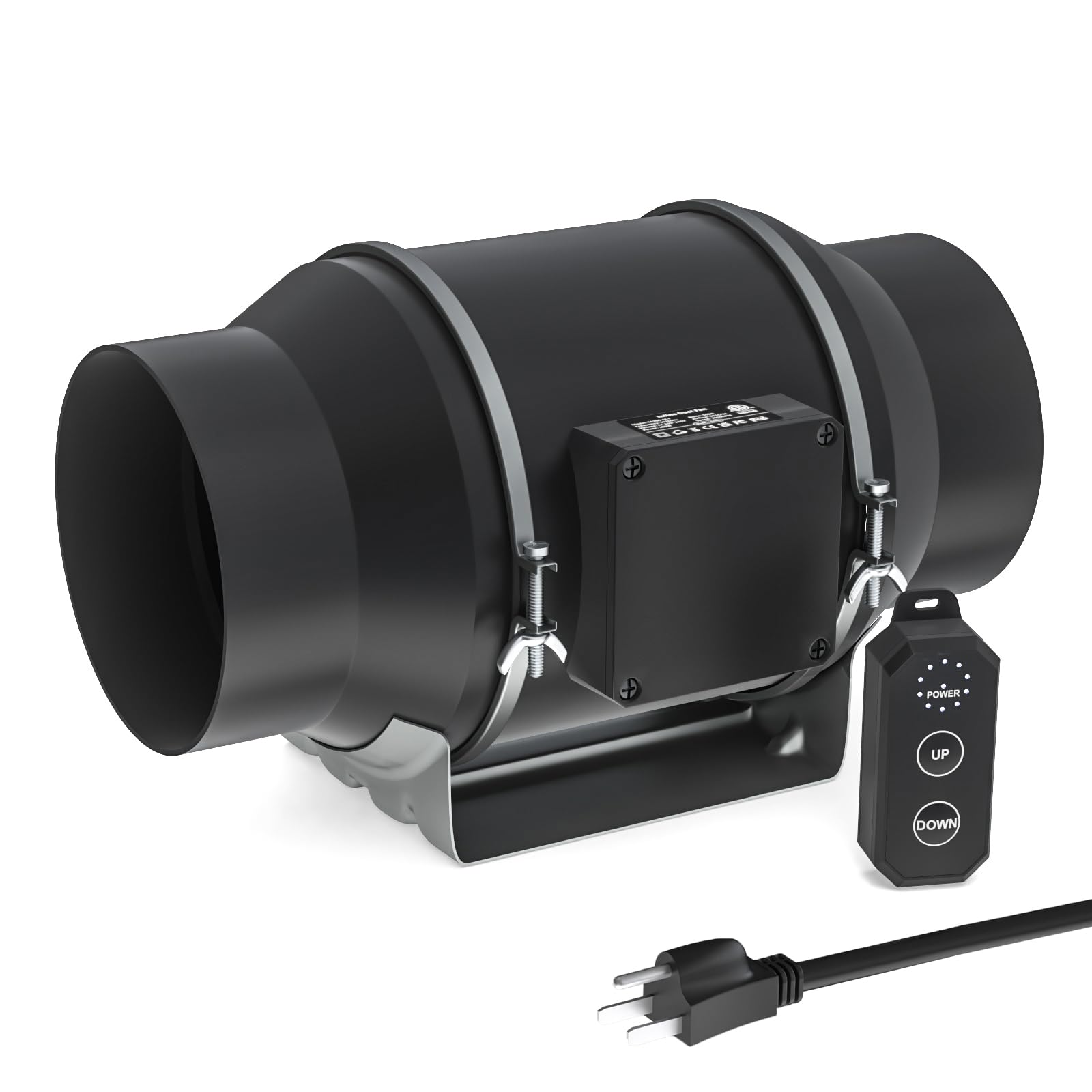


How To Choose The Right Air Duct Booster Fan
Two numbers decide almost every booster fan purchase: the duct diameter you are cutting into and the CFM the fan can push against the resistance in your run. Get those wrong and the strongest fan on the shelf still underdelivers. Here is what to check before you buy.
Match the fan to your duct diameter first
A 4-inch fan cannot clamp onto 6-inch round duct without a reducer, and a 6-inch fan will not fit a 4-inch bathroom vent run. Measure the duct you plan to interrupt, then pick the fan that matches it exactly — 4-inch, 6-inch, or 8-inch. If you have rectangular duct as shallow as 3.25 inches, you need a booster built for that shape rather than a round inline unit.
For context on scale: the VEVOR 6-inch fan is a 6-inch unit rated 400 CFM, while the Voltset is 4-inch rated 280 CFM — different duct sizes entirely, so they are not interchangeable in one system.
Read CFM together with static pressure
CFM (cubic feet per minute) tells you how much air the fan moves in open air. Static pressure is the back-pressure a long, bendy, or lint-filled duct adds. A fan with a mixed-flow impeller keeps pushing air even when static pressure is high, which matters more than peak CFM on a 25-foot run. If your duct is short and straight, even a modest fan will do the job.
Decide between auto and manual speed control
Some boosters run on a pressure switch that cuts in only when it senses airflow from your furnace or dryer. Others give you a knob or touchpad to dial speed yourself. Pressure-triggered models suit ductwork you don’t want to think about; manual controllers suit setups where you want fixed airflow all day. Look for a wide low-speed range if you want to keep it gentle.
Pair the noise figure with where it lives
A fan bolted near a bedroom register needs to be quiet; one buried in an attic or crawlspace — like the Tjernlund line commonly installed out of the way — can be louder without bothering anyone. Published dBA (a sound-pressure measure) is only a starting point, because vibration and mounting method often create more noise than the motor itself.
Side-by-Side Comparison
| Model | Best For | Airflow (CFM) | Duct Size | Noise (dB) | Amazon |
|---|---|---|---|---|---|
| Toolazy 6 Inch Inline Duct Fan★ Best Overall | Quiet whole-room boost | 405 cfm | 6 in | 31 dB | Amazon |
| VEVOR 6-Inch 400 CFMQuiet Performer | Hands-on speed control | 400 cfm | 6 in | 34 dB | Amazon |
| Voltset 4 Inch 280 CFMCompact Power | Compact 4-inch runs | 280 cfm | 4 in | 30 dB | Amazon |
| VEVOR 6-Inch 402 CFM Temp/Humidity | Hands-off climate venting | 402 cfm | 6 in | 32 dB | Amazon |
| Toolazy 8 Inch 831 CFM | Large spaces and long runs | 831 cfm | 8 in | 50 dB | Amazon |
| AC Infinity Automatic Booster 4″ | Auto-on dryer and vent lines | 230 cfm | 4 in | 60 dBA | Amazon |
| Hon&Guan 6 inch 469 CFM | Attic and shop exhaust | 469 cfm | 6 in | 55 dB | Amazon |
| Tjernlund DB-2 | Tight rectangular chases | 275 cfm | 5 to 8 in round | — | Amazon |
| Tjernlund M-6 | High-moisture heavy duty | 460 cfm | 6 in | — | Amazon |
Detailed Reviews
1. Toolazy 6 Inch Inline Duct Fan
Our pick — 4.5+★ from 100+ verified ratings; the strongest balance of quality and price.
The quiet workhorse that keeps 405 CFM on tap for long, high-resistance runs
The defining figure here is the noise floor: 31dB. That is a rated sound level lower than a normal conversation, and it comes from an EC motor (a brushless electronic motor that runs cooler and cheaper than a standard AC motor) rated for 40,000+ hours. The same fan pushes 405 CFM through a 6-inch duct while drawing just 60W of power, so you get real airflow without the electricity bill climbing alongside it. The mixed-flow impeller still holds pressure in a long duct run rather than folding the moment back-pressure builds.
What separates it from the 4-inch crowd is raw capacity in the same size class. Against the Voltset 4-inch at 280 CFM, this one leads on airflow 405 to 280, and it also spins faster at 2600 rpm versus 2200 rpm. If your problem duct is 6-inch, the 405 CFM headroom means the fan rarely has to run flat out, so you get the boost without the full-speed roar.
Owners consistently report the pressure is real: the fan keeps its push down a 10-meter flexible duct, and one owner noted it works cleanly with a CO2 laser. The recurring honest caveat is noise, which the review pages treat as genuinely mixed — surprisingly quiet at low speeds, but it earns a plane-engine comparison when you run it wide open. The fix is obvious: use the 10-speed PWM (pulse-width modulation) knob and stop well below maximum unless you need the full blast.
What the numbers actually buy you
- 405 CFM at just 60W from a 6-inch fan body
- 31dB rated noise — conversation-level and easy to live near
- 10-speed PWM controller plus optional WiFi app scheduling
- Removable locking-tab duct ends for quick cleaning
Where it will not suit everyone
- Louder when you push it near maximum speed
- Built for 6-inch / 150mm ductwork only, no reducers included
- The wireless app controller is sold separately, not in the box
Reach for this if: you own 6-inch ducting and want a strong push that still keeps a bedroom or office livable.
Look elsewhere if: your run is 4-inch, since this fan will not clamp onto a smaller duct without an adapter.
2. VEVOR Inline Duct Fan 6-Inch 400 CFM
A 6-inch, 400 CFM inline fan with a manual knob for people who want their hands on the dial
You get 400 CFM (cubic feet per minute, a measure of how much air moves per minute) — enough to push air through a wide, long duct run. The AC motor is quieter than you would expect for that output, rated at 34dB (decibels, a noise measure where higher numbers are louder), so it won’t drown out conversation in the next room. The manual variable-speed knob lets you dial the flow to exactly what the room needs instead of being stuck at one fixed speed. At 10 inches wide, the body is compact enough to hang or wall-mount.
Compared with the Toolazy 6-inch above, the numbers are close — 400 CFM versus 405, and 2600 rpm (revolutions per minute, how fast the fan spins) on a comparable spindle. This one trades a step or two of quietness for the tactile knob control and an airflow rating that most owners describe as simply more than enough. It’s also heavier at 2.28 kg, so hanging slings really are needed rather than optional.
Owners do not complain about the airflow — quite the opposite, it moves a lot of air and drops into walls, crawlspaces, and attic chases without fuss. Where the review pages are mixed is noise: quiet at the fan housing, but with a motor whine some notice at every speed, and a bit louder at the vent. It arrives with rubber mats, hang-up slings, and self-tapping screws, so installation does not add a shopping trip.
Where it stands out: the manual variable-speed knob gives you direct, no-app flow management, and 400 CFM is plenty for a 6-inch run that feeds more than one outlet.
The one caveat that matters: the motor has a detectable whine owners flag, so place it in a chase or crawlspace rather than inches from a bedroom vent.
The pick for: a hands-on setup where you control speed with a dial and want airflow close to the best in this size class.
Think twice if: you need a fully silent household fan or want app-based scheduling built in.
3. Voltset 4 Inch Duct Fan
A compact 4-inch inline that punches well above its size for laser booths and small rooms
For a 4-inch duct, 280 CFM is a big number — enough to move serious air through a narrow pipe. The copper-core motor spins at 2200 rpm (revolutions per minute, how fast the fan turns) and the whole unit is rated to a quiet 30dB (decibels, a noise measure where higher numbers are louder), which is the lowest noise figure in this group. It measures 6″D x 7″W x 9″H, so it tucks into tight chase spaces where the 6-inch VEVOR above simply will not fit — that 6-inch VEVOR is a 50% larger duct size than this 4-inch fan, which is the real dividing line between the two.
Two-speed control is done through an included touch panel and remote, so you flip between low and high without crawling to the unit. The quick-release clips make the install a tool-free job, and the copper motor is rated for 10,000+ hours of continuous run. Common owner stories include a laser cutter vent system that never clogged across a full two years of smoke, and a 3D printing enclosure that vents cleanly on the low setting.
Built for small bathrooms, kitchen hoods, closets, and electronics. Owners mention a small air leak from an opening on the outer cones, and the noise is described as minimal rather than silent. Both are minor on a fan this size — it just means sealing the seams is worth the extra minute when you first hang it.
Best for tight 4-inch runs: fits a narrow chase that a 6-inch fan cannot reach, and the 30dB rating keeps it liveable in a lived-in space.
Honest limit: you cannot feed a large, branching 6-inch trunk with this fan; it is a compact-run booster, not a main-system blower.
Choose this if: your ducting is 4-inch and you need a compact, quiet fan with remote or touch control.
Skip past it if: your system runs 6-inch duct or you want airflow north of 300 CFM.
4. VEVOR Inline Duct Fan 6-Inch 402 CFM

The set-and-forget fan that reads your temperature and humidity and adjusts speed on its own
What sets this apart is the intelligent controller: instead of a fixed knob, this 6-inch VEVOR reads temperature and humidity and automatically adjusts the airflow to hold your target. It moves 402 CFM through 6-inch duct at a rated 32dB, and the 2800 rpm EC motor runs more efficiently than the standard AC motor in the 400 CFM VEVOR above. At 6 pounds it is heavy enough that the included straps and rubber mats really earn their place.
Owners describe the airflow as the thing they bought it for — it moves a lot of air quietly — and the controller setup is called simple and easy to navigate in review after review. The mechanism also triggers lower bedroom airflow when used to feed a large room. Anyone chasing a passive, no-switches ventilation solution for a grow tent, basement, or AV closet tends to love that it just runs itself.
The variable that keeps showing up honestly is reliability. Some units have failed after about a year, and there is a humidity-sensor failure story from a greenhouse setup that dropped the fan into manual mode. Treat this as the unit to pick when you want automated climate response and you value the controller more than you value total silence.
Why owners keep it around
- Automatic speed adjustment based on temperature and humidity
- 402 CFM at a low 32dB rated noise level
- 2800 rpm EC motor with 30% claimed energy savings versus an AC unit
- Hang or wall-mount install with clamp and mat kit included
What to weigh before buying
- Occasional units have failed around the one-year mark
- Sensor faults can drop the fan into manual mode
- 6 pounds of fan means you really need the mounting hardware secure
Perfect for: a grow tent, basement, or server room you want to vent based on climate readings and forget about.
Not for you if: you want to see the fan running manually with zero electronics between you and the speed control.
5. Toolazy 8 Inch Inline Duct Fan 831 CFM

Industrial-grade 831 CFM horsepower for warehouses, workshops, and commercial grow rooms
There is no subtle way to describe the airflow here: 831 CFM through an 8-inch duct is a different tier of fan than the 6-inch picks above. The three-phase brushless EC motor spins at 3000 rpm on 180W and is rated IP44 water-resistant, which matters in a humid basement or a commercial grow environment. Dual ball bearings are rated for 40,000+ hours of continuous operation, and the mixed-flow impeller keeps pressure strong even in long runs. It is built for use as 8×8+ grow tent ventilation or heavy commercial exhaust.
The 0-100% variable speed controller is a genuine external knob with 8.2 ft of controller cable, so you can trim the airflow down from ear-splitting to merely strong without a smartphone in hand. It handles continuous duty without a break, which is what commercial spaces demand. ETL Listing covers the safety side of that claim.
Owners buy it for the 831 CFM and 3000 rpm airflow, not for quiet. It is not subtle at full speed — the rated noise is 50dB but users describe it as very loud wide open — and the recurring feedback centers on build quality and airflow rather than silence. That trade-off is honest and predictable: an 8-inch, 831 CFM fan working flat out will always be heard, so pair it with a speed setting that matches the space.
The mic-drop spec: 831 CFM is roughly double the airflow of the 6-inch fans here, from an 8-inch housing that will not fit a standard residential trunk without reduction.
The honest catch: at full throttle it is loud. If your space is a bedroom, dial it down; if it is a workshop, run it wide.
Your pick if: you are venting a large grow room, warehouse, or big shop on continuous duty.
Not the one if: your duct is 6 inches — this fan needs 8-inch round ductwork to work properly.
6. AC Infinity Booster Duct Fan 4″

Runs itself: a 4-inch inline fan that switches on the moment it smells moving air
The feature you are paying for is not the airflow — it is the pressure switch. This 230 CFM, 4-inch fan watches for a pressure change in the duct and fires itself up when it detects airflow from your dryer or vent fan, then shuts off when both stop. You do not wire a manual switch, you do not remember to turn it on. Five fan speed levels run through a PWM-controlled EC motor, and a differential pressure switch lets you mount it in any orientation.
The install story is where it wins over manual fans: owners who dealt with a 15-foot crawlspace vent that kept clogging and wetting clothes report the drying time cut in half after mounting the blower partway along the run. Long dryer vent lines — the 8-foot and longer ones — are exactly the problem this fan is designed to solve.
The honest downside is the pressure sensor. Some owners think it is spot-on; others find it over-sensitive and report the fan running even when the HVAC is off. Rated noise is 60 dBA, so it is louder than the quiet inline picks above. If the trigger behaves, it is the most hands-off option in the group.
The reason to pick this one: pressure-triggered auto start-stops means it runs on its own whenever your dryer or bath fan kicks on — no wiring to a switch required.
The trade-off: a fussy pressure sensor and a 60 dBA rating make it a poor fit for a bedroom-adjacent return duct.
Best if: your dryer or bath vent is long and you want the booster to follow along automatically.
Rather not if: you need whisper-quiet running right up against a living space.
7. Hon&Guan Inline Duct Fan 6 inch

A 469 CFM inline built for hot attic chases and smoke-heavy shop venting
469 CFM from a 6-inch fan is unusual airflow for the size. The EC motor spins up to 4300 rpm on 77W and holds up in high-temperature runs — the housing is rated for air from -4°F to 140°F, and the junction box carries an IP44 rating. That combination is the reason attic installs and wood-stove-room transfers show up in the owner feedback so often.
Variable speed control is smooth across the full range, and the removable center section makes cleaning the impeller a two-minute job. Buyers report substantial airflow at half speed, quiet operation at low settings, and the ability to pull fumes through 10 feet of hose when used for laser cutting or 3D printing exhaust. Getting airflow that far down a hose is where a cheap 4-inch fan falls short.
The recurring install snag has been reported on a couple of units: two of the plastic tabs on the tightening belts arrived cracked, which is a shipping-robustness issue, not a performance one. Full speed is loud — one owner compares it to a vacuum cleaner — so high speed is reserved for clearing the room, not background running.
Why it earns the attic spot
- 469 CFM with a 4300 rpm EC motor on just 77W
- Rated for -4°F to 140°F air and IP44 sealing for humid spaces
- Removable center section for easy impeller cleaning
- Pulls fumes through 10 feet of hose with capacity to spare
What you should know going in
- Loud at full speed — closer to a vacuum than a whisper
- A few units have arrived with cracked plastic belt tabs
- No remote or app; control is on the physical controller
Pick this for: attic, garage, or workshop ventilation where you want maximum airflow for the 6-inch size.
Pass on it if: your setup needs background silence above half speed.
8. Tjernlund DB-2 Duct Booster, 275 CFM

The one that fits where round inline fans cannot — shallow rectangular chases and 5 to 8-inch duct
Most booster fans in this list need a 4, 6, or 8-inch round duct. This one is different by design: it fits round duct anywhere from 5 to 8 inches and it also fits rectangular duct as shallow as 3.25 inches. If your problem duct is a shallow rectangle behind drywall, this is often the only shape in the group that will physically go in.
Country of origin is the United States.
Owners who sized it right report meaningful improvements, with one describing a doubling of airflow down a 6-inch pipe and another running fans on a split HVAC trunk with a 120V duct switch. The other half of the story is where it underdelivers: on very long runs (25-30 feet), owners find it does not push as far as they wish, and one measured airflow noticeably under the rated figure after 20 feet of vertical run and a junction. Vibration is another point to plan around — an arm’s-length install may transmit noise through the whole ductwork, so isolate it.
The unique selling point: universal fit across round and shallow rectangular ducts makes it the only real option when nothing else will physically clip in.
Honest trade-off: at 275 CFM with 200°F-rated galvanized construction, it is a targeted placement booster, not a high-volume whole-system fan.
Best for: a short-to-medium run in a duct shape no one else makes a round inline fan for.
Do not buy it for: a 30-foot run or a big open room — you will want more CFM than this.
9. Tjernlund M-6 Metal Inline Duct Booster Fan, 6 in, 460 CFM

A heavy metal inline that survives heat, moisture, and years in an attic
The build is the headline: a metal-bodied 6-inch inline fan rated for 460 CFM with a metal rotor and dual bearings. It fits a standard 6-inch duct, includes mounting brackets and hardware, and is designed specifically for exhausting high-moisture areas — bathrooms, attics, crawlspaces, basements. Speed control is available but the speed control device is not included, so plan to add one if you want to vary speed.
Owners repeatedly comment that it moves tons of air, works as a direct replacement for a weak bathroom vent fan, and survives hostile environments where plastic housings fail — one owner runs it in a Las Vegas attic without issue. The vibration feedback is remarkably consistent: the bearings are balanced enough that there is essentially no wobble, so the mount can stay simple.
The recurring piece of honest feedback is noise at the register, not at the fan body: the airflow is strong, but a booster pushing 460 CFM into a single small register makes noise as the air hits the grille. The workaround owners mention is to install the fan further from the register, or to muffle the outlet with added duct. Fitment has also been reported tricky on some installations, mostly around getting the mounting flanges aligned. A separate smaller share of owners have seen fan starts degrade around the two-year mark if the small motor capacitor fails, but this is not the dominant story.
Why metal housing matters
- 460 CFM from a 6-inch standard duct; brackets and hardware included
- Metal rotor and dual-bearing design with almost no vibration in use
- Built to exhaust high-moisture areas and handle extreme attics
- Handles proper high-airflow when paired with a speed controller
What to account for
- No speed controller included — you buy one separately
- Loud at the register when it pushes full volume through a small outlet
- Mounting alignment can be fiddly on a standard cut-in install
The right pick if: you want a metal-bodied booster that vents moisture and runs near silent at the fan itself.
One step down if: your problem is register noise on a short duct, where a smaller-fan-with-damping approach works better.
Know the Specs
CFM — cubic feet per minute
CFM is the volume of air the fan moves each minute. The size of the space and the length of the duct drive which number you need. A 200-plus CFM fan is plenty for a bathroom vent; a large workshop or long trunk line is where the numbers climb toward 400 or beyond. But raw CFM alone does not mean much if the duct is surprisingly restrictive — a fan with the same CFM can deliver very different results at the register depending on the resistance in the run.
Static pressure and duct diameter
Static pressure is the back-pressure air fights through a long or bendy duct. A mixed-flow impeller keeps pushing air even when the duct is long, while a simple axial fan gives up sooner. Duct diameter matters just as much: a 4-inch fan cannot clamp onto a 6-inch trunk and a 6-inch fan cannot fit a 4-inch chase. Match the fan to the exact duct size first, then consider CFM and static pressure. Resist the urge to oversize by too much — one owner’s overkill install required splitting a single 6-inch trunk into two registers just to control the blast.
Common Questions
Will a 6-inch booster fan fit my existing 6-inch ductwork?
Does the booster fan run when my furnace or dryer is off?
How loud is a typical booster fan at the register?
Can I add a booster fan to a long dryer vent line?
Do I need a speed controller with a booster fan?
Is a 4-inch or 6-inch fan better for a bathroom vent?
Will an inline duct fan handle high heat from an attic or furnace supply?
How long do booster fans typically last?
Can I mount a booster fan vertically or does it need to hang?
Does a booster fan reduce energy efficiency of an HVAC system?
The Bottom Line
For most households the winner here is the Toolazy 6 Inch Inline Duct Fan, because 405 CFM at a 31dB rated noise level from a 6-inch body covers the widest range of household jobs — bathroom, workshop, grow tent, or HVAC boost — without forcing you to choose between airflow and keeping a room livable. The VEVOR 6-inch at 400 CFM is the alternative if you want a manual knob instead of a controller, and the Voltset 4-inch at 280 CFM is the pick for a tight 4-inch chase where nothing bigger will fit. If the boost lives in a humid attic or hot furnace supply, the Tjernlund DB-2 and Tjernlund M-6 are the two that were designed for exactly that environment.
One respectful nudge: the base of this group — the fans with hundreds of ratings holding solid 4.3 and 4.4 averages — is where you start. Two owners of the Tjernlund DB-2 lost their first unit between year seven and year nine, which is a reminder that even a good booster is a serviceable part, worth having on hand when the current one finally quits.
How we choose
We do not accept paid placement. Every pick is matched to a real buyer and a real use-case; we do not hands-on test units.
Sources
Specifications: manufacturer listings and product documentation. Review insights: verified customer reviews, as of October 2026. Pricing: not shown on this page (it changes often); check the current price via the retailer link.
As an Amazon Associate, My Heart Lives Here earns from qualifying purchases. This does not affect which products we feature.