Heads up: This post contains affiliate links. As an Amazon Associate I earn from qualifying purchases, at no extra cost to you. Learn more
Specs are compiled from manufacturer listings and verified buyer reviews and can change over time — please confirm the key details on the product page before buying.
Four phone lines in one office sounds simple until the wrong call lands on the wrong desk, a held caller vanishes, or you buy five bases that refuse to talk to each other. The fix is understanding one thing before you spend a cent: in a 4-line system you buy one base station and then add wireless handsets or desksets to it, not four separate phones. Get that backwards and you end up with a shelf of expensive paperweights. Below are the five systems worth your attention, sorted by who they actually suit.
This guide is built by comparing the manufacturers’ published specifications and the patterns across verified customer reviews, so you get each pick’s real strengths and trade-offs instead of marketing spin.
A base that dies at eighteen months or a handset that drops its line costs you customers, not just money. That is exactly why this breakdown of the best 4 line phone system options focuses on real owner experience, not spec sheets.
Top Picks
How To Choose The Best 4 Line Phone System
You can narrow the choice to four questions: how many stations you need now, how many you might add in two years, if you want voicemail on each line or one shared mailbox, and how the base handles a call on hold. Everything else is detail.
One base, many stations — the rule that trips up most buyers
You are not buying four separate phones. You get one base station wired to your phone jacks, plus wireless handsets or desksets that register to that base over DECT 6.0 (a wireless standard built for voice, with longer range and less interference than older cordless tech). Expansion numbers tell you the ceiling: the Motorola ML1000 and the Panasonic KX-TGW420B both accept up to 10 total stations, and the VTech AM18447 expands to 10 stations as well.
Skip that rule at your peril. Buyers report ordering five bases only to discover they will not work together, and by the time the boxes were opened the return window had closed. If you need five desks covered, you buy one base and four extensions.
Answering capacity and call routing
Answering systems are quoted in minutes of storage. The Motorola ML1000 holds 200 minutes across up to 10 mailboxes; the Panasonic KX-TGW420B also stores up to 200 minutes; the VTech AM18447 captures 180 shared minutes. An auto attendant — sometimes called a digital receptionist — answers the call and lets the caller dial an extension instead of a human picking up. For a small office that means the phone stops ringing off the hook at lunch.
Wired desk phone, wireless handset, or both
A corded base never needs charging and never walks off. Cordless handsets let staff move between rooms or out to the yard. The systems here split: the AT&T SB67138 ships with one corded and one cordless handset, the Panasonic and VTech bases are corded with wireless expansion, and several bases let you add cordless desksets rather than plain handsets.
Side-by-Side Comparison
| Model | Best For | Lines | Max Stations | Answering Storage | Amazon |
|---|---|---|---|---|---|
| Motorola ML1000★ Best Overall | Growing offices that want auto-routing | 4 | 10 (wireless extensions) | 200 minutes, 10 mailboxes | Amazon |
| VTech AM18447Best for Small Business | Small businesses replacing a PBX | 4 | 10 stations | 180 shared minutes | Amazon |
| Panasonic KX-TGW420B | Desk-heavy offices wanting call recording | 4 | 10 (9 add-on stations) | Up to 200 minutes | Amazon |
| AT&T SB67138 | Salons and non-desk businesses | 4 | 10 handsets or desksets | Per-line mailboxes with auto attendant | Amazon |
| AT&T SynJ SB67158 | Multi-room offices needing range | 1 to 4 | — | Digital, with 6 AA batteries | Amazon |
Detailed Reviews
1. Motorola ML1000 4-Line Corded Base Station
The base station that answers your phones for you and still fits on a reception desk.
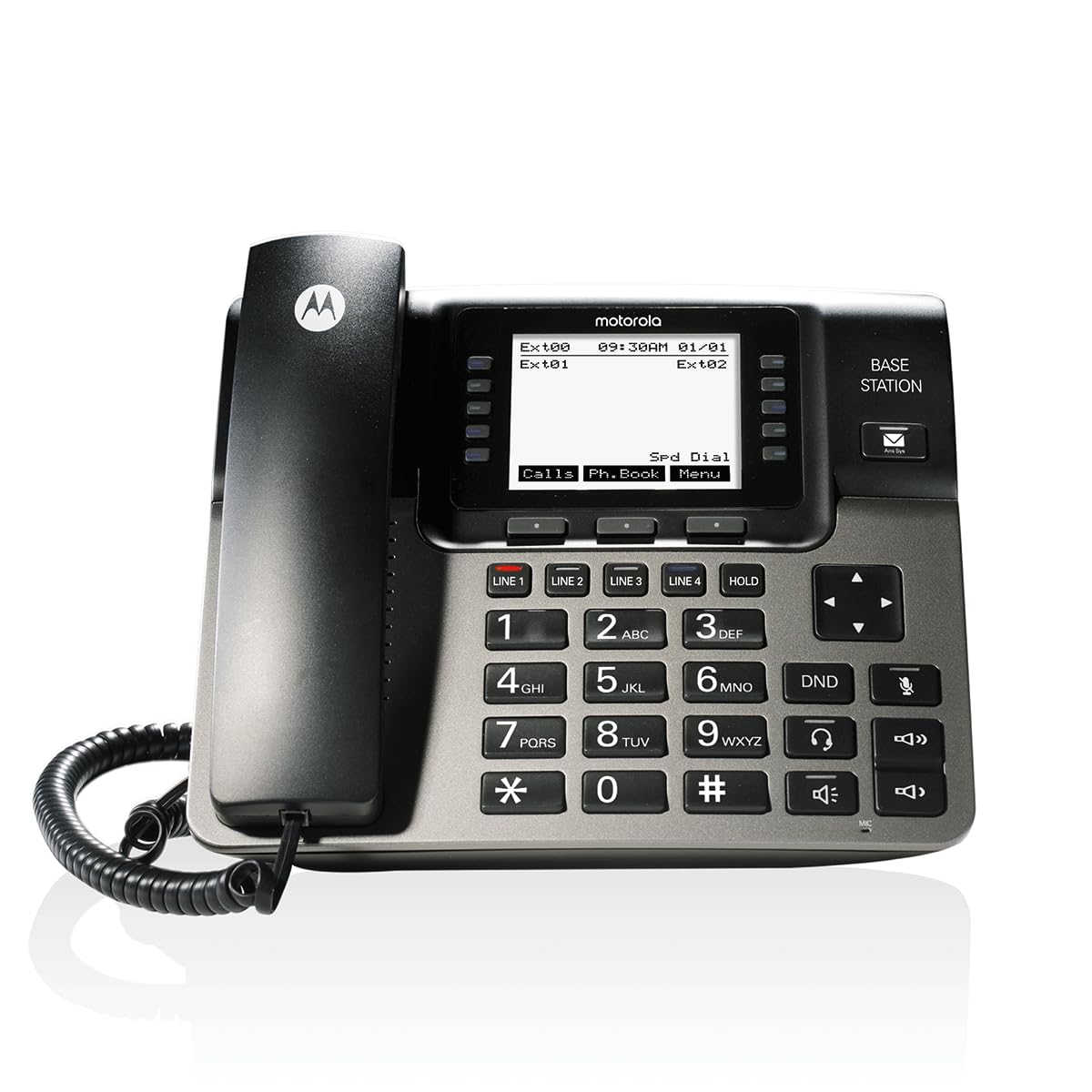
The Motorola ML1000 is the pick for a small office that wants a professional front-of-house feel without rewiring the building. It needs exactly one phone jack to get started — plug the base into the wall and the system is live. From there you add up to 10 wireless extensions using the ML1100 or ML1200 units, which register over DECT 6.0 without any additional cabling. For an office that is growing a desk at a time, that is the whole point: you scale by adding handsets, not by buying another base.
The digital receptionist is the feature that earns this the top slot. It picks up automatically and routes callers to the right department, so nobody is chained to the front desk during lunch. Callers can leave a message too — the answering system stores 200 minutes across up to 10 separate mailboxes, each with a time and date stamp and remote retrieval, so a manager travelling home can still pull messages from outside the office.
Owners say the handset and speakerphone sound like a proper business line, not a plastic desk toy. The handset and speakerphone pick up clearly from across the room, the display and buttons are easy to read, and setup is genuinely plug-and-play — the manual promises a working system in minutes and that matches what people find. Owners also flag the punch-list: the base and deskset take up real desk space, the buttons run large, there is no colour screen, and unused lines keep showing a “no line connected” notice with no way to switch it off. The occasional unit arrives with a handset that will not register, so test your system within the return window rather than letting the boxes sit.
Where the ML1000 earns its keep
- Auto attendant handles incoming calls without a receptionist stationed at the desk
- 200 minutes of voicemail across 10 mailboxes, each with time and date stamps plus remote retrieval
- Grows to 10 wireless extensions over DECT 6.0 — one base, no extra wiring runs
- Wall-mountable, headset-ready, and hearing-aid compatible for varied staff needs
What to plan around
- The base and deskset occupy real counter space — measure your reception area first
- Unused lines display a “no line connected” message that cannot be turned off
- No colour screen, and the buttons are sized larger than most desk phones
Built for: offices with a front desk that need calls routed to the right person without a human answering every ring.
Check first: wireless handsets are sold separately, so the base alone does not cover a second desk.
2. VTech AM18447 Main Console
A metal-bodied console that turns four analog lines into something that behaves like a real phone system.
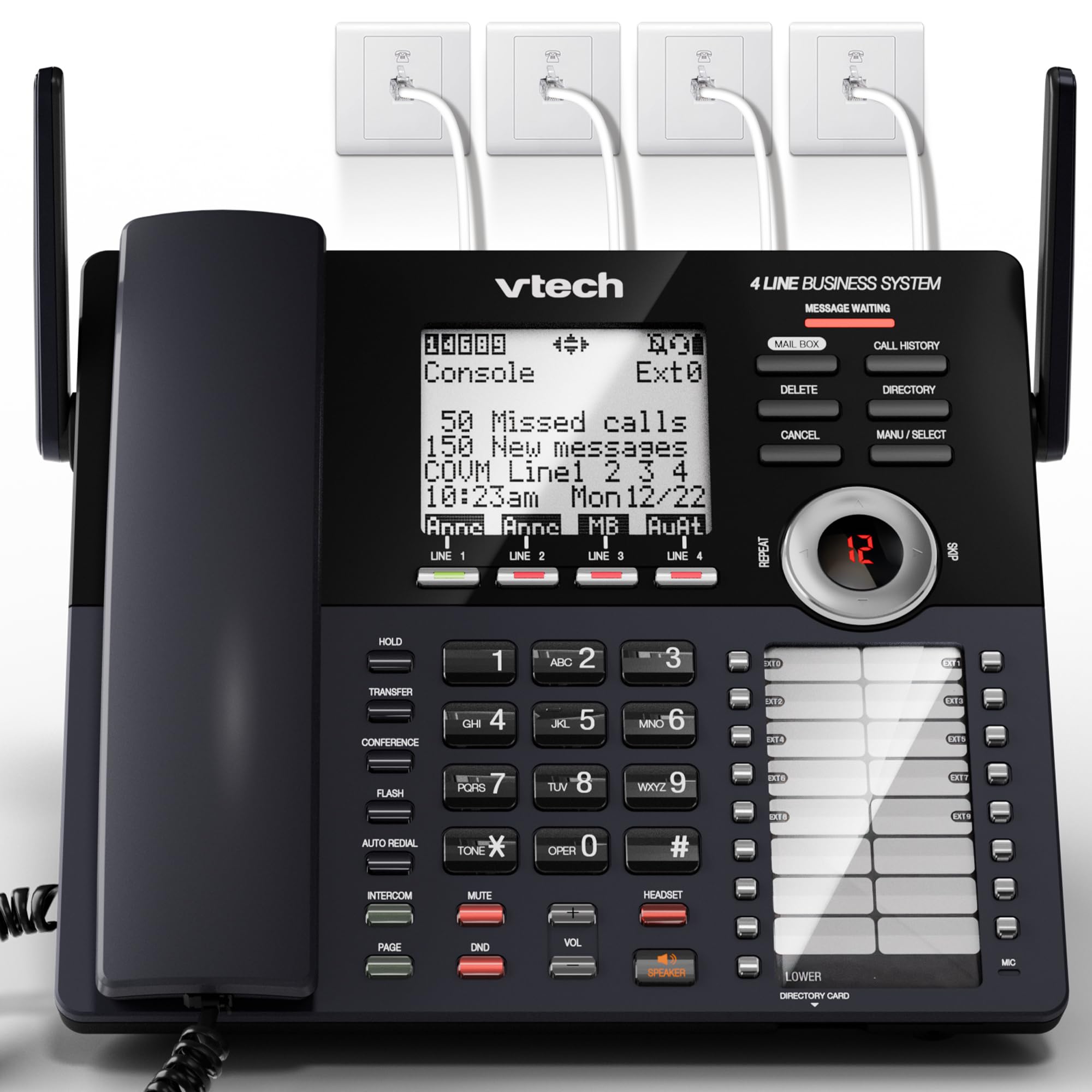
If your office is currently making do with four separate phones and a lot of shouting, the VTech AM18447 is the natural upgrade. The main console connects to your analog lines through RJ11 jacks (the standard phone wall socket you already have), and additional handsets or desksets pair wirelessly using one-touch DECT 6.0 — no technician, no new cabling, no visit charge. Owners say call quality holds up in daily use and the console slots naturally into a small business setup, with some comparing it to a PBX at a fraction of the complexity.
Where it pulls ahead of the Motorola ML1000 is in the productivity layer. The auto attendant works per line — it answers on each of your four lines individually, offers a company directory, routes to extensions, and drops the caller into voicemail if nobody picks up. The answering machine captures 180 shared minutes of incoming messages, announcements, and memos. There is a full-duplex speakerphone so both ends can talk at once without clipping, an extra-large display, caller ID with call waiting, a 100-name phonebook, 32 speed dials, intercom between stations, cordless headset support, and music on hold piped in through a 2.5mm jack.
Two honest notes. The enclosure mixes metal and plastic, and the metal parts feel notably more solid than the budget-tier competition — but sound quality draws genuinely mixed reports, with some users picking up echo noise on calls. And while the base ships with mains power, the console itself weighs just 2 pounds, so it will slide around on a smooth desk if you are not careful where you push it. Neither issue is a dealbreaker at this price tier; they are things to test inside your first week while returns are still easy.
Why small offices keep this one: the per-line auto attendant and 180 shared minutes of voicemail cover the gaps when nobody is at the desk, and expansion to 10 stations means the system follows the business as it hires.
Who should look elsewhere: if a call centre needs multi-person conferencing, the advanced conference capability here is aimed at small-team use, not call-routing complexity.
Reach for this if: you want PBX-style call handling on analog lines without a service contract.
Look elsewhere if: you need pinpoint sound quality — echo noise is the recurring gripe.
3. Panasonic KX-TGW420B 4-Line Corded Base Station

Six-way conferencing and two-way call recording make this the front-runner for desk-heavy offices.
What the Panasonic KX-TGW420B offers that the Motorola ML1000 and VTech AM18447 do not is conference capability that stretches. Where both of those consoles list basic conferencing, this one supports 6-way conferences — three or more callers can be on the same line at once without a bridge service. Paired with 30 speed-dial numbers and 2-way call recording, this is the system for a sales desk or a support line where calls get recorded and replayed.
Expansion works the way it should. The corded base accepts up to 9 additional stations, wired or wireless, sold separately. Compatible units are the Panasonic KX-TGWA40B corded desk phone and the KX-TGWA41B cordless handset, and because the wireless links run over DECT 6.0 you get range that holds cleanly across separate rooms — useful if your warehouse or back office sits far from the base.
The trade-offs all sit around usability. The recurring criticism from owners isn’t reliability, it’s the little things: this system will not let you change the ringtone or even the ringtone volume, and the ring itself is quiet enough that a person one room over can miss it entirely. Speakerphone sound is serviceable but not the strength — owners who moved from a different desk phone say the speaker side is a step down, while the handset side is clear. Bear in mind the base-station rule particularly sharply with this model: Owners mention ordering five bases only to discover they needed one base plus four extensions, and returns closed before they could sort it out.
The standout capability: 6-way conferencing plus 2-way recording in a corded desk phone is a rare combination at this tier, and it is the single reason to pick this over the VTech.
The honest caveat: fixed ringtone and fixed ringtone volume will frustrate anyone whose office has a noisy back room — check that in week one, not month two.
Pick this one if: conference calls and legally recorded calls are part of your daily work.
Skip the upgrade if: a quiet-ringing phone with an adjustable ringtone is a hard requirement.
4. AT&T SB67138 DECT 6.0 4-Line Corded/Cordless Phone System

A corded desk phone plus a cordless handset, built for businesses where nobody sits still.
Hair salons, clinics, and workshop offices share one problem: the phone rings while everyone is with a customer. The AT&T SB67138 answers that directly. It ships with one corded handset for the reception desk and one cordless handset for whoever is moving between rooms, and the base expands to 10 handsets or desksets in total. Owners of similar setups specifically call out that this family supports several cordless handsets off one base — a point of difference from systems that force a fresh base per handset.
Voicemail is handled per line, not as one shared mailbox. Each of the four lines gets its own mailbox and auto attendant, so a call to the bookings line and a call to the staff line land in separate places instead of a single overflowing inbox. Call routing works the same way: work calls can be pushed to the office handset while a family call goes to a handset in another room on the exact same system. Three-way calling, speed dial, redial, mute, hold, selectable ring tones, and remote access round out the feature set, and the display is large and backlit for a dim reception area.
The recurring complaint is button feel — these keys want a firm press, and a soft tap can drop a call or trigger a redial. It is manageable once you are used to it, and owners broadly describe setup as a short job, but it is worth knowing before you order. One other thing: at 3.5 pounds and measuring 18 x 9.5 x 5.3 inches, this is the bulkiest base in this lineup. By comparison the Motorola ML1000 base measures 8.7 x 3.16 x 5.9 inches, so the AT&T footprint is dramatically bigger — reserve real counter space or plan to wall-mount it.
The good
- Per-line mailboxes and auto attendant across all four lines — no single shared inbox
- Corded and cordless handsets both included, so you can start working the day it arrives
- Supports multiple cordless handsets per base, unlike systems that require one base per handset
- Large backlit display plus remote voicemail access for messages pulled from outside the office
The fine print
- Buttons need a firm, deliberate press or calls hang up mid-conversation
- Base is far larger and heavier than the other consoles here — plan your surface
- Expansion handsets and desksets are purchased separately from the base
Suits: salons, clinics, and service businesses where staff handle calls standing up between clients.
Think twice if: soft-touch keys are a dealbreaker for the people who will be dialling all day.
5. AT&T SynJ SB67158 Phone System

The one buyers reach for when the office spans more than one floor.
Range is what the AT&T SynJ SB67158 sells on, and owners back it up. In offices with a desk upstairs and staff working a floor below, the DECT 6.0 signal holds without static — one report describes clear coverage two floors down, and a dental office specifically notes no line noise through the base. The base itself is the lightest here at 2.5 pounds, and unlike the AT&T SB67138 at 3.5 pounds it sits comfortably on a small desk without dominating it.
It runs 1 to 4 lines, which means it is equally happy as a single-line desk phone or as the hub for a four-line office. Six AA batteries are included for the cordless side. Three-way conferencing, intercom between handsets, and DSL compatibility (a DSL filter may be required if your line carries broadband) are all present, and handset registration takes under a minute. If your existing wiring is DSL, this is one of the few systems in this lineup that clearly states compatibility with that service.
The quirks are documented and specific. Switching a call from one line to another puts the first call on hold rather than hanging it up, which can tie lines up if you do it absentmindedly. Individual lines cannot be silenced, so a fax line keeps ringing along with everything else. Headsets only connect through cordless desksets, not through the handsets. Voicemail cannot be shared across all four lines. And the steeper warning comes from long-term, high-volume users: in a medical office running a base plus nine handsets, held calls occasionally vanished, with the line showing occupied but no caller on the other end. That is a heavy-load scenario — a three-person home office will not hit it, but a busy practice with nine stations should know what it is getting into.
Where it beats the field: the DECT 6.0 range. Two floors down and still clear is a real figure in owner reporting, and it is the reason to pay the premium tier price for this base.
Where it falls short: call-handling flexibility. No per-line silence, no shared voicemail, no automatic hang-up when switching lines — small things that add up if your office runs hot.
Best for: home offices and small teams that need one phone system to cover a genuinely large building.
Not for: high-volume call queues where held calls must never slip — that is where this one has produced complaints.
Know the Specs
DECT 6.0 — the wireless standard that makes cordless handsets work
DECT 6.0 is a wireless protocol specifically designed for voice calls, using a frequency band that keeps it clear of Wi-Fi and microwave interference. In a 4-line system, that is what lets you add a cordless handset to a wired base and have it ring cleanly two floors away. If a handset supports DECT 6.0 and it is from the same manufacturer family as your base, it will likely register — but always check the compatible-model list, because handsets are generally locked to their own brand’s base.
Answering capacity and mailboxes — what “200 minutes” actually gets you
Answering-system storage is quoted in minutes, and that figure covers every message, announcement, and memo on the machine. The Motorola ML1000 stores 200 minutes across 10 mailboxes, the Panasonic KX-TGW420B stores up to 200 minutes, and the VTech AM18447 holds 180 shared minutes. A per-line mailbox system gives each of your four lines its own inbox; a shared system pools all messages in one place. For a busy office, separate mailboxes mean the bookings line and the accounts line stop treading on each other.
Common Questions
Do I buy one base plus extensions, or four separate phones?
Will a Panasonic handset work with a Motorola base?
How many stations can I expand each system to?
Do I need a professional installer for a four-line office phone?
What is an auto attendant and do I actually need one?
Can a four-line system handle DSL broadband on the same wiring?
How many minutes of voicemail do I get on these systems?
Which system is best if my staff move between rooms while on calls?
Is a corded handset better than a cordless one for a four-line system?
Will a headset work with these office phone systems?
The Bottom Line
For most small offices, the best 4 line phone system is the Motorola ML1000 — a single base that needs one phone jack, answers calls through its own digital receptionist, and expands to 10 wireless stations over DECT 6.0 as you grow. If call handling is more complex than call volume, the VTech AM18447 brings per-line auto attendant and 180 shared minutes of voicemail at a strong mid-tier value. For sales desks that live on conferences and recorded calls, the Panasonic KX-TGW420B is the one to reach for. Between the two AT&T systems, the SB67138 fits salons and clinics where staff are on their feet, while the SynJ SB67158 is the pick when the office spans floors. Whichever you choose, order only the extensions you need alongside the base — that one habit is what saves the most money and the most headaches.
How we choose
We do not accept paid placement. Every pick is matched to a real buyer and a real use-case; we do not hands-on test units.
Sources
Specifications: manufacturer listings and product documentation. Review insights: verified customer reviews, as of October 2026. Pricing: not shown on this page (it changes often); check the current price via the retailer link.
As an Amazon Associate, My Heart Lives Here earns from qualifying purchases. This does not affect which products we feature.