Heads up: This post contains affiliate links. As an Amazon Associate I earn from qualifying purchases, at no extra cost to you. Learn more
Specs are compiled from manufacturer listings and verified buyer reviews and can change over time — please confirm the key details on the product page before buying.
Five trays hits the balance for most home dehydrator buyers: enough room for a full batch of jerky or a week of dried apple rings, yet small enough to sit on the counter without taking over. But “5 tray” covers wildly different machines — round stackers with plastic trays, square stainless units with four-way rotation, 240W compact boxes and 500W workhorses. This guide sorts nine real 5-tray dehydrators by what matters in daily use: usable drying area, how high the temperature really goes, how long the timer runs, and how loud the machine hums while your fruit leather finishes overnight.
This guide is built by comparing the manufacturers’ published specifications and the patterns across verified customer reviews, so you get each pick’s real strengths and trade-offs instead of marketing spin.
You will see where each machine wins and where it quietly gives something up, from tray spacing to timer length to whether the fan sits above or below your food. By the end you will know which one earns counter space in your kitchen and which to hand to a friend who just wants dog treats, whether you are shopping for the best 5 tray food dehydrator for the first time or replacing a dead one.
Top Picks

How To Choose The Best 5 Tray Food Dehydrator
A five-tray dehydrator is a small appliance, but the differences between models are not small. Two machines can both list “5 trays” and still differ by hundreds of square inches of drying space, by sixty degrees of maximum temperature, and by hours of timer range. The list below walks through the four specs that separate a machine you will actually use weekly from one that ends up in a cabinet.
Drying area and tray shape
Round stackers with five trays give you roughly 11.4 to 12.5 inches of diameter per tray, which is plenty for apple rings, herb bundles, and jerky strips laid in a spiral. Square trays that measure 15 by 15 inches cover noticeably more surface — one 5-tray square unit here lists 8 square feet of drying space, while a compact round 5-tray model lists 3.1 ft². If you dry garden leftovers or full batches of meat, the square format wins. If you dry a few apples at a time, the compact round footprint keeps your counter clear.
Wattage and airflow direction
Wattage is the engine behind the drying: 240W, 350W, 400W, 420W, and 500W all appear across this list. Higher wattage typically means faster moisture removal and less time per batch, but it also means a bigger unit and more heat near the food. Airflow direction matters just as much. Bottom-mounted fans push warm air up through the stack; rear fans move air horizontally across the trays. Both work — the difference shows up in if you need to rotate trays mid-batch for even drying.
Temperature range and timer length
The safest jerky drying happens at higher heat, so the ceiling on your temperature dial matters. Across these machines the range runs from 95°F up to ceilings of 158°F, 160°F, 165°F, 167°F, and 176°F. For herbs and fruit leather you want the low end steady and gentle. Timer length is the other half: some units cap at 12 or 24 hours, while others run 48 hours, which lets you load overnight and wake up to finished jerky without babysitting the machine.
Tray clearance and storage
Adjustable tray heights are the spec most buyers overlook and then regret. With a minimum clearance of 0.55 inches you are limited to thin slices; raise it to 1.02 or 1.1 inches and thick-cut meats and large fruit fit. Pair that with how the unit stores — collapsible trays that nest flat save real cabinet space, while fixed trays mean the machine occupies its full height year-round.
Side-by-Side Comparison
| Model | Best For | Max Temp | Timer | Power | Amazon |
|---|---|---|---|---|---|
| Cosori 5 BPA-Free Trays★ Best Overall | Everyday jerky and fruit | 165 °F | 48 hours | 350W | Amazon |
| Elite Gourmet 5-Tray 11.4″Best Value | Budget fruits and crafts | 158 °F | — | 350W | Amazon |
| OSTBA 5 Stainless Steel TraysMost Compact | Small batches, mesh trays | 160 °F | 48 hours | 400W | Amazon |
| Elite Gourmet Digital SlimStore | Collapsible storage | 158 °F | 48 hours | — | Amazon |
| NESCO FD-5TC Snackmaster | Compact counters | 160 °F | 24 hours | 420W | Amazon |
| Magic Mill MFD-5000 | Stainless trays on a budget | 167 °F | 48 hours | 240W | Amazon |
| Cosori 5 Stainless Steel Trays | Metal-only food contact | 176 °F | 48 hours | — | Amazon |
| LEM 5 Tray | Large square batches | — | 30 hr 55 min | — | Amazon |
| Excalibur 3548CDB | Serious volume drying | 165 °F | 48 hours | — | Amazon |
Detailed Reviews
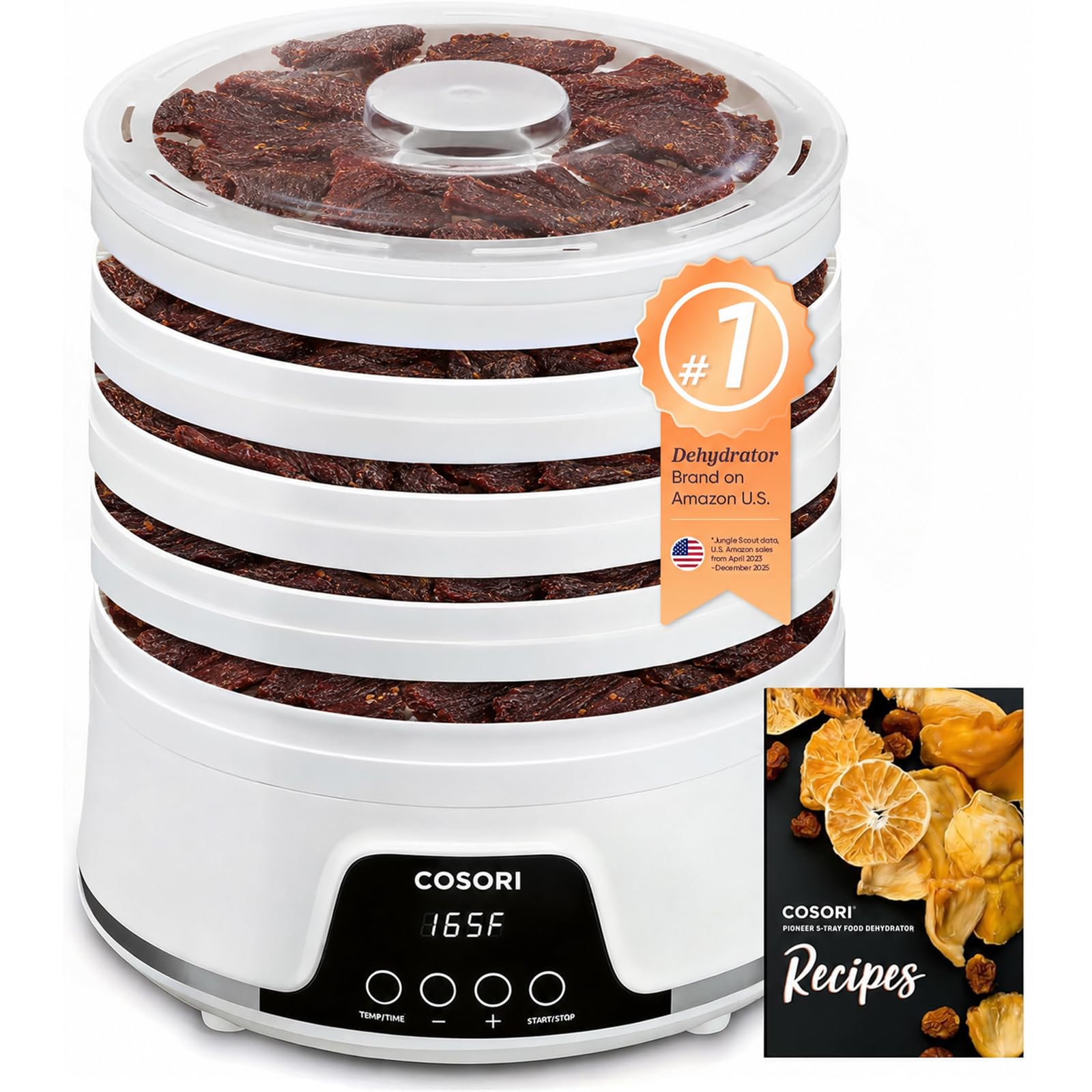
1. Cosori Food Dehydrator 5 Trays
Our pick — 4.5+★ from 9,500+ verified ratings; the strongest balance of quality and price.
The five-tray workhorse that doubles as a seven-tray machine the day you outgrow it.
The first thing that sets this Cosori apart is a temperature ceiling of 165 °F, adjustable in 1 °F increments all the way from 95 °F. That matters because jerky needs sustained heat to dry safely, and a 158 °F ceiling leaves you no margin above the safe zone. The second is the timer: it runs up to 48 hours in 30-minute increments, so a batch of thick-cut jerky or a tray of wet fruit leather can run overnight without anyone standing over it.
Where it pulls ahead of most round stackers is the tray system. The five BPA-free trays measure 12.2 inches across on the outside and 11.6 inches on the inside, and the plastic body is a solid shell rather than a fragile clear one. Better still, those numbers are not the ceiling — you can buy two more trays separately and run seven levels, which is why this sits in the top slot for anyone who starts small and scales up. Fan noise stays under 47 dB, quiet enough to run in a kitchen overnight without anyone upstairs noticing. Owner reviews back the daily-use experience: the machine is easier to operate than most models they have tried, the stackable trays clean up quickly, and the precise temperature control is the part people call out most.
The one habit to know about is tray rotation. With a fan pushing heat through a round stacker, spreading food evenly and swapping tray positions mid-dry gets you more consistent results than loading unevenly and walking away. And while the bundled recipe book eases the first week, the extra trays and fruit-roll sheets are sold separately — budget for them if you plan to max it out.
What it does well
- 165 °F top temperature gives real headroom for safe jerky
- Expandable from 5 trays to 7 for growing batches
- 48-hour timer in 30-minute steps for overnight drying
- Quiet operation under 47 dB, fine for a sleeping household
Worth knowing first
- Round tray shape limits you to spiral loading rather than flat sheets
- Extra trays and fruit-roll sheets are sold separately
Start here if: you want one machine that handles jerky, fruit, dog treats, and herbs, and you might grow into bigger batches later.
Think twice if: you specifically need square trays and flat sheet drying for fruit leather.
2. Elite Gourmet 5-Tray Food Dehydrator
A dial-and-watch machine that earns its keep with speed and simple cleanup.
This one keeps things physical: a turn dial rather than a digital panel, with a range from 95 °F to 158 °F. The blue light on the front confirms power — it is not a temperature readout, so you get used to setting the dial and trusting your recipe. What wins people over is the speed. Owners who routinely made thick-cut jerky on other machines in six to seven hours say they are pulling it at five hours here, and that is the single most useful thing about the machine in real cooking terms. Five BPA-free trays measure 11.4 inches across, and the bottom-mounted fan circulates warm air up through the stack while the clear trays let you watch progress without pulling a tray out.
The honest trade-offs are matters of tolerance. The temperature dial is not a precision instrument — one owner tested it with a separate thermometer and found it running roughly 10 °F low, which is exactly why a cheap oven thermometer is the first accessory to buy if you dry meat. Drying on the low end also runs slow, so herbs and fruit need patience, and the 11.4-inch round footprint is genuinely compact — fine for apples and jerky strips, less so for a full garden haul.
The cleanup story: the removable parts are dishwasher safe, which is why easy cleaning shows up alongside value in what owners appreciate most about this machine.
The storage angle: one buyer moving up from a dead model put it simply — being able to increase the height of the racks is the feature that impressed them most, since it opens the door to thick-cut ingredients.
Pick it when: you want fast jerky without spending on digital controls and you are happy to verify the dial once.
Move on if: you need a precise, repeatable temperature readout or a timer that shuts the machine off for you.
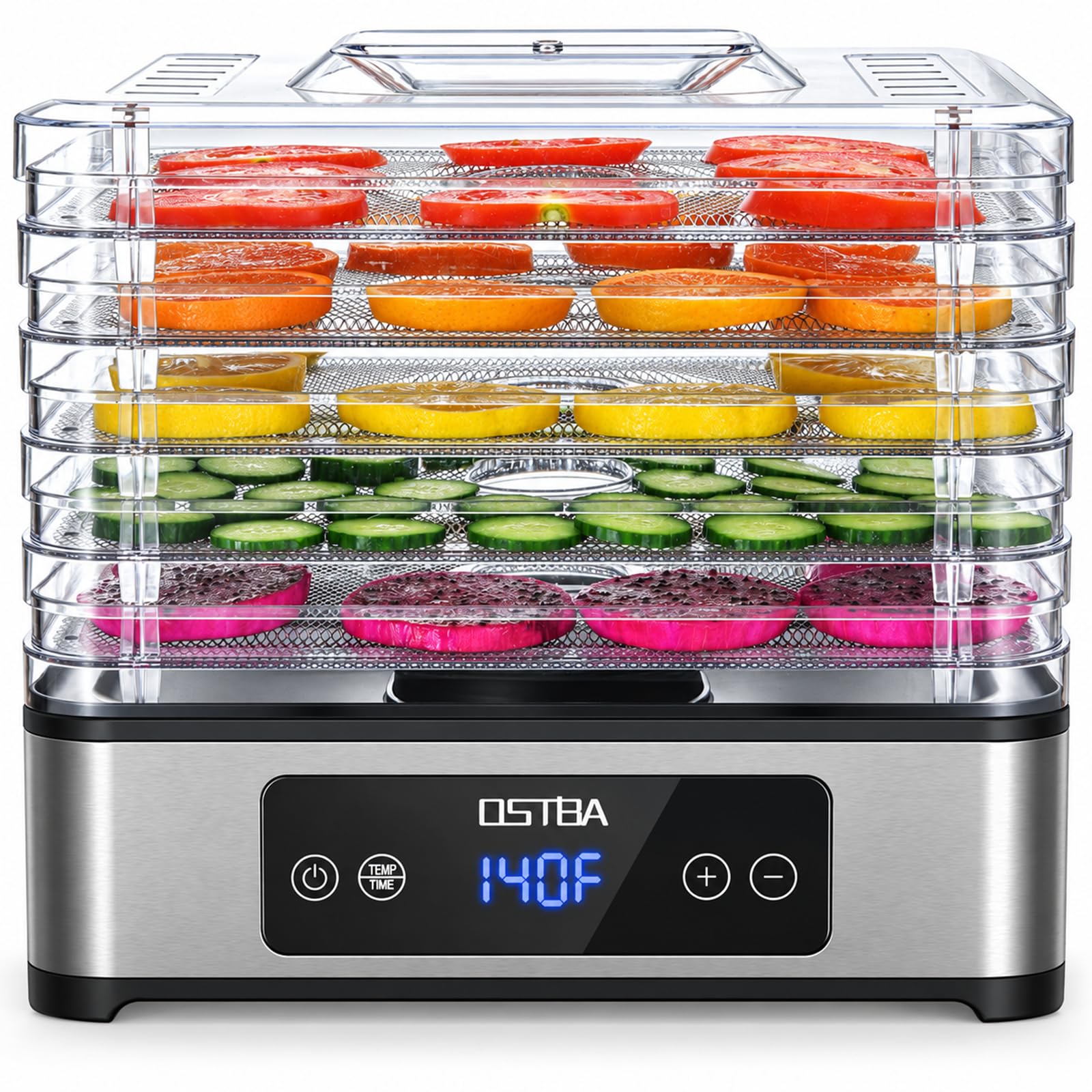
3. OSTBA Food Dehydrator 5 Trays
Mesh trays instead of plastic, packed into the smallest footprint on this list.
Measure the depth and the OSTBA stands out immediately: 8.26 inches front to back, against 12.6 inches on the Elite Gourmet digital unit — a real difference in whether the machine fits a crowded counter or gets tucked beside a coffee maker. It brings 400W of drying power to that compact frame, top of the group on wattage, and pushes heat at 360° airflow while the brand claims it retains up to 97% of nutrients. The temperature range runs 95 °F to 160 °F, and the timer stretches a full 48 hours if you need it.
The trays are the part owners cannot stop talking about. Five rust-resistant stainless steel mesh trays replace the plastic you get on most budget machines, and the difference shows in how food releases and how the trays wash. Owners routinely praise the performance of this little unit and call the mesh far superior to plastic competitors, noting that parchment paper cuts cleanup further on sticky items like fruit slices. Tray height is adjustable from 0.55 inches to a maximum of 1.02 inches, so thick-cut meat fits when you open them up.
Two honest notes. The compact size is exactly what a small household needs and exactly what a big drying session does not — owners describe it as ideal for small batches and single-tray work, less so for a full basket of garden produce. And drying can run slower than the manual suggests if you crowd the trays, so keep the layers thin and single-file. For tidy cord storage, there is a bottom compartment, and everything removable is dishwasher safe.
Best for: small kitchens, single-person households, and anyone who wants metal mesh trays without buying a big machine.
Skip if: you regularly dry enough food to fill a countertop unit to the brim.
4. Elite Gourmet Digital Food Dehydrator

Five trays that fold down flat when the drying week is over.
Storage is the whole pitch here, and it is a good one. This model uses five BPA-free SlimStore collapsible trays measuring 12.50 inches in diameter, and they nest tightly together so the whole stack shrinks down when it is not drying. The trays are fully immersible and dishwasher safe, and the base holds the fan and heater for even circulation upward through the stack. Temperature is adjustable from 95 °F to 158 °F, with a timer that reaches 48 hours in 30-minute steps.
The daily reality owners describe is simple: pick a temperature, walk away, come back to dried sweet potato for the dog or a tray of dried fish. Use is straightforward enough that one owner skipped the manual entirely and still ran it fine the first time out, and the collapse feature earns repeat praise for making cabinet space realistic in a small kitchen.
The trade-off to weigh is heat consistency and longevity. Drying times tend to run longer than the machine suggests for jerky and fruit, and while most units deliver steady heat, a minority lose their heating entirely and blow only cold air after about a month of service. That is a warranty issue if you hit it, not a reason to rule the model out — but it is worth registering the unit the day it arrives and keeping the receipt accessible.
Small-space win: collapsing against the wall beats storing a rigid tower on a shelf, which is the reason most buyers pick this one over the fixed-tray alternatives.
Reach for it when: counter and cabinet space are your limiting factor, and you accept drying times will run past the manual’s estimate.
Look elsewhere if: you need a guaranteed-warm unit from day one without the small risk of a heater failure.
5. NESCO FD-5TC Snackmaster Food Dehydrator

A compact Snackmaster built for quiet overnight jobs and easy hand-washing.
NESCO’s small footprint model leans on 420W of heating power, a digital timer running 1 to 24 hours, and an adjustable range of 95 °F to 160 °F. The five BPA-free trays measure 12 by 9.5 inches and slot into two positions — an Operating Position for airflow and a Storage Position that collapses the whole stack down in height between uses. A built-in cord compartment keeps the cable tidy, and the housing is lightweight for moving around the kitchen.
The part owners praise loudest is the cleanup. Trays hand-wash quickly, and the clear plastic construction makes it obvious what is dry and what is not. One quirk that owners call out repeatedly is the tray orientation — each tray has to be seated in the correct position, and rotating one 180° the wrong way will stall the airflow and leave food soggy. Line them up right and an 8-hour run handles dried apples, strawberries, or jerky without fuss. Quiet operation during use gets consistent mention, which makes it a good fit for overnight vegetable drying or a small room.
Be clear about the limits before buying. The 24-hour timer is half the ceiling of the 48-hour machines here, though for most home batches that is sufficient. Dried herbs are the weak spot — one owner turned the temperature up and extended the time and still saw very little result, so if herbs are your priority, look at a higher-temperature unit. Hot peppers at the 135 °F mark need 12 to 14 hours for best results.
Where it shines: quiet running plus quick cleanup make this the smoother machine for daily small-batch work.
Where it stumbles: effectiveness is a real question mark for tough jobs like herbs, so match it to fruit, jerky, and pet treats rather than a dehydrating marathon.
Choose it for: quiet countertop drying of fruit, jerky, and dog treats where cleanup speed matters more than maximum capacity.
Think twice if: you need the timer to run beyond a day or you are drying herbs specifically.
6. Magic Mill Food Dehydrator Machine

Five stainless trays, a 167 °F ceiling, and a quiet 240W motor that sips power.
Magic Mill trades raw wattage for tray quality. The five food-grade trays are stainless steel and passed quality checks for food safety, the body is BPA-free plastic, and the base is stainless steel too. Between the trays the standard clearance is 0.6 inches, but each one raises to 1.1 inches for thick-cut ingredients. The digital panel runs from 95 °F to 167 °F for up to 48 hours, and the machine itself is rated for 240W.
What owners actually report is reliability. With thousands of ratings, quality sits at the very top of what people praise, with value for money a close second — the unit is routinely called the best they have owned, capable of handling herbs, fruit, and wild game jerky in the same machine. It runs quietly for a dehydrator, cleans easily since the trays detach for soapy water or the dishwasher, and is priced as a value pick. Its top temperature of 167 °F sits just below the 176 °F on the Cosori stainless model, which matters only if you want the absolute maximum heat for jerky.
The size catches some buyers out. At 11.8 inches wide and 11 inches tall, it is compact for the class, but a few owners find it smaller than expected once a real batch is loaded. For everyday household dehydrating, the 240W draw is efficient and the 97% nutrient-retention claim is marketing, not a spec to shop by.
Why it holds its ground: stainless trays and a digital 48-hour timer in a compact body that most rival units cannot match on price-to-quality.
The right call if: you want stainless trays, quiet operation, and a 167 °F top end without pushing into premium territory.
Give it a pass if: you consistently need a larger drying load than five compact trays will hold.
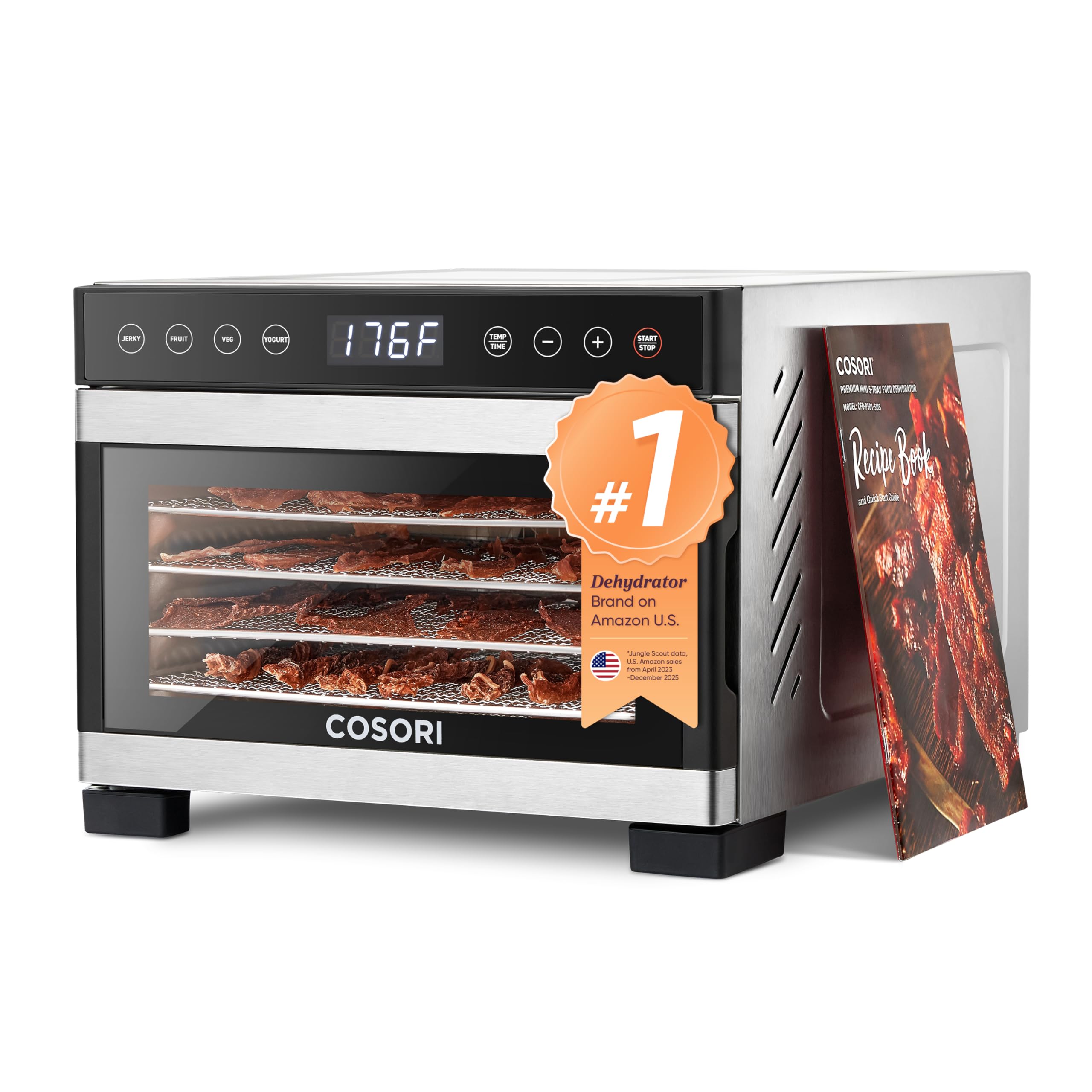
7. Cosori Food Dehydrator 5 Stainless Steel Trays
The all-stainless Cosori that puts metal on every surface your food touches.
This is the upgrade model in the lineup, and the headline number is temperature: 176 °F maximum, adjustable in 1 °F steps, which is the highest ceiling here. That matters if jerky safety is your priority, since the machine’s own notes cite 165 °F as the recommended jerky temperature. Five stainless steel trays give 3.1 ft² of drying space, with the body, base, and trays all in stainless so no plastic contacts your food. The rear fan promotes even dehydration with horizontal airflow. There are four presets — jerky, fruit, vegetables, and yogurt — and the timer runs to 48 hours. You also get a recipe cookbook, mesh screen, and fruit roll sheet in the box.
The performance numbers speak for themselves. What buyers praise most is the thorough, even drying — jerky, fruit, and vegetables all come out consistent, and the unit is genuinely compact for a countertop, easily fitting two pounds of meat. It is also significantly more expensive than the other machines here — around double the entry-level options — so this is a considered purchase rather than a casual one.
Two honest notes from the review pages. First, most of the machine is metal, but the included mesh screen and fruit roll sheet are plastic, so buyers wanting zero plastic in the box must buy silicone versions separately. Second, some owners notice the smell while running and report heat escaping around the hinge on longer jobs, so keep it near a window or vent for anything over a few hours.
The metal-first argument: trays, body, and base in stainless means the only kitchen items with plastic contact are the two accessories, and the 176 °F ceiling leads the group for jerky safety.
Built for small batches: owners consistently describe it as a two-pound-meat machine for couples and small families, not a volume unit for a crowd.
Go this way if: you want maximum heat for jerky, all-metal contact surfaces, and a compact build for one or two people.
Reconsider if: you will be drying large batches or want the whole kit plastic-free — the mesh and roll sheet are not.
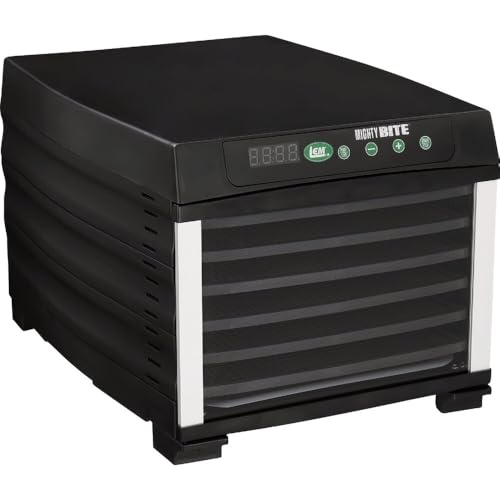
8. LEM Food Dehydrator – 5 Tray, Black
Square 15-inch trays that rotate four ways and a drip tray that catches the mess.
Where round stackers give you a spiral, this one gives you real estate. Five square trays measuring 15 by 15 inches, each rotating four ways for positioning, with a large drip tray underneath to catch runoff and make cleanup less of a chore. A clear, heat-trapping door keeps an eye on progress and, according to the maker, traps heat to shorten drying time. The digital timer with automatic shut-off runs up to a maximum dry time of 30 hours and 55 minutes, and the cord stretches 60 inches for flexible placement.
The performance notes are reassuring. Buyers report a machine that does a wonderful job with fruit, veggies, and meats, drying items faster than expected, and the clear door makes monitoring easy. It is a big, tall unit, so measure your counter depth before committing.
On noise, the reviews split — some find it relatively quiet for the size, others note a bit of a hum. Neither is a dealbreaker; it is worth setting expectations that a unit this large moves more air and makes more sound than a compact stacker. Tray cleanup is straightforward, though with stainless construction you will want to dry thoroughly before storing to avoid water spots.
Why it earns the space
- 15 by 15 inch square trays with four-way rotation for even drying
- Large drip tray simplifies cleanup
- Clear heat-trapping door shows progress without opening
- Digital timer shuts off automatically at the end of a run
Where it costs you
- Big footprint and tall body — check your counter depth first
- Noise level is a mixed report depending on who you ask
Pick this when: you dry full trays at a time and count square inches as the deciding spec.
Leave it if: you are tight on counter space or need a small, quiet machine.
9. Excalibur 3548CDB Electric Food Dehydrator

Eight square feet of drying on five trays, with a clear door and two temperature settings.
The 3548CDB goes big on space. Five trays, each 15 by 15 inches, add up to 8 square feet of drying area — the largest in this list and the reason garden leftovers and full dehydrating sessions fit. The clear door lets you check progress without opening and interrupting the process, and the digital timer runs 48 hours with two time and two temperature settings, plus an adjustable thermostat from 95 °F to 165 °F.
Inside, the machine leans on its airflow design: a horizontal drying system built to push thermostatically controlled warm air across the trays continuously, which the brand says this airflow removes water faster and more evenly. Five trays are enough to handle fruit, vegetables, nuts, jerky, fruit leather, and even homemade yogurt or raised bread.
The honest sizing is upfront. This is a 17-pound floor-standing unit from a long-established brand known for food dehydrators, and it is not built for a tight counter. Owners describe fine temperature and time control and easy cleaning, with one noting it is even light enough to carry. But when the unit does fail, it tends to be the overheating fuse or an assembly issue, and at this price the reliability question is the one to think about hardest. If you are drying large batches consistently, that space and control remain hard to match.
The space argument: 8 square feet of tray surface across five trays beats every compact option here, so full loads dry in a single session instead of two.
Best for: serious home dryers who want maximum tray area and a clear door for batch work.
Look past it if: your kitchen is small, your batches are modest, or you want a lighter, less investment-heavy machine.
Know the Specs
Wattage
Wattage is the muscle behind the heat. A 240W unit sips power and suits smaller batches; 350W units like the Cosori and Elite Gourmet standard models dry a full five-tray load; 400W and 420W machines like the OSTBA and NESCO push more heat into compact frames for faster drying. Higher wattage does not automatically mean better food — it means faster moisture removal and, usually, a larger body. Match it to your batch size, not the biggest number on the box.
Maximum temperature
The temperature ceiling decides what you can safely dry. Herbs and fruit leather do fine at 95 °F to 125 °F, but jerky needs heat — the Cosori 5-tray’s own guidance cites 165 °F as the recommended jerky temperature. Machines here top out anywhere from 158 °F to 176 °F. A higher ceiling gives more room for meat and a wider usable range overall, while a machine locked at 158 °F works just fine for fruit, veg, and crafts. Adjustability matters as much as the ceiling: some units step in 1 °F increments, others in broader dial turns.
Timer length
The timer tells you how long the machine can run without you. A 1 to 24 hour range like the NESCO handles most fruit and jerky jobs; 48-hour models like the Cosori, Magic Mill, and Excalibur let you load at midnight and wake up to finished food. A longer timer is not wasted — it is the difference between monitoring a batch and forgetting it while it finishes. Match the timer to what you actually dry: short runs for fruit, long runs for jerky and fruit leather.
Tray material and height
Tray material changes both cleanup and how food releases. Plastic BPA-free trays are common and dishwasher safe; stainless steel mesh trays like those on the OSTBA and Magic Mill resist rust and let moisture through faster. Height adjustability is the underrated spec: a tray that can raise from 0.55 or 0.6 inches up to 1.02 or 1.1 inches is the difference between thin slices and thick-cut meat, and it affects how the stack stores between uses.
Common Questions
How long does jerky take in a 5 tray dehydrator?
Is 5 trays enough for a family?
Can you stack more trays on a 5 tray dehydrator?
Do I need a specific temperature for safe beef jerky?
How loud is a food dehydrator while running?
Are the trays really dishwasher safe on all of these?
What is the difference between a 5 tray and a larger dehydrator?
Why do drying times vary so much between these dehydrators?
Is it better to buy a machine with stainless steel trays or BPA-free plastic?
Can I dry herbs in a 5 tray dehydrator?
The Bottom Line
For most kitchens, the 5 tray food dehydrator worth starting with is the Cosori 5 BPA-Free Trays unit — it tops out at 165 °F, runs a full 48 hours, stays under 47 dB, and expands to seven trays if your hobby grows, which is a rare mix at this size. If stainless trays and a higher 176 °F ceiling are what you want for jerky, the Cosori 5 Stainless Steel model is the step up, provided you accept its plastic mesh and roll sheet accessories. And if you dry full square trays at a time, the LEM 5 Tray is the one to reach for — it and its square-tray class are the answer to weekly large-batch drying. For a household that buys once and uses often, the Cosori 5 BPA-Free Trays machine is the one to bring home.
How we choose
We do not accept paid placement. Every pick is matched to a real buyer and a real use-case; we do not hands-on test units.
Sources
Specifications: manufacturer listings and product documentation. Review insights: verified customer reviews, as of October 2026. Pricing: not shown on this page (it changes often); check the current price via the retailer link.
As an Amazon Associate, My Heart Lives Here earns from qualifying purchases. This does not affect which products we feature.